
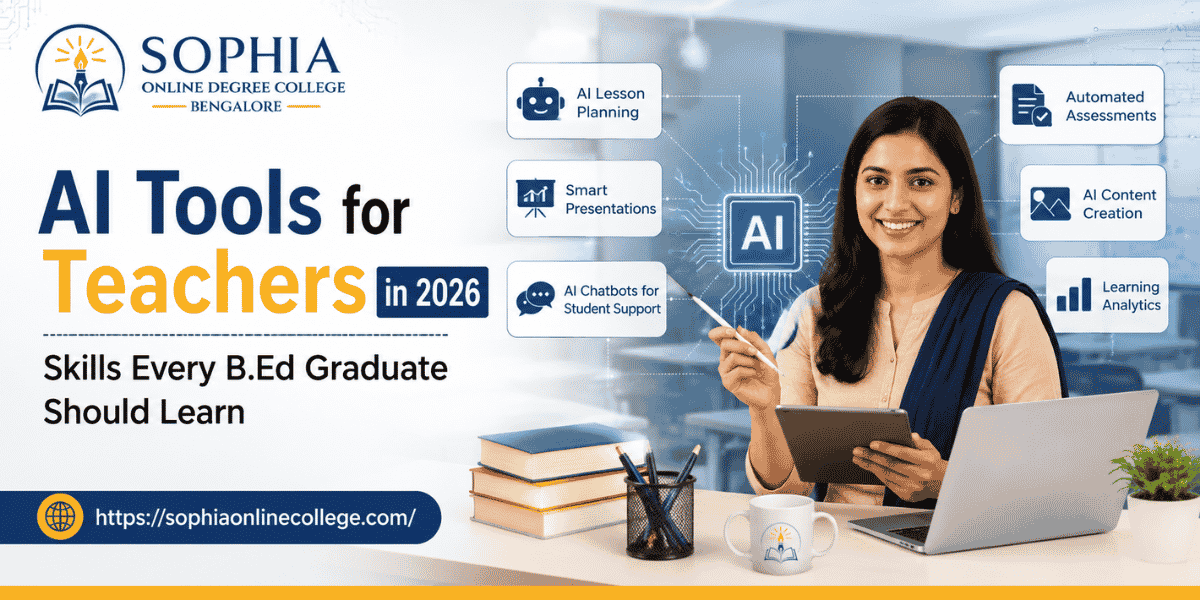
A teacher’s day often extends far beyond the classroom. Lesson planning, worksheet creation, assessment design, feedback, research, parent communication, and differentiated instruction can consume hours of a teacher’s time. That is why AI Tools for Teachers can be so valuable.
The latest 2026 education technology trends suggest that teacher-AI collaboration is becoming more focused on lesson planning, assessment, differentiated instruction, classroom engagement, and administrative tasks.
This means that B.Ed graduates can begin their careers with confidence, knowing that they do not have to learn AI as a separate technical skill. Instead, they can learn how to apply AI Tools for Teachers in a classroom setting.
The ultimate aim is not to allow AI to take over teaching but to use AI Tools for Teachers to free up time for more meaningful aspects of teaching.
Why AI Skills Matter for Teachers in 2026?
A teacher’s day often extends far beyond the classroom. Lesson planning, worksheet creation, assessment design, feedback, research, parent communication, and differentiated instruction can consume hours of a teacher’s time.
That is why AI Tools for Teachers can be so valuable.
The latest 2026 education technology trends suggest that teacher-AI collaboration is becoming more focused on lesson planning, assessment, differentiated instruction, classroom engagement, and administrative tasks.
This means that B.Ed graduates can begin their careers with confidence, knowing that they do not have to learn AI as a separate technical skill. Instead, they can learn how to apply AI Tools for Teachers in a classroom setting.
The ultimate aim is not to allow AI to take over teaching but to use AI Tools for Teachers to free up time for more meaningful aspects of teaching.
How AI Is Changing Everyday Teaching?
Let us imagine a teacher preparing for the next day’s lesson. Traditionally, they may spend hours searching for information, preparing a lesson plan, designing questions, creating activities, and differentiating instruction.
With AI Tools for Teachers, the first draft of these teaching materials can be created in minutes.
For instance, a teacher could ask an AI assistant to help them develop a lesson plan, suggest examples, create questions, explain ideas in simple terms, design classroom activities, prepare revision questions, propose discussion topics, develop a basic assessment rubric, or adapt reading material for different ability levels.
The key point is that AI can assist, but the teacher must review, edit, fact-check, and personalize the information before sharing it with students.
This step is critical, as AI-generated information can sometimes be incorrect or inappropriate for a given curriculum.
AI Tools for Teachers: What Can They Actually Do?
The biggest mistake beginners make is trying to learn every AI platform at once. A better approach is to start with the teaching problem you want to solve.
Current 2026 resources commonly group teacher AI tools around lesson planning, grading and assessment, engagement, accessibility, differentiation, research, and administrative work.
1. Lesson Planning
Teachers can use AI to generate lesson structures, learning objectives, discussion questions, examples, and classroom activities.
For instance, instead of asking an AI tool to “create a lesson,” a teacher could provide the subject, grade level, learning objective, duration, and student ability level. The resulting material is likely to be more useful because the instruction is specific.
2. Quiz and Assessment Creation
AI can help create multiple-choice questions, short-answer questions, revision exercises, and basic rubrics.
However, teachers should always check whether the questions actually measure understanding. AI-generated questions can sometimes focus too heavily on simple recall instead of application and reasoning.
3. Personalized Learning
One classroom may contain students with very different learning speeds. AI Tools for Teachers can help create different versions of the same material.
A teacher could request:
- A simpler explanation for beginners
- A standard explanation for the general class
- An advanced activity for stronger students
This makes differentiation easier while keeping the core learning objective consistent.
4. Classroom Engagement
Teachers can also use AI to brainstorm debates, role-playing exercises, project ideas, storytelling activities, case studies, and discussion prompts.
The teacher remains responsible for selecting the activities that actually fit the class.
5. Research and Content Preparation
AI can help teachers organize ideas, summarize provided material, generate questions from a lesson, or suggest examples.
But teachers should not treat AI output as automatically authoritative. Important facts, statistics, references, and curriculum-sensitive information should be checked against reliable sources.
7 AI Tools and Tool Categories B.Ed Graduates Should Explore
Rather than memorizing dozens of software names, B.Ed graduates should understand different categories of AI Tools for Teachers.
- General AI assistants – useful for brainstorming, drafting, explanations, and idea generation.
- Teacher-focused AI platforms – designed for lesson planning, rubrics, assessment, and classroom tasks.
- AI presentation tools – help create visual teaching materials and presentation outlines.
- AI quiz generators – useful for creating practice questions and revision exercises.
- AI research assistants – help organize information and research ideas.
- AI accessibility tools – support translation, text simplification, speech, and different learning needs.
- AI learning platforms – can support personalized learning and student engagement.
Platforms such as MagicSchool, Diffit, Conker, SchoolAI and similar education-focused products are increasingly discussed in 2026 teacher-AI resources.
The right tool depends on the task. A teacher who needs differentiated reading material does not necessarily need the same platform as someone who primarily wants assessment support.
AI Skills Every B.Ed Graduate Should Learn
Simply knowing how to click a button is not enough. The most valuable AI skills for teachers are those that allow them to communicate effectively with AI and critically evaluate its suggestions. For instance,
Prompt Writing
Prompt writing is one of the most valuable AI skills for teachers. Rather than asking an AI assistant to “create a lesson,” a teacher could provide specific instructions, such as “create a 40-minute Class 8 science lesson on photosynthesis that includes three learning objectives, a five-minute introduction, one classroom activity, five assessment questions, and a short recap.”
This way, the prompt includes specific instructions for the AI assistant, and the final output is more likely to meet the teacher’s expectations.
AI Fact-Checking
Teachers should always fact-check AI-generated information, especially when it comes to sensitive or controversial topics. This process is similar to traditional research, with the exception that teachers must verify the accuracy of information against traditional educational resources.
Content Editing
While AI can generate content, it is the teacher’s responsibility to adapt the information to the needs of their students. A good teacher will know when to explain a concept in more detail, provide local examples, or simplify complex ideas.
AI-Assisted Assessment
Teachers should also learn how to use AI for question generation, rubric design, feedback, and revision activities while retaining control over the final product.
Data and Digital Literacy
Teachers need to be comfortable with data and digital technologies, including understanding student data, online learning platforms, and AI recommendations.
AI Ethics
AI ethics include issues of privacy, bias, copyright, misinformation, academic integrity, and student data privacy.
Critical Thinking
Perhaps most importantly, teachers should develop critical thinking skills so that they do not rely on AI for everything.
AI Skills and Their Classroom Uses
| AI Skill | Practical Teaching Use | Main Benefit |
| Prompt writing | Generate specific lesson resources | Better results |
| AI research | Brainstorm teaching material | Saves preparation time |
| Content generation | Create worksheets and activities | Faster resource creation |
| Personalization | Adapt material to learner levels | More inclusive learning |
| Assessment support | Draft quizzes and rubrics | Easier preparation |
| Fact-checking | Verify AI-generated information | Better accuracy |
| AI ethics | Protect student interests | Responsible adoption |
How to Use AI Without Losing the Human Side of Teaching?
There is no doubt that many people fear that artificial intelligence will ultimately replace teachers. However, the more interesting question is whether teachers will learn to use AI to its full potential.
The most valuable AI Tools for Teachers are those that allow educators to delegate repetitive tasks.
A teacher can use an AI assistant to create the first draft of a worksheet and then spend more time discussing the topic with their students. AI can suggest questions, but the teacher will recognize that a particular student requires more support. AI can organize information, but the teacher will know which explanation is most appropriate for their students. These are the kinds of skills that cannot be replaced by technology.
After all, education is not just about information. Teachers inspire students, understand their needs, encourage them, manage the classroom, recognize patterns, and much more. These are the skills that cannot be replaced by chatbots.
AI Tools for Teachers and Different Classroom Needs
The value of AI Tools for Teachers will depend on the teacher’s needs.
For Primary Teachers
Primary teachers can use AI to create stories, vocabulary activities, simple quizzes, visual aids, and age-appropriate examples.
For Secondary Teachers
Secondary teachers can use AI for subject-specific explanations, practice questions, revision worksheets, project ideas, debate topics, and exam preparation.
For Higher Education
Higher Education teachers can use AI for research, presentation ideas, discussion questions, assessment design, and learning-resource development. The teacher should always adapt the final product to the needs of their students.
Responsible AI Use in Education
The rise of AI Tools for Teachers also raises ethical concerns. For instance, teachers should be cautious about sharing sensitive student data with third-party AI platforms. This is why many educational institutions are developing responsible AI use policies.
Other ethical concerns include student privacy, copyright, bias, misinformation, academic integrity, and the potential for AI to undermine critical thinking.
A simple rule of thumb is that convenience should never outweigh learning. In other words, teachers should not sacrifice education for the sake of efficiency.
- Student privacy
- Copyright
- Bias
- Incorrect information
- Academic dishonesty
- Overdependence on AI
- Lack of original student thinking
- Unverified AI-generated content
Traditional Teaching vs AI-Assisted Teaching
| Teaching Activity | Traditional Approach | AI-Assisted Approach |
| Lesson planning | Created manually | AI can prepare a first draft |
| Quiz creation | Questions written individually | AI can suggest question sets |
| Worksheets | Teacher prepares each resource | AI can generate starting material |
| Differentiation | Separate resources prepared manually | Content can be adapted faster |
| Research | Manual searching and organizing | AI can help brainstorm and organize |
| Feedback | Completely manual | AI can assist with draft feedback |
| Teacher role | Content delivery | Guidance, mentoring and evaluation |
How B.Ed Graduates Can Build an AI-Ready Career
For a fresh graduate, learning AI Tools for Teachers can be an excellent way to supplement their B.Ed qualification. A B.Ed graduate can build an AI-ready portfolio by completing one AI-assisted lesson plan, one differentiated worksheet, one AI quiz, one classroom presentation, one student activity, one basic assessment rubric, and one AI policy for classroom activities.
This way, they can demonstrate their ability to use technology in a professional teaching environment. In addition, B.Ed graduates can also pursue a B.Ed course for working professionals or other teacher education programs.
For those considering postgraduate studies, an M.Ed correspondence college in Bangalore can be a good option if the goal is to continue advancing their teaching career.
Flexible education options can also be valuable for those considering Teaching distance education, as they allow students to balance their professional and personal life while pursuing their qualification.
Learning AI Alongside Flexible Education
Not every aspiring teacher has the time or resources to stop working and learn a new technology. This is why flexible education is so important.
Students researching a Correspondence college in India may also want to develop modern digital skills alongside their qualification. Similarly, those comparing distance education in bangalore can consider how flexible study can fit around their teaching, professional, and personal commitments.
The point is not to choose between education and technology but to combine the two. A graduate who understands pedagogy, classroom management, communication, digital learning, and AI can be much more attractive to employers.
For learners exploring Traditional distance education in Bangalore, the critical consideration is whether the qualification fits their needs and whether they can complement their studies with workplace skills. Other students may want to compare options such as Correspondence degree colleges in Bangalore, Science distance education in Bangalore, B.Sc correspondence college in Karnataka, BA correspondence college in Bangalore, MA correspondence college in India, or management distance education in Bangalore, depending on their interests and career goals.
A 90-Day AI Learning Roadmap for B.Ed Graduates
You do not need to become an AI expert in one month. A more realistic goal is to create a 90-day AI learning roadmap that will help you identify the most valuable skills for your teaching practice.
Days 1–30: Learn the Basics
Learn the basics of generative AI, including prompts, responses, fact-checking, limitations, and privacy. Practice using one general-purpose AI assistant for simple teaching tasks.
Days 31–60: Apply AI to Teaching
Experiment with different AI tools and apply them to lesson planning, worksheets, quizzes, activities, differentiated content, and presentation ideas. Save your best work in a digital portfolio.
Days 61–90: Develop Responsible AI Practice
Learn about AI ethics, student privacy, copyright, assessment integrity, fact-checking, and responsible classroom practices. By the end of this roadmap, you should not only know several AI Tools for Teachers but also understand which tools are most appropriate for different teaching tasks.
Can AI Replace Teachers?
No technology should be presented as a complete replacement for a qualified teacher. The most valuable AI Tools for Teachers are those that allow educators to delegate repetitive and time-consuming tasks. This way, teachers can focus on more meaningful aspects of education, such as mentorship, classroom engagement, personalized support, creativity, and decision-making.
The rise of educator-focused AI products in 2026 suggests that the future of teaching will be characterized by collaboration rather than competition between teachers and AI.
For B.Ed graduates, the most important consideration is that no technology should replace their professional judgment. That is why the most valuable AI Tools for Teachers are those that allow educators to focus on what they do best.
Future Scope of AI Skills for Teachers
The future of AI Tools for Teachers will be defined by personalized learning, AI tutoring, learning analytics, administrative support, multilingual resources, AI assessment, adaptive learning, and digital classroom assistance. At the same time, educators will need to develop strong ethical guidelines regarding the use of AI in education.
The most valuable teachers will not necessarily use the most AI tools but will know which tools to use and when. They will also understand the importance of verifying information, protecting students, and using technology to enhance rather than replace learning.
Why B.Ed Graduates Should Start Learning AI Now?
The education sector is undergoing a technological revolution. Research published in 2026 on preservice teacher education suggests that future educators must develop AI literacy and digital material design skills.
This makes AI learning a valuable professional development priority for B.Ed graduates.
You do not need to know how to code to benefit from AI Tools for Teachers. Anyone can start their journey by learning how prompts work, experimenting with different tools, and applying basic prompts to teaching tasks. It is also essential to fact-check AI-generated information and compare it to traditional educational resources. By following these steps, anyone can prepare a valuable AI-assisted lesson plan, worksheet, quiz, or presentation.
Conclusion
The real value of AI Tools for Teachers lies in their ability to reduce the teacher’s workload. By delegating repetitive and time-consuming tasks to AI assistants, educators can focus on more meaningful aspects of teaching and learning.
For B.Ed graduates, 2026 is a great time to start preparing for a career that increasingly relies on technology. Start with simple tasks, experiment, fact-check, and learn the ethical implications of AI in education. Remember that AI should support the teacher rather than the other way around.
If you are considering advancing your academic and professional qualifications while developing modern teaching skills, explore flexible education options with Sophia Online College and prepare for an AI-assisted career in teaching.
Start Building Your AI-Ready Teaching Career
Whether you are a fresh B. Ed graduate, a working teacher, or thinking of becoming one, combining teaching skills with tech and AI readiness will make you future-ready.
Take the leap and start studying at Sophia Online College to upgrade your skills towards becoming an AI-ready educator
FAQs
1. What are the best AI Tools for Teachers in 2026?
It depends on what one looks for since most of the 2026 Educator tools cater to different needs, including lesson planning, grading, differentiation, class engagement, accessibility, and administration. MagicSchool, Diffit, Conker, and SchoolAI are some of the AI tools for teachers currently trending in the education field. However, every teacher should explore the options that suit their needs, considering factors like ease of use, quality of results, privacy policies, pricing, and whether the tool aligns with their curriculum and institutional requirements. Most critically, one should not rely solely on AI results and should scrutinize the information before presenting it to students.
2. Do B.Ed graduates need coding skills to use AI?
Mostly Not Required. Coding is not required to use most classroom-oriented AI tools. However, B.Ed students can learn to code later in their careers to advance their teaching skills if they want to go into AI development or classroom analytics. At this level, students should focus on prompt writing, lesson planning, grading, content development, research, and classroom presentation. However, coding can come in handy later in one’s career, especially when one wants to develop their AI-powered applications, analyze classroom data, or engage in advanced educational technology.
3. How can AI help teachers with lesson planning?
One can use AI to lesson plan by asking the tool to generate a lesson plan based on their topic, objective, and class. One can also request variations of the plan to suit different levels of learners. However, one should revise the plan because, more often than not, AI may not fully understand the exact requirements of a lesson, especially one’s curriculum needs. Therefore, even if the teacher uses AI to plan, they should ensure that it serves only as a guideline. In my view, AI is a lesson planning assistant, not a lesson planner.
4. Can AI replace teachers in the future?
AI will unlikely replace teachers because teaching entails interpersonal skills that robots cannot replicate, including relationships, mentoring, motivation, and communication. However, it can take over some of the monotonous tasks and free teachers to focus on human-centric skills in teaching. Besides, the education sector is currently leaning towards making AI a co-teacher rather than a replacement for human teachers.
5. Which AI skills should every B.Ed graduate learn?
Every graduate should consider learning prompt writing, planning, content generation, grading, fact-checking, research, personalization, AI ethics, privacy, and data analytics basics. They should also master detecting hallucination and bias in AI results. However, I do not think that every B.Ed graduate needs to learn all AI skills because some are too advanced, such as coding. Also, AI tools are evolving, so it is good to learn the fundamentals and build on them as one advances their career. Lastly, knowing how to operate most AI tools is more important than knowing the names of all the available tools.
6. Is AI certification useful for teachers?
I think a teacher should get certified only if they are sure that the course they want is informative and does not just waste their time by giving them a certificate. The best thing about a certification program is that one should know exactly what it entails. Hence, one should look out for courses that teach generative AI, prompt writing, responsible AI use and application, digital teaching, evaluation, and teaching assistants. Moreover, one should ensure that the program is practical to help them gain valuable experience. Therefore, certification is useful as long as one knows what they are getting into.
7. How should teachers protect student privacy while using AI?
A teacher should not input students’ information into AI tools unless they are confident that the data will not be exposed or used unlawfully. Hence, it is essential to be wary of the tools one chooses to use while being aware of what one shares with them. It is always advisable to work with a team to establish policies on what information can be shared with the AI and what cannot. Privacy should always be considered a priority over convenience, and teachers should use generic information where possible.
8. What is the future of AI in teaching?
AI will continue to evolve and revolutionize teaching and learning in the coming years. It will play a pivotal role in lesson planning, grading, accessibility, research, and administration. However, the tools will change, so it is always necessary to learn AI skills that will last longer rather than rely on a specific application. The future of teaching will be defined by those who understand the concept of blending education, teaching, and technology and prioritize the development of strong human skills alongside technological proficiency.