
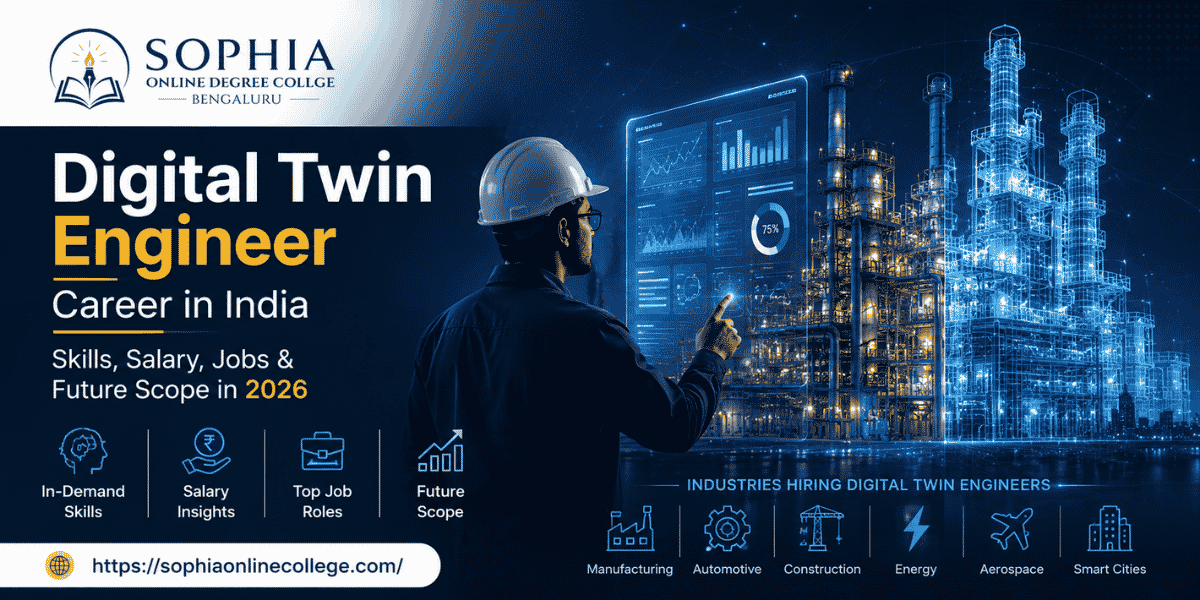
A Digital Twin Engineer Career in India is rapidly emerging as one of the most exciting opportunities in the engineering and technology sectors. As industries adopt Industry 4.0, Artificial Intelligence (AI), the Internet of Things (IoT), and cloud computing, organizations increasingly rely on Digital Twin technology to create virtual replicas of physical assets and processes. A Digital Twin Engineer Career in India offers excellent salary packages, global career opportunities, and the chance to work on innovative projects across manufacturing, healthcare, aerospace, automotive, and smart cities. If you enjoy combining engineering with data-driven decision-making, a Digital Twin Engineer Career in India can be a future-ready profession with exceptional long-term growth.
What is Digital Twin?
A Digital Twin is a virtual representation of a physical object, machine, system, or process that continuously receives real-time data through sensors and connected devices. This digital model allows engineers to monitor performance, predict failures, simulate operations, and optimize efficiency before implementing changes in the real world.
Unlike traditional simulations that rely on static data, Digital Twins continuously update using live information collected from IoT devices, making them more accurate and valuable for decision-making.
Today, Digital Twin technology is widely used in:
- Manufacturing
- Automotive
- Aerospace
- Construction
- Healthcare
- Energy
- Smart Cities
- Oil & Gas
- Logistics
The increasing adoption of Digital Twins is creating significant demand for professionals pursuing a Digital Twin Engineer Career in India.
Digital Twin vs Traditional Simulation
| Feature | Digital Twin | Traditional Simulation |
| Real-time Data | Yes | No |
| IoT Connectivity | Yes | Limited |
| Continuous Monitoring | Yes | No |
| Predictive Maintenance | Yes | Limited |
| Decision Making | Data-driven | Scenario-based |
| Industry Adoption | Rapidly Growing | Conventional |
Why Digital Twin Engineering is Growing Rapidly?
Digital Twin technology has become one of the most important pillars of Industry 4.0. Organizations are investing heavily in intelligent systems that reduce downtime, improve efficiency, and lower operational costs.
Some of the major reasons behind this growth include:
Industry 4.0 Transformation
Manufacturing companies are embracing automation and digital technologies to improve productivity. Digital Twins help organizations monitor equipment performance and optimize production processes.
Predictive Maintenance
Instead of waiting for machines to fail, Digital Twins predict equipment failures before they occur, reducing maintenance costs and preventing production delays.
Artificial Intelligence Integration
AI algorithms analyze data collected from Digital Twins to improve decision-making, automate maintenance schedules, and enhance operational efficiency.
Smart Manufacturing
Factories now use Digital Twins to simulate production lines, test new designs, and optimize manufacturing workflows without interrupting actual production.
Sustainability
Organizations use Digital Twins to reduce energy consumption, improve resource utilization, and minimize environmental impact.
These developments make a Digital Twin Engineer Career in India one of the fastest-growing career options for engineering graduates.
Roles and Responsibilities of a Digital Twin Engineer
A Digital Twin Engineer combines engineering knowledge with advanced technologies such as IoT, cloud computing, AI, and data analytics to create intelligent digital models.
Their responsibilities include:
Developing Digital Models
Designing virtual representations of machines, manufacturing systems, buildings, or industrial equipment.
Collecting Real-Time Data
Integrating IoT sensors and connected devices to continuously gather operational data from physical assets.
Performance Monitoring
Monitoring equipment performance through dashboards and analytics platforms to identify operational improvements.
Predictive Analytics
Using historical and real-time data to predict failures, reduce downtime, and improve maintenance planning.
System Optimization
Analyzing simulation results to improve production efficiency, reduce waste, and increase operational performance.
Cloud Integration
Deploying Digital Twin platforms on cloud environments for secure access, collaboration, and scalability.
Collaboration
Working closely with mechanical engineers, electrical engineers, software developers, automation experts, and data scientists to build complete Digital Twin solutions.
Industries Using Digital Twin Technology
Digital Twin adoption is expanding rapidly across multiple industries.
Major sectors include:
- Manufacturing
- Automotive
- Aerospace
- Construction
- Healthcare
- Energy & Utilities
- Oil & Gas
- Smart Infrastructure
- Robotics
- Logistics & Supply Chain
These industries actively recruit professionals with expertise in Digital Twin platforms, IoT, cloud computing, and engineering analytics.
Students pursuing Engineering distance education can strengthen their technical foundation by learning CAD software, automation technologies, IoT, and programming languages alongside their academic studies. Practical projects and certifications significantly improve career prospects in this evolving engineering field.
Why Choose a Digital Twin Engineer Career?
A Digital Twin Engineer Career in India offers numerous advantages for students and working professionals interested in advanced engineering technologies.
Key benefits include:
- High industry demand
- Excellent salary packages
- Global employment opportunities
- Work on cutting-edge technologies
- Exposure to AI and IoT
- Career growth across multiple industries
- Opportunity to solve real-world engineering challenges
- Strong future relevance in Industry 4.0
As organizations continue investing in smart manufacturing, intelligent infrastructure, and automation, professionals with Digital Twin expertise will remain highly sought after.
Digital Twin Technology
Digital Twin Technology combines physical systems with virtual models to create real-time digital replicas of machines, equipment, buildings, and manufacturing processes. By integrating technologies such as IoT, Artificial Intelligence (AI), Cloud Computing, Big Data, and Machine Learning, Digital Twin systems continuously collect and analyze data to improve operational efficiency.
Today, Digital Twin Technology is transforming industries by enabling organizations to:
- Monitor equipment remotely
- Predict machine failures
- Improve product quality
- Optimize manufacturing processes
- Reduce maintenance costs
- Increase productivity
- Improve energy efficiency
- Enhance customer experience
Industries such as automotive, aerospace, healthcare, construction, and renewable energy are investing heavily in Digital Twin solutions to improve decision-making and operational performance.
A successful Digital Twin Engineer Career in India requires professionals to understand how these technologies work together to create intelligent engineering systems.
Skills Required to Become a Digital Twin Engineer
To build a successful Digital Twin Engineer Career in India, students need both technical expertise and strong problem-solving abilities.
Technical Skills
Employers look for candidates with knowledge of:
- Internet of Things (IoT)
- Artificial Intelligence
- Machine Learning
- Cloud Computing
- CAD/CAM Software
- Data Analytics
- Python Programming
- SQL
- MATLAB
- PLC & SCADA
- Automation Systems
- Simulation Modeling
- Product Lifecycle Management (PLM)
- Digital Manufacturing
Knowledge of industrial communication protocols and cloud platforms such as Microsoft Azure and AWS is an added advantage.
Soft Skills
Besides technical knowledge, engineers should also develop:
- Analytical Thinking
- Communication Skills
- Problem Solving
- Team Collaboration
- Innovation
- Leadership
- Critical Thinking
- Time Management
- Project Management
These skills help professionals work effectively with cross-functional engineering and software development teams.
Educational Roadmap
The right educational path plays an important role in building a Digital Twin Engineer Career in India.
Step 1: Complete a Diploma or Bachelor’s Degree
Students can begin with:
- Diploma in Mechanical Engineering
- Diploma in Electrical Engineering
- Diploma in Electronics
- B.Tech in Mechanical Engineering
- B.Tech in Electrical Engineering
- B.Tech in Mechatronics
- B.Tech in Computer Science
Students enrolled in a Diploma in Engr correspondence college in India can build a strong engineering foundation while developing practical skills through software training and industrial projects.
Step 2: Learn Industry Technologies
Develop expertise in:
- CAD Design
- IoT Platforms
- Cloud Computing
- AI & Machine Learning
- Digital Manufacturing
- Industrial Automation
- Simulation Software
Step 3: Gain Practical Experience
Employers highly value candidates with hands-on exposure through:
- Industrial internships
- Manufacturing projects
- Automation laboratories
- Smart factory simulations
- IoT implementation projects
Step 4: Pursue Higher Education
Professionals who wish to specialize further can pursue advanced engineering programs.
Students studying through a B.Tech correspondence college in India can strengthen their technical expertise before pursuing advanced certifications or higher studies. Similarly, an M.Tech correspondence college in Karnataka provides opportunities to specialize in automation, manufacturing systems, and advanced engineering technologies while balancing professional commitments.
Best Certifications for Digital Twin Engineers
| Certification | Best For | Career Benefit |
| Microsoft Azure Digital Twins | Cloud-based Digital Twins | Smart Infrastructure |
| Siemens NX | Product Design | Manufacturing Industry |
| AWS IoT Certification | IoT Integration | Cloud Engineering |
| MATLAB & Simulink | Simulation | Engineering Analysis |
| Python for Data Science | Automation & AI | Industry 4.0 Careers |
Professional certifications significantly improve employability by validating practical knowledge and industry-specific skills.
Digital Twin Software
Digital Twin Engineers use specialized software to design, simulate, monitor, and optimize physical systems. Learning these tools increases employability and prepares professionals for advanced engineering roles.
Popular Digital Twin software includes:
Siemens NX
Widely used for product lifecycle management, simulation, and digital manufacturing.
Microsoft Azure Digital Twins
A cloud-based platform for building digital representations of physical environments and connected systems.
ANSYS Twin Builder
Used for creating simulation-driven Digital Twin models for engineering applications.
PTC Thing Worx
Helps organizations connect IoT devices and build industrial Digital Twin solutions.
Dassault System 3DEXPERIENCE
Provides collaborative product design, engineering simulation, and Digital Twin capabilities.
MATLAB & Simulink
Useful for system modeling, simulation, algorithm development, and predictive engineering analysis.
Learning these software platforms significantly strengthens a Digital Twin Engineer Career in India and prepares candidates for Industry 4.0 roles.
Digital Twin Engineer Jobs
As industries continue adopting intelligent manufacturing and automation technologies, the demand for Digital Twin professionals is increasing rapidly.
Popular job roles include:
- Digital Twin Engineer
- Simulation Engineer
- Smart Manufacturing Engineer
- IoT Engineer
- Automation Engineer
- Systems Engineer
- Industrial Data Engineer
- Product Lifecycle Engineer
- Digital Transformation Consultant
- Cloud Solutions Engineer
- AI Integration Engineer
- Manufacturing Systems Engineer
These roles involve developing intelligent engineering systems that improve productivity, efficiency, and predictive maintenance across industries.
Students pursuing education through a Correspondence college in india can strengthen their job prospects by combining academic learning with technical certifications, internships, and practical software training.
Top Recruiters Hiring Digital Twin Engineers
Leading companies recruiting Digital Twin Engineers include:
- Siemens
- Tata Technologies
- Bosch
- ABB
- Schneider Electric
- Honeywell
- GE Digital
- L&T Technology Services
- TCS
- Infosys
- Wipro
- Capgemini
- Accenture
- Tech Mahindra
- Dassault Systèmes
These organizations actively hire engineers skilled in IoT, automation, cloud computing, simulation software, and AI technologies.
Professionals pursuing distance education in bangalore can improve their career opportunities by gaining practical exposure through internships, certifications, and live engineering projects before entering the job market.
Digital Twin Engineer Salary
One of the biggest reasons students are choosing a Digital Twin Engineer Career in India is the attractive salary package and excellent career progression. As industries rapidly adopt Industry 4.0 technologies, Digital Twin Engineers are becoming highly valuable across manufacturing, automotive, aerospace, healthcare, and smart infrastructure sectors.
Freshers (0–2 Years)
Graduates entering the industry as Junior Digital Twin Engineers or Simulation Engineers can expect salaries ranging from:
Average Salary: ₹5–8 LPA
Candidates with certifications in IoT, cloud computing, CAD software, or Digital Twin platforms often receive higher starting packages.
Mid-Level Professionals (3–6 Years)
Engineers with experience in automation, cloud platforms, simulation software, and predictive analytics typically move into senior engineering or solution architect roles.
Average Salary: ₹10–18 LPA
Professionals at this stage often lead Digital Twin implementation projects, optimize industrial systems, and collaborate with multidisciplinary engineering teams.
Senior Professionals (7–12 Years)
Senior Digital Twin Engineers, Technical Architects, and Engineering Managers handle enterprise-level digital transformation initiatives.
Average Salary: ₹20–40 LPA
Leadership positions in multinational organizations also include bonuses, stock options, and international project opportunities.
International Career Opportunities
Countries such as:
- Germany
- United States
- Canada
- Singapore
- United Kingdom
- UAE
- Australia
offer excellent career prospects for Digital Twin professionals due to the growing adoption of smart manufacturing and industrial automation.
Career Roadmap
Building a successful Digital Twin Engineer Career in India requires continuous learning and practical experience.
Career Progression
Diploma / B.Tech Graduate
↓
Graduate Engineer Trainee
↓
Digital Twin Engineer
↓
Simulation Engineer
↓
Senior Digital Twin Engineer
↓
Technical Lead
↓
Digital Transformation Manager
↓
Engineering Consultant / Solution Architect
As professionals gain expertise in IoT, Artificial Intelligence, Cloud Computing, and Product Lifecycle Management (PLM), they become eligible for leadership and consulting positions in global organizations.
Future Scope of Digital Twin Engineering in 2026
The future of the Digital Twin Engineer Career in India is exceptionally promising. With organizations investing in intelligent manufacturing, AI-driven automation, and smart infrastructure, Digital Twin technology is expected to become a standard engineering practice across industries.
Major growth drivers include:
- Industry 4.0 adoption
- Smart factories
- AI-powered predictive maintenance
- Electric vehicle manufacturing
- Smart city development
- Healthcare digitalization
- Aerospace innovation
- Renewable energy projects
- Robotics and automation
- Industrial IoT expansion
Engineers who continuously upgrade their knowledge of cloud computing, simulation software, AI, and IoT will enjoy excellent career stability and long-term growth.
Students pursuing higher studies through an M.Tech correspondence college in Karnataka can further specialize in advanced manufacturing, automation, and intelligent engineering systems, preparing themselves for leadership roles in this evolving field.
Is Digital Twin Engineering the Right Career for You?
A Digital Twin Engineer Career in India is an excellent choice if you:
- Enjoy solving engineering problems using technology.
- Have an interest in Artificial Intelligence and IoT.
- Like working with simulations and virtual models.
- Want a high-growth engineering career.
- Prefer working on innovative industrial projects.
- Aspire to build a global engineering career.
- Are passionate about automation and digital transformation.
As industries increasingly embrace smart technologies, Digital Twin Engineers will continue to play a vital role in designing efficient, intelligent, and sustainable engineering solutions.
Conclusion
A Digital Twin Engineer Career in India combines engineering expertise with emerging technologies such as Artificial Intelligence, Cloud Computing, IoT, and Digital Manufacturing. It is one of the most future-ready careers for engineering students looking to work on innovative projects with global organizations.
Whether you begin with a diploma or an engineering degree, continuous learning, technical certifications, practical internships, and hands-on project experience will help you build a rewarding career. With strong industry demand, excellent salaries, and opportunities across multiple sectors, Digital Twin Engineering is set to become one of India’s most sought-after engineering professions in 2026 and beyond.
Build Your Engineering Career with Sophia Online College
Start your journey toward a successful Digital Twin Engineer Career in India with Sophia Online College. Whether you’re looking for Engineering distance education, a B.Tech correspondence college in India, or an M.Tech correspondence college in Karnataka, Sophia Online College offers flexible, career-focused programs designed to help you build industry-ready engineering skills. Enroll with Sophia Online College today and prepare for future careers in Digital Twin Technology, Industry 4.0, IoT, and smart manufacturing.
FAQs
1. What is a Digital Twin Engineer?
A Digital Twin Engineer is a technology professional who creates and manages virtual replicas of physical machines, systems, or processes using real-time data collected from sensors and connected devices. These digital models help organizations monitor equipment performance, predict maintenance needs, improve efficiency, and reduce operational costs. Digital Twin Engineers combine expertise in engineering, IoT, cloud computing, simulation, and data analytics to develop intelligent solutions for modern industries. Students pursuing Engineering distance education can prepare for this career by learning CAD software, automation, cloud technologies, and programming while gaining practical experience through internships, industrial projects, and professional certifications.
2. What does a Digital Twin Engineer do?
A Digital Twin Engineer develops digital models that mirror real-world assets and continuously update using IoT sensor data. Their responsibilities include creating simulations, monitoring equipment performance, analyzing operational data, predicting system failures, and improving manufacturing processes through data-driven insights. They also collaborate with software developers, automation engineers, and data scientists to integrate Artificial Intelligence and cloud platforms into Digital Twin solutions. These professionals work across industries such as manufacturing, aerospace, healthcare, and energy. Students studying through a B.Tech correspondence college in India can strengthen their careers by building technical skills in simulation software, cloud computing, and industrial automation.
3. What skills are required for Digital Twin Engineering?
Digital Twin Engineering requires a strong combination of technical and analytical skills. Professionals should understand IoT, Artificial Intelligence, Machine Learning, cloud computing, CAD/CAM software, Python, SQL, simulation modeling, PLC, SCADA, and data analytics. Knowledge of industrial automation and product lifecycle management is also highly valuable. In addition to technical expertise, employers seek communication, problem-solving, teamwork, critical thinking, and project management skills. Continuous learning is essential because Digital Twin technologies evolve rapidly. Students pursuing Diploma in Engr correspondence college in India programs can enhance their employability by combining academic education with software training, certifications, and real-world engineering projects.
4. Which software should Digital Twin Engineers learn?
Digital Twin Engineers should become proficient in software platforms used for simulation, design, cloud integration, and industrial automation. Popular tools include Siemens NX, ANSYS Twin Builder, Microsoft Azure Digital Twins, PTC Thing Worx, Dassault system 3DEXPERIENCE, MATLAB & Simulink, AutoCAD, SolidWorks, and AWS IoT services. Programming languages like Python and SQL also play an important role in developing intelligent Digital Twin applications. Learning these technologies enables engineers to create accurate simulations and optimize industrial systems. Students enrolled in a Correspondence college in india can strengthen their technical profiles by mastering these software tools through certifications and practical projects.
5. What is the average Digital Twin Engineer salary in India?
Digital Twin Engineers enjoy competitive salaries because of the growing demand for Industry 4.0 and smart manufacturing professionals. Entry-level engineers typically earn between ₹5–8 LPA, while professionals with several years of experience can earn ₹10–18 LPA. Senior engineers, technical architects, and digital transformation consultants often receive ₹20–40 LPA or more depending on their expertise, certifications, and industry. Professionals working for multinational companies may also receive bonuses and international opportunities. Students pursuing distance education in bangalore can improve their earning potential by gaining practical experience, learning cloud platforms, simulation software, and earning industry-recognized certifications.
6. Which industries hire Digital Twin Engineers?
Digital Twin Engineers are employed across a wide range of industries that rely on automation, predictive maintenance, and intelligent engineering systems. Major recruiters include manufacturing, automotive, aerospace, healthcare, construction, renewable energy, oil and gas, smart cities, logistics, robotics, and defense sectors. Organizations use Digital Twin technology to improve operational efficiency, reduce downtime, and enhance product development. As Industry 4.0 adoption continues to expand, demand for skilled professionals is expected to grow significantly. Students pursuing Engineering distance education can prepare for these opportunities by developing expertise in IoT, AI, cloud computing, and industrial simulation technologies.
7. Can diploma students become Digital Twin Engineers?
Yes. Diploma students can build successful careers as Digital Twin Engineers by strengthening their technical knowledge and gaining practical industry experience. After completing a diploma, students can pursue higher education, certifications, or specialized training in automation, IoT, CAD design, cloud computing, and simulation software. Internships, industrial projects, and programming skills further improve employability. Employers increasingly value practical expertise and problem-solving ability alongside academic qualifications. Students studying through a Diploma in Engr correspondence college in India can become competitive candidates by continuously upgrading their skills and gaining hands-on experience in modern engineering technologies.
8. What is the future scope of Digital Twin Engineering?
The future of Digital Twin Engineering is exceptionally promising as industries continue investing in smart manufacturing, Artificial Intelligence, Industrial IoT, predictive maintenance, and digital transformation. Digital Twin technology is becoming essential for optimizing production, reducing costs, improving sustainability, and enhancing decision-making across industries. Professionals with expertise in cloud computing, simulation software, automation, and data analytics will remain in high demand worldwide. Emerging areas such as smart cities, autonomous vehicles, renewable energy, and healthcare are expected to create additional career opportunities. Students pursuing M.Tech correspondence college in Karnataka programs can further specialize in advanced engineering technologies and prepare for leadership roles in this rapidly growing field.