
Completing a Bachelor of Commerce (B.Com) degree does not mean you must pursue Chartered Accountancy (CA) or a Master of Business Administration (MBA) to build a career. If you are a commerce graduate looking for your first job, a fresher trying to identify the right direction, or a working professional planning your next step, several career paths are worth exploring.
Accounting, banking, financial analysis, taxation, digital marketing, human resources and business operations all offer different kinds of work. The right option depends on your interests, existing skills, willingness to learn and the qualifications required for the role you want.
However, knowing the available career options is only the beginning. You also need to understand what employers expect from freshers, which practical skills can improve your readiness, and when further education may be useful.
This guide explores ten career options after B.Com without CA or MBA, explains how to prepare for each path, and helps you decide whether additional qualifications are worth considering. It also discusses how online courses for commerce students can support skill development, how undergraduate and postgraduate commerce degrees differ, and what to check before choosing an online education programme.
The aim is to help you make an informed decision rather than encourage you to enrol in another course without a clear purpose.
Can You Build a Good Career After B.Com Without CA or MBA?
Yes. CA and MBA are valuable qualifications for certain professional goals, but neither is compulsory for every commerce-related career.
A B.Com degree introduces students to accounting, economics, taxation, business law, finance and management concepts. This foundation can be relevant to entry-level roles in organisations that manage transactions, financial records, customer relationships, business processes and reporting.
Consider two graduates with different interests. One enjoys working with figures and may prefer accounting or finance. The other enjoys communication and understanding customer needs and may find business development more suitable. Both can investigate career paths without automatically committing to CA or MBA.
The important distinction is between academic eligibility and job readiness. A degree may satisfy an employer’s minimum education requirement, but practical skills, communication, accuracy and experience can influence selection.
Some positions also have specific conditions. Public-sector banking jobs may require competitive examinations, while specialised financial services roles may involve professional certifications or regulatory requirements. Advanced financial analysis and data-related positions can require technical skills beyond the B.Com syllabus.
Instead of asking whether B.Com is enough for every job, ask: What does my preferred entry-level role require beyond graduation?
Review actual job descriptions, identify the skills employers repeatedly mention and build your preparation around those requirements. This approach gives you a clearer direction than choosing a career simply because it is popular.
How to Choose the Right Career After B.Com
Before applying for jobs or enrolling in a course, consider what you enjoy doing and what you are prepared to learn.
Start by examining your interests. Do you prefer maintaining financial records, interacting with customers, coordinating business activities, studying data or creating digital content? Your answers can help you narrow the choices.
Next, assess your current strengths. If you are comfortable with numbers and spreadsheets, accounting or reporting may be worth investigating. If you communicate confidently, recruitment or business development may suit you better.
Your financial situation matters as well. If you need to begin earning soon, applying for suitable entry-level positions while developing relevant skills may be practical. If you can invest time in further education, compare the cost, duration and career relevance of different qualifications before making a commitment.
Also consider your preferred working environment. Some roles involve routine documentation and accuracy, while others involve customer interaction, targets, deadlines or coordination across departments.
A useful approach is to shortlist two or three careers and compare their requirements. For example, if several accounts executive vacancies mention spreadsheet skills and accounting software, prioritise those abilities. If reporting analyst positions repeatedly mention Excel, SQL or dashboard tools, build your learning plan accordingly.
You do not need to master every skill before applying. Focus on the requirements for the entry-level positions you can realistically target.
Ten Best Career Options After B.Com Without CA or MBA
The following ten options represent different ways to use a commerce background. They are possible career directions rather than guaranteed employment outcomes. Entry requirements vary between employers, industries and job levels.
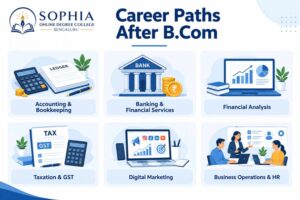
| Career option | Useful skills | Additional preparation that may help |
| 1. Accountant or accounts executive | Accounting, Excel, accuracy | Accounting software and bookkeeping practice |
| 2. Banking and financial services | Numeracy, communication, customer service | Role-specific training or examinations where applicable |
| 3. Financial analyst or junior finance associate | Excel, financial statements, analysis | Financial modelling and reporting practice |
| 4. Taxation and GST executive | Documentation, accounting, attention to detail | Current tax and GST compliance knowledge |
| 5. Business development executive | Communication, sales, negotiation | CRM tools and sales practice |
| 6. Digital marketing executive | Writing, research, analytical thinking | Campaign projects and marketing tools |
| 7. HR or recruitment executive | Communication, organisation, confidentiality | Recruitment workflows and HR software |
| 8. Business operations executive | Coordination, reporting, problem-solving | Process documentation and spreadsheet skills |
| 9. Data or business reporting analyst | Excel, numerical reasoning, interpretation | SQL or visualisation tools for relevant roles |
| 10. E-commerce or sales operations executive | Organisation, reporting, customer service | E-commerce platforms and order-management processes |
These options are not equally accessible to every graduate. Some entry-level positions may accept candidates with a general commerce degree, while specialised roles can require additional training, experience or formal qualifications.
Choose according to the work involved, not only the job title. A role that matches your strengths and gives you opportunities to develop relevant experience may be more useful than one that sounds impressive but does not suit your interests.
Accountant or Accounts Executive
Accounting is a practical career option for commerce graduates who enjoy working with numbers, maintaining records and checking financial information.
An accounts executive may record transactions, prepare invoices, reconcile bank statements, organise expense records, maintain ledgers and assist with monthly reports. In a small business, the role may cover several routine accounting activities. In a larger organisation, responsibilities may be divided among accounts payable, accounts receivable, payroll and reporting teams.
A commerce background can help you understand the principles behind these tasks. However, employers may also expect familiarity with spreadsheets and accounting software.
Skills to develop
- Understanding of debit, credit, ledgers and basic financial statements.
- Spreadsheet skills, including formulas, sorting and reconciliation.
- Familiarity with accounting software used by the employer.
- Attention to detail and organised documentation.
- Basic knowledge of invoices, expenses and applicable tax procedures.
A fresher can practise by creating a sample ledger using fictional transactions, preparing a simple expense report and checking whether totals match. An internship or supervised project can help you understand how these activities work in a real organisation.
CA is not compulsory for every entry-level accounting position. However, statutory audit work, regulated professional responsibilities and senior finance roles may have specific qualification requirements. General bookkeeping support should not be confused with the responsibilities of a qualified chartered accountant.
Further education may be useful if you want to deepen your commerce knowledge, but another degree is not always the immediate priority. If you already understand accounting fundamentals, practical software training and relevant experience may be sensible starting points.
Banking and Financial Services Careers
Banking and financial services include several types of work. Depending on the employer and vacancy, a commerce graduate may investigate customer service, banking operations, documentation, loan-processing support, relationship support or entry-level financial services positions.
A banking operations employee may check transaction records and process documents. A customer-facing employee may help clients understand account services and complete routine requests. Other financial services organisations may deal with investments, insurance, lending or securities markets.
The preparation required depends on the position. Some public-sector banking jobs involve competitive examinations and specific eligibility conditions. Private-sector vacancies may use different selection processes.
How to prepare
Develop numerical accuracy, professional communication, customer handling and spreadsheet skills. Learn the basics of financial products and understand why financial organisations follow documentation and compliance procedures.
If you are interested in securities markets, investigate relevant learning opportunities. The National Institute of Securities Markets offers a Securities Markets Foundation certification examination intended to develop foundational knowledge of Indian securities markets. It is a voluntary examination, not a universal requirement for every banking or finance job.
Before investing in any certification, check whether it is relevant to your target position. A qualification that supports one financial services role may not be required or sufficient for another.
CA and MBA are not universal prerequisites for entry-level banking operations or customer support. However, more specialised positions may require additional credentials, experience or examinations. Always verify the requirements of the particular vacancy you intend to pursue.
Financial Analyst or Junior Finance Associate
A financial analyst examines financial information to help an organisation understand performance, costs, budgets and business decisions. Entry-level opportunities may also appear under titles such as junior finance associate, financial reporting assistant or finance analyst trainee.
A junior employee may update spreadsheets, compare actual expenditure with a budget, organise financial statements or help prepare reports for senior colleagues. More advanced roles may involve forecasting, valuation, investment analysis and detailed financial modelling.
Financial modelling means using structured calculations to estimate how a business or financial decision might perform under different assumptions.
Skills and preparation
Begin with spreadsheet proficiency. Learn how to organise data, use formulas, compare financial periods and present numerical findings clearly. You should also understand the basic relationship between a profit and loss statement, balance sheet and cash flow statement.
For practice, create a fictional monthly budget for a retail business. Estimate sales, calculate operating expenses, compare planned and actual figures, and explain why the results differ.
Once you are comfortable with the fundamentals, investigate introductory financial analysis and modelling training. Employers may expect stronger technical skills for specialist analyst positions, so compare the requirements in current vacancies.
An MBA or CA is not a universal requirement for every junior finance position. However, specialised investment, valuation or corporate finance roles may favour additional credentials, relevant experience or advanced analytical ability.
Further education should address a specific objective. A postgraduate degree alone will not replace the ability to work accurately with financial information and explain what the numbers mean.
Taxation and GST Executive
Businesses need organised financial records to support tax calculations, filings and compliance activities. This creates opportunities for graduates interested in taxation, accounting documentation and business procedures.
A taxation or GST executive may assist with collecting invoices, maintaining records, preparing supporting schedules, organising purchase and sales information, checking documentation and helping senior staff prepare returns.
The scope of the role is important. Administrative support and data preparation are different from independently providing regulated professional advice or performing responsibilities reserved for appropriately qualified professionals.
How to prepare
Strengthen your accounting fundamentals before moving into specialised taxation work. Learn how GST documentation works, how invoices are organised and how businesses maintain records for review. Tax rules and procedures can change, so use current learning material.
Practice with a fictional business’s sales and purchase records. Organise the information, identify missing documents and prepare a summary for review. This can help you develop accuracy without handling confidential taxpayer information.
A short course may help you understand software or procedures, but it should not be treated as a professional licence or a guarantee of eligibility for every taxation-related role.
CA is not mandatory for all taxation support positions. However, professional tax practice, statutory responsibilities and certain advisory activities may require specific qualifications or authorisations. Confirm the requirements before choosing a career path.
Business Development Executive
Business development may suit graduates who enjoy communicating with people, understanding customer needs and explaining products or services.
A business development executive helps an organisation identify prospective customers, follow up on enquiries, arrange meetings, explain offerings and maintain relationships. Some roles focus on generating leads, while others concentrate on converting enquiries into sales.
For example, an employee at an education company may contact prospective learners, understand their academic goals, explain available programmes and coordinate follow-ups with the admissions team.
Skills employers may value
- Clear spoken and written communication.
- Listening and understanding customer requirements.
- Professional follow-up and time management.
- Basic negotiation and presentation skills.
- Familiarity with customer relationship management (CRM) software.
A fresher can practise by preparing a short product presentation, writing a professional follow-up email and creating a sample lead-tracking sheet.
A commerce background can be useful because understanding prices, revenue, customers and business needs is relevant to sales environments. However, the work may involve targets, repeated follow-ups and rejection. Consider whether these responsibilities suit your personality and working style.
Additional education is not automatically required for entry-level business development positions. Communication, product knowledge and the ability to organise a sales process may be more immediately useful. If you later aim for management roles, assess whether postgraduate study supports your intended progression.
Digital Marketing Executive
Digital marketing suits graduates interested in online businesses, customer behaviour, communication and campaign performance.
A digital marketing executive may assist with content calendars, search engine optimisation (SEO), social media posts, email campaigns, paid advertising coordination and website reporting. The responsibilities depend on the employer and the role’s specialisation.
SEO involves improving a website so search engines and potential visitors can discover and understand its pages. Campaign analytics involves examining measures such as clicks, enquiries and conversions to understand how marketing activities perform.
How can a commerce graduate enter this field?
Begin by learning the fundamentals of content, audience research, keyword intent and campaign measurement. Then practise on a sample business instead of relying only on certificates.
For example, create a digital marketing plan for a local stationery shop. Identify likely customers, suggest content themes, draft sample posts and decide which measures would help evaluate performance.
A beginner portfolio could include sample articles, social media creatives, campaign plans and explanations of your decisions. Clearly label simulated projects and do not present sample results as real client outcomes.
A commerce background may be useful when marketing involves pricing, sales, customer acquisition and return on advertising expenditure. Specialised advertising and analytics roles, however, may require additional technical skills and experience.
CA and MBA are not prerequisites for general entry-level digital marketing positions. A targeted course may help you learn a specific tool, but employers may also look for clear writing, sound judgement and evidence that you can apply your knowledge.
Human Resources or Recruitment Executive
Human resources (HR) and recruitment roles suit graduates who enjoy communication, coordination and working with people.
A recruitment executive may organise interview schedules, contact applicants, maintain candidate records, update job listings and coordinate feedback between candidates and hiring teams. An HR executive may also assist with employee documentation, onboarding, attendance records and routine HR administration.
The two job families overlap, but they are not identical. Recruitment focuses more directly on finding and coordinating candidates, while broader HR roles can involve employee records, workplace policies and other administrative processes.
Preparation for freshers
Develop professional email writing, scheduling, spreadsheet organisation and confidentiality. Learn how recruitment stages work, from receiving an application to coordinating interviews and communicating outcomes.
A useful practice project is to create a fictional recruitment tracker with candidate stages, interview dates and follow-up status. Use invented information rather than personal data from real applicants.
Familiarity with HR software can help, but you do not need to learn every platform before applying. Focus first on transferable skills and the tasks mentioned in the job description.
A B.Com degree may meet the educational requirement for some administrative and recruitment positions. Other employers may prefer HR, psychology or management qualifications, particularly for specialist positions.
Further study should depend on your career objective. If you enjoy recruitment coordination, practical experience may be a sensible first step. If you want to specialise in HR management, employee relations or organisational development, investigate the qualifications expected for those roles.
Business Operations Executive
Business operations is concerned with keeping an organisation’s everyday activities running smoothly. An operations executive may coordinate information between departments, update reports, track pending tasks, maintain records and help identify delays in routine processes.
For example, a retail business may need someone to coordinate between sales, inventory and delivery teams. A service company may need an employee to track requests, update operational reports and ensure unresolved issues reach the appropriate team.
Commerce graduates may find this work relevant because it often combines business understanding, numerical information, documentation and coordination.
Skills to develop
- Spreadsheet-based tracking and reporting.
- Written communication and follow-up.
- Time management and prioritisation.
- Basic process mapping and problem-solving.
- Attention to detail when handling records.
Try documenting a simple process, such as how an order moves from customer enquiry to delivery. Identify the people involved, the information required at each stage and the points where delays might occur.
This exercise helps you understand how departments depend on one another rather than viewing each task in isolation.
Some operations positions are open to graduates from different academic backgrounds. More specialised roles in supply chain management, logistics, quality or regulated industries may have additional requirements.
A postgraduate qualification can be useful for certain long-term goals, but it is not automatically necessary for entry-level operations work. Review the responsibilities and progression route before deciding whether to study further.
Data or Business Reporting Analyst
Businesses generate information about sales, expenses, customers, inventory and performance. Reporting professionals organise this information so managers can understand what is happening and decide what to investigate.
A junior reporting analyst may clean spreadsheets, combine information from different sources, prepare recurring reports and identify differences between periods. More technical roles can involve databases, SQL, dashboard tools and complex analysis.
A commerce background can be valuable because data is rarely meaningful without business context. Understanding sales and profit, for example, helps you distinguish between an increase in revenue and an improvement in profitability.
Skills and practical preparation
Begin with Excel or another spreadsheet application. Learn sorting, filtering, lookup functions, pivot tables, charts and basic data cleaning. Practise explaining what a report shows rather than merely producing a table.
A beginner project could use fictional monthly sales figures for several product categories. Calculate total sales, compare monthly performance and create a chart showing which categories contribute most to revenue.
If the positions you target mention SQL, Power BI or another visualisation tool, develop those skills gradually. SQL is a language used to retrieve and manage information in relational databases. Visualisation tools turn data into charts and dashboards that help people interpret results.
Not every reporting job requires advanced programming. However, analytical positions differ considerably in technical depth, and a general B.Com degree will not automatically satisfy all requirements.
You may not need a CA or MBA for an entry-level reporting position, but you will need to demonstrate that you can work accurately with data, understand basic business measures and communicate findings clearly.
E-commerce or Sales Operations Executive
E-commerce operations support the processes involved in selling products through online channels. Depending on the organisation, an executive may help manage product listings, monitor orders, coordinate dispatches, update inventory records, track returns and prepare sales reports.
Sales operations are related but broader. It can involve maintaining sales records, preparing performance reports, supporting sales teams and keeping customer or transaction information organised.
Consider an online retailer that sells household products. The operations team may monitor product availability, identify delayed orders, coordinate with a delivery partner and investigate discrepancies between orders and inventory records.
A commerce graduate may find this work interesting because it combines transactions, business processes, customer expectations and sales data.
How to prepare
Learn spreadsheet reporting, basic inventory concepts, order-processing workflows and customer service practices. Familiarity with e-commerce platforms or inventory-management systems may help when those tools appear in a job description.
You can practise by creating a sample order tracker with order dates, product quantities, dispatch status, delivery status and return reasons. Use fictional information and explain how the tracker could help identify recurring delays.
Some roles may involve shifts, demanding sales periods or coordination with external partners. Others may focus more on reporting and administration. Read the job description carefully to understand the working conditions.
A specialised degree is not automatically required for every entry-level e-commerce or sales operations position. Practical knowledge of the process, accuracy and reliable communication can be useful starting points.
Skills B.Com Graduates Should Develop Before Applying for Jobs
Whichever career you choose, a few foundational skills can help you prepare for entry-level work. The priority is not to learn every tool available. It is to develop the abilities most relevant to your target roles.
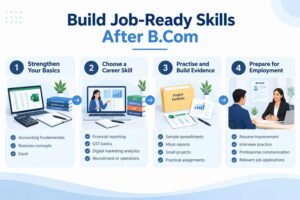
Spreadsheet skills: Practise organising data, using formulas, preparing summaries and checking for errors. Excel or equivalent spreadsheet tools are useful across accounting, operations, finance, HR and reporting.
Business communication: Learn to write concise emails, explain information clearly, ask relevant questions and communicate professionally with colleagues or customers.
Numerical reasoning: Be comfortable with percentages, ratios, totals, comparisons and basic financial calculations. These skills are relevant to commerce and many business roles.
Digital literacy: Learn to use shared documents, presentation tools, online meeting platforms and workplace software responsibly.
Problem-solving: When a number does not match, a task is delayed or a report appears inconsistent, practise identifying possible causes rather than simply forwarding the issue.
Role-specific knowledge: Accounting candidates should practise bookkeeping; marketing candidates should create work samples; aspiring analysts should prepare reports; and HR candidates should practise recruitment coordination.
Relevant online courses for commerce students can help address specific skills gaps. Evaluate the course content before enrolling. A course is useful when it addresses a genuine requirement and gives you opportunities to practise what you learn.
Build evidence, not just certificates
Create two or three small projects that demonstrate your abilities. An accounts candidate might prepare a sample reconciliation, while a reporting candidate might build a dashboard from fictional sales data.
Explain the objective, your approach and what you learned. Do not use confidential information or claim that simulated work was completed for a real employer.
Projects cannot replace all workplace experience, but they can give you something concrete to discuss during an interview.
Is Further Education Necessary After B.Com?
Further education can be useful, but it should not be treated as an automatic next step for every graduate.
If you want to start working quickly and already meet the basic requirements for entry-level roles, applying for jobs while developing relevant skills may be a reasonable approach.
If your target position requires specialised knowledge, an additional qualification may help you build the necessary foundation. If you want to pursue academic progression or a particular postgraduate pathway, a formal degree may be more appropriate than a short course.
Consider three broad choices.
Short-term skill training: Useful when you need to learn a particular tool or task, such as spreadsheet reporting, accounting software, digital marketing or introductory data analysis. It does not replace a recognised degree.
Professional certification: Relevant where an employer, industry or regulatory framework values or requires a particular credential. Confirm its purpose, eligibility conditions and current status before investing in it.
Postgraduate education: May deepen subject knowledge or support academic progression. Its value depends on the programme, recognition, curriculum, eligibility requirements and your intended career.
If you have already completed B.Com, do not enrol in another undergraduate degree without a clear reason. If you are considering postgraduate commerce education, an M.Com may be relevant, but it is not compulsory for all ten career options discussed here.
The right decision depends on the gap you are trying to close. Do not pay for a qualification simply because you feel that graduation must always be followed by another course.
How Online Education Can Support Commerce Graduates
Flexible learning can help students and working professionals develop knowledge while managing other responsibilities. However, different educational formats serve different purposes, so it is important to understand what you are choosing.
An online degree programme delivers a formal academic qualification through an online learning arrangement. Depending on the institution and programme, it may include digital lessons, assignments, online resources, examinations and academic support.
A distance education programme is designed for learners who study away from a conventional campus, with delivery and assessment arrangements determined by the institution and programme. Distance learning should not automatically be assumed to mean fully online study.
Correspondence education traditionally relies heavily on printed or distributed learning materials and independent study, although arrangements can vary.
Regular campus-based education generally involves in-person academic activities according to the institution’s timetable and requirements.
A short-term skill-development course focuses on a specific subject or ability. It may help you learn a tool or process but is not equivalent to a B.Com or M.Com degree.
Before choosing an online programme, check whether the qualification fits your present education and intended career. Review the institution, the exact programme, the applicable recognition or approval requirements, the curriculum and the examination arrangements.
Also consider the total fee, payment conditions, duration, academic support and weekly study commitment. If you are working, make sure you can realistically manage assignments and examinations alongside your other responsibilities.
For regulatory checks, consult the University Grants Commission’s Distance Education Bureau. Its official programme listing allows learners to investigate institutions and programmes approved or entitled for online and open-distance learning. Check the relevant academic year, institution, programme and mode before enrolling.
Do not assume that a college’s online presence proves that every course it advertises is available in an approved mode. Recognition and eligibility should be checked against the specific programme and applicable rules.
B.Com Online Degree vs M.Com Online Degree
A B.Com and an M.Com serve different academic purposes. Understanding this difference helps you choose a qualification that matches your current education and career plans.
A B.Com is an undergraduate commerce qualification that introduces subjects such as accounting, economics, taxation, finance and business law. An M.Com is a postgraduate qualification that builds on prior undergraduate study, with subjects and specialisations depending on the institution.
| Comparison factor | B.Com | M.Com |
| Academic level | Undergraduate | Postgraduate |
| Typical entry point | After qualifying school education, subject to eligibility | After a qualifying bachelor’s degree |
| Main purpose | Build foundational knowledge of commerce | Develop deeper academic knowledge of commerce |
| Potential relevance | Entry-level commerce roles and further study | Academic progression and roles where postgraduate study is relevant |
| Is it compulsory for all ten careers? | No | No |
If you have not completed an undergraduate degree, a B.Com may be relevant to your academic plans. If you have already graduated, an M.Com may be worth considering when you want deeper academic study or a qualification relevant to your intended career.
However, further education is not automatically the best next step. A graduate targeting digital marketing may benefit more immediately from practical campaign experience, while someone interested in advanced commerce studies may have a stronger reason to explore postgraduate options.
Before enrolling in an online programme, review the qualification awarded, delivery mode, eligibility, curriculum, assessment arrangements and applicable recognition status. Do not assume that every online degree offers identical value or that all employers treat all qualifications in the same way.
How to Evaluate Online Degree Courses in Bangalore and Karnataka
Students researching online degree courses in Bangalore or online degree courses in Karnataka should compare programmes based on verifiable information rather than location-based marketing claims.
Start by identifying the qualifications you need. Are you looking for your first undergraduate degree, postgraduate study or a short course to strengthen a particular skill? The answer determines which programmes are relevant.
Next, examine the institution and the specific programme. Check the applicable recognition or entitlement information for the relevant academic year and mode. Approval for one programme should not be assumed to cover every other programme offered by the same institution.
Use this comparison table when evaluating potential programmes:
| What to check | Questions to ask before enrolling |
| Recognition | Is the institution entitled or recognised to offer this specific programme in the intended mode and academic session? |
| Eligibility | Does your previous qualification meet the admission requirements? |
| Curriculum | Do the subjects match your academic and career objectives? |
| Total fees | Are tuition, examination, registration and other applicable charges clearly explained? |
| Assessment | How are examinations, assignments and any practical components conducted? |
| Learning support | What academic guidance, study materials and technical assistance are available? |
| Study commitment | Can you manage the schedule alongside work and personal responsibilities? |
| Documentation | Can you obtain the official programme details, fee structure and admission terms in writing? |
For regulatory checks, consult the University Grants Commission’s Distance Education Bureau. Check the relevant academic year, institution, programme and mode before enrolling.
Common Mistakes to Avoid After B.Com
One common mistake is assuming that another degree is always the best next step. Additional education can be valuable, but it should address a genuine academic or career objective.
Another mistake is choosing a career only because someone describes it as high-paying or easy to enter. Job responsibilities, eligibility, competition and working conditions differ, so investigate the role rather than relying on broad promises.
Avoid collecting certificates without applying what you learn. A candidate with a small, well-explained practical project may be better prepared to demonstrate a skill than someone who cannot explain the contents of several completed courses.
Do not ignore job requirements. If a role requires a particular qualification or professional credential, a general commerce degree or short course may not be a substitute.
Also avoid sending the same CV to every employer. Highlight the skills and experience relevant to each position, while keeping all claims truthful.
Finally, do not compare your progress with friends who have chosen different paths. One graduate may start working immediately, while another may continue studying. The more useful comparison is whether your current actions are helping you move towards your own goal.
Students who are interested in both commerce and legal studies can also explore our guide on B.Com in Business Law vs BBA in Business Law to understand how these two degrees differ in their academic focus, skill development, and career opportunities.
How Sophia Online Degree College May Fit Your Education Plans
Sophia Online Degree College (SODC) is an educational option readers can investigate when considering their next academic step. The appropriate choice depends on the programmes currently available, the learner’s eligibility and the intended qualification.
Review the actual programme names from SODC, study modes and admission information available rather than assuming that the institution offers a specific B.Com, M.Com or other degree.
If you are already a B.Com graduate, consider what you want to achieve before enquiring. You may be looking for postgraduate commerce education, a different academic qualification or a flexible way to continue learning while employed. The right option, if available, should match that objective.
If you have not yet completed an undergraduate degree, establish which qualifications and modes of study are available and whether they meet the applicable recognition requirements.
Before making a decision, ask for written confirmation of:
- The exact programme name and qualification awarded.
- Eligibility and admission requirements.
- Learning mode and examination arrangements.
- Programme duration and complete fee structure.
- Applicable recognition or approval information.
- Academic support and any required practical components.
Do not assume that every career in this article requires a new degree. Someone preparing for digital marketing may need practical campaign experience, while a prospective postgraduate student may need a formal academic programme.
For programme-specific questions, Contact SODC to enquire about current offerings and confirm whether a particular programme fits your plans.
The purpose of an education enquiry should be to establish suitability, not to enrol simply because a qualification is available.
Frequently Asked Questions
1. What are the best career options after B.Com without CA or MBA?
Accounting, banking and financial services, junior finance, taxation support, business development, digital marketing, recruitment, business operations, reporting analysis and e-commerce operations are ten options worth investigating. The right choice depends on your skills, interests and the eligibility requirements of the role.
2. Can I get a job immediately after B.Com?
Yes, some employers recruit graduates into entry-level positions, but selection is not guaranteed. Relevant skills, internships, communication, practical work samples and the employer’s eligibility criteria can influence your chances.
3. Which skills should a B.Com fresher learn first?
Start with spreadsheet skills, professional communication, numerical reasoning and digital literacy. Then develop the specialised abilities required for your target career, such as accounting software, marketing tools, recruitment coordination or data reporting.
4. Is M.Com necessary after B.Com?
No. An M.Com is a postgraduate option, not a universal requirement for commerce-related employment. Consider it when the academic depth or qualification supports your particular career or further-study objective.
5. Are online courses useful for commerce students?
They can help learners develop specific knowledge and practical skills, especially when the content matches a real requirement. However, a short course is not equivalent to a formal degree, and completing a course does not guarantee employment.
6. How should I choose an online degree programme in Karnataka?
Check the exact institution and programme, applicable recognition or entitlement, eligibility, curriculum, fees, examination requirements and academic support. Verify official information for the relevant academic year before paying fees or enrolling.
7. Can working professionals pursue further education after B.Com?
Yes, if they meet the programme’s eligibility conditions and can manage its study requirements. Compare the timetable, assessments, fees and learning support with your work commitments before choosing a programme.
8. What should I check before enrolling in an online degree?
Confirm the qualification awarded, programme recognition, eligibility, total cost, duration, delivery mode, examination arrangements and support services. Keep copies of the official programme details and written admission terms.
Conclusion: Choose a Career Path That Fits Your Goals
A B.Com degree can provide a foundation for several career paths without requiring you to pursue CA or MBA. Accounting, financial services, taxation, marketing, recruitment, operations and digital commerce offer different kinds of work, each with its own skill requirements and opportunities for development.
The most useful next step is to identify the kind of work you want to do, review real job requirements and develop the skills that matter for that role. Practical projects, internships and relevant experience can help you demonstrate what you know. Further education may also be valuable when it supports a clear academic or professional goal.
For students exploring online courses for commerce students, the decision should go beyond convenience. Compare the programme’s relevance, recognition, eligibility, cost and study commitments before enrolling. A B.Com online degree and an M.Com online degree serve different academic purposes, and neither should be selected without considering your existing qualification and intended direction.
If you are considering further study, review the programmes and academic information published by Sophia Online Degree College and confirm the details directly before making a decision. “Choose education that fits your goals, rather than assuming that another qualification is automatically the right next step.”