
Have you completed Class 12 and are considering a Bachelor of Arts degree, but want to understand your study options before applying? An online BA can be worth exploring if you are interested in humanities, social sciences, languages, communication, or related subjects and need a learning arrangement that fits your circumstances.
Before choosing among online BA degree courses, it is important to understand the eligibility criteria, available subjects, course duration, fees, recognition requirements, and career possibilities. The right choice depends on your interests, academic background, budget, and plans after graduation.
This guide explains what Indian students should know about studying a BA after Class 12 in 2027. It also explains how to compare online, distance, and regular programmes, what to check before paying admission fees, and how to plan for further education or employment after graduation.
Can You Pursue an Online BA After Class 12?
Yes, students can consider an online or distance-learning Bachelor of Arts programme after completing Class 12, provided they meet the eligibility requirements of the institution and the specific programme.
A BA is an undergraduate qualification that may cover subjects in the humanities, languages, social sciences, and other academic disciplines. Depending on the programme, students may study literature, history, political science, economics, sociology, psychology, or related subjects.
The main difference between BA programmes lies in their subject combinations, teaching arrangements, assessments, duration, and the university awarding the qualification.
An online programme may provide digital learning resources, online academic interaction, and access to study materials through a learning platform. However, students should not assume that every online programme is completely self-paced or that all examinations can be completed from home.
Consider a student who has completed Class 12 in Commerce and wants to prepare for competitive examinations while continuing undergraduate studies. A BA may be one option worth comparing, particularly if the student is interested in economics, public administration, history, or political science. The final choice should depend on the subjects available and the programme’s admission rules.
Before applying, check the exact qualification, awarding institution, approved mode of delivery, course structure, and current admission information.
Online BA Eligibility After 12th
The eligibility criteria for a BA depend on the university and the programme selected. There is no single admission rule that automatically applies to every institution offering undergraduate arts education.
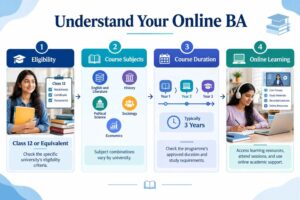
The following are common eligibility considerations.
Completion of Class 12: Many BA programmes require applicants to have passed Class 12 or an equivalent qualification from a recognised educational board.
Minimum marks: Some institutions specify minimum marks or grades. Others may have different eligibility conditions. Do not assume that every BA requires the same percentage.
Accepted qualifications: Students who completed school through a recognised board or an equivalent educational pathway should check whether their qualification is accepted by the institution.
Subject requirements: Some programmes may have language requirements, subject prerequisites, or other programme-specific conditions. These must be checked individually.
Admission procedure: An institution may admit eligible students through an application process, merit-based selection, or another prescribed route. Do not assume that every BA requires an entrance examination or that none does.
What documents might you need?
Depending on the institution’s application process, students may be asked to provide:
- Class 10 certificate or marksheet.
- Class 12 marksheet and passing certificate.
- Government-issued identification, where requested.
- Recent photograph and signature.
- Details of the previous school or board.
- Any additional documents specified in the admission instructions.
Prepare digital copies if you are applying online, but follow the institution’s actual file-format and verification requirements.
The most reliable approach is to check the current admission notification before submitting an application. If a requirement is unclear, ask the institution for written clarification instead of relying on a general online article.
Can Arts, Commerce, and Science Students Apply for a BA?
Students from Arts, Commerce, and Science backgrounds may be eligible for BA programmes, depending on the programme’s admission rules.
Arts students
Students from Arts or Humanities backgrounds may already have studied subjects such as history, political science, sociology, geography, or languages. This can help them identify the subjects they enjoy and decide whether to continue in a related discipline.
For example, someone who enjoys reading about government and public institutions may want to investigate political science or public administration. A student who enjoys literature and writing may prefer English or another language-based discipline.
Commerce students
Commerce students may consider subjects such as economics, sociology, political science, or languages if they meet the institution’s eligibility conditions.
A BA can provide a different academic direction from accounting or business studies. Students should compare the subject content carefully rather than assuming that a BA will automatically lead to a particular business career.
Science students
Science students who want to move towards humanities or social sciences may also explore relevant BA programmes where eligible. Their decision might be based on an interest in psychology, economics, history, public policy, or communication.
Changing streams does not automatically mean that a student must start from the beginning in every area of learning. However, the selected subject may involve unfamiliar reading, writing, research, or analytical methods that require consistent practice.
The important point: your Class 12 stream is only one part of the decision. Verify the entry requirements and select a subject combination that genuinely interests you.
Which BA Subjects Can You Choose Online?
BA subjects differ by university and programme. Some degrees focus on one major subject, while others allow students to combine disciplines or select electives.
The following examples can help you identify areas worth investigating. They are not a promise that every subject is available in every online programme.
| BA subject or discipline | Main areas of study | Interests it may suit | Important consideration |
| English | Literature, language, writing and critical reading | Reading, writing and communication | Check the language and literature components |
| History | Historical periods, societies and historical interpretation | Understanding events and social change | Requires reading and evidence-based analysis |
| Political Science | Political systems, institutions and political ideas | Government, public affairs and policy | Subject content varies by curriculum |
| Sociology | Society, social institutions and human behaviour | Social issues and community studies | Research and interpretation are important |
| Economics | Economic concepts, markets and public policy | Economic issues and analytical thinking | Some programmes include mathematics or statistics |
| Psychology | Human behaviour and psychological concepts | Understanding behaviour and research | Check whether practical work or specific prerequisites apply |
| Public Administration | Public institutions, administration and governance | Administration and public-sector interests | Check the exact subjects and assessment methods |
| Other language or interdisciplinary subjects | Depends on the programme | Language, culture and broader academic interests | Confirm availability and the qualification awarded |
How should you choose a BA subject?
Start with three questions.
What do you enjoy learning? If you enjoy reading and writing, a language or literature subject may suit you. If you like understanding public institutions, political science or public administration may be worth exploring.
What type of work do you prefer? Some students enjoy research and written assignments, while others prefer discussing social issues, interpreting information, or developing communication skills.
What do you plan to do after graduation? If you intend to pursue postgraduate study, check the eligibility conditions for your preferred next qualification. Some postgraduate programmes require a particular subject background or other prerequisites.
Do not select a subject only because you have heard that it leads to a particular job. A subject provides academic knowledge, but employment also depends on skills, experience, employer requirements, and sometimes additional qualifications.
How Long Does an Online BA Take to Complete?
Many BA programmes in India are structured around a three-year minimum duration, but the applicable structure depends on the institution, programme, and current academic framework.
Some undergraduate programmes may have different structures, including longer honours or research pathways where applicable. Maximum completion periods and permitted flexibility also vary.
For example, IGNOU publishes programme-specific details for its BA offerings. Its official Bachelor of Arts programme illustrates why students should check the duration, eligibility, and fee conditions for the exact course rather than assuming that all BA programmes have identical rules.
Before enrolling, verify:
- Minimum duration of the selected programme.
- Maximum permitted time to complete it.
- Number of semesters or academic years.
- Required credits and subject combinations.
- Rules for failed subjects or repeat examinations.
- Any permitted break, re-entry, or extension arrangements.
A flexible completion period can be helpful for learners managing work or family responsibilities, but it should not be assumed to apply to every programme.
Students should also consider their own pace. Completing a degree requires more than attending online sessions: it may involve reading, writing assignments, revising lessons, preparing for examinations, and completing other academic requirements.
Online BA Course Structure and Assessment
The structure of a BA programme usually depends on the subjects offered and the university’s curriculum. Some programmes organise learning semester by semester, while others may use year-wise structures or a different approved arrangement.
Students may encounter several types of academic work.
Core subjects: These are the main subjects that form the foundation of the chosen degree or discipline.
Electives: Some programmes allow students to choose additional subjects from an approved list. The options depend on the programme.
Assignments: Written work may require students to explain concepts, analyse information, compare viewpoints, or answer questions based on their study material.
Examinations: Assessment may include term-end examinations, semester examinations, or other prescribed methods. The timing and format must be confirmed with the institution.
Projects or practical activities: Certain subjects may include projects, presentations, fieldwork, or practical components. Do not assume that every BA programme includes the same requirements.
What does studying online actually involve?
An online learning platform may provide recorded lessons, digital reading material, announcements, assignment instructions, and communication tools. Some programmes may also include scheduled live classes.
Students should ask how they will access learning resources, contact faculty, submit assignments, receive feedback, and obtain help with technical issues.
A programme’s flexibility does not remove the need for self-discipline. Create a weekly timetable that includes study time, assignment preparation, revision, and assessment deadlines.
If you are comparing online UG degree courses in India, look beyond the programme title. The learning structure and support available to students can affect whether the course suits your needs.
Online BA Fees and How to Evaluate Affordable Options
The cost of a BA varies between institutions and programmes. It may depend on the university, subjects, study mode, academic structure, and the services included in the published fee.
It is not responsible to give one fee amount as a universal price for online BA education. Students should obtain the current fee schedule for the exact programme and admission session.
What should you include when calculating the total cost?
Consider all published charges, including:
- Tuition fees for the full programme.
- Application or registration charges.
- Examination fees.
- Learning materials, where charged separately.
- Technology or platform costs, if applicable.
- Re-examination or repeat-assessment charges.
- Other mandatory expenses disclosed by the institution.
Also check payment dates, instalment conditions, late-payment rules, and the refund policy.
How can you identify affordable online degrees?
A lower advertised tuition fee does not always mean a programme is the most economical option. Compare the total cost of completing the degree, including mandatory additional charges.
Then consider what is included in the learning experience. A programme’s academic support, access to course material, assessment arrangements, and administrative services may be relevant to your decision.
Students and families should also calculate whether the payment schedule is manageable alongside other expenses. Avoid making an admission decision based only on a discount or an urgency-based advertisement.
Ask for the official fee structure in writing and retain copies of receipts and admission documents. If the published total does not explain an additional charge, seek clarification before paying.
Online BA vs Regular BA vs Distance BA
Online, distance, correspondence, and regular programmes can differ in the way learning materials are delivered, how students interact with teachers, and how assessments are organised. Their precise arrangements depend on the institution and the approved mode of the programme.
| Factor | Online BA | Distance or correspondence BA | Regular BA |
| Learning delivery | Primarily through digital learning arrangements | Often uses self-learning materials and may include digital resources | Primarily classroom-based |
| Interaction | May include live online sessions, forums or digital support | Depends on the institution’s support arrangements | Usually includes in-person classroom interaction |
| Campus attendance | Depends on programme requirements | Depends on programme requirements | Normally involves regular campus attendance |
| Assessment | May include online learning activities and prescribed examinations | May include assignments and examinations in the prescribed format | Commonly includes classroom-linked assessments and examinations |
| Flexibility | Can offer flexibility, but deadlines may still apply | Can suit independent study, subject to programme rules | Usually follows a more fixed timetable |
| Student experience | Depends on the online platform and support available | Depends on the learning materials and student-support system | Includes opportunities for campus-based interaction |
| Cost | Varies by institution | Varies by institution | Varies by institution |
Neither mode is automatically the best choice for every student.
An online programme may suit a learner who needs to study from home, while a regular programme may appeal to someone who values campus activities and face-to-face interaction. A distance programme may suit someone who prefers independent study, depending on its arrangements.
Before comparing options, confirm the actual learning mode and assessment requirements. Do not assume that the words online, distance, and correspondence mean exactly the same thing in every institutional context.
How to Check Recognition and Approval Before Admission
Recognition should be one of the first checks when evaluating an undergraduate programme. Students should identify the institution awarding the degree and verify the status of the exact programme and mode of delivery for the intended admission session.
A website advertisement, counselling office, or general statement about an institution does not by itself prove that every programme it promotes is authorised in every mode.
What should students verify?
The awarding institution: Find out which university or legally authorised institution will award the final qualification.
The exact programme: Confirm the official programme title and whether the subject combination you want is available.
The mode of study: Check whether the programme is offered in the mode advertised and whether the relevant requirements apply to that mode.
The academic session: Verify the information for the session in which you plan to enrol. Do not rely only on an old brochure or a previous year’s admission page.
The official documents: Read the programme prospectus, eligibility conditions, fee schedule, and examination rules.
The final qualification: Understand what certificate or degree you will receive and which institution will issue it.
India’s higher-education policy includes discussion of flexibility in undergraduate learning and academic pathways. Students can consult the Ministry of Education’s National Education Policy information to understand the broader policy context. However, policy information should not be treated as proof that a particular programme is approved or that every institution follows the same structure.
If you are uncertain, ask the institution for the specific official document that supports its programme and mode-of-study claims. Verify the details before making a payment.
How to Compare Online BA Options in India, Karnataka, and Bangalore
Students often search by location because they want to find an institution that is familiar, accessible, or able to provide assistance. However, a search term that mentions a city does not establish that a programme is offered there or that the programme meets the student’s requirements.
When researching online degree courses in Karnataka, focus on the actual institution and programme rather than the location phrase alone.
Use the same approach when comparing online degree colleges in Bangalore. Check the awarding university, exact course, delivery mode, eligibility, fee structure, and relevant approval details.
A practical comparison checklist
| Factor | What students should verify | Why it matters |
| Eligibility | Accepted Class 12 qualifications and minimum marks, if applicable | Confirms whether you can apply |
| Recognition | Awarding institution and programme status for the intended session | Helps establish the qualification’s status |
| Subjects | Available disciplines, electives and curriculum | Helps you choose a suitable academic direction |
| Duration | Minimum and maximum completion periods | Supports realistic study planning |
| Total fees | Tuition and all mandatory charges | Helps you compare the full cost |
| Assessment | Examination, assignment and attendance requirements | Clarifies the academic workload |
| Student support | Faculty access, administrative help and technical assistance | Helps you understand the support available |
| Further study | Entry conditions for your intended next qualification | Helps you plan your academic pathway |
Do not choose a programme simply because it appears first in search results or uses phrases such as “best college” or “most affordable.” Compare the documents and details that can actually be verified.
If a provider cannot explain who awards the degree, which programme is offered, or what the full fee includes, treat that as a reason to pause and investigate further.
Students exploring online degree courses in Bangalore should also confirm whether any local office provides counselling only or is directly responsible for academic delivery. A physical office address is not a substitute for verifying the degree-awarding institution.
What Can You Do After Completing a BA?
A BA can provide a foundation for several employment and further-study directions. The opportunities available to an individual depend on the subject studied, communication skills, practical experience, employer requirements, and any additional qualification needed for the role.

Administrative and office-support roles
Some graduates may consider entry-level administrative positions involving document preparation, scheduling, record management, coordination, and communication. Employers may expect computer literacy, accuracy, organisation, and professional communication.
Content and communication work
Students with strong writing and research skills may investigate content writing, copywriting, editorial assistance, publishing support, or communications-related roles.
A student interested in this direction can practise by creating original articles, summaries, newsletters, or portfolio pieces. Digital publishing skills may also be useful, depending on the position.
Customer relations and client support
Some organisations recruit graduates for customer support, client coordination, service operations, or related roles. Communication, patience, problem-solving, and the ability to explain information clearly can be valuable.
Human resources and organisational support
Graduates may explore entry-level recruitment coordination or HR support roles when they meet the employer’s requirements. Further study or specialised training may be useful for some positions.
Media, digital communication, and marketing
Students who develop writing, research, presentation, or digital skills may investigate social media support, marketing coordination, communication, and related entry-level opportunities. Additional training may be expected for specialised responsibilities.
Government-examination preparation
A BA may provide an undergraduate qualification for certain competitive examinations, provided the candidate meets the eligibility conditions in the relevant recruitment notification. Requirements differ between examinations and posts.
For official career information and employment-related services, students can explore India’s National Career Service portal. Always check the specific employer or examination notification before deciding whether a degree meets the entry requirements.
A degree does not guarantee a particular job. Students should combine academic learning with practical skills, experience, and a realistic understanding of the roles they intend to pursue.
Higher Education Options After an Online BA
Students who want to continue studying after a BA can investigate postgraduate and professional pathways that match their academic background and goals.
Master of Arts
An MA may allow students to develop deeper knowledge in a discipline such as English, history, economics, sociology, or political science. Admission requirements depend on the institution and the chosen subject.
Some programmes accept graduates from a broad range of disciplines, while others require a relevant undergraduate background or specific prerequisites.
Master of Social Work
Students interested in community development, social services, or related areas may investigate an MSW. Programme eligibility and practical requirements should be checked with the institution.
Master of Business Administration
A student interested in management may consider an MBA if they meet the programme’s entry requirements. Some MBA programmes accept graduates from different academic backgrounds, but admission and selection conditions vary.
Professional and skill-based programmes
Depending on the intended career, students may also consider relevant diplomas, certificates, or professional training. These can help develop specific skills but should not be confused with an undergraduate or postgraduate degree.
Law and other regulated pathways
Students interested in law, teaching, psychology-related work, or other regulated professions must check the relevant professional and institutional eligibility rules. A BA alone may not satisfy all the requirements for such careers.
Before choosing a postgraduate course, check whether the undergraduate subjects you plan to study will meet the entry requirements for your preferred next qualification. Planning ahead can prevent avoidable limitations later.
Skills That Can Complement a BA Degree
Academic knowledge is important, but practical skills can help students apply what they learn in study, projects, and employment.
Communication: Practise explaining ideas clearly in writing and conversation. Summarising an article or presenting a short argument can help develop this skill.
Research: Learn to identify credible sources, compare viewpoints, take notes, and distinguish evidence from opinion.
Writing and editing: Students interested in communication or content-related work can practise grammar, structure, fact-checking, and clear presentation.
Digital literacy: Become comfortable with documents, spreadsheets, presentations, online collaboration tools, and responsible use of digital resources.
Critical thinking: Learn to question assumptions, assess evidence, and explain why a conclusion follows from the information available.
Presentation: Practise organising information into a short presentation, choosing relevant evidence, and responding to questions.
Time management: Create a realistic study schedule, break assignments into smaller tasks, and plan revision ahead of deadlines.
You can develop these skills through coursework, independent projects, volunteering, internships, or suitable part-time opportunities. For example, a student interested in history might prepare a well-sourced research presentation, while a student interested in writing might build a portfolio of original articles.
Choose activities that strengthen your interests rather than collecting certificates without a clear purpose.
How to Choose the Right Online BA Programme
The right programme is one that meets your academic needs, has verifiable programme details, fits your budget, and supports your intended study pathway.
Use the following steps before making a final decision.
Step 1: Decide which subjects interest you. Shortlist disciplines that you enjoy and that fit your future education plans.
Step 2: Check eligibility. Confirm the required school qualification, marks, subject prerequisites, and admission process.
Step 3: Verify the awarding institution. Identify who will award the degree and check the programme and study mode for the intended session.
Step 4: Read the curriculum. Look at the subject list, electives, academic structure, and assessment requirements.
Step 5: Calculate the full cost. Include tuition and all mandatory charges rather than comparing only the advertised starting fee.
Step 6: Understand the learning arrangement. Ask about study materials, live sessions, examination requirements, assignment deadlines, and academic support.
Step 7: Consider your next step. If you intend to pursue postgraduate study or a particular career, check the relevant eligibility conditions in advance.
Step 8: Keep written records. Save the official prospectus, fee details, admission communication, payment receipts, and any written clarification you receive.
Do not rush into admission because a website uses urgent promotional language. A short period of careful comparison can help you identify important differences between programmes.
“For a deeper understanding of career paths, higher education options, and skills that can support your next step, read our guide on what to do after BA graduation.”
Common Mistakes to Avoid When Choosing an Online BA
Several mistakes can make it harder to choose a suitable programme.
Choosing only by low fees: A low advertised price may not include every mandatory charge. Compare the total cost before deciding.
Ignoring recognition: Check the awarding institution, exact programme, and mode of study rather than relying on a general marketing statement.
Assuming all BA subjects are available everywhere: Subject combinations and electives vary. Confirm the curriculum before applying.
Treating every online programme as self-paced: Scheduled classes, assignments, examinations, and other deadlines may still apply.
Choosing a subject only for a perceived career benefit: Your interests, academic strengths, and further-study plans should also guide the decision.
Assuming a degree guarantees employment: Employers may require additional skills, experience, examinations, or professional qualifications.
Ignoring postgraduate eligibility: If you already have a possible next qualification in mind, check its entry requirements before choosing your BA subjects.
Relying on verbal assurances: Obtain important information about fees, eligibility, recognition, and assessment in official written form.
Confusing a short course with a degree: A certificate course may help build a skill, but it is not automatically equivalent to a recognised undergraduate qualification.
Avoiding these mistakes will not guarantee a particular outcome, but it can help you make a more informed choice.
How Sophia Online Degree College May Fit Your Education Plans
Students exploring undergraduate education can review the programme information published by Sophia Online Degree College (SODC). Its official website lists a BA among its undergraduate offerings, but prospective applicants should confirm the exact awarding university, programme title, subjects, learning mode, eligibility, fees, and current admission arrangements before enrolling.
Begin by exploring SODC and reviewing the information relevant to your intended qualification. Do not assume that every BA subject or study mode is available simply because the website lists a BA category.
If you need clarification about programme availability, admission requirements, or fees, you can contact us and request the current details in writing.
You may also review the SODC course application information to understand the enquiry and application process. Before submitting an application or payment, make sure you have verified the programme and the institution awarding the final qualification.
The aim is to make a decision based on verified academic information—not just on the name of a programme or a promotional description.
A Practical Checklist Before Applying for an Online BA
Before completing an application, take a few minutes to review the following checklist.
- I have completed Class 12 or meet the programme’s accepted entry qualification.
- I have checked the exact eligibility conditions and any minimum-mark requirements.
- I know which university or institution awards the final degree.
- I have verified the programme and study mode for my intended admission session.
- I have read the syllabus and confirmed the subjects available.
- I understand the minimum and maximum completion periods.
- I have checked examinations, assignments, and any attendance requirements.
- I have calculated the total fee, including mandatory additional charges.
- I understand the payment schedule and refund conditions.
- I know how to access learning materials and obtain academic support.
- I have considered my further-study or career plans.
- I have saved the official documents and written answers to my questions.
If you cannot answer one or more of these questions, pause and obtain the missing information before paying fees. A clear answer is more useful than a quick promise.
Frequently Asked Questions
1. Can I pursue a BA online after Class 12?
Yes, you can consider an online BA if you meet the eligibility criteria of the specific institution and programme. Verify the awarding institution, programme details, study mode, and current admission requirements before applying.
2. Can Commerce or Science students choose a BA?
Students from Commerce or Science backgrounds may be eligible for many BA programmes, depending on the institution’s rules. Check the subject requirements and available disciplines before making a decision.
3. How many years does an online BA take to complete?
Many BA programmes have a three-year minimum duration, but the applicable structure and maximum completion period vary. Confirm the exact duration in the current programme documentation.
4. Which subjects can I study in an online BA?
Common BA disciplines include English, history, political science, economics, sociology, psychology, and public administration. The actual subjects and combinations depend on the institution and programme.
5. Are online BA degrees recognised in India?
Recognition depends on the institution, programme, mode of delivery, and applicable requirements for the relevant academic session. Verify the exact programme through official information before enrolling.
6. What can I do after completing a BA?
Depending on your subject, skills, and experience, you may explore administrative support, communication, content, customer relations, or other entry-level roles. Further education and additional qualifications may be required for certain careers.
7. Can I pursue postgraduate study after an online BA?
Potentially, yes, if the degree and your academic background meet the entry requirements of the postgraduate programme. Check the eligibility rules of the institution and course you intend to pursue.
8. How should I compare online degree options in Bangalore or Karnataka?
Compare the awarding institution, programme recognition, eligibility, subjects, duration, total fees, assessment arrangements, and student support. Do not rely only on location-based search results or promotional claims.
Conclusion: Is an Online BA After 12th Right for You?
An online BA may be worth considering if you want to study humanities or social sciences and need a learning arrangement that suits your circumstances. The right decision depends on more than flexibility or cost: you should also understand the subjects, eligibility criteria, programme duration, assessment requirements, and recognition.
When comparing online BA degree courses, start with your academic interests and intended next step. Then verify the exact programme and awarding institution, compare the full cost, and read the official admission documents before making a payment.
Students exploring online UG degree courses in India can use the same careful approach regardless of their location. If you are considering SODC, review the available information and contact the institution to confirm the specific programme details relevant to your goals.
“A well-informed choice will help you begin undergraduate study with a clearer understanding of what you are enrolling in, how you will complete it, and what you may want to do afterwards.”