
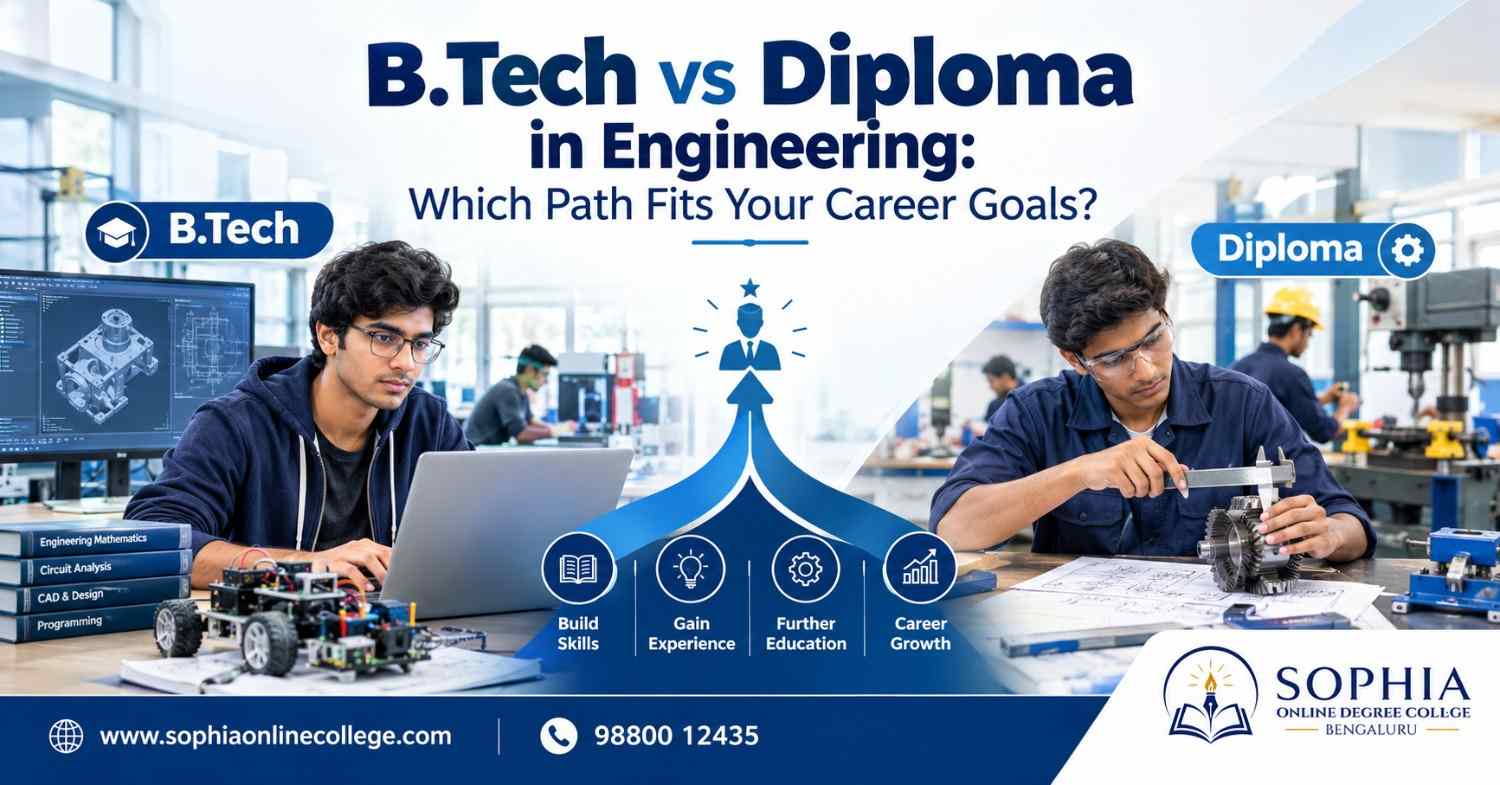
Choosing between B.Tech and Diploma in Engineering is more than a decision about which course to study. It is about deciding how you want to learn, how soon you want to enter the workforce, what kind of responsibilities you want to handle and where you see your career in the coming years. For students after Class 10 or Class 12, working professionals considering further education, and learners returning to academics after a break, the right choice depends on individual circumstances rather than popular opinion.
As interest in technical careers continues to grow, understanding the difference between these qualifications can help you plan your next step with greater confidence. If you are researching an online engineering degree in india, it is equally important to understand which programmes are available in recognised formats and which engineering courses require in-person practical training.
Both pathways can lead to valuable opportunities. The important thing is to choose a qualification that supports your current situation while leaving room for future growth.
Two Engineering Paths, Two Different Starting Points
Imagine two students who are equally interested in technology.
The first student has completed Class 12 with the required subjects and wants to study computer science, mechanical engineering or electronics. They are interested in understanding how systems work, solving complex problems and building a foundation for advanced technical roles. A B.Tech programme may suit their long-term ambitions.
The second student has completed Class 10 and wants to explore technical education through practical learning. They would prefer to understand machinery, electrical systems, manufacturing processes or computer hardware before deciding whether to pursue a higher qualification. A Diploma in Engineering may be an appropriate starting point.
Neither student is making an inferior choice. They are simply starting from different places and prioritising different outcomes.
This distinction matters because students sometimes choose a course based on what their friends are studying, what relatives recommend or what sounds more prestigious. However, the right decision should account for academic preparation, financial resources, preferred learning style and future employment goals.
Before comparing fees or career opportunities, ask yourself one question: Do I want to begin with a degree-level engineering education, or would I prefer to build technical skills through a diploma first?
Your answer can help you narrow down the options.
Before Comparing Them, Understand What Each Path Is Designed to Do
A B.Tech and a Diploma in Engineering are both technical education pathways, but they differ in academic level, curriculum depth, entry requirements and progression opportunities.
What does a B.Tech programme offer?
A Bachelor of Technology (B.Tech) is an undergraduate degree that develops engineering knowledge through theoretical concepts, mathematical foundations, technical subjects, laboratory work and projects. The curriculum varies by specialisation, but students generally study how engineering principles can be applied to real-world problems.
Depending on the branch, students may explore programming, circuit design, structural analysis, manufacturing systems, automation or data-related technologies. The course typically involves several semesters of progressively advanced learning, helping students build both technical understanding and problem-solving skills.
A B.Tech is often worth considering if you want to:
- Develop a deeper understanding of engineering principles.
- Qualify for graduate-level engineering roles that require a bachelor’s degree.
- Explore technical specialisations and project-based learning.
- Keep postgraduate education options open, subject to admission requirements.
- Build a foundation for long-term technical or managerial responsibilities.
What does a Diploma in Engineering offer?
A Diploma in Engineering is a technical qualification that generally focuses on engineering fundamentals and their practical application. In India, a conventional engineering diploma commonly takes three years after Class 10, although specific admission routes and durations can vary.
Students may learn technical drawing, electrical fundamentals, workshop practices, machine operations, computer applications or other subjects relevant to their chosen branch. Practical exercises help them understand how equipment, components and systems function.
A diploma may be worth considering if you want to:
- Begin technical education after Class 10.
- Develop practical, job-related technical competencies.
- Explore whether a particular engineering branch suits your interests.
- Investigate technician, maintenance, production or technical-support roles.
- Consider further education later through an eligible progression route.
A diploma is not simply a shorter version of a B.Tech. It is a different qualification with its own purpose, entry route and career applications. The AICTE Approval Process Handbook provides an official reference for technical programme requirements and admission pathways.
B.Tech vs Diploma in Engineering: The Key Differences
The simplest way to understand these qualifications is to compare their practical features. The table below offers a general overview; actual requirements vary by state, institution, engineering branch and admission year.
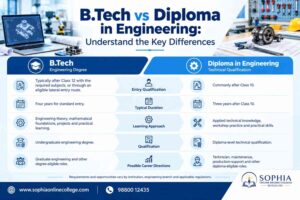
| Comparison factor | B.Tech | Diploma in Engineering |
| Typical entry point | After Class 12 with the prescribed subjects, or through an eligible lateral-entry route | Commonly after Class 10 |
| Typical duration | Four years for standard entry | Three years after Class 10 |
| Qualification level | Undergraduate engineering degree | Diploma-level technical qualification |
| Learning approach | Engineering theory, mathematical foundations, practical work and projects | Engineering fundamentals, applied concepts and practical skills |
| Curriculum depth | Broader degree-level engineering study | Focused technical and applied study |
| Early career direction | Graduate engineering and other degree-eligible roles | Technician, technical-support and other diploma-eligible roles |
| Further education | Relevant postgraduate programmes, subject to eligibility | Eligible lateral-entry degree programmes or other further-study routes |
| Practical considerations | May require substantial laboratory work, projects and campus attendance | Often includes workshops, laboratory sessions and practical training |
The most important difference is not the number of years alone. It is the level and purpose of the qualification.
For example, a diploma holder may be well prepared for a practical technical assignment, while a B.Tech graduate may be eligible for positions that require degree-level engineering knowledge. Nevertheless, employers define their own requirements, and actual responsibilities depend on the job, the industry and the individual’s abilities.
A diploma holder who develops strong troubleshooting skills and workplace experience may progress significantly. Likewise, a B.Tech graduate who lacks practical exposure may need additional training before performing effectively in a technical role.
Therefore, compare the opportunities available to you rather than assuming that one qualification guarantees success.
Your Starting Point Matters More Than You Think
The best engineering pathway often becomes clearer when you consider your current educational stage.
If you have completed Class 10
A diploma can be a practical route into technical education. You can select a branch such as mechanical, civil, electrical or electronics engineering, depending on your interests and the programmes available.
This route may suit students who prefer applied learning or want to explore a technical field before progressing to a degree. It also provides an opportunity to develop technical foundations earlier in their education.
However, do not choose a diploma only because it appears to offer a faster route to employment. Check the institution’s recognition, the curriculum, practical facilities and the roles for which graduates are eligible.
If you have completed Class 12
Your subject combination and admission eligibility will influence your options. Students who meet the prescribed requirements may consider a B.Tech through the relevant entrance examination or admission process.
You should compare engineering branches before making a decision. Someone interested in programming and computational problem-solving may prefer computer science, while someone fascinated by machines, structures, electrical systems or manufacturing may explore other branches.
A diploma can also be an option for eligible applicants, but you should compare the consequences of starting at diploma level with entering a degree programme directly.
If you have taken a break from education
A gap in education does not automatically mean that further study is impossible. Your next step depends on your previous qualification, completed subjects, age-related rules where applicable, financial circumstances and the institution’s admission policy.
Start by collecting your academic records and identifying the programmes for which you are eligible. If you need to work while studying, consider the timetable, attendance requirements and realistic study hours before enrolling.
If you are already working
Working professionals should think carefully about what qualification would help them move towards their desired role.
For example, an employee in a technical-support position may need specialised training or an appropriate recognised qualification to pursue the next opportunity. Someone seeking a degree-level engineering role should check whether the employer requires a B.Tech or another specific credential.
The right decision should connect your existing experience with the requirements of your target job. Avoid enrolling in a programme simply because it promises flexibility without verifying its recognition and suitability.
What Will You Actually Learn in Each Route?
Course titles only tell you part of the story. Understanding the learning experience can help you decide whether a qualification matches your strengths.
Learning through B.Tech
B.Tech programmes typically combine foundational theory with increasingly specialised engineering subjects. Depending on the branch, students may study:
- Engineering mathematics and scientific principles.
- Core engineering concepts and technical analysis.
- Programming, simulation or computer-aided design where relevant.
- Laboratory experiments and practical assignments.
- Engineering projects, presentations and teamwork.
- Industrial training or internships where included in the curriculum.
Consider a student studying electrical engineering. They may move from basic circuit concepts to electrical machines, power systems, control systems and advanced technical applications. This progression helps them understand not only how a component operates, but also how it fits into a larger engineering system.
Learning through a Diploma in Engineering
Diploma programmes generally place considerable emphasis on foundational technical knowledge and applied competencies. Depending on the specialisation, learning may include:
- Technical drawing and engineering fundamentals.
- Workshop practices and equipment handling.
- Basic calculations and measurements.
- Testing, inspection and troubleshooting.
- Practical laboratory exercises.
- Industry-oriented assignments and projects.
A mechanical engineering diploma student, for instance, may learn to interpret engineering drawings, understand machine components, perform measurements and explore manufacturing processes.
These examples are illustrative rather than fixed syllabuses. Students should consult the curriculum published by their intended institution.
Which learning style suits you?
If you enjoy analysing complex problems, working with mathematical concepts and understanding why systems behave in particular ways, a degree-level engineering programme may appeal to you.
If you prefer hands-on technical tasks, applied exercises and learning through practical activities, a diploma may be a more suitable starting point.
Of course, these approaches overlap. Both pathways can involve theory and practical work. The difference lies in their overall qualification structure and curriculum objectives.
Compare the Real Investment, Not Just the Course Fee
Education costs influence decisions for students, families and working professionals. However, comparing the advertised tuition fee alone can produce a misleading picture.
A programme with a lower fee may involve additional travel, accommodation or equipment expenses. A more expensive programme may offer facilities or learning support that matter to your goals. The most suitable option is the one that provides appropriate educational value within your financial circumstances.
| Cost factor | What to consider |
| Tuition fees | Total programme cost, not only the first semester |
| Admission expenses | Application fees, examination charges and other applicable payments |
| Learning materials | Books, software, stationery and technical resources |
| Equipment | Tools, protective equipment, computer access or other branch-specific requirements |
| Travel and accommodation | Daily commuting, hostel expenses and food where applicable |
| Time commitment | Whether studying will affect your working hours or income |
| Additional training | Certification, skill-development or supplementary learning expenses |
Is a diploma always cheaper than B.Tech?
Not necessarily in every individual case, although the typical three-year diploma route after Class 10 may involve a different overall financial commitment from a four-year B.Tech programme after Class 12.
The total cost depends on the institution, location, available financial support and the student’s living arrangements. A diploma holder who later pursues a degree will also need to consider the cost of that additional education.
How can you make engineering education more affordable?
Start by identifying recognised institutions that offer the programme you actually need. Compare the complete fee structure and ask whether scholarships, fee concessions or installment options are available.
Students and professionals exploring affordable online degrees should also investigate whether online study is appropriate for their intended qualification. Flexibility can help some learners manage work and education together, but a lower fee or online delivery label does not establish that a programme is valid for every career goal.
Create a realistic education budget before making a decision. Include a contingency for travel, equipment and other costs that may arise during the course.
A financially sensible choice is one that you can complete without placing yourself under unsustainable pressure while still meeting your academic and career requirements.
Your First Job Is Only One Part of the Career Story
Students often compare B.Tech and Diploma in Engineering by asking which qualification leads to a better job. A more useful question is: Which roles can I realistically qualify for, and what skills will help me grow after entering the workforce?
The answer depends on your specialisation, practical ability, experience and the eligibility requirements of individual employers.
Career directions after a Diploma in Engineering
Diploma holders may explore technical positions such as:
- Junior engineering or technical roles: Supporting engineering teams with measurements, documentation, equipment checks and routine technical activities.
- Maintenance technician: Helping inspect, maintain and troubleshoot machinery or electrical systems, depending on training and employer requirements.
- Production technician: Supporting manufacturing operations, monitoring processes and assisting with production activities.
- CAD technician: Preparing or modifying technical drawings using computer-aided design tools when the required software skills are available.
- Quality inspection assistant: Checking products, components or processes against established technical specifications.
These are possible career directions, not guaranteed placements. Some positions have specific qualification, licensing, experience or recruitment requirements.
A diploma may provide an entry point into the technical workforce, allowing learners to develop practical experience and understand how their chosen industry operates.
Career directions after B.Tech
A B.Tech graduate may explore roles such as:
- Graduate engineer trainee: Learning engineering processes through structured workplace training.
- Design or development engineer: Supporting design, testing and improvement activities in a relevant specialisation.
- Software or systems-related roles: Applying programming, analytical and technical skills where the graduate’s branch and abilities are suitable.
- Quality or process engineer: Helping evaluate processes, identify problems and improve technical performance.
- Project or operations roles: Coordinating technical activities, documentation, resources and project milestones.
Some positions require additional experience, certifications, specialised software knowledge or postgraduate education. Employers may also accept candidates from different educational backgrounds for particular roles.
What about salary and career growth?
There is no single salary figure that accurately represents every B.Tech graduate or diploma holder. Earnings depend on the engineering branch, location, industry, employer, job responsibilities, experience and individual performance.
Rather than choosing a course based on an online salary estimate, review current job advertisements for the roles you want. Identify their minimum qualifications and recurring skill requirements.
For example, if several entry-level jobs in your preferred field require a bachelor’s degree, a diploma alone may not meet the stated eligibility criteria. If a technical role accepts a diploma and emphasises equipment knowledge, practical competence and troubleshooting, the diploma route may be worth considering.
The goal is to understand the requirements of your intended career before investing time and money in a qualification.
What If Your First Qualification Is Not Your Final One?
One of the most useful things to understand about technical education is that your first qualification does not necessarily have to be your last.
Some students begin with a diploma and later decide that they want to pursue a bachelor’s degree. Others complete a degree, enter employment and then return to education to develop specialised knowledge.
From diploma to B.Tech
Eligible diploma holders may be able to enter the second year of a B.Tech or B.E. programme through lateral entry, subject to the applicable regulations, available seats, branch requirements and admission procedures.
The AICTE Approval Process Handbook 2024–2027 is a useful starting point for understanding technical-education norms. Applicants should also consult the relevant state admission authority and university because the applicable eligibility conditions and selection process can vary.
Before applying, check:
- Whether your diploma is recognised for the intended admission route.
- Whether your marks meet the prescribed eligibility criteria.
- Whether your diploma branch is accepted for the degree programme.
- Whether an entrance examination or counselling process is required.
- Whether lateral-entry seats are available at your preferred institution.
Do not assume that every diploma automatically guarantees direct admission to the second year of every engineering degree.
From a degree to further specialisation
A B.Tech graduate may consider postgraduate study, professional certifications or specialised technical training. The right option depends on whether the person wants to deepen technical knowledge, enter research, develop management skills or move into a particular industry.
For working professionals, further study can be particularly valuable when it addresses a specific career requirement rather than simply adding another credential to a résumé.
What if you need to earn while studying?
If your financial responsibilities require you to work, explore programmes that genuinely accommodate your schedule. Verify attendance rules, examination arrangements, practical requirements and the expected weekly study commitment.
A flexible learning format is useful only when it allows you to complete the programme properly and obtain a qualification recognised for your intended purpose.
Planning your next step carefully can help you avoid repeating coursework, spending unnecessarily or enrolling in a programme that does not meet your career requirements.
Can Online Education Fit into Your Engineering Career Plan?
Online education has become an important consideration for people who need flexibility. Students may live far from an institution, working professionals may have fixed shifts, and learners returning after a gap may need to balance study with family or financial responsibilities.
However, engineering education requires special consideration because many programmes include compulsory laboratory sessions, workshops, equipment-based learning and supervised practical work.
An online programme should never be assumed to be a substitute for a conventional engineering degree simply because it carries a similar title.
The University Grants Commission’s official notification on online courses provides a starting point for understanding India’s regulatory framework. The availability of online programmes depends on applicable rules, the discipline and the institution’s authorisation.
For engineering-related career planning, distinguish between three options:
- A conventional engineering qualification: A B.Tech or diploma programme delivered through an approved, appropriate mode, with the required practical and laboratory components.
- Online learning for supplementary skills: Courses in programming, data analysis, project management, technical communication or other relevant areas that complement your existing qualification.
- An online academic degree in another eligible discipline: A flexible higher-education option that may suit a working professional’s wider career goals, but does not automatically qualify them for engineering roles.
These options serve different purposes. Choosing between them requires an understanding of your intended job, the qualification it requires and the mode of education permitted for that programme.
Exploring online study in Bangalore and Karnataka
Students searching for online degree courses in karnataka may be interested in studying without relocating or leaving their current employment. Similarly, those searching for online degree colleges in bangalore may want to compare institutional support, programme recognition, fees and learning arrangements.
The search for online diploma courses in bangalore can also include learners who want to study while working or manage their education alongside other commitments.
Before enrolling, verify the awarding university, the programme’s recognition for the applicable academic year, the permitted delivery mode and any restrictions relevant to your intended career. The location of a college or the availability of an online learning platform does not, by itself, establish that every programme it advertises is recognised.
For readers considering an online engineering degree in india, the key is to check whether the specific engineering programme and delivery format are permitted under the applicable regulations. Many engineering qualifications require practical components that cannot simply be replaced by online lectures.
Where does Sophia Online Degree College Bangalore fit in?
Sophia Online Degree College Bangalore can be a starting point for learners exploring flexible higher-education options that fit their broader educational and career plans. If you are considering online study, review the programmes listed on SODC and verify the relevant qualification, awarding institution, eligibility requirements and mode of delivery before applying.
The important consideration is to select a programme based on your intended outcome. An online degree in an eligible discipline may support career development, but it should not be presented as an engineering qualification unless the specific programme is authorised and appropriate for that purpose.
Which Engineering Path Fits Your Situation?
Instead of asking which course is universally better, consider which route matches your current circumstances. The following guide can help you decide what to investigate next.

| Your situation | Path to investigate | What to do next |
| You have completed Class 10 and prefer technical learning | Diploma in Engineering | Compare branches, polytechnic recognition, practical facilities and fees |
| You have completed Class 12 and meet engineering admission requirements | B.Tech | Review entrance requirements, curriculum, college facilities and total costs |
| You want to work in a technical role sooner | Diploma or another relevant technical pathway | Check the qualifications required for your target entry-level jobs |
| You are a diploma holder seeking degree-level opportunities | Eligible B.Tech lateral entry | Verify branch eligibility, marks, entrance procedures and available seats |
| You are already working in a technical field | A qualification or skill programme relevant to your target role | Review employer requirements and choose an appropriate recognised course |
| You need flexibility because of work or personal commitments | A suitable flexible programme, where permitted | Verify the qualification, delivery mode, schedule and practical requirements |
| You are uncertain about your engineering specialisation | A structured comparison of branches and introductory learning | Explore the subjects, work environments and skills involved in each branch |
Use this table as a starting point rather than a final admission decision. Two students in the same situation may make different choices because their academic strengths, financial resources and career ambitions differ.
For instance, a student who enjoys mathematics and wants to work in a graduate engineering role may prefer a B.Tech. Another student who wants to gain practical technical knowledge after Class 10 may find a diploma more suitable.
Both can be sensible choices when they match the individual’s goals and are pursued through an appropriate institution.
Six Checks to Complete Before You Pay an Admission Fee
A course advertisement may highlight career opportunities, convenient learning or attractive fees. However, your decision should be based on verified information rather than promotional claims.
Before paying an admission fee, work through these six checks.
1. Verify recognition and approval
Find out which institution awards the qualification and which regulatory requirements apply to the programme. Check the relevant approval or recognition for the academic year in which you intend to enrol.
For technical education, consult the AICTE official website and the relevant state technical-education authority where applicable. Remember that institutional recognition and programme-specific eligibility are not interchangeable.
2. Read the admission requirements carefully
Confirm the required previous qualification, subjects, minimum marks, entrance examinations and any additional conditions. Do not assume that meeting a general eligibility requirement guarantees admission to a particular college or branch.
3. Understand the actual delivery mode
Ask whether the course is conducted on campus, through an approved online format or through another permitted arrangement. For engineering programmes, find out how laboratory work, workshops, projects and examinations are conducted.
4. Calculate the complete cost
Request the official fee structure and identify additional expenses. Ask about payment schedules, refunds, scholarships and other applicable conditions before making a financial commitment.
5. Investigate progression opportunities
If you intend to study further, confirm whether your qualification will be accepted for the next programme you have in mind. This is particularly important for diploma holders considering lateral-entry B.Tech admission.
6. Check the support available to students
Ask about academic guidance, faculty access, practical training, examination support, career services and opportunities to develop relevant skills. These factors can influence your learning experience and ability to complete the course successfully.
Taking these steps before admission can help you make a more informed decision and avoid costly misunderstandings later.
Build a Career Plan Around Your Qualification
Selecting a course is only the first stage of preparing for an engineering career. What you do during and after your education can influence how effectively you use your qualification.
Start by identifying two or three roles that interest you. Look at their job descriptions and note the qualifications, technical skills, software knowledge and experience employers commonly request.
Next, connect those requirements to your course.
If you are pursuing a diploma, make the most of laboratory sessions, workshops, internships where available and opportunities to practise technical problem-solving. Build familiarity with the tools and equipment relevant to your branch.
If you are pursuing a B.Tech, balance academic learning with projects, practical assignments, internships and communication skills. Learn to explain technical problems clearly, work with others and document your solutions.
If you are already employed, identify the specific skills or qualification that would support your next career move. A relevant course, additional training or a recognised degree may be more useful than pursuing a qualification without a defined objective.
Learners who need flexible higher education can explore suitable options through Sophia Online Degree College Bangalore, while carefully checking that the programme matches their intended career direction. Visit SODC to review the available programme information and use the details to decide whether an option meets your needs.
For readers researching an online engineering degree in india, the priority should remain qualification validity and suitability. Online learning can support professional development, but the appropriate programme depends on the discipline, applicable regulations and the career outcome you want to achieve.
Frequently Asked Questions
1. Is B.Tech better than a Diploma in Engineering?
Neither qualification is universally better. B.Tech provides a degree-level engineering education and may meet requirements for graduate engineering positions. A diploma provides technical education that may suit learners seeking applied skills or a starting point after Class 10. The better option depends on your eligibility and career goals.
2. Can I pursue B.Tech after completing a diploma?
Yes, eligible diploma holders may apply for B.Tech lateral entry where the relevant institution and regulations permit it. Admission can depend on your diploma, marks, branch, entrance requirements and seat availability. Always verify the current rules with the relevant university or admission authority.
3. Which is better after Class 10: B.Tech or Diploma in Engineering?
A conventional B.Tech programme generally requires Class 12 or another eligible entry route. A Diploma in Engineering is a common technical education option after Class 10. If you want to enter engineering education immediately after Class 10, compare recognised diploma programmes and consider whether you may wish to pursue a degree later.
4. Can I work after completing a Diploma in Engineering?
Yes, diploma holders can apply for suitable technical positions, depending on the branch, employer requirements and their skills. Potential areas include maintenance, production support, technical operations and quality inspection. Some positions may require additional experience, certifications or specific qualifications.
5. Can I study engineering while working?
It depends on the programme, its permitted delivery mode and your work schedule. Engineering courses may require in-person laboratory sessions, practical training, attendance and examinations. Before enrolling, confirm that you can meet these requirements alongside your job.
6. Is an online engineering degree available in India?
Availability depends on the specific programme and applicable regulatory requirements. Engineering education often involves practical and laboratory components, and an online format is not automatically permitted for every engineering qualification. Check the current rules and verify the institution and programme before applying.
7. Are online degrees valid for employment?
The validity and acceptance of an online degree depend on the awarding institution, programme, applicable recognition requirements and the intended employment. Confirm the programme’s status for the relevant academic year and check whether your target employer or profession requires a particular qualification.
8. How can I find affordable engineering education options?
Compare the total fees of recognised institutions, including admission charges, equipment, accommodation, travel and other expenses. Check scholarships and fee concessions where available. Choose a programme that meets your career requirements and fits your budget rather than relying on the advertised tuition fee alone.
9. Should I choose a diploma if I want to earn sooner?
A diploma may be worth considering if you want technical education after Class 10 and plan to apply for suitable entry-level roles. However, employment is not guaranteed, and some jobs require a degree. Review actual job eligibility requirements before deciding.
10. What should I check before selecting an engineering college in Bangalore?
Review the institution’s recognition, the programme’s approval where applicable, admission requirements, course curriculum, laboratory facilities, fees, placement information and progression opportunities. If you are considering an online programme, verify that its delivery mode is permitted for that specific qualification.
Conclusion: Choose the Path That Supports Your Next Step
The decision between B.Tech and Diploma in Engineering becomes easier when you stop comparing the qualifications only by duration, cost or perceived prestige.
If you have completed Class 12, meet the required eligibility criteria and want a degree-level engineering education, B.Tech may align with your ambitions. If you have completed Class 10 and want to develop technical skills through a diploma, that route may be a suitable starting point. If you are already working or returning to education after a break, your choice should reflect your existing qualifications, financial commitments and intended career progression.
There is no need to make this decision based on someone else’s timeline. Take the time to understand the curriculum, confirm the recognition of your chosen programme, review the roles you want to pursue and assess the total investment involved.
If flexibility is important, investigate recognised higher-education options carefully and distinguish supplementary online learning from formal engineering qualifications.
Your best engineering pathway is the one that connects your current circumstances with a realistic plan for future growth. Make an informed choice today, build relevant skills throughout your education and keep reviewing your goals as your interests and opportunities develop.