
Choosing an MBA specialisation is easier when you understand what you will study, how the programme fits your background, and what it may help you do professionally. An MBA in Business Analytics combines management education with the interpretation of data, helping learners understand how organisations use evidence to make business decisions.
If you are researching an online MBA in Bangalore, comparing universities, or looking for affordable postgraduate education, the important questions go beyond the course name. You need to understand the syllabus, eligibility criteria, total fees, assessment methods, and practical learning opportunities before applying.
This guide explains the MBA in Business Analytics in straightforward terms, with examples for commerce graduates, freshers, career changers, and working professionals. It also explains how to evaluate online programmes without assuming that every university offers the same subjects, fee structure, or specialisation.
What Is an MBA in Business Analytics?
An MBA in Business Analytics is a management qualification that combines business subjects with methods for interpreting data and supporting organisational decisions. The exact curriculum depends on the university and the approved programme structure.
Imagine a retail company whose sales have declined in one region. A manager may initially assume that the problem is pricing. However, an analysis of sales records, customer feedback, stock availability, seasonal demand, and promotional activity might reveal a different explanation.
Business analytics helps professionals investigate such questions systematically instead of relying only on assumptions.
Students may learn to interpret reports, understand statistical information, identify patterns, compare business performance, and communicate findings to managers. Some programmes also include tools for data visualisation, forecasting, business intelligence, or analytical modelling.
An MBA in Business Analytics is not automatically the same as a master’s degree in Data Science. Business Analytics generally connects analysis with management decisions, while Data Science programmes may place greater emphasis on programming, mathematical modelling, machine learning, and technical methods. The distinction varies by curriculum.
Why Consider Business Analytics as an MBA Specialisation?
Many business functions generate information that can help organisations plan and evaluate their activities. The value lies not simply in collecting data, but in asking the right questions and interpreting the answers correctly.
Business Analytics can be relevant to learners interested in:
- Marketing: Understanding customer behaviour, campaign performance, and conversion patterns.
- Finance: Reviewing budgets, financial reports, costs, and business performance.
- Operations: Examining delivery times, stock levels, process delays, and resource use.
- Human resources: Interpreting recruitment, training, attendance, and workforce information.
- Sales: Comparing targets, regional performance, customer segments, and repeat purchases.
- Strategy: Supporting decisions about products, markets, pricing, and resource allocation.
For example, a marketing team may discover that one campaign generates many enquiries but few completed purchases. An analytics-oriented professional can help examine where potential customers leave the process and present possible explanations to the team.
This specialisation may suit students who enjoy both business concepts and evidence-based problem-solving. However, it should not be selected only because the subject sounds technical or appears frequently in career discussions. Your interests, learning preferences, programme quality, and intended career direction all matter.
Who Should Consider an MBA in Business Analytics?
The course may appeal to different types of learners, although admission depends on the institution’s eligibility rules.
Commerce graduates may find connections between accounting, finance, economics, marketing, and business performance analysis. Their existing knowledge can provide useful context when studying business data.
Business and management graduates may want to strengthen their ability to interpret reports, evaluate decisions, and communicate analytical findings.
Students from non-technical backgrounds should investigate how much mathematics, statistics, and programming the course expects. Some programmes introduce analytical concepts gradually; others may assume stronger quantitative preparation.
Working professionals may want to add analytical methods to their existing business experience. Before enrolling, they should examine the weekly study commitment, assignment schedule, live sessions, examinations, and project requirements.
Fresh graduates should be realistic about the roles they can target immediately after completing a programme. A qualification may support their learning, but employers can also look for practical experience, software knowledge, communication skills, and evidence of applied work.
If you enjoy understanding why sales change, how businesses measure results, or how organisations allocate resources, Business Analytics may be worth investigating. If your primary interest is developing software or building machine-learning systems, compare the syllabus with more technically focused courses before making a decision.
MBA in Business Analytics: Course Highlights
There is no single course structure that applies to every university. Duration, assessment, teaching methods, electives, and the final qualification must be confirmed from the institution’s current documentation.
The following overview describes typical features to investigate rather than the official details of a particular institution.
| Course aspect | Typical information | What students should verify |
| Qualification level | Postgraduate management qualification | Exact award and awarding university |
| Duration | Depends on the approved programme structure | Official duration and completion rules |
| Study mode | May be regular, online, or distance-based where permitted | Approved mode for the exact programme |
| Core learning | Management, finance, marketing, operations, and related subjects | Current curriculum and subject list |
| Analytics learning | May include statistics, reporting, visualisation, or forecasting | Depth of analytics and technical content |
| Assessment | May include examinations, assignments, presentations, or projects | Actual assessment pattern |
| Practical component | May include case studies or an analytical project | Project expectations and available support |
A course overview should be treated as the starting point, not a substitute for the university’s official syllabus and admission documents.
MBA in Business Analytics Course Syllabus
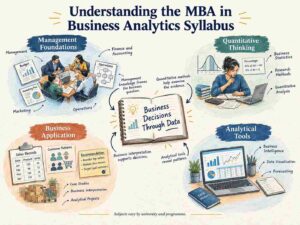
The MBA Business Analytics syllabus usually brings together management foundations and analytical subject areas. The balance between these components differs across programmes.

Management foundation subjects
Principles of Management introduces planning, organising, leadership, coordination, and decision-making. These concepts help students understand how departments operate and how managers set priorities.
Managerial Economics examines economic principles that influence business decisions, including demand, supply, costs, pricing, and resource allocation.
Financial Management and Accounting introduce financial statements, budgeting, cost analysis, and the interpretation of financial performance. These subjects can help learners understand the business implications of analytical findings.
Marketing Management covers customer needs, market segmentation, product decisions, promotional activity, and marketing strategy. Analytical methods can help evaluate how these activities perform.
Operations Management explores how organisations manage processes, capacity, quality, inventory, and delivery. Analytics can support the identification of delays and operational inefficiencies.
Analytics-related subjects
Business Statistics introduces ways to summarise information, understand variation, compare results, and interpret quantitative evidence. Depending on the course, students may study descriptive statistics, probability, correlation, or related concepts.
Research Methods explains how to frame a question, collect appropriate information, assess evidence, and present findings. It helps students avoid drawing conclusions from incomplete or unsuitable data.
Business Intelligence may cover the process of turning business information into reports and dashboards that support monitoring and decisions.
Data Visualisation focuses on presenting information through charts, graphs, dashboards, and other visual formats. A useful visual should make a finding easier to understand, not merely make a report look attractive.
Forecasting and Predictive Analysis may introduce methods for estimating future outcomes from available information. Forecasts are not guarantees; their usefulness depends on data quality, assumptions, and the suitability of the method.
Operations and Marketing Analytics apply analytical methods to particular business functions. Students might examine inventory patterns, campaign results, customer segments, or process performance.
Not every MBA in Business Analytics includes all these subjects. Some programmes offer specialised electives, while others teach analytics within broader management modules. Always compare the actual syllabus rather than relying on a programme title alone.
MBA in Business Analytics Syllabus by Semester
Students often search for a semester-wise syllabus because they want to understand the order in which subjects are taught. The official semester structure must come from the university concerned.
The illustrative progression below explains one way a curriculum might be organised. It is not an official syllabus for SODC or any named university.
Early stage: Build management foundations
The initial stage may introduce management principles, accounting, economics, marketing, quantitative methods, and business communication. These subjects provide the context needed to understand organisational problems.
A learner might examine a simple business case, calculate changes in revenue, or explain how costs influence profitability.
Middle stage: Develop analytical understanding
Later modules may introduce business statistics, research methods, business intelligence, data visualisation, or functional analytics. Students may work with structured datasets and practise interpreting results.
For instance, a student could compare monthly sales across product categories and prepare a short explanation of which categories performed differently.
Advanced stage: Apply learning to business decisions
The final stage may include electives, strategic management, case studies, or a capstone project, depending on the institution. The objective is to connect the concepts studied earlier with a business question.
A project might investigate customer retention, stock management, marketing effectiveness, or operating costs. The expected tools, scope, and assessment criteria should be confirmed in the official programme documentation.
When reviewing a semester-wise syllabus, check whether the progression makes sense. A course that lists many advanced tools but provides little grounding in statistics or business fundamentals may not suit every beginner.
Eligibility Criteria for an MBA in Business Analytics
Eligibility requirements vary by institution, programme, admission route, and applicable regulations. Do not assume that one university’s conditions apply to every MBA in India.
Applicants are commonly asked to consider the following:
- Graduation: Whether a recognised bachelor’s degree is required.
- Minimum marks: Whether the institution specifies a minimum percentage or grade.
- Degree background: Whether graduates from all disciplines can apply or whether certain subjects are expected.
- Entrance requirements: Whether an entrance examination, interview, or other selection step applies.
- Documents: Whether transcripts, proof of graduation, identity documents, or other records are needed.
- Additional conditions: Whether the programme has specific prerequisites or admission rules.
A commerce graduate may have useful preparation in accounting, economics, and finance. A science or humanities graduate may bring different strengths. Neither background should be assumed to guarantee eligibility or success without checking the actual programme requirements.
How to check eligibility before applying
Start with the university’s official admission page and current programme brochure. Confirm the exact qualification accepted, minimum marks, application deadline, and selection process.
For online and distance programmes, check the institution and programme for the relevant academic session through the UGC Distance Education Bureau’s official programme. Search for the awarding institution, exact programme name, mode of delivery, and session rather than relying only on an advertisement or a general claim of recognition.
This check is especially important for learners comparing online degree courses in Bangalore or across Karnataka. A local office, counselling centre, or marketing page does not itself establish that a particular programme is authorised in the mode being advertised.
Admission Process and Documents Required
The admission process depends on the institution, but students can use a simple sequence to organise their research.
Step 1: Shortlist programmes. Identify courses whose curriculum, delivery mode, and learning requirements match your goals.
Step 2: Check eligibility. Review the current admission rules and confirm that your academic background meets them.
Step 3: Read the programme documents. Look for the syllabus, duration, assessment pattern, total fees, refund conditions, and details of the qualification awarded.
Step 4: Prepare your records. Commonly requested documents may include academic marksheets, degree certificates, identification, photographs, and application details. The institution’s official list takes precedence.
Step 5: Submit the application. Complete the prescribed form and provide the documents requested by the institution.
Step 6: Follow the admission instructions. If the institution requires an entrance test, interview, verification, or additional payment, follow its published process.
For eligible online or distance-learning programmes, the UGC’s student information service explains the requirement to create a DEB ID. Read the instructions and confirm the current process through the official UGC-DEB student portal before completing admission formalities.
Do not assume that all programmes have the same admission calendar or that every MBA requires—or waives—an entrance examination.
MBA in Business Analytics Fees: What Should You Expect?
MBA in Business Analytics fees can differ substantially between institutions. The total cost may depend on the university, curriculum, delivery mode, academic support, assessment arrangements, and programme structure.
Instead of relying on an advertised starting price, ask for the complete fee schedule applicable to your intended intake.
Check whether the published amount includes:
- Tuition for the entire programme.
- Application or registration charges.
- Examination and assessment fees.
- Learning materials or platform charges.
- Project-related expenses, where applicable.
- Re-examination or repeat-submission charges.
- Any other mandatory fees.
Also confirm the payment schedule. A programme may permit instalments, but the conditions, due dates, and consequences of late payment need to be understood in advance.
How to compare fees fairly
Imagine two programmes with different advertised tuition amounts. The less expensive one may have additional examination charges, while the other may include them in its published total. A fair comparison requires the full cost of completing the qualification.
Review what is included in the learning experience as well. Relevant considerations may include access to course materials, faculty interaction, academic guidance, software requirements, project supervision, and technical support.
The phrase affordable online degrees should mean more than a low headline price. Consider the total amount payable, the time required to complete the programme, your ability to manage the payments, and whether the curriculum meets your educational goals.
Do not select a programme solely because it offers a discount or an instalment plan. Obtain the current fee details in writing, check the refund policy, and retain copies of official receipts and admission documents.
Online MBA in Business Analytics vs Regular MBA
The right study mode depends on your circumstances and the actual arrangements offered by the institution. An online MBA and a regular, campus-based MBA may cover similar management concepts, but the learning experience can differ.
Online learning
An online programme may help learners who need to study from home or manage education alongside employment. However, online programmes can still have scheduled classes, deadlines, live sessions, examinations, or group assignments.
Students should check the learning platform, faculty interaction, access to recordings, assessment requirements, technical support, and attendance rules. Do not assume that online means completely self-paced.
Campus-based learning
A regular programme may offer more frequent in-person interaction, campus activities, face-to-face group work, and access to physical facilities. These features can be valuable for learners who prefer a structured campus environment.
The practical value depends on the institution and its actual teaching arrangements. A campus location alone does not guarantee a strong learning experience.
Which should you choose?
If you are employed, compare the course timetable with your working hours and family responsibilities. If you are a recent graduate, consider how you learn best, whether you want a campus environment, and what practical opportunities the programme offers.
The key comparison is not simply online versus regular. It is whether the particular programme provides a suitable, properly authorised learning experience for your goals.
How to Evaluate Online MBA Options in Bangalore and Karnataka
Searches for the best online MBA in India can return many advertisements, rankings, and course comparison pages. A useful shortlist should be based on verifiable programme details rather than promotional language.
For learners investigating online degree courses in Bangalore or online degree courses in Karnataka, begin by identifying the university that awards the qualification. Then verify the programme’s current availability and delivery mode.
The following checks are particularly useful:
- Recognition and authorisation: Verify the exact institution and programme for the relevant admission session.
- Curriculum: Compare core management subjects, analytics modules, electives, and project work.
- Teaching arrangements: Understand live sessions, recordings, faculty access, and learning resources.
- Assessment: Confirm examinations, assignments, presentations, and project expectations.
- Student support: Ask how academic questions, technical issues, and administrative requests are handled.
- Fees: Obtain the complete cost and payment schedule.
- Career relevance: Check whether the curriculum develops skills related to your intended role.
- Official documents: Request a programme brochure, admission rules, and written fee details.
Where a programme falls within the applicable technical-education approval framework, consult the relevant official requirements and seek clarification from the institution. The AICTE Approval Process explains approval provisions for technical institutions and programmes within its scope. Do not interpret this as meaning that every MBA automatically requires the same approval; the applicable rules depend on the institution, programme, and regulatory framework.
A practical comparison should leave you with written answers to the questions that matter most: what qualification you receive, who awards it, what you will study, how you will be assessed, what you will pay, and whether the programme is appropriate for your intended purpose.
Skills You May Develop During an MBA in Business Analytics
The skills you develop will depend on the subjects taught, the depth of the curriculum, and the effort you put into practice.
Analytical thinking helps you break a business question into smaller questions that can be investigated. Rather than asking only why revenue fell, you might compare product categories, regions, customer groups, and time periods.
Statistical reasoning helps you understand averages, variation, relationships, and the limits of the available information. It also helps you avoid treating every pattern as proof of cause and effect.
Spreadsheet skills can support calculations, data organisation, summaries, and charts. The exact software taught varies by programme.
Data visualisation helps communicate findings through charts and dashboards. Effective visualisation should make comparisons clearer and highlight relevant information without misleading the reader.
Business communication is essential because an analysis is useful only when people can understand what it means. Students should practise writing short explanations, presenting evidence, and stating the limitations of their conclusions.
Decision-making involves comparing possible actions, considering costs and risks, and explaining why a recommendation may be appropriate.
Some programmes teach specific tools, but proficiency often requires additional practice. Before enrolling, check whether the course includes guided exercises, datasets, practical assignments, or projects rather than assuming that every subject will involve extensive hands-on training.
Career Opportunities After an MBA in Business Analytics
An MBA in Business Analytics may be relevant to several business and analytical roles. The responsibilities and entry requirements vary by employer, industry, location, and prior experience.
Business Analyst
Business analysts investigate organisational needs, document requirements, examine processes, and help teams understand problems or opportunities. The role may involve stakeholder discussions, reports, process mapping, and data interpretation.
Business Intelligence Analyst
Business intelligence analysts help prepare and interpret reports or dashboards used to monitor performance. Depending on the position, employers may expect spreadsheet skills, database knowledge, visualisation tools, or experience with reporting platforms.
Marketing Analyst
Marketing analysts examine campaign performance, customer behaviour, audience segments, and related metrics. They may help teams understand which activities are producing useful results and where further investigation is needed.
Operations Analyst
Operations analysts study business processes, resource use, inventory, service performance, or delivery times. Their work may help identify inefficiencies and support process improvements.
Reporting Analyst
Reporting analysts prepare recurring reports, validate information, maintain dashboards, and communicate trends to business teams. Accuracy, consistency, and attention to detail are important.
Analytics-related management roles
Experienced professionals may apply analytical methods to planning, strategy, performance management, or departmental decision-making. These positions often require relevant work experience in addition to academic qualifications.
An MBA does not automatically qualify a fresher for a senior management position or a specialist Data Science role. Some technical positions require deeper programming, statistics, machine learning, or database skills than a management curriculum provides.
To make your learning more demonstrable, build a small portfolio of projects where appropriate. Examples include analysing a sample sales dataset, preparing a clear dashboard, comparing marketing metrics, or writing a concise report with evidence-based recommendations. Use legitimate data and explain your assumptions.
Is an MBA in Business Analytics Suitable for Working Professionals?
Working professionals should evaluate the programme as a commitment of time, attention, and money – not just as another qualification.
Start by estimating how many hours you can realistically devote to lectures, reading, assignments, revision, and project work each week. Your workload may change during busy periods at work or when several assessments are due together.
Ask the institution how classes are scheduled, whether attendance is compulsory, when examinations take place, and how group projects are organised. Find out whether recorded sessions are available and how quickly faculty or support staff generally respond to queries.
Consider your current role as well. Someone working in sales may find marketing analytics examples familiar, while someone in operations may relate more easily to inventory or process analysis. Existing work experience can provide useful context, but it does not remove the need to learn unfamiliar concepts.
If you cannot commit to a full postgraduate programme at present, you may first strengthen your spreadsheet, statistics, or reporting skills. A shorter learning option can help you assess your interest before making a larger academic commitment. Just be clear about the difference between completing a skills course and earning a recognised postgraduate degree.
How to Choose the Right MBA Programme
A well-informed decision should consider academic fit, recognition, learning arrangements, cost, and career relevance together.
Use the following checklist when comparing programmes.
| Factor | What to check | Why it matters |
| Graduation requirement | Accepted qualifications and required marks | Confirms whether you meet the entry rules |
| Admission route | Entrance test, interview, or direct application conditions | Helps you prepare correctly |
| Recognition | Institution and programme status for the intended session | Helps verify the qualification’s status |
| Syllabus | Management core, analytics depth, electives, and project work | Shows what you will actually study |
| Total fees | Tuition and all mandatory additional charges | Helps you plan the complete cost |
| Assessment | Examinations, assignments, attendance, and projects | Clarifies the academic workload |
| Learning support | Faculty access, study materials, and technical assistance | Helps you judge the learning experience |
| Study schedule | Live sessions, deadlines, and completion rules | Helps you assess compatibility with work or other commitments |
| Career alignment | Skills and practical work relevant to your target role | Helps you compare the programme with your goals |
After completing the checklist, shortlist two or three programmes and compare their official documents side by side. If an important detail is missing, ask the institution for clarification in writing before paying fees.
Avoid relying on a single ranking, testimonial, or advertisement. These may help you discover options, but they do not replace checking the exact programme and its terms.
“Students comparing management specialisations can also explore our guide to MBA in Business Analytics vs MBA in FinTech to understand how the two fields differ in terms of curriculum, skills, and potential career pathways.”
How to Prepare Before Starting Business Analytics
You do not necessarily need to master every analytical tool before beginning a programme. However, a few foundational skills can make the initial learning process more comfortable.
Refresh basic mathematics and statistics
Practice percentages, ratios, averages, percentage changes, and reading charts. These concepts frequently appear in business discussions and can help you interpret reports.
Improve spreadsheet confidence
Learn how to organise rows and columns, use basic formulas, sort and filter information, create charts, and check data for inconsistencies. More advanced features can be developed as your learning progresses.
Understand common business measures
Become familiar with revenue, cost, profit, margin, conversion rate, customer retention, and inventory. You do not need to know every metric in advance; the goal is to understand what a business is trying to measure.
Practise explaining findings
Choose a small dataset and write three short observations. State what the information shows, what it does not establish, and what additional evidence might be useful.
For example, if monthly sales increased after a promotion, do not immediately conclude that the promotion caused the entire increase. Compare the previous period, product availability, seasonality, and other possible influences before making a recommendation.
This approach builds the habit of asking clear questions and interpreting evidence carefully – an important foundation for business analytics.
How Sophia Online Degree College Can Help You Explore Education Options
Sophia Online Degree College serves learners exploring higher-education and course options. Its website and published course information can help prospective students begin researching the educational pathways available through the institution.
However, students should not assume that every MBA specialisation or delivery mode is offered simply because it is relevant to their career goals. Before treating SODC as an option for an MBA in Business Analytics, ask the institution to confirm the exact programme title, awarding institution, current syllabus, eligibility, mode of study, fees, and applicable recognition for the intended admission session.
You can begin with the SODC and explore the SODC blog for general course and career guidance. If the specific MBA is not clearly listed, request written clarification rather than relying on assumptions.
This distinction matters: researching a qualification and confirming its availability through a particular institution are two different steps. A suitable educational decision should be based on verified programme details.
Common Mistakes to Avoid When Choosing an MBA Specialisation
Several avoidable mistakes can make course selection more difficult.
Choosing only by salary claims: A job title or advertised salary does not tell you whether the work suits your interests or whether you meet the employer’s requirements.
Ignoring the syllabus: Two programmes with similar names may teach different subjects or provide different levels of practical work.
Assuming every online programme is flexible: Scheduled classes, attendance, examinations, and project deadlines may still apply.
Comparing only tuition fees: Registration, examinations, learning materials, and other mandatory charges can affect the total cost.
Overlooking recognition: Verify the institution, programme, delivery mode, and relevant admission session before enrolling.
Expecting the degree to replace practical skills: Analytical roles may require evidence that you can interpret information, use relevant tools, communicate findings, and solve problems.
Applying without checking eligibility: Confirm academic requirements and the admission process before paying an application or registration fee.
Relying on verbal assurances: Request important details about fees, qualification, assessment, and programme arrangements in official written form.
Avoiding these mistakes will not guarantee a particular career outcome, but it can help you make a more informed educational decision.
Frequently Asked Questions
1. What is an MBA in Business Analytics?
It is a management qualification that combines business subjects with analytical methods used to interpret information and support decisions. The exact mix of management and technical content depends on the university’s curriculum.
2. What subjects are included in an MBA in Business Analytics syllabus?
Common subject areas may include management, accounting, finance, marketing, operations, business statistics, research methods, business intelligence, and data visualisation. Not every programme includes every subject, so check the official syllabus.
3. What are the eligibility criteria for an MBA in Business Analytics?
Applicants commonly need a recognised bachelor’s degree, but minimum marks, entrance requirements, accepted qualifications, and other conditions vary. Confirm the requirements for the exact programme and admission session.
4. How much do MBA in Business Analytics programmes cost?
Fees vary by institution and programme structure. Compare the full cost, including tuition and mandatory additional charges, and obtain the current fee schedule from the institution before enrolling.
5. Can a commerce graduate pursue an MBA in Business Analytics?
A commerce graduate may be eligible for many management programmes, subject to the institution’s admission rules. Knowledge of accounting, economics, and finance can provide useful context, while statistics and analytical tools may require additional practice.
6. Is an online MBA in Business Analytics suitable for working professionals?
It may suit professionals who need to study alongside employment, provided the programme’s schedule and workload are manageable. Check live sessions, attendance rules, assessment dates, project requirements, and the availability of academic support.
7. What career options may be available after an MBA in Business Analytics?
Potentially relevant roles include business analyst, business intelligence analyst, marketing analyst, operations analyst, and reporting analyst. Eligibility for a specific position depends on the employer, skills, experience, and technical requirements.
8. How can I verify whether an online MBA programme is recognised?
Check the awarding institution and the exact programme against the relevant official regulatory information for the intended academic session. Confirm the approved mode of delivery and keep copies of the official programme and admission documents.
Conclusion
An MBA in Business Analytics may be worth considering if you want to combine management knowledge with the ability to interpret data and support business decisions. Before applying, understand the syllabus, check your eligibility, compare the total fees, and assess the practical learning and assessment arrangements.
For students exploring an online MBA in Bangalore or comparing postgraduate options across Karnataka, the strongest starting point is not an advertisement or a ranking. It is a verified programme that matches your academic background, budget, study commitments, and intended career direction.
Take time to compare official documents, ask questions about anything unclear, and confirm the exact qualification and awarding institution before making a payment. If you are exploring education options through SODC, visit the official website and request confirmation of the specific programme details relevant to your goals.