
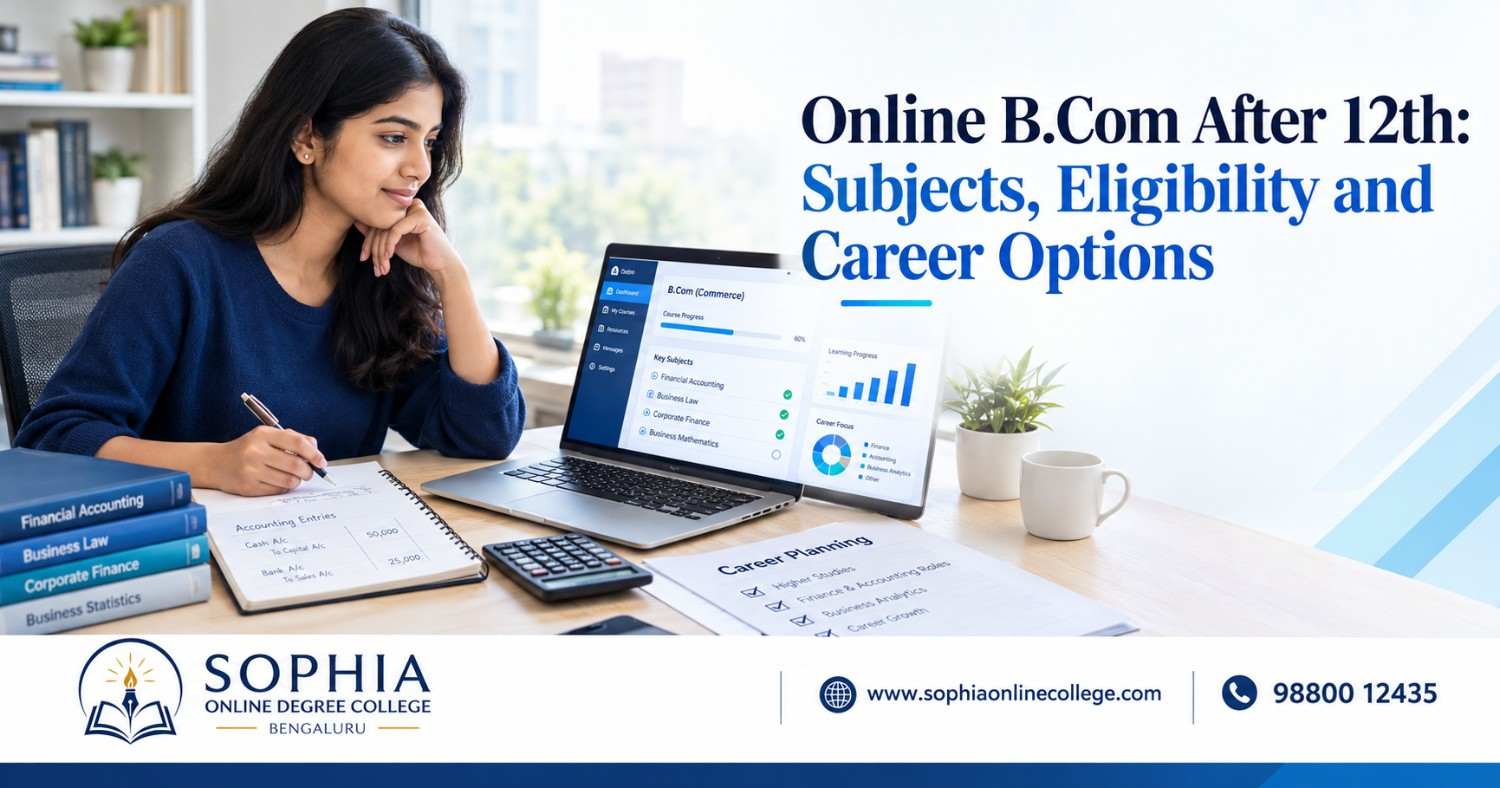
Choosing a degree after Class 12 can feel like a major decision, especially when you want an education that supports your career goals without putting your personal responsibilities on hold. An Online B.Com can be worth exploring if you are interested in accounting, finance, taxation, banking or business management. A b.com online degree may also suit working professionals and students returning to education who need greater flexibility in organising their studies.
However, selecting a course involves more than checking its duration or admission requirements. You need to understand what you will study, how the subjects connect with real business activities, what career opportunities may follow, and whether the programme fits your budget and schedule.
This guide explains the course in practical terms so you can make an informed decision instead of choosing a degree simply because it is convenient.
Before Choosing B.Com, Understand What You Want From Your Degree
Commerce is closely connected with the way businesses operate. Companies need people who can maintain financial records, understand transactions, support budgets, communicate with customers, manage business information and follow financial procedures.
A Bachelor of Commerce introduces students to many of these business functions. It provides a foundation in accounting, economics, taxation, finance, business law and management-related concepts, although the exact subjects depend on the university and programme structure.
Before applying, consider which of these situations sounds most like yours.
If you have recently completed Class 12: You may want a degree that introduces you to commerce fundamentals and helps you explore different career directions before specialising.
If you are already working: You may need a qualification that can be pursued alongside your job, provided the learning format, examinations and workload fit your schedule.
If you paused your education: Returning to study can help you work towards a formal undergraduate qualification. Your first step is to check the admission rules of the university and confirm which documents are required.
If you want to improve your career options: You may be interested in combining a commerce qualification with practical skills in spreadsheets, accounting software, business communication or financial reporting.
The best starting point is to identify what you want the degree to help you achieve. Your answer will make it easier to evaluate subjects, fees, study methods and future opportunities.
What Is an Online B.Com Degree?
A Bachelor of Commerce, commonly called B.Com, is an undergraduate degree focused on commerce, accounting, finance and business-related subjects.
In an online programme, teaching and learning activities are delivered through digital platforms. Depending on the university, students may access recorded lessons, live classes, electronic study materials, assignments, online assessments and academic support through a learning portal.
The exact learning experience varies between institutions. Some programmes rely heavily on recorded lectures, while others include scheduled online sessions and regular interaction with faculty members.
A useful distinction is that online education and distance education are not automatically the same. Their delivery methods, learning requirements and student support arrangements can differ. Check the mode officially approved for the particular programme before applying.
For students exploring online UG degree courses in India, B.Com is one option to consider when their interests align with business, finance or accounting. It is not necessary to have a completely settled career plan before starting, but it helps to know which areas you would like to explore.
What can you expect from the course?
A typical B.Com curriculum aims to develop an understanding of:
- Financial transactions and accounting records.
- Business economics and market behaviour.
- Taxation principles and statutory compliance.
- Business laws and organisational practices.
- Banking, finance and financial decision-making.
- Business communication and management fundamentals.
The depth of these subjects depends on the curriculum. Some programmes may offer electives or specialisations, while others provide a broader general commerce education.
B.Com Subjects Explained Through Real Business Situations
Rather than memorising subject names, it helps to understand what each subject teaches you to recognise or do.
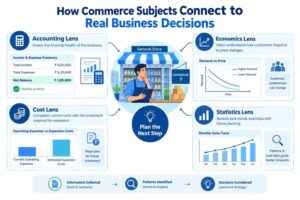
Imagine a small company that purchases products, pays employees, sells goods, collects payments and calculates its profits. Different commerce subjects explain different parts of these activities.
Decode the B.Com Curriculum
| Subject | What you learn | How it connects with business |
| Financial Accounting | Recording transactions and preparing financial statements | Understanding a business’s income, expenses and financial position |
| Business Economics | Demand, supply, pricing and market behaviour | Understanding how economic changes affect business decisions |
| Business Law | Legal principles related to commercial activities | Recognising contractual obligations and basic business responsibilities |
| Business Mathematics and Statistics | Calculations, data interpretation and quantitative methods | Supporting budgeting, comparisons and numerical analysis |
| Corporate Accounting | Accounting concepts related to companies and corporate transactions | Understanding company accounts and financial reporting |
| Cost and Management Accounting | Cost measurement, budgeting and internal financial information | Helping organisations monitor expenses and evaluate performance |
| Income Tax and Taxation | Tax concepts and applicable compliance principles | Understanding tax-related records and supporting relevant processes |
| Banking and Financial Services | Banking operations, financial products and services | Building familiarity with financial institutions and transactions |
| Business Management | Planning, organising and coordinating business activities | Understanding how teams and organisations function |
| Business Communication | Professional writing, presentations and workplace communication | Preparing reports, communicating with clients and working with colleagues |
Note: This is an illustrative subject guide, not a guaranteed syllabus. Universities may use different subject names, combine papers, introduce electives or update the curriculum. Always check the current programme syllabus.
How do these subjects work together?
Consider a business that wants to expand its operations.
- Accounting helps the business understand its financial position.
- Economics helps explain changes in demand and costs.
- Cost accounting helps evaluate the expenses associated with expansion.
- Business law introduces relevant contractual and legal considerations.
- Management helps coordinate the people and processes involved.
- Statistics supports the interpretation of sales and financial data.
This connection is what makes commerce useful across different industries. The subjects are not isolated areas of knowledge; they help explain how organisations make decisions.
Do you need to be excellent at mathematics?
Not necessarily. You should be comfortable developing numerical skills and willing to practise calculations, but the level and type of mathematics vary across commerce programmes.
Accounting requires accuracy and logical thinking. Statistics involves interpreting data, while economics uses numerical and graphical concepts. Students who find mathematics difficult can improve through regular practice and by revisiting foundational concepts.
If you are choosing commerce after Class 12, look at the actual syllabus and assessment pattern rather than assuming that every B.Com programme requires the same level of mathematical ability.
Online B.Com Eligibility After Class 12
Eligibility is one of the first things to verify before shortlisting a college.
Many B.Com programmes accept students who have passed Class 12 or an equivalent examination from a recognised board. Some institutions may accept students from different academic streams, while others may specify particular subjects, minimum marks or additional conditions.
The requirements for an online programme are determined by the institution and the applicable regulations. Do not assume that every university follows identical admission criteria.
What should you check before applying?
Educational qualification: Confirm that your Class 12 qualification meets the institution’s requirements.
Minimum marks: Check whether the programme specifies an aggregate percentage or any subject-wise requirements.
Accepted streams: Find out whether students from Arts, Commerce and Science backgrounds are eligible.
Required documents: Commonly requested documents may include Class 10 and Class 12 marksheets, proof of identity, a photograph and other records specified by the institution.
Admission procedure: Review the application form, document verification process, admission deadlines and payment instructions.
Programme recognition: Verify that the university and the exact online programme are recognised or entitled for the relevant academic session.
For an authoritative check, consult the UGC Distance Education Bureau’s official recognition information. The bureau advises learners to confirm the institution’s recognition status for the session in which they intend to enrol. Recognition in a previous academic year should not automatically be treated as proof of recognition for a later session.
Can students from Arts or Science choose B.Com?
Possibly, depending on the university’s eligibility requirements.
Students who studied Arts may need to become familiar with accounting and business terminology. Science students may need to adjust to commercial concepts, financial statements and business law.
Neither background automatically determines whether a student will succeed. What matters is meeting the admission criteria, understanding the foundational concepts and being prepared to practise consistently.
What if you have a gap after Class 12?
A gap in education does not automatically mean you cannot pursue an undergraduate degree. Your eligibility will depend on the institution’s rules and the documents you can provide.
If you left school several years ago, start by confirming that your qualifying examination is accepted and that you meet any applicable admission conditions. Also consider how much time you can realistically allocate to learning each week.
How Online Learning Fits Into Everyday Life
Flexibility is useful only when it matches your actual routine. Before enrolling, think about how you will attend classes, complete assignments, prepare for examinations and seek help when a subject becomes difficult.
Online learning may reduce the need to travel to a campus regularly, but it does not remove the work involved in earning a degree.
If you are a student after Class 12
You may have more time available for studying, but it is still important to establish a routine. Set aside regular periods for lectures, reading, revision and assignments. Use the flexibility to explore accounting tools, communication skills or introductory finance topics alongside your coursework.
If you are working full-time
Your routine may need to fit around shifts, commuting, family responsibilities and deadlines at work.
A practical approach is to divide study time into smaller, manageable sessions. For example, you could review one concept during the week, practise related questions later, and use a longer weekend session to revise the material.
Before admission, confirm whether live classes are compulsory, whether recordings are available and how examination dates are communicated.
If you are returning to education
You may need time to rebuild your study habits. Begin with the basics, keep notes in your own words and revise unfamiliar concepts regularly.
Do not wait until examinations are close to identify topics you find difficult. Use the university’s academic support channels and ask questions early.
What should a student-friendly learning routine include?
- A weekly study schedule that reflects your actual commitments.
- Regular revision of accounting and numerical concepts.
- A calendar for assignments, internal assessments and examinations.
- A reliable internet connection and access to a suitable device.
- A place to study without frequent interruptions.
- Time for practice questions and self-assessment.
These habits can make online learning more manageable. They are also useful in a traditional classroom environment.
Understanding the Cost: Look Beyond the Advertised Tuition Fee
Affordability matters, particularly for students paying for their education independently or professionals managing household expenses alongside study costs.
However, the lowest advertised fee is not always the most economical option. A fair comparison should consider the total amount you may need to pay during the programme and what academic support is included.
Understand the Real Cost of Studying
| Cost component | What to verify | Why it matters |
| Tuition fee | Total programme fee and payment schedule | Establishes the main education expense |
| Admission or registration fee | Whether it is separate from tuition | Helps you calculate the initial payment |
| Examination fee | Whether examinations or repeat attempts incur additional charges | Prevents unexpected assessment costs |
| Learning resources | Whether digital materials are included | Helps you assess the cost of books and additional resources |
| Technology and internet | Device availability, data usage and connectivity | Identifies the practical cost of studying online |
| Optional support or services | Whether extra sessions or services carry charges | Helps you distinguish essential costs from optional spending |
| Re-examination or backlog fees | Applicable rules and charges | Helps you plan for possible additional assessments |
| Payment and refund conditions | Due dates, instalment options and refund policy | Helps you understand financial commitments before paying |
Actual charges vary by institution. Use the official fee schedule for the programme and academic session you are considering.
How can you assess affordability?
Start by finding the complete fee structure. Ask whether the published amount covers the entire programme or only one semester or year.
Next, consider how you will pay. If you are working, you might prefer a payment schedule that fits your monthly budget. If your household is supporting your education, discuss the total commitment before making a payment.
Also check the refund policy and what happens if you need to discontinue your studies. These details are important even when you expect to complete the course.
Students comparing affordable online degrees should evaluate three things together: total cost, academic credibility and the learning support available. Saving money at admission is not helpful if the programme does not meet your educational requirements.
Does online education automatically cost less?
Not always. Online learning may reduce some expenses, such as daily commuting or relocation, but tuition and examination charges depend on the institution.
Your personal savings will also depend on whether you already have a suitable device, how much internet access you need and whether you must purchase additional learning materials.
Compare complete costs rather than assuming that every online programme is cheaper than every campus-based programme.
Career Options After B.Com: Where Can Your Knowledge Be Used?
B.Com can provide a foundation for several business-related career paths. The opportunities available to you will depend on your skills, practical experience, employer requirements and any additional qualifications needed for a specific role.
A degree is an academic foundation, not a guarantee of employment or a particular salary. Your goal should be to understand which roles match your interests and what you need to learn to become a credible candidate.
Accounting and accounts support
Accounting-related roles may involve recording transactions, maintaining ledgers, reconciling records, supporting invoices and assisting with financial statements.
To prepare for this direction, practise spreadsheet formulas, accounting entries and basic accounting software. Accuracy, attention to detail and the ability to organise financial records are valuable skills.
Banking and financial services
Commerce graduates may explore entry-level support roles in banking operations, customer service, financial administration and related areas, subject to the employer’s eligibility requirements.
Useful skills include numerical accuracy, professional communication, documentation and familiarity with financial products. Some roles, particularly regulated or specialist positions, may require additional qualifications or examinations.
Taxation and compliance support
Students interested in taxation can develop a foundation in tax terminology, financial documentation and compliance procedures.
Practical preparation may include learning how invoices are organised, how financial records are maintained and how to work with relevant accounting software. Tax-related responsibilities depend on the role and the applicable professional requirements.
Business operations and administration
Businesses require people who can coordinate documents, support internal processes, maintain records and communicate with different departments.
A commerce background can be relevant to administrative and operations support positions. Organisation, email writing, spreadsheet skills and the ability to follow procedures can improve your readiness for such work.
Sales, customer relations and business development
Students who enjoy communication and working with people may explore sales coordination, customer support and business development assistance.
These roles may involve maintaining customer records, preparing reports, following up on enquiries and supporting sales teams. Communication, product knowledge and customer relationship skills are particularly useful.
Finance and reporting support
Students who enjoy working with numbers may explore junior finance support, reporting assistance or budgeting-related work where their qualifications meet the requirements.
To build relevant skills, practise organising data, preparing simple summaries and interpreting financial information. Advanced analytical roles may require further training, experience or specialist qualifications.
Entrepreneurship and family business
A commerce education may also help learners who want to understand the financial and administrative side of a small business.
Accounting, cost awareness, pricing, cash-flow concepts and customer communication can be useful when managing a shop, service business or family enterprise. The degree alone will not replace practical experience, but it can provide a structured foundation.
How can you research these career options?
The Government of India’s National Career Service offers job-search services and career information that can help you explore occupational roles and employer requirements.
Use job descriptions to identify the skills employers repeatedly request. Compare several advertisements for the same type of position, noting their education requirements, software expectations, communication skills and experience criteria.
This approach gives you a more realistic picture of the work you may want to pursue after graduation.
Build Skills Alongside Your Degree
Two students can complete similar academic programmes but prepare for employment in very different ways. One may understand the theory, while another has also practised relevant tools, prepared sample reports and developed workplace communication skills.
You do not need to learn every business tool at once. Choose practical skills that connect with your preferred career direction.
For accounting-related work:
- Practise spreadsheet formulas and basic financial calculations.
- Learn how invoices, ledgers and reconciliations work.
- Become familiar with accounting software used in relevant job descriptions.
- Practice preparing simple financial summaries.
For finance and reporting:
- Strengthen your spreadsheet and data-interpretation skills.
- Learn how to organise information into tables and charts.
- Practice explaining what a set of numbers indicates.
- Understand basic budgeting and financial reporting concepts.
For business operations:
- Improve email writing and professional documentation.
- Learn spreadsheet-based record management.
- Practise organising information and tracking tasks.
- Develop communication and coordination skills.
For sales and customer support:
- Practise clear spoken and written communication.
- Learn how customer records and follow-up systems work.
- Develop problem-solving and product-explanation skills.
- Understand the importance of accurate documentation.
Where possible, build a small portfolio of practice work. You could prepare a sample expense report, a mock sales summary or an illustrative bookkeeping exercise using fictional data. Clearly label these as practice projects rather than professional client work.
Which Study Path Makes Sense for Your Situation?
A B.Com degree can serve different purposes depending on where you are starting. Instead of assuming that every learner should follow the same route, consider your current circumstances and the next step you want to take.
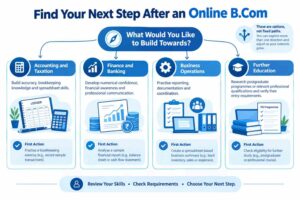
Match Your Background With Your Next Move
| Your situation | What to prioritise during B.Com | A possible next step |
| Recently completed Class 12 | Build a strong foundation in accounting, economics and business concepts | Explore entry-level roles, internships where available, or further study |
| Working professional without a degree | Confirm eligibility and choose a study format that fits your work schedule | Work towards completing the qualification while developing relevant skills |
| Returning after an education gap | Rebuild study habits and revise foundational concepts | Complete the degree and assess career or further-study options |
| Interested in accounting | Practise bookkeeping, spreadsheets and accounting software | Explore suitable accounts-related roles or relevant professional study |
| Interested in finance or banking | Strengthen numerical skills, communication and financial awareness | Investigate employer-specific entry requirements and suitable additional preparation |
| Interested in management | Develop communication, reporting and organisational skills | Consider relevant postgraduate study after meeting admission requirements |
| Planning to run a business | Understand costs, records, cash flow and business operations | Apply the knowledge to business planning alongside practical experience |
These pathways are examples rather than fixed rules. You can change direction as you discover which subjects and activities interest you most.
Should you study further after B.Com?
That depends on your goals.
M.Com: May suit students who want deeper academic study in commerce or related areas.
MBA: May suit graduates interested in management, business strategy, marketing, finance or other management specialisations, depending on the programme.
Professional qualifications: Students interested in accounting, cost management, company law or taxation can investigate the eligibility and examination requirements of relevant professional bodies.
Skill-based learning: Short courses in spreadsheets, accounting software, data analysis or business communication may help you build practical capabilities alongside your degree.
Before committing to another qualification, consider its entry requirements, duration, total cost and relevance to the type of work you want to pursue.
How to Choose an Online B.Com College Without Regretting Your Decision
A course can look attractive in an advertisement but still be unsuitable for your needs. Spend time evaluating the institution and the exact programme before submitting fees or documents.
Check recognition and programme details
Verify the institution’s current recognition or entitlement for the relevant online programme and academic session. Check the exact degree title, duration, eligibility requirements and delivery mode.
Do not rely only on promotional statements, social media posts or the presence of a college name on an unrelated list. Confirm the specific programme through the official sources.
Understand how teaching and assessment work
Find out whether the course includes live sessions, recorded lectures, downloadable materials, assignments, internal assessments and term-end examinations.
Ask how students can contact faculty or academic support teams. A clear support process is especially important if you are studying after a long gap or balancing work with education.
Compare the full fee structure
Review tuition, examination charges and any other mandatory costs. Read the payment and refund terms before making a commitment.
If you need a flexible payment arrangement, check whether the institution offers one and whether any additional charges apply.
Evaluate the learning platform
A learning portal should make it reasonably straightforward to locate course materials, receive announcements, submit assignments and review academic information.
Ask what device requirements apply and how you can obtain assistance if you face a technical issue.
Check whether the programme suits your long-term plan
Consider whether the curriculum covers the subjects you want to learn and whether the degree can support your intended next step.
If you plan to pursue postgraduate education or a professional qualification, confirm the eligibility rules of the institution or professional body you intend to approach later.
For students considering online degree colleges in Bangalore, comparing institutions by recognition, syllabus, student support and transparent fees is more useful than relying on location or advertising alone.
Is Online B.Com Suitable for Students Who Need Flexibility?
For many learners, the appeal of online education is the ability to organise study around other responsibilities. However, flexibility does not mean every programme is self-paced or that attendance and assessment requirements can be ignored.
An online degree may be worth considering if you:
- Need to combine education with employment.
- Prefer learning through digital resources.
- Want to reduce the need for regular campus travel.
- Are returning to education and need a structured academic route.
- Can manage independent study and meet deadlines consistently.
You should also be prepared to work through subjects that require practice, particularly accounting, statistics and quantitative business concepts.
If you need frequent in-person support, prefer a fixed classroom routine or have limited internet access, compare the available learning formats carefully before making a decision.
The right programme is the one whose delivery method, requirements and support arrangements suit your circumstances.
Consider Your Options With Sophia Online Degree College Bangalore
Choosing a degree is an important step, but it should follow an understanding of your eligibility, preferred subjects, available time and future plans.
At Sophia Online Degree College Bangalore, students and working professionals can explore higher-education information and consider how a degree may fit into their academic or career journey. Before making any admission decision, review the specific programme information, eligibility rules, fee structure and applicable recognition details.
Students comparing online courses for commerce students should begin with their goals rather than choosing a course solely because it is popular. Someone interested in accounting may prioritise practical financial skills, while a learner interested in management may focus on business fundamentals and communication.
The same principle applies if you are researching online degree courses in Karnataka: compare the actual programme and institution requirements, not just the headline fee or the convenience of online delivery.
“Students exploring career opportunities after completing a B.Com can discover these 10 best career options after a B.Com without CA or MBA to identify potential career paths that match their skills and interests.”
What should you do next?
Before applying, write down the answers to four questions:
- Does the programme accept my existing qualification?
- Can I manage its study and assessment requirements?
- Do I understand the full cost and payment conditions?
- Have I verified the institution and programme for the relevant session?
If any answer is unclear, seek clarification before paying fees. A careful decision now can help you avoid confusion later.
Frequently Asked Questions About Online B.Com After 12th
1. Can I pursue an Online B.Com after Class 12?
Yes, if you meet the eligibility requirements of the university offering the programme. Many B.Com programmes accept students who have passed Class 12 or an equivalent examination, but stream requirements, minimum marks and documentation rules can vary. Verify the exact admission criteria before applying.
2. What subjects are taught in an Online B.Com?
Common subject areas include financial accounting, business economics, business law, taxation, business mathematics and statistics, corporate accounting, management and business communication. The actual syllabus depends on the university and may include electives or specialisations.
3. Is a b.com online degree valid in India?
A degree earned through online mode should be from an institution authorised or entitled to offer the specific programme in that mode for the relevant academic session. Check the institution and programme through the official UGC Distance Education Bureau website before enrolling. Do not assume that every online course advertised as B.Com meets these requirements.
4. Can students from Arts or Science choose B.Com?
Some universities accept eligible students from Arts, Science and Commerce backgrounds. Others may specify particular subjects or admission conditions. Check the programme’s official eligibility rules and be prepared to develop your understanding of accounting and business fundamentals if these subjects are new to you.
5. How long does an Online B.Com take to complete?
The duration depends on the programme structure and applicable university regulations. Many undergraduate B.Com programmes are structured over three years, while some institutions offer programmes with a four-year structure or different approved arrangements. Verify the published duration, semester pattern and completion rules for your chosen course.
6. What career options are available after B.Com?
Depending on your skills and the employer’s requirements, you may explore accounts assistance, bookkeeping, finance support, banking operations, taxation support, business administration, sales coordination and customer relations. Further study or professional qualifications may be useful for specialised career paths.
7. Is an Online B.Com suitable for working professionals?
It can be suitable if the programme’s learning format fits your job and personal responsibilities. Check live-class requirements, examination arrangements, assignment deadlines and the availability of recorded materials. Online study still requires consistent effort and planning.
8. How can I find affordable online degrees?
Compare the total programme cost, including tuition, registration, examination charges and other mandatory expenses. Also review recognition, curriculum, academic support and payment terms. The lowest advertised fee should not be the only factor in your decision.
9. Can I pursue an MBA after B.Com?
You may be eligible to apply for an MBA after completing a recognised bachelor’s degree, subject to the admission criteria of the institution offering the MBA. Some programmes have additional requirements, entrance tests or minimum-mark conditions. Check the rules for the specific programme.
10. What should I check before enrolling in an online commerce programme?
Confirm the institution’s recognition or entitlement for the exact programme and academic session, review eligibility and syllabus details, compare the full fee structure, understand examinations and assessment methods, and check the availability of student support. Keep copies of the official admission and payment documents.
Conclusion: Make Your Commerce Degree a Practical Career Step
An Online B.Com can provide a foundation in accounting, finance, economics, taxation and business operations. Its value to you will depend on the quality and recognition of the programme, the effort you put into learning, and how you connect academic concepts with practical skills.
Whether you are moving directly from Class 12, working while studying or returning to education after a break, take time to understand the curriculum, verify eligibility and compare the full cost before enrolling.
For guidance on exploring your higher-education options, visit SODC and contact us with your questions about the relevant programmes, admission requirements and available support. A well-informed decision can help you take your next academic step with greater confidence.