
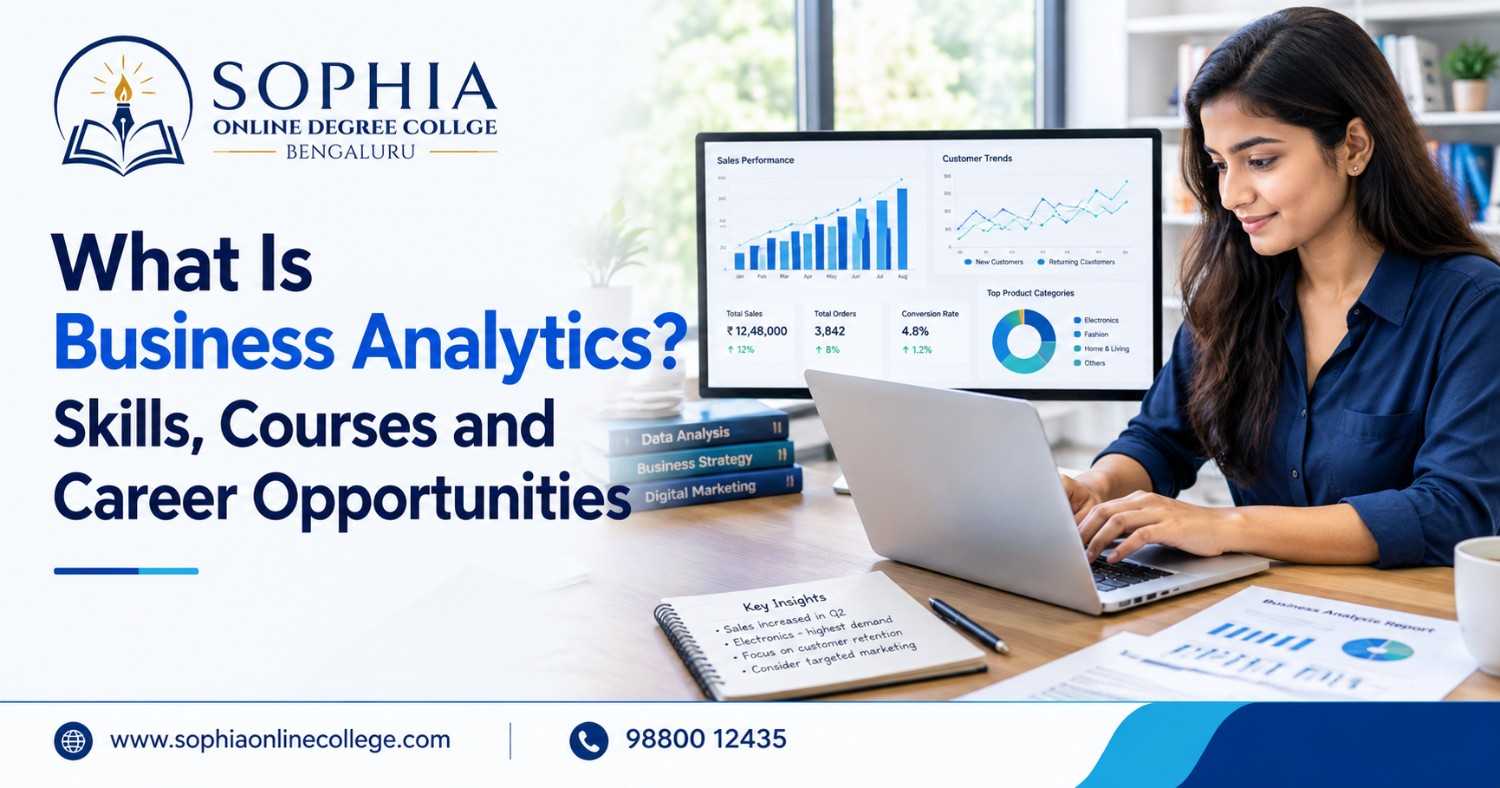
Imagine a company that receives thousands of orders but struggles to understand which products customers prefer, why sales are declining or where it is losing money. Business Analytics helps organisations answer these questions by turning business information into practical insights. For students and working professionals exploring an online mba in bangalore, this field offers an opportunity to connect management knowledge with analytical thinking and decision-making.
However, what should you study to enter this field? Is an MBA necessary, or can a B.Com graduate, BBA student or working professional qualify through specialised training? Can you learn Business Analytics through online, distance or correspondence education? And what salary and job opportunities can you expect after developing the required skills?
This guide answers these questions in a practical way. It explains the qualifications you can consider, the tools employers use, the learning options available and the career paths you can explore based on your educational background.
What Is Business Analytics, and Why Do Companies Need It?
Business Analytics is the process of examining business data to understand performance, identify patterns, investigate problems and support decisions. Companies use it to make sense of information collected through sales, customer interactions, financial records, marketing campaigns and daily operations.
Consider an online retailer experiencing a decline in completed purchases. Instead of spending more money on advertising immediately, the company can examine website visits, product availability, delivery charges and abandoned shopping carts. The analysis might reveal that customers leave because delivery costs are higher than expected.
This insight helps the business investigate the actual problem rather than rely on assumptions.
Business Analytics is useful across retail, banking, healthcare administration, education, manufacturing, logistics, information technology and marketing. It is not restricted to large companies or people with advanced technical qualifications. The skills required depend on the role, but the basic approach remains the same: understand a business question, examine the evidence and recommend a sensible next step.
The four types of Business Analytics
| Type | Main question | Practical example |
| Descriptive Analytics | What happened? | Reviewing monthly sales reports. |
| Diagnostic Analytics | Why did it happen? | Investigating why sales declined. |
| Predictive Analytics | What might happen next? | Estimating future product demand. |
| Prescriptive Analytics | What action should we consider? | Comparing possible delivery or inventory plans. |
These categories are connected. An analyst may begin with a performance report, investigate the reasons for a change, estimate possible outcomes and help managers evaluate their options.
The goal is not simply to create charts. It is to make information useful for business decisions.
Which Course Should You Study to Become a Business Analyst?
There is no single compulsory degree for every Business Analyst position. The right qualification depends on your current education, the type of role you want and the skills expected by employers.
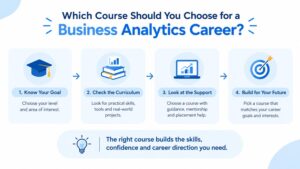
A student after Class 12 may need a relevant undergraduate qualification first. A commerce graduate may already have a useful business foundation and can add practical analytics training. A working professional may choose a short course or management qualification depending on whether they want to change careers or progress within their existing field.
Here are the main learning pathways to consider.
1. Bachelor’s degree after Class 12
If you have completed Class 12, you can explore undergraduate programmes in commerce, business administration, economics, mathematics, statistics, computer applications or other relevant disciplines.
A B.Com can provide knowledge of accounting, finance, economics and business operations. A BBA can introduce management, marketing and organisational processes. A BCA or a qualification with a stronger technical foundation may be useful for learners interested in technology-oriented analytical roles.
Your choice should reflect your interests and eligibility. A technical analytics position may require more programming or mathematics than a business reporting position.
After completing an appropriate degree, you can develop practical skills through a specialised certificate, project-based course or other suitable training.
2. Business Analytics certificate or job-oriented course
A specialised certificate can be useful if you already have a degree or relevant educational foundation and want to learn the tools used in analytics work.
Depending on the syllabus, such courses may cover:
- Excel and spreadsheet analysis.
- Basic statistics and data interpretation.
- SQL and database fundamentals.
- Power BI or Tableau for dashboards.
- Business reporting and visualisation.
- Introductory Python and data analysis.
- Practical projects using sample datasets.
Before enrolling, check whether the programme includes hands-on assignments rather than only recorded lectures. You should be able to demonstrate what you learned through a project, dashboard or analytical report.
A short certificate may help you develop relevant skills, but it does not replace a degree when an employer specifically requires one.
3. MBA with Business Analytics or related subjects
An MBA may suit graduates who want to develop management knowledge alongside analytical skills. Depending on the institution, the curriculum may include business intelligence, statistics, marketing analytics, financial analysis, operations management or data-informed decision-making.
An online mba in bangalore may be an option for eligible learners who want to continue studying while managing work or other responsibilities. However, not every MBA offers the same analytics subjects, and a management qualification does not automatically provide advanced technical training.
Before selecting a programme, review the syllabus, specialisation, projects, examination arrangements, fees and recognition status.
An MBA is generally more relevant to learners who want a broader management qualification. If your immediate goal is to learn Excel, SQL and dashboards for an entry-level reporting role, a focused skills course may be a more direct starting point.
4. PGDM with analytics-related learning
A Post Graduate Diploma in Management may be worth considering if you want to develop management knowledge and your chosen programme includes relevant analytics subjects.
A pgdm correspondence course may appeal to learners looking for a flexible study arrangement. However, the curriculum, delivery format, qualification and recognition vary by provider.
Check the institution awarding the qualification, the programme’s recognition status, admission requirements and the actual technical content. A general management diploma should not be assumed to provide the same analytical depth as a specialised Business Analytics programme.
5. Advanced analytics or data science programmes
Learners interested in predictive modelling, machine learning or more technical analytical work can consider advanced programmes after building the necessary foundations.
These programmes may require statistics, programming, database knowledge or mathematics. They can be useful for learners who want to move beyond business reporting towards more technical analytics responsibilities.
You do not need to begin with advanced data science. Start with the skills appropriate to your current level and progress as your career goals become clearer.
Which Course Is Right for Your Educational Background?
The best pathway becomes easier to identify when you start with your current qualifications rather than selecting a course based only on its popularity.
| Your current situation | A practical learning route |
| Class 12 student | Choose a suitable undergraduate degree, then develop analytics skills. |
| B.Com graduate | Build on finance and commerce knowledge with Excel, SQL and visualisation training. |
| BBA graduate | Combine management knowledge with reporting, statistics and analytical projects. |
| BA graduate | Check the eligibility requirements for analytics courses and build numerical and technical foundations where needed. |
| BCA or technical graduate | Develop database, visualisation and business communication skills; consider more advanced tools if relevant. |
| Working professional | Identify skill gaps in your current role and choose a certificate, relevant postgraduate programme or MBA accordingly. |
| Learner returning after a break | Review your existing qualifications, complete any required recognised qualification and progress through manageable skills training. |
For example, a commerce graduate working in accounts might begin by analysing expenses and budgets in Excel. A sales executive could learn to evaluate conversion rates and customer trends. An IT graduate might focus on SQL, dashboards and business requirements.
The course should help you move towards a defined career goal rather than simply add another certificate to your CV.
Can You Study Business Analytics Online, Through Distance Education or Correspondence?
Yes. You can explore several learning formats, but it is important to understand the difference between a formal qualification and a short skills course.
Online education
Online programmes generally provide learning materials through a digital platform. Depending on the institution, you may receive recorded lectures, live classes, online assignments, discussion forums and remote examinations.
This format may suit working professionals, graduates and learners who need flexibility. However, you should check attendance requirements, assessment methods, support services and whether the programme includes practical analytics exercises.
If you are comparing online degree courses in bangalore, check the specific institution and qualification rather than assuming that every programme advertised online has the same recognition status.
Distance education
Open and distance learning (ODL) can provide a more flexible route to a formal degree or postgraduate qualification. The structure varies by institution and programme, and some courses may involve scheduled examinations, assignments or other academic requirements.
This option may be suitable for learners who need to study alongside employment or family responsibilities.
Correspondence courses
Correspondence learning traditionally relies more heavily on study materials and independent learning, although the exact format differs across providers. Some learners prefer this approach because it allows them to organise study time around existing commitments.
If you are considering a correspondence programme, confirm how learning materials are provided, how assessments work and whether practical instruction is available for the skills you want to develop.
Short online skills courses
Short courses can teach specific tools such as Excel, SQL or Power BI without requiring you to enrol in a full degree. They may be useful for graduates who already meet the educational requirements of their intended jobs.
For example, the NPTEL course Business Intelligence & Analytics covers topics including SQL, descriptive analytics, data mining and modelling. Check the current course schedule, prerequisites, assessment arrangements and certificate requirements before planning your studies.
How to verify an online or distance qualification
Before paying fees for a formal online or distance degree, check the institution’s recognition and the specific programme’s status for the relevant admission session.
The official UGC Distance Education Bureau explains how learners can verify the recognition status of institutions and programmes. Recognition for a previous session should not be treated as automatic approval for a later session.
Also check the qualification awarded, eligibility, curriculum, total fees, examination process and available student support. Do not rely on advertisements or a provider’s use of words such as “online,” “distance” or “correspondence” alone.
Skills You Need to Learn for Business Analytics Jobs
A qualification gives you an educational foundation, but employers may also expect you to demonstrate practical skills. You can develop these progressively rather than trying to master every tool at once.
Excel and spreadsheets
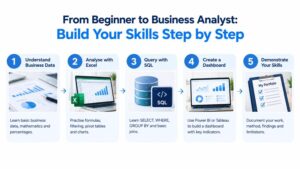
Excel is a useful starting point for working with tables, calculations and business reports. Learn formulas, sorting, filtering, pivot tables, lookup functions and charts.
Practise using sample sales or expense records to answer simple questions, such as which product category contributes the most revenue or which department has the highest expenses.
SQL and databases
SQL helps users retrieve, filter and organise information stored in relational databases. It is particularly useful when datasets are too large or complicated to manage comfortably in spreadsheets.
Start with SELECT statements, filtering, sorting, grouping and joins. Then practise answering business questions using sample customer, sales or inventory data.
Power BI or Tableau
Business analysts and reporting professionals may use visualisation tools to create dashboards and monitor key performance indicators.
Learn how to prepare data, select suitable charts, organise a dashboard and explain what the results mean. A clear dashboard should make a business question easier to answer rather than simply display attractive graphics.
Statistics and analytical thinking
Basic statistics helps you interpret averages, percentages, variation, trends and relationships. Analytical thinking helps you decide which information is relevant and whether the evidence supports your conclusion.
You should also understand that correlation does not automatically prove causation. A pattern in the data may suggest a possible explanation, but further investigation may be necessary.
Communication and business knowledge
Analysts often work with managers, clients and technical teams. They must be able to ask clear questions, document requirements, explain findings and communicate recommendations.
Knowledge of finance, marketing, operations, human resources or supply chains can be useful because it helps you understand the business context behind the numbers.
Python as an additional skill
Python can support data cleaning, automation and more advanced analysis. It may be especially relevant for technical analytics roles, but it is not necessarily the first skill every beginner needs.
Start with the tools most frequently required by the positions you intend to pursue.
Business Analyst Salary in India: What Can You Expect?
Salary is an important consideration when choosing a career, but there is no single salary applicable to every Business Analyst. Pay depends on experience, industry, location, employer, technical skills and the responsibilities attached to the role.
The following figures are indicative annual salary ranges for career planning, not guaranteed offers. They are based on published India-focused salary guides and should be checked against current vacancies in your preferred city and industry.
| Career stage | Indicative annual salary | Typical responsibilities |
| Entry-level or fresher, 0–2 years | ₹3.5–7 lakh | Basic reporting, documentation, spreadsheet analysis and supporting senior analysts. |
| Early to mid-career, around 2–5 years | ₹6–12 lakh | Handling analysis independently, working with stakeholders and improving reporting processes. |
| Experienced analyst, around 5–8 years | ₹10–18 lakh | Managing complex requirements, developing dashboards and supporting business decisions. |
| Senior or lead roles | ₹15 lakh and above in some roles | Leading analytical work, advising stakeholders and managing larger projects. |
These ranges overlap because job titles and responsibilities vary. Some entry-level jobs pay less, and some technical or specialised roles may pay more. The figures should not be interpreted as the expected salary of every graduate who completes a course.
A useful additional reference is the Business Analyst salary guide for India, which discusses compensation by experience and role.
What influences a Business Analyst’s salary?
Practical skills: Candidates who can demonstrate relevant Excel, SQL, visualisation and analytical skills may be better prepared for suitable vacancies.
Industry knowledge: Understanding a sector such as banking, retail, insurance, logistics or healthcare can be useful when interpreting business problems.
Experience: Employers may expect experienced analysts to manage requirements, communicate with stakeholders and take responsibility for more complex work.
Location and employer: Salaries can differ between cities, industries, company sizes and hiring arrangements.
Role specialisation: A business reporting role, an IT business analyst role and a technical analytics role may have very different requirements and pay structures.
When comparing offers, consider fixed pay, variable components, benefits, responsibilities and opportunities to learn. A higher advertised package does not always mean a higher fixed salary.
Job Opportunities After Learning Business Analytics
Business Analytics can support different career directions. Your qualification and practical skills will influence which entry-level positions are realistic for you.
Business Analyst
A Business Analyst helps organisations understand business requirements, identify process problems and recommend improvements. The role may involve stakeholder discussions, documentation, process mapping and coordination with technical teams.
Some roles are business-process focused, while others require stronger technical or data-analysis skills. Read the job description carefully.
MIS or Reporting Analyst
A Management Information System (MIS) or Reporting Analyst prepares reports, maintains spreadsheets and tracks performance indicators.
This can be a useful route for learners who are developing Excel, data organisation and reporting skills. Some employers may also expect SQL or dashboard experience.
Business Intelligence Analyst
A Business Intelligence Analyst often works with data from different systems and prepares dashboards or reports for decision-makers. SQL, data visualisation and data modelling may be important, depending on the role.
Marketing Analyst
A Marketing Analyst examines customer behaviour, campaign performance, conversions and engagement. Marketing knowledge can help the analyst understand why a metric matters and how it relates to campaign objectives.
Operations Analyst
An Operations Analyst studies processes, costs, delays, resource usage and service performance. The work may involve identifying inefficiencies and helping teams evaluate improvements.
Financial or Commercial Analyst
These professionals examine budgets, revenue, expenses, forecasts and commercial performance. Relevant finance knowledge may be particularly valuable, and certain roles require specialised accounting or financial qualifications.
Product and Customer Insights Analyst
These roles may focus on how customers use a product, where users encounter difficulties and which features or experiences need improvement. They can involve a combination of business understanding, analytics and collaboration with product or technology teams.
Can freshers get Business Analytics jobs?
Yes, some employers recruit fresh graduates for junior analyst, reporting or associate positions. However, completing a course alone does not guarantee employment.
Freshers can improve their preparation by building small projects, practising interview questions, learning to explain findings and applying for roles that match their existing qualifications.
If a vacancy requires experience or a specialised degree, consider related entry-level positions that help you develop relevant skills before progressing.
A 90-Day Learning Roadmap for Beginners
If you are unsure where to start, divide your preparation into manageable stages. This plan assumes you already meet the educational requirements for the roles you want to pursue; learners who need a degree should plan that qualification separately.
Days 1–30: Build the foundation
Learn spreadsheet basics, percentages, simple statistics and business concepts. Practise organising sample sales or expense data and explaining what the numbers show.
Days 31–60: Develop technical skills
Learn SQL fundamentals and create a basic dashboard using Power BI or Tableau. Practise answering questions such as which product category performs best or how sales change across months.
Days 61–90: Complete projects and prepare for applications
Create two or three small projects using public or synthetic datasets. Document the business question, the steps you followed, the findings and the limitations. Prepare a CV that describes your actual skills and projects, then start applying for appropriate junior roles.
This roadmap is a starting point, not a guarantee that you will be job-ready in exactly 90 days. Your progress will depend on your existing knowledge, study time and the complexity of your target roles.
How Can Sophia Online Degree College Help You Explore Your Study Options?
Choosing the right qualification is an important first step, particularly if you need to balance education with work, family responsibilities or a return to studies after a break.
Sophia Online Degree College Bangalore can be one of the institutions you explore while comparing suitable academic options. Start by identifying whether you need an undergraduate qualification, a management degree or a separate technical skills course.
If you are considering an MBA, review the current programme details, eligibility, curriculum, fees and recognition information. Confirm whether the subjects align with your goals rather than assuming that every management programme provides specialised Business Analytics training.
You can explore the available information on the SODC and contact us to discuss your educational goals and the study options that may suit your background.
Sophia Online Degree College Bangalore encourages learners to make informed education decisions. The most appropriate course will depend on your existing qualifications, intended career path and the programme’s current eligibility and recognition requirements.
“As technology continues to evolve, understanding emerging digital trends can help aspiring business analysts stay ahead in the industry. Explore our guide on the Future of App Development in 2027: Skills, Trends and Career Opportunities to learn about the latest developments shaping the technology sector.”
Frequently Asked Questions
1. Which course is best to become a Business Analyst?
There is no single best course for everyone. A relevant bachelor’s degree followed by practical analytics training can be a suitable route. Graduates may also consider specialised certificates, while an MBA with relevant subjects may suit those seeking broader management education.
2. Can I become a Business Analyst after B.Com?
Yes, a B.Com graduate can explore Business Analyst, MIS, reporting and related roles, depending on the employer’s requirements. Learning Excel, SQL, data visualisation and analytical thinking can complement a commerce background.
3. Is an MBA compulsory for Business Analytics?
No. Some positions accept graduates with relevant skills and experience, while other roles may prefer or require postgraduate qualifications. An MBA is one possible pathway, particularly for learners interested in management responsibilities.
4. Can I learn Business Analytics through distance education?
You can explore recognised distance-learning qualifications and separate online skills courses. Check whether the formal qualification is recognised for the relevant admission session, and confirm that your skills course includes practical exercises.
5. Is a correspondence course enough to get a job?
A correspondence course can help you learn, but employment depends on your educational background, practical skills, experience and the role’s requirements. You may need to supplement a general management course with hands-on analytics training.
6. What is the starting salary for a Business Analyst in India?
Entry-level salaries vary by employer, city, role and skills. Published salary guides show a broad range of possible earnings, so compare current vacancies and treat market estimates as indicative rather than guaranteed.
7. Which tools should I learn first?
Start with Excel and basic statistics, then learn SQL and a visualisation tool such as Power BI or Tableau. Add Python if it is relevant to the positions you want.
8. Can working professionals study Business Analytics online?
Yes. Online courses, certificates and suitable postgraduate programmes may allow professionals to study alongside work. Check schedules, assessment requirements, total costs and the level of practical support before enrolling.
9. Are online MBA programmes suitable for Business Analytics careers?
Some programmes include analytics-related subjects, but their technical depth varies. Review the curriculum and projects carefully. If you want a highly technical analytics role, you may need additional training in databases, statistics or programming.
10. What can I do if I have a career break?
Start by reviewing your existing qualifications and identifying the skills required for your target roles. You can refresh your knowledge through a structured course, complete practical projects and gradually prepare for suitable vacancies.
Conclusion
Business Analytics can be a useful career direction for students, commerce graduates, working professionals and learners returning to education. The most important decision is choosing a learning pathway that matches your present qualifications and future goals.
If you are starting after Class 12, explore a suitable undergraduate degree. If you already hold a degree, consider focused training in Excel, SQL and data visualisation. If you want broader management knowledge, evaluate an MBA or PGDM with relevant subjects, checking the curriculum and recognition status before enrolling.
Online, distance and correspondence learning can provide flexible options, but the course format alone does not guarantee employment. Practical projects, relevant qualifications, communication skills and a clear understanding of job requirements remain important.
Explore the available study options, compare them carefully and choose a realistic next step towards your intended career.