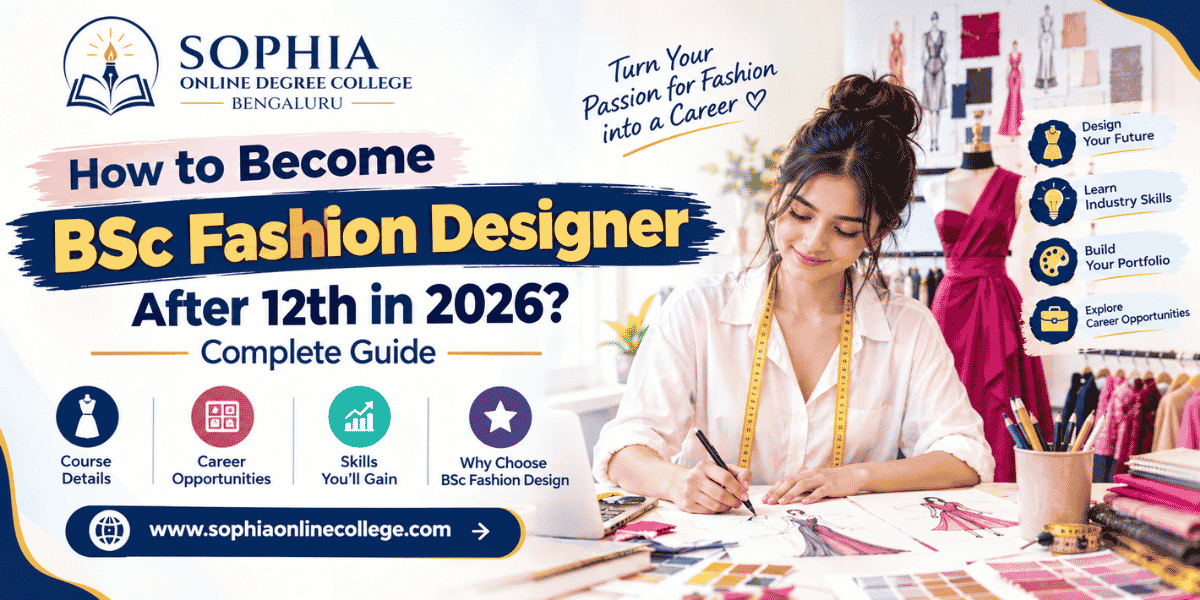
Fashion is not only about wearing attractive clothes. It is about understanding colours, fabrics, silhouettes, culture, comfort, trends, and the ideas that turn an ordinary piece of clothing into something memorable. For students who have completed Class 12 and enjoy creativity, design, and visual expression, fashion can become an exciting career direction. If you want to Become BSc Fashion Designer, the journey starts with choosing the right academic path and then developing practical skills step by step.
Many students search for fashion design courses after 12th because they want a structured way to enter this field. A B.Sc. The programme can introduce students to design concepts along with technical areas such as textiles, pattern making, garment construction, and fashion-related production. The exact curriculum and eligibility can vary between institutions, so checking the programme requirements before applying is important.
This guide explains how to Become BSc Fashion Designer after 12th, what you may learn, how to build your portfolio, what skills matter, and which career directions you can explore after graduation.
What Does a BSc Fashion Designer Actually Do?
Before deciding to Become BSc Fashion Designer, it is essential to understand not only the work with fashion designs but to get to know the work process of a designer.
A designer can work with clothing ideas, textiles, colour schemes, silhouettes, garment details, samples, and whole collections. Designers can research the target audience, analyze the fashion market, work with patterns, create computer graphics, work with manufacturers, and deal with advertising and merchandising.
Therefore, becoming a designer involves developing design skills, understanding the work principles in the industry, acquiring know-how in sewing and knitting, learning to work with different materials, mastering technical design skills in CAD, and bringing ideas to life on textiles.
Modern design courses offer a comprehensive study of the field, including sewing and knitting, garment construction, textiles, patternmaking, computer graphics, and fashion forecasting.
Why Consider Fashion Design After 12th?
For many students, the thought of becoming BSc fashion designer commences from the enjoyment of clothes, the love for colors, styling, illustrations, or even experimenting with new apparels.
The field is ideal for students that have an urge to create rather than conforming to, or working within, a rigid system.
It offers a wide berth for exploring different avenues and specializations, ranging from apparel design, styling, textiles, merchandising, costume design, fashion communication, to launching a label.
Students that intend to pursue a fashion designing career after 12 th will find a range of different degrees, diplomas, and certificates available.
While a degree course enables learners to take a long and in-depth study pathway, shorter programs could be considered for acquiring specific skills in a specialty area.
The critical takeaway point is to understand that the choice of program should be informed by desired professional goals rather than the label of the chosen curriculum.
Can You Become BSc Fashion Designer After Any Stream in 12th?
One common concern among students is whether they need a particular stream to Become BSc Fashion Designer.
Fashion design programmes can have different admission requirements depending on the institution. Many fashion design programmes accept students who have completed 10+2, while some B.Sc. programmes may specify particular subjects or minimum marks. Therefore, students should always verify the eligibility criteria of the institution and programme they plan to join.
Instead of assuming that your school stream automatically decides your future, look at the actual admission rules.
If you are planning to Become BSc Fashion Designer, check:
- Class 12 qualification requirements
- Accepted educational streams
- Minimum marks, if applicable
- Entrance examination requirements, if applicable
- Documents required for admission
- Course duration
- Mode of study
- Practical learning opportunities
This simple checklist can make the admission process much easier to understand.
What Will You Study in BSc Fashion Design?
A student taking into account enrolling in a B.Sc Fashion Designer course should be wary of the fact that the course embraces way more than the art of fashion illustration. Depending on the academic institution, subjects such as:
- Fashion illustration
- Textile and fabric
- Pattern making
- Garment construction
- Draping
- Apparel production
- Colour and design
- Fashion forecasting
- Computer aided design
- Fashion communication
- Styling and presentation
- Fashion merchandising
A B.Sc. Fashion Design programme is normally a blend of creative and technical subjects. Some courses are designed in a manner to enable students to understand how a design concept is evolved from a design brief into a tangible garment or a collection of outfits. Therefore, a student aspiring to Become BSc Fashion Designer should view their course of study as a platform where their creative ideas take shape in the form of practical designs.
A Simple Roadmap to Become BSc Fashion Designer
Instead of treating fashion design as one big decision, break the journey into manageable stages.
Step 1: Understand Your Interest
The first step to becoming a BSc Fashion Designer is identifying what attracts you to fashion.
Do you enjoy creating outfits? Are you interested in fabrics? Do you like styling people? Are you fascinated by colours and patterns? Or are you more interested in the business side of fashion?
You do not need to have every answer immediately. Your interests can become clearer as you learn.
Step 2: Explore the Right Programme
Once you decide to Become BSc Fashion Designer, compare programmes rather than choosing the first option you find.
Look at:
- Curriculum
- Practical assignments
- Course duration
- Learning format
- Faculty experience
- Portfolio opportunities
- Industry exposure
- Admission requirements
Students comparing online degree courses in Karnataka or online degree courses in Bangalore should also carefully check whether the particular fashion programme provides the practical and design-based learning they need.
Step 3: Learn the Fundamentals
The next stage to Become BSc Fashion Designer is building a foundation.
Start learning how colours work together, how fabrics behave, how garments are constructed, and how fashion ideas are developed.
Do not worry if your first sketches are not perfect. Design skills improve through repetition.
Step 4: Turn Ideas Into Projects
To Become BSc Fashion Designer, you need to move beyond watching tutorials or collecting fashion inspiration.
Create small projects.
For example, you could:
- Design a casualwear collection
- Create a festivewear concept
- Experiment with fabric combinations
- Develop a colour story
- Create a mood board
- Sketch a mini collection
- Study traditional clothing and reinterpret it
Projects give you something tangible to learn from.
Step 5: Build a Fashion Design Portfolio
A strong fashion design portfolio can show how you think, not just what you have finished.
If you want to Become BSc Fashion Designer, start documenting your work from the beginning of your course.
Your portfolio can include:
- Initial sketches
- Mood boards
- Colour palettes
- Fabric experiments
- Design development
- Technical drawings
- Garment photographs
- College projects
- Styling concepts
- Final collections
Showing the process can be particularly useful because it demonstrates how an idea developed from the first concept to the final result.
Step 6: Gain Practical Exposure
Students who want to Become BSc Fashion Designer should not wait until graduation to understand how fashion works outside the classroom.
Look for opportunities such as:
- Internships
- Workshops
- Fashion exhibitions
- College fashion shows
- Boutique projects
- Styling assignments
- Freelance work
- Design competitions
Even small experiences can teach you things that textbooks cannot fully explain.
Skills That Can Help You Become BSc Fashion Designer
A successful fashion professional needs a combination of creative, technical, and professional skills.
| Skill | Why It Matters |
| Sketching | Helps communicate design ideas |
| Colour Knowledge | Supports attractive combinations |
| Textile Knowledge | Helps with fabric selection |
| Pattern Making | Converts ideas into garment structures |
| Garment Construction | Builds practical understanding |
| Digital Design | Supports modern design workflows |
| Communication | Helps explain ideas to clients and teams |
| Trend Research | Keeps designs relevant |
| Time Management | Helps complete collections and projects |
| Presentation | Makes design concepts easier to understand |
If your goal is to Become BSc Fashion Designer, do not try to master everything in one month. Build these abilities gradually through your coursework and projects.
Do You Need to Be an Expert at Drawing?
This is one of the most common questions asked by students, who are about to become Bsc fashion designer
Being comfortable while sketching might help you, but it is not mandatory that a beginner should have excellent designing skills on the very first day.
Fashion designing is also about understanding the body proportions, construction, form, fabric, colors, and visual media. With continuous sketching practice, you will be able to express your ideas better on paper.
So instead of worrying about whether your drawing skills are good enough or not to become a fashion designer, start worrying about whether you are consistent enough to practise sketching regularly or not.
How to Choose Between Different Courses After 12th?
When students search for fashion design courses after 12th, they may come across B.Sc., B.Des, diploma, certificate, and other programmes.
A simple comparison can help:
| Course Type | General Focus | Suitable For |
| B.Sc. Fashion Design | Academic + technical + creative learning | Students seeking a degree pathway |
| B.Des Fashion Design | Design-focused undergraduate education | Students interested in intensive design study |
| Diploma | Skill-oriented learning | Students seeking a shorter route |
| Certificate | Specific fashion skills | Beginners exploring a particular area |
The exact duration, eligibility, syllabus, and learning format vary by institution, so compare the actual programme details before making a decision.
Students considering a pgdm correspondence course should also check whether the programme they are considering is genuinely suitable for fashion design and includes the learning components they require.
What About Online Degree Courses in Karnataka?
The rise of online degree courses in Karnataka has enabled students to pursue their education through a more convenient mode of learning
However, fashion design requires a certain level of practical component. Hence, if you are considering doing online courses while preparing to Become BSc Fashion Designer, be sure to look into the manner in which the program deals with assignments, design projects, portfolio building, evaluation, and other practical tasks.
Avoid choosing online courses only on the basis of convenience. The program has to be relevant to your professional goals.
The same advice goes for prospective students interested in enrolling at online degree colleges in Bangalore. Don’t jump blindly into enrollment. Ask yourself what kind of practical component you should be expecting from the program.
Can PGDM or BSc IT Courses Lead to Fashion Design?
Sometimes students get confused about the different programmes available.
Such as, an affordable online degrees program could be perfect for a student looking towards management, but a bsc it correspondence course would help a student to understand more about information technology. Both of which lead to a completely different career path.
So if your objective is to become a basic fashion designer, your program should be related to fashion, textile, design, garment, and so on.
Choosing a course based on what’s available after 12th will only confuse you, So choose what you want to be and work backwards from there.
Career Options After BSc Fashion Design
Once you Become BSc Fashion Designer, your career will not be linear.
Fashion graduates have a wide range of options to choose from. The following are the popular choices:
- Fashion Designer
- Assistant Fashion Designer
- Fashion Illustrator
- Textile Designer
- Fashion Stylist
- Fashion Merchandiser
- Costume Designer
- Apparel Production Coordinator
- Fashion Consultant
- Fashion Entrepreneur
Becoming a fashion designer can also lead students towards related fields since the industry encompasses a broad spectrum of activities, including designing, production, retail, merchandising, styling, communication, and business development. Thus, a graduate with a portfolio of work and relevant practical experience can position themselves better depending on the area of expertise they wish to pursue in the industry.
Where Can Fashion Graduates Work?
A person who wants to Become BSc Fashion Designer can consider working in a number of different types of organisations.
These include:
- Fashion brands
- Apparel companies
- Textile businesses
- Garment manufacturers
- Retail companies
- Styling agencies
- E-commerce fashion businesses
- Costume departments
- Boutiques
- Independent fashion labels
Some people may eventually choose to become entrepreneurs themselves and design their own collections or set up their own fashion business. This makes the combination of design knowledge and business awareness valuable to learn.
How Sophia Online College Can Fit Into Your Education Search?
If you are searching for higher education, Sophia online college can be one of the establishments you will consider comparing the programs and modes of learning.
Before enrolling in the course to Become BSc Fashion Designer, ensure to understand the course structure, eligibility, learning mode, practical training, and admission guidelines of the chosen program.
The aim must not be to obtain a degree but to gain the knowledge and skills required to grow in your career path.
Common Mistakes Students Should Avoid
Students trying to Become BSc Fashion Designer sometimes make the mistake of concentrating only on the creative side.
Here are a few mistakes worth avoiding:
Copying Every Popular Trend
Trends can provide inspiration, but constantly copying them will not help you develop your own design thinking.
Ignoring Fabric Knowledge
A beautiful sketch may not work with the chosen fabric. Understanding materials is therefore important.
Waiting Until Final Year for a Portfolio
Start saving your best projects from the beginning.
Focusing Only on Marks
Academic performance matters, but fashion also requires practical and creative development.
Avoiding Technology
Modern fashion education increasingly includes digital tools and computer-aided design.
Not Taking Feedback
Feedback can help identify weaknesses that you may not notice yourself.
Trying to Master Everything at Once
Fashion has many areas. Explore first, then gradually identify your strongest interests.
A Practical 3-Year Growth Plan
If you Become BSc Fashion Designer, you can think about your development in three broad stages.
First stage – Explore:
Learn the fundamentals, experiment with different design areas, practise drawing, understand fabrics, and begin collecting your best work.
Second stage – Develop:
Work on more detailed projects, improve garment-related skills, explore digital tools, and participate in practical activities.
Third stage – Present:
Build a stronger portfolio, explore internships, identify your preferred career direction, and prepare yourself for professional opportunities.
This approach makes the journey feel less overwhelming because you are not expected to become an expert immediately.
What Makes a Fashion Design Student Stand Out?
The students who eventually become Bsc Fashion Designers are rarely those who went into the course being already adept at all the skills they will need.
What matters is having the persistence to get better at doing things.
Look around you at what others are wearing, and when you can, go and see fashion shows and exhibitions, and study different materials.
Draw and experiment with colors and see what mistakes look like. Stay up to date with what is happening in the world of fashion. Keep all your work, and most importantly, learn to question why something works, rather than focussing on whether it works or not.
Final Roadmap: Become BSc Fashion Designer After 12th
If You Want to Become BSc Fashion Designer, the path may be defined as follows:
Pass 12th → Meet Eligibility Criteria → Choose an Appropriate BSc Program → Study Basics of Fashion → Acquire Design Skills → Work on Projects → Create a Portfolio and Gain Experience → Specialize Further
A fashion designer is a person who shapes clothes and accessories. After obtaining the degree, one should keep learning the profession as fashion is constantly changing. The work of a fashion designer is not limited to the end of the education process since there is always something new to know about fabrics, trends, clients’ demands, and technologies.
If You Seriously Want to Become BSc Fashion Designer, it is essential to understand the need to invest in the quality of the education and increase the skill level.
Conclusion
Choosing fashion as an option after 12th can be an exciting time for students who enjoy bringing ideas to life and who like to use their creative talents. Becoming Bsc fashion designer is much more than just learning how to sketch beautiful clothes. The aspiring fashion designer needs to learn about fabric, hone their designing skills, indulge in brainstorming, execute projects, prepare a portfolio and find their own unique stamp in the world of fashion.
While a degree can help give structure to a fashion designer’s career, it’s the designer’s ability to be able to actively engage with their art outside of the classroom that will decide their success. Whether you’re browsing through online degree courses in Karnataka or looking for online degree courses in Bangalore it’s important to be realistic about the course content.
Sophia Online College can be explored as a part of your higher education research but ensure you look at the current admission guidelines before embarking on the admission process.
If you wish to be a Bsc fashion designer, the first step is to take one practical step towards your dream – research the eligibility criteria, make a shortlist of courses and start building the designing portfolio that will soon be your creative expression.
FAQs
1. Can I Become a BSc Fashion Designer after 12th?
Yes, students who satisfy eligibility criteria of any suitable B.Sc. Fashion Design programmes can go for the course after completing class 12. The requirements differ from institute to institute, therefore, it is advisable to check the current eligibility norms.
2. What should I study to become a BSc Fashion Designer?
To become a BSc Fashion Designer, students must look for courses that offer specialisations like fashion illustration, textiles, pattern making, garment construction, fashion communication, etc.
3. What should I do after becoming a BSc Fashion Designer?
After you become a BSc Fashion Designer, build a portfolio, identify your niche, gain experience and explore opportunities or pursue higher education.
4. Why is a portfolio essential for a fashion design course?
A portfolio is a comprehensive perspective of an individual’s imaginative, creative, and artistic skills and expertise in the domain. Aspiring students looking forward to becoming a Bsc Fashion Designer in the future must start working on their portfolio while in college.
5. What are the career options after Bsc Fashion Design?
After you Become BSc Fashion Designer, one can work as a fashion designer, stylist, textile designer, fashion illustrator, merchandiser, costume designer, or even start a career as a fashion entrepreneur.
Take the Next Step
Ready to Become BSc Fashion Designer after 12th? Explore suitable B.Sc. fashion-related programmes, compare eligibility and learning formats, and choose a study path that matches your creative interests and long-term career goals. Sophia Online College can be included in your research when comparing available higher-education options.