
Imagine a situation where a company’s warehouse is full of goods, but the customers still complain that they are not able to get the products on time. The purchasing department says that suppliers deliver goods on time, the logistics department claims that transportation works fine, and the warehouse manager insists that there are no stock outs. Who is wrong?
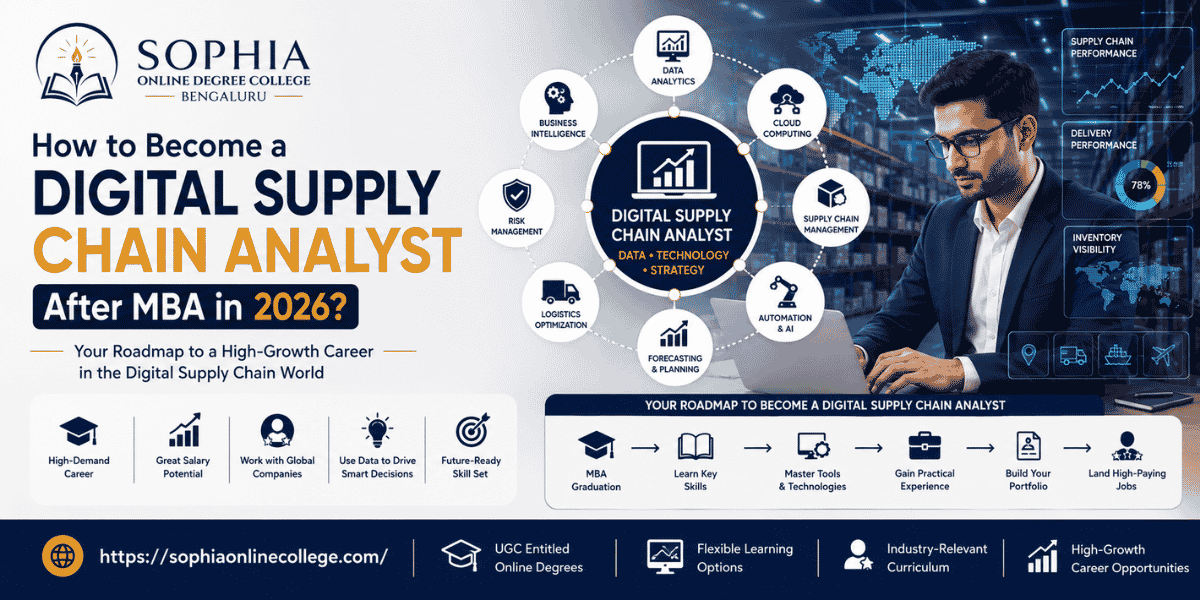
This is where a Digital Supply Chain Analyst comes to help. Being able to connect business processes, strategic thinking, analytics, and digital technologies, this specialist investigates and solves the issues in the supply chains of enterprises. The job of a Digital Supply Chain Analyst helps MBA students to combine business management knowledge and information technologies. It is not the end of the road for those who want to learn both fields. This career start is a good choice for those who prefer to work with data rather than be a manager at the head of the department. The digital supply chain analysts are not going to prepare reports and Excel sheets every month. Instead, they work with dashboards, automation, predictive analytics, artificial intelligence, ERP, and other tools.
This career path is suitable for an MBA student who wants to learn how to operate in the modern supply chain managerial space.
What Is a Digital Supply Chain Analyst?
A Digital supply chain analyst takes on the role of an expert in supply chain management practices, as well as business analysis and technology. The primary purpose of the latter includes the provision of a profound knowledge and understanding of supply chains and data-driven information connected to it for achieving a positive outcome in the functioning of the business in general.
A digital supply chain analyst focuses on any relevant data there is to help any organization achieve an overall better result. A typical workload for a Digital Supply Chain Analyst probably includes numbers pertaining to any of the following:
- inventory
- suppliers
- procurement
- demand planning
- warehousing
- transportation
- order fulfilment
- logistics costs
- customer demand
- supply chain KPIs
As such, when it comes to the importance it plays and the scope of its work, it probably is best to describe the role through an example. One particular aspect an analyst in charge might examine includes the likelihood of stock outs of a particular item given a certain level of inventory available for sale, considering sales made and scheduled purchases. By taking a closer look and analyzing data, the analyst can reveal whether there is a stock issue or not and what can be done about it. It is this mix of qualities, and the ability to take them into consideration together rather than the function in isolation which makes it unique in comparison to business roles which focus mostly on reporting.
Why Is This Career Becoming Important in 2026?
Supply chains have evolved.
Companies today want faster deliveries, lower costs, better inventory visibility, more accurate forecasting, and greater resilience when disruptions occur. Digital technologies help businesses achieve these goals by connecting data from different parts of the supply chain.
Thus, this is the kind of work that a Digital Supply Chain Analyst can do to transform the company.
Some of the most effective technological trends that could be utilized to digitize the supply chain are as follows:
- Artificial intelligence and machine learning
- Internet of Things
- Cloud platforms
- Automation
- Business intelligence
- Predictive analytics
- Digital twins
- ERP systems
Digital supply chains use technology and real-time information to improve planning and optimise the flow of goods, making analytics increasingly important for supply chain professionals.
This means an MBA graduate who understands both management and digital tools can potentially build a strong professional profile.
Is an MBA Enough to Become a Digital Supply Chain Analyst?
An MBA can provide an excellent foundation, but it may not be enough by itself.
Your MBA may already have given you knowledge of:
- Business management
- Operations
- Strategy
- Finance
- Decision-making
- Marketing
- Business communication
- Organisational management
However, a Digital Supply Chain Analyst also needs to understand data and technology.
You may therefore need to add skills such as:
- Advanced Excel
- SQL
- Power BI
- Tableau
- Basic Python
- Data visualisation
- Supply chain KPIs
- ERP systems
- Forecasting
- Process automation
Recent job listings for digital supply chain and analytics-oriented roles commonly mention tools such as SQL, Power BI, Tableau, Python, advanced Excel, data visualisation, and AI/ML.
Think of your MBA as the business foundation and your analytics skills as the digital layer that makes you more job-ready.
What Skills Does a Digital Supply Chain Analyst Need?
The skill set can be divided into four simple groups.
1. Supply Chain Knowledge
First, understand how a supply chain actually works.
Learn about:
- Procurement
- Inventory management
- Warehousing
- Logistics
- Transportation
- Demand planning
- Supplier management
- Order management
Without this knowledge, knowing a dashboard tool alone will not make you a strong Digital Supply Chain Analyst.
2. Data Analytics Skills
Next, learn how to work with data.
Start with:
- Excel
- Data cleaning
- Basic statistics
- SQL
- Data interpretation
- Forecasting
SQL is particularly useful when working with large datasets, while Excel remains valuable for everyday analysis and reporting.
3. Business Intelligence Skills
Power BI and Tableau can help a Digital Supply Chain Analyst turn complex information into dashboards that managers can understand quickly.
For example, you could create dashboards showing:
| Supply Chain KPI | What It Tells You |
| Inventory Turnover | How efficiently inventory is moving |
| Order Fulfilment Rate | How successfully orders are completed |
| Supplier Lead Time | How quickly suppliers deliver |
| On-Time Delivery | Whether deliveries meet schedules |
| Logistics Cost | Transportation and delivery expenses |
| Forecast Accuracy | How close predictions are to actual demand |
A good dashboard does more than display numbers. It helps someone understand what happened, why it happened, and what should happen next.
4. Digital Technology Skills
A modern Digital Supply Chain Analyst should also understand the technologies used in supply chain environments.
These may include:
- ERP platforms
- SAP
- Warehouse Management Systems
- Transportation Management Systems
- Power Automate
- AI tools
- Automation platforms
- Cloud-based analytics
You do not necessarily need to become a software developer. Your goal is to understand how technology can solve supply chain problems.
How to Become a Digital Supply Chain Analyst After MBA?
Now comes the most important part: the actual career roadmap.
Step 1: Understand Supply Chain Fundamentals
Before learning advanced analytics, understand the business process.
Learn how products move from suppliers to manufacturers, warehouses, distributors, and customers.
Understand concepts such as:
- Lead time
- Safety stock
- Reorder point
- Demand planning
- Procurement
- Inventory optimisation
- Distribution
- Logistics
This gives you the business context required to interpret data correctly.
Step 2: Become Strong in Excel
Excel is still a practical starting point for an aspiring Digital Supply Chain Analyst.
Focus on:
- Pivot tables
- XLOOKUP
- SUMIFS
- IF functions
- Conditional formatting
- Power Query
- Charts
- Data cleaning
Do not stop at knowing formulas. Practise using Excel to solve realistic supply chain problems.
For example, build an inventory tracker that highlights products with low stock, slow movement, or unusually high demand.
Step 3: Learn SQL
Once you are comfortable with Excel, move to SQL.
SQL can help you retrieve and analyse information from databases.
Learn:
- SELECT
- WHERE
- GROUP BY
- ORDER BY
- JOIN
- CASE
- Aggregate functions
- Subqueries
For a Digital Supply Chain Analyst, SQL becomes particularly useful when working with large operational datasets.
Step 4: Learn Power BI or Tableau
The next step is turning data into something decision-makers can understand.
Power BI is particularly useful for creating:
- Inventory dashboards
- Supplier dashboards
- Procurement reports
- Logistics dashboards
- Demand dashboards
- KPI scorecards
Current supply-chain job descriptions in Bengaluru also show demand for reporting and dashboard capabilities involving Power BI and related analytics tools.
Step 5: Understand ERP and Supply Chain Platforms
An ERP system connects different business functions and provides valuable operational data.
You don’t necessarily need deep technical expertise at the beginning. Start by understanding how systems such as SAP support:
- Procurement
- Inventory
- Sales
- Order management
- Logistics
- Finance
This can help you communicate more effectively with both business and technology teams.
Step 6: Explore AI and Automation
AI is becoming another important part of the digital supply chain.
A Digital Supply Chain Analyst may use AI-supported solutions for:
- Demand forecasting
- Anomaly detection
- Predictive maintenance
- Inventory optimisation
- Automated reporting
- Scenario analysis
- Process automation
The important point is not simply to say that you know AI. You should understand where AI can create measurable business value.
Step 7: Build Real Projects
This is where your learning becomes practical.
Create at least three portfolio projects.
Project 1: Inventory Dashboard
Use sample data to identify slow-moving, fast-moving, and low-stock products.
Project 2: Supplier Performance Dashboard
Compare suppliers based on delivery time, quality, cost, and order fulfilment.
Project 3: Demand Forecasting Project
Analyse historical sales and create a basic forecast.
These projects give you something concrete to discuss during interviews and demonstrate how you think as a Digital Supply Chain Analyst.
Which MBA Specialisation Is Best for This Career?
There is no single mandatory MBA specialisation.
However, some backgrounds can provide a more direct connection to the role.
| MBA Specialisation | Relevance |
| MBA Supply Chain Management | Very High |
| MBA Operations | Very High |
| MBA Business Analytics | Very High |
| MBA Information Systems | High |
| MBA Finance | Moderate to High |
| General MBA | Good with additional skills |
If you are considering an MBA through flexible learning, researching MBA distance education in Bangalore can help you compare programmes based on curriculum, flexibility, recognition, and career relevance.
Similarly, management distance education in Bangalore can be an option for learners who want to continue their education while managing work or other responsibilities.
The important thing is to look beyond the course title. Check whether the programme develops useful business, operations, analytics, and decision-making skills.
Can Distance Education Help You Build This Career?
Yes, depending on the programme and how you use your learning.
For working professionals, distance learning can provide flexibility while they develop additional technical skills independently.
Students exploring distance education in Bangalore should consider whether the programme offers relevant subjects, reliable academic support, recognised qualifications, and flexibility that fits their schedule.
Someone interested in business-oriented undergraduate education may also research a BBA correspondence college in Karnataka before progressing toward an MBA.
Likewise, students comparing correspondence degree colleges in Bangalore should evaluate the programme carefully rather than selecting a college only because it is convenient.
The qualification gives you an academic foundation, but your practical skills, projects, internships, and portfolio can make a major difference when you start applying for analyst positions.
Where Can a Digital Supply Chain Analyst Work?
A Digital Supply Chain Analyst can potentially work across many industries because supply chains exist almost everywhere.
Possible sectors include:
- E-commerce
- Manufacturing
- FMCG
- Retail
- Pharmaceuticals
- Automotive
- Logistics
- Technology
- Healthcare
- Consumer goods
The job title may also vary between organisations.
You could find related positions such as:
- Supply Chain Analyst
- Supply Chain Data Analyst
- Logistics Analyst
- Procurement Analyst
- Inventory Analyst
- Operations Analyst
- Demand Planning Analyst
- Business Analyst – Supply Chain
- Supply Chain Analytics Specialist
So, do not search for only one exact job title when beginning your career.
What Does a Digital Supply Chain Analyst Do in a Typical Day?
A normal day may involve much more than sitting in front of a dashboard.
For example:
9:00 AM: Review supply chain performance dashboards.
10:00 AM: Investigate unusual inventory movements.
11:30 AM: Analyse supplier performance.
1:00 PM: Work with the operations team on a data issue.
2:30 PM: Update a Power BI report.
4:00 PM: Present findings to a manager.
5:00 PM: Track whether recommended actions improved the KPI.
This is why communication is also important.
A Digital Supply Chain Analyst needs to explain technical findings in simple business language.
What Salary Can You Expect?
Salary can vary considerably based on experience, industry, location, company, and technical skills.
As a broad 2026 reference, published Indian supply-chain salary data places entry-level Supply Chain Analyst roles around ₹3–6 lakh per year and SCM Data Analyst roles around ₹4–8 lakh per year, with higher ranges as experience increases. These figures are indicative rather than guaranteed salaries for a specific job title.
Professionals who combine supply chain knowledge with SQL, Power BI, Python, ERP systems, forecasting, and digital transformation may have opportunities to move into more specialised roles over time.
Your MBA can also become more valuable as you progress toward senior analytical, consulting, management, or transformation positions.
How Can You Get Your First Job?
Your first job does not have to carry the exact title Digital Supply Chain Analyst.
You can enter through related positions and move toward the role.
A practical approach is:
Build a Skills-Based Resume
Mention tools and capabilities that match job descriptions:
- Excel
- SQL
- Power BI
- Supply chain analytics
- Data visualisation
- Forecasting
- ERP
- Inventory analysis
Create a Small Portfolio
Show two or three projects rather than simply listing certificates.
Apply for Related Roles
Search for:
- Supply Chain Analyst
- Operations Analyst
- Logistics Analyst
- Procurement Analyst
- Supply Chain Data Analyst
Prepare for Practical Interviews
Expect questions around:
- Excel
- SQL
- KPIs
- Inventory
- Forecasting
- Business cases
- Dashboard interpretation
Employers may also test whether you can explain your analysis clearly.
How Can You Build a Career With MBA Distance Education in Bangalore?
If flexibility is important to you, exploring MBA distance education in Bangalore can be one possible academic route.
The bigger question, however, is what you do alongside the degree.
A strong career-building combination could look like this:
MBA → Supply Chain Knowledge → Excel → SQL → Power BI → Projects → Internship/Experience → Analyst Role
Learners comparing management distance education in Bangalore can also look for programmes that complement their career goals instead of treating the degree as the only requirement.
If you already have an MBA, you do not necessarily need another full degree simply to start learning analytics. You can focus on targeted skill development, practical projects, and industry exposure.
What About IT and Digital Skills?
Technology is increasingly connected with supply chain operations. However, you do not need to become a full-time IT professional to enter this field.
For learners exploring IT distance education, the useful takeaway is that technology knowledge can complement business and supply chain expertise.
For a Digital Supply Chain Analyst, the goal is to understand how digital tools support business decisions.
For example:
Business Problem → Data → Analysis → Insight → Recommendation → Action
That is the mindset you should develop.
A Simple 6-Month Learning Plan
If you want a structured starting point, use this roadmap.
| Month | Main Focus |
| Month 1 | Supply chain fundamentals + Excel |
| Month 2 | Advanced Excel + supply chain KPIs |
| Month 3 | SQL + data analysis |
| Month 4 | Power BI + dashboard projects |
| Month 5 | ERP + forecasting + AI basics |
| Month 6 | Portfolio + resume + interview preparation |
Do not worry if you cannot master everything immediately.
The goal is consistent progress.
By the end of six months, you should be able to take a supply chain problem, work with the data, create a useful analysis, and explain your recommendation.
That is much more valuable than simply saying, “I completed several online courses.”
Common Mistakes MBA Graduates Should Avoid
Many candidates make the same mistakes when trying to enter digital supply chain careers.
Mistake 1: Learning Tools Without Understanding Supply Chain
Knowing Power BI does not automatically make you a supply chain analyst.
Mistake 2: Collecting Certificates Without Projects
A portfolio can demonstrate what you can actually do.
Mistake 3: Ignoring SQL
SQL can become an important skill when working with business databases.
Mistake 4: Focusing Only on Technical Skills
Communication and stakeholder management remain important because analysts must explain findings to business teams.
Mistake 5: Applying Only for One Job Title
Your first opportunity may be called Supply Chain Analyst, Operations Analyst, or Logistics Analyst.
Mistake 6: Treating AI as a Shortcut
AI can support analysis and automation, but you still need supply chain knowledge to understand whether the output makes business sense.
Career Growth After Becoming a Digital Supply Chain Analyst
The Digital Supply Chain Analyst role can be a starting point rather than the final destination.
A possible career path could look like:
MBA Graduate → Junior Analyst → Digital Supply Chain Analyst → Senior Analyst → Supply Chain Analytics Manager → Digital Supply Chain Manager → Supply Chain Transformation Leader
With experience, you may move toward areas such as:
- Supply chain consulting
- Digital transformation
- Supply chain planning
- Business analytics
- Operations management
- Product or technology consulting
- Supply chain strategy
The more you understand both business operations and technology, the more career directions you can potentially explore.
How Sophia Online College Can Support Your Learning Journey
For students and working professionals looking for flexible higher-education options, Sophia Online College can be considered as part of the broader academic journey.
However, becoming a Digital Supply Chain Analyst requires more than a qualification alone. Build your academic foundation while developing analytics tools, completing practical projects, and understanding real supply chain problems.
If you are comparing flexible education options, take time to review the programme structure, learning support, curriculum, and how well the course fits your long-term career goals.
Can Distance Education Help MBA Graduates Build This Career?
Working professionals often need flexibility when developing new skills. If you are comparing MBA distance education in Bangalore, look beyond flexibility and examine curriculum relevance, academic support, learning resources, and whether the programme fits your career objective.
Similarly, people exploring management distance education in Bangalore may find flexible learning useful when they want to continue working while strengthening management knowledge.
Students researching distance education in Bangalore should also compare recognition, programme structure, support services, and career relevance before making a decision.
For learners exploring broader undergraduate pathways, a BBA correspondence college in Karnataka can be one route for developing an early foundation in business and management before moving into specialised postgraduate learning.
Those comparing correspondence degree colleges in Bangalore should similarly evaluate the programme, institution, learning support, and suitability for their long-term career plan.
The important point is that education should be connected to a clear career strategy. A qualification becomes more valuable when it is supported by practical skills, projects, and relevant industry knowledge.
For learners looking for flexible academic pathways, Sophia Online College can be considered alongside other available options based on the programme and learning requirements.
Is Becoming a Digital Supply Chain Analyst a Good Career Choice in 2026?
For MBA graduates who enjoy numbers, business decisions, operations, and technology, this can be a promising career direction.
The strongest candidates are unlikely to be those who understand only supply chain operations or only data tools. The real advantage comes from combining both.
A Digital Supply Chain Analyst can understand the business problem, find the relevant data, analyse it, communicate the insight, and help the organisation decide what to do next.
That combination is particularly valuable as companies invest in digital transformation, analytics, AI, automation, and more connected supply chains. Current programmes and industry sources increasingly reflect this blend of supply chain expertise and digital capability.
Conclusion
Becoming a Digital Supply Chain Analyst after an MBA can be a smart career move for professionals who want to combine management knowledge with data, technology, and modern supply chain practices. Your MBA gives you a strong understanding of business and decision-making, while skills such as Excel, SQL, Power BI, forecasting, ERP systems, and AI can help you become more job-ready.
The key is not to learn everything at once. Start with supply chain fundamentals, build your analytical skills, work on practical projects, and gradually develop a portfolio that demonstrates what you can actually do. As businesses continue adopting digital supply chain management, professionals who can connect data with business decisions can find opportunities across logistics, manufacturing, retail, e-commerce, procurement, and other industries.
If you are ready to take the next step, focus on building the right combination of MBA knowledge + supply chain expertise + digital skills. With consistent learning and practical experience, you can work toward a rewarding career as a Digital Supply Chain Analyst in 2026 and beyond.
Start Your Journey with Sophia Online College
Looking to strengthen your management knowledge through a flexible learning pathway? Sophia Online College can help you explore suitable programmes designed around your academic and career goals.
Take the next step toward your career goals today. Explore Sophia Online College, choose the programme that fits your aspirations, and start building the knowledge you need for tomorrow’s digital business world.
FAQs
1. How can I become a Digital Supply Chain Analyst after an MBA?
Start by strengthening supply chain fundamentals, Excel, SQL, Power BI, forecasting, ERP knowledge, and analytical thinking. Then build practical projects and apply for supply chain, operations, logistics, and analytics roles.
2. Is an MBA enough to become a Digital Supply Chain Analyst?
An MBA can provide a strong business foundation, but additional technical skills are usually valuable. Learning tools such as SQL, Power BI, Excel, ERP systems, and basic Python can make your profile more competitive.
3. What skills does a Digital Supply Chain Analyst need?
Important skills include supply chain management, data analysis, forecasting, Excel, SQL, Power BI, communication, problem-solving, and familiarity with digital supply chain technologies.
4. Is SQL important for supply chain analytics?
Yes. SQL can help analysts retrieve and analyse information stored in business databases. It becomes particularly useful when working with large operational datasets.
5. Which tools should I learn for this career?
Start with Excel, SQL, and Power BI. Depending on your target role, you can then add Python, Tableau, SAP, ERP systems, and other specialised supply chain platforms.
6. Is supply chain analytics a good career option in 2026?
It can be a strong option for people interested in the combination of business, operations, data, and technology. The increasing use of digital tools and analytics is creating demand for professionals who can connect supply chain information with business decisions.
7. What projects should I build for a supply chain analyst job?
Inventory dashboards, demand forecasting, supplier performance analysis, logistics cost analysis, and supply chain risk dashboards are useful project ideas.
8. What is the salary of a Digital Supply Chain Analyst in India?
Salary varies by experience, location, employer, industry, and technical skills. Current 2026 market reporting indicates that supply chain analyst salaries can range from approximately ₹3–6 lakh at entry level to ₹14–22 lakh for senior analyst roles, while specialised SCM data analytics positions can command higher ranges.