
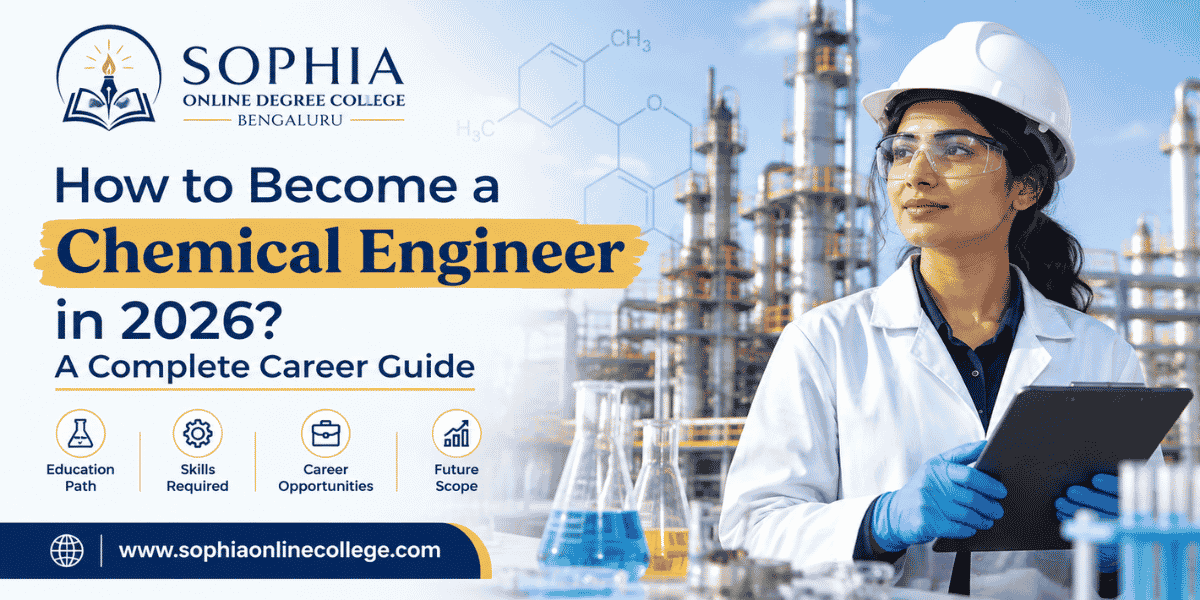
Choosing an engineering career is not only selecting the field of study but also finding the right way to fit one’s interests into the existing practical applications of this science. For those who like to study chemistry, mathematics, and critical thinking, discovering how various products are being created, How to Become a Chemical Engineer is a great place to start. Chemical Engineering is a multifaceted discipline that involves the application of chemistry, physics, math, and engineering to create chemical processes and products. These processes can be applied in various industries like pharmaceuticals, energy, food processing, chemicals, materials, and many others.
How to Become a Chemical Engineer in 2026 is also a matter of this field’s development, as automation and optimization of chemical processes, sustainable production methods, cutting-edge materials, and new engineering approaches are changing the way modern chemical engineers work. This book aims to provide a brief overview of the career and necessary preparations like studying natural sciences in high school, gaining practical skills, and looking at the different fields of work in chemical engineering.
What Does a Chemical Engineer Actually Do?
Before asking How to Become a Chemical Engineer, it is important to understand the profession you are going to pursue, beyond the name of the course.
A chemical engineer does not work exclusively with chemicals in a laboratory. Chemical Engineering is a profession that uses engineering principles to transform raw materials into more useful materials and to make production processes more sustainable, safe, economical and less damaging to the environment. The chemical engineer can act in the development of production processes, in the supervision of production, in the improvement of machinery and equipment, in the collection of data and quality control, besides assisting in solving production problems.
For example, a pharmaceutical company may need a chemical engineer to improve a manufacturing process; a food-processing company may need to hire professionals to work in production processes; or even an energy company may need to optimize its production chain. All these examples illustrate the relevance of How to Become a Chemical Engineer
Why Chemical Engineering Has a Wide Range of Applications?
One reason students research How to Become a Chemical Engineer is the variety of industries connected to the field.
Chemical engineering principles are used in industries such as pharmaceuticals, petrochemicals, plastics, food processing, energy, biotechnology, consumer products, environmental technology, and advanced materials.
The work can therefore change depending on the industry. One professional may spend more time around production systems, while another may work on research, quality, process design, or environmental projects.
| Industry | Possible Chemical Engineering Work |
| Pharmaceuticals | Manufacturing and process development |
| Food Processing | Production and process improvement |
| Chemicals | Plant and process operations |
| Energy | Process efficiency and energy systems |
| Environmental | Waste and treatment processes |
| Materials | Development and processing of new materials |
This variety makes How to Become a Chemical Engineer a useful career question for students who want a science-based profession with several possible directions.
Begin With the Right School Subjects
For students wondering about How to Become a Chemical Engineer after school, the academic foundation matters.
Students typically begin the 10+2 stream with science, and their studies in Physics, Chemistry, and Mathematics provide an important foundation for their studies in engineering.
Exact eligibility and admission requirements may vary between institutions, so students should always consult current requirements of the college or university that they are interested in attending.
Chemistry helps students learn about reactions and materials, while Mathematics helps them calculate and model various processes. Physics gives students a grounding in energy, motion, pressure, heat, and other forces and concepts that crop up in engineering.
This is why How to Become a Chemical Engineer should not include picking a college to start with, but rather lays out a path to building the academic foundation required to understand the concepts behind engineering.
Understanding Chemical Engineering Eligibility
When researching How to Become a Chemical Engineer, students often come across different eligibility rules. The basic route usually involves completing 10+2 in the science stream, followed by an undergraduate engineering programme. However, minimum marks, entrance examinations, subject requirements, and admission processes vary between institutions.
A typical academic route can look like this:
10th → 12th with Science/PCM → Engineering Admission → B.Tech/B.E. Chemical Engineering → Internship/Projects → Entry-Level Career
Students interested in higher-level specialisation can later consider postgraduate study.
Understanding chemical engineering eligibility before applying can prevent confusion during the admission process. It also helps students compare different institutions based on their own academic background.
Choose the Right Undergraduate Degree
The easiest path to becoming a Chemical Engineer, How to Become a Chemical Engineer is often a bachelor’s degree in chemical engineering, like a B.Tech or B.E. in Chemical Engineering. In a regular B.Tech Chemical Engineering program, you study general engineering topics, as well as more specialized chemical engineering courses, and you also get hands-on experience.
A bachelor’s degree in chemical engineering provides you with a comprehensive understanding of:
- Engineering maths
- Engineering chemistry
- Engineering thermodynamics
- Fluid mechanics
- Heat transfer
- Mass transfer
- Chemical reaction engineering
- Process control
- Process design
- Industrial safety
Among other things. The goal of a chemical engineering education is not to make you a chemical genius who can recite chemical equations backward and forward. You will, however, learn how to use your knowledge of science and math to understand and improve industrial processes.
This is an essential distinction in regards to How to Become a Chemical Engineer, since a chemical engineer needs to be able to apply their knowledge to real-world issues.
What Will You Learn During a Chemical Engineering Course?
A good chemical engineering course leads students from basic engineering concepts towards more complex process based applications.
Thermodynamics introduces them to how energy and equilibrium work, fluid mechanics deals with how liquids and gases behave and move through a system, heat and mass transfer look at how energy and substances move between different parts of a process and reaction engineering covers what it takes to design and control chemical reactions.
Process control then ties a lot of these things together by showing how industrial systems can be monitored and controlled to maintain stable operations.
This academic progression is an important part of the How to Become a Chemical Engineer as each subject feeds into how engineers are able to analyse real production systems.
Build Chemical Engineer Skills Alongside Your Degree
A degree provides the academic foundation, but How to Become a Chemical Engineer also involves developing skills that can be applied outside the classroom.
Important chemical engineering skills include analytical thinking, mathematical reasoning, problem-solving, process understanding, technical communication, teamwork, and attention to detail.
Technical skills can include:
- Process analysis
- Data interpretation
- Process simulation
- Chemical process safety
- Process control
- Technical documentation
- Quality analysis
- Basic programming or data tools
Professional skills matter as well. Engineers regularly communicate with production teams, technicians, managers, researchers, and other engineering professionals.
Therefore, How to Become a Chemical Engineer is not only about earning marks in technical subjects. It is also about learning how to explain a problem, analyse information, communicate a solution, and work responsibly with others.
Why Internships Can Change Your Understanding of the Field?
One of the best responses to the search How to Become a Chemical Engineer is to gain practical exposure before graduation
An internship can expose students to how actual engineering could take place in a workplace. They would learn about production lines, quality control measures, safety audits, equipment, documentation, or industrial processes among others.
A short internship can enable students to gain an insight into the difference between learning about a certain industrial process in school and the actual implementation
Students should not only seek to collect a certificate for an internship but also gather some of the key things that the organisation does. They should seek to learn about what the organisation makes, the process it uses, the safety precautions it employs, and how it solves certain problems.
For anyone searching online for How to Become a Chemical Engineer, such exposure can help ease the transition between sitting in a classroom and working in a factory.
Create Projects That Demonstrate Your Knowledge
Another practical tip from How to Become a Chemical Engineer is to devise some projects that will demonstrate your approach to engineering challenges.
Such projects may relate to:
- wastewater treatment
- heat exchanger enhancement
- process optimization
- production of renewable fuels
- chemical process simulation
- industrial waste reduction
- energy efficiency
- or process safety
among other things. Your project does not have to be sophisticated: what is important is your ability to understand and evaluate the situation and discuss your findings, limitations, and proposed improvements. This will make your résumé stand out by demonstrating how your knowledge of chemical engineering can be applied in practice.
Explore Different Chemical Engineering Career Paths
Once students understand How to Become a Chemical Engineer, the next question is naturally: where can this qualification lead?
Chemical engineering graduates can explore different roles depending on their interests and experience.
| Career Role | Typical Area of Work |
| Process Engineer | Process design and improvement |
| Production Engineer | Manufacturing operations |
| Quality Engineer | Quality and process standards |
| Process Safety Engineer | Industrial safety and risk |
| Research Engineer | Research and product development |
| Environmental Engineer | Environmental processes |
| Plant Engineer | Industrial plant operations |
| Energy Engineer | Energy efficiency and systems |
These roles demonstrate that a chemical engineering career can develop in several directions rather than following one fixed path.
Where Can Chemical Engineering Jobs Be Found?
The demand for chemical engineering jobs is spread across several process-driven industries. Chemical engineers operate in pharmaceuticals, chemicals, petrochemicals, food and beverages, energy, manufacturing, environmental services, biotech, and material related industries. Students studying online degree courses in Bangalore should as well compare the course structure and career relevance to choose the programme that is right for them.
The exact opportunities available to a graduate depend on qualifications, practical exposure, technical skills, location, industry requirements and experience.
As such students should not be considering a career by only looking at a job title. Having an understanding of the exact responsibilities of the position can help them establish if the possibility fits their interests.
This is another significant aspect of How to Become a Chemical Engineer: the possibility might open the way, but skills and experience will dictate which direction they take after completing the degree.
How Technology Is Changing Chemical Engineering in 2026?
Technology has introduced a new dimension to How to Become a Chemical Engineer
Modern engineering environments are increasingly reliant on automation, data analysis, process-control systems, and simulation and digital tools. Chemical engineers can employ such tools to interpret the processes, identify inefficiencies, enhance production, and facilitate decision-making.
AI and data-driven systems are also part of a larger industrial transformation, but such digital tools cannot replace foundational engineering knowledge. Engineers still need to be aware of the physical and chemical processes that inform the data.
For students interested in How to Become a Chemical Engineer in 2026, it is important to consider that developing proficiency in both traditional engineering knowledge and digital literacy would be beneficial.
Should You Consider Higher Education?
After completing an undergraduate degree, some students might want to pursue postgraduate education to expand their technical knowledge.
An M.Tech or the equivalent postgraduate qualification can be useful to students who want to specialise in a particular technical field, conduct research, teach, or pursue more technically advanced jobs. Career resources currently also list M.Tech/M.E. qualifications as possible options for someone who has studied chemical engineering and wants to pursue further studies.
For working professionals or students who want to consider further studies, it might involve searching for mtech courses in Bangalore and mtech for working professionals in Bangalore. The appropriateness of a course would depend on its credibility, admission criteria, mode of instruction, syllabus, and the student’s existing qualification.
This makes postgraduate studies a possible progression path of How to Become a Chemical Engineer, not necessarily obligatory for every student.
How Online Education Can Support Engineering Aspirants
The tendency of flexible education has also changed the approach to research How to become a chemical engineer and related qualifications.
Now students can find online degree courses in Karnataka, online degree colleges in Bangalore, or online degree courses in Bangalore. Still, in the process of finding online learning opportunities, a student must invest time and attention to ensure that the chosen online program fulfills the academic and professional requirements of the desired engineering career.
Therefore, when a student wishes to practice chemical engineering, it is crucial to research the course mode, engineering syllabus, laboratory practice, institutional accreditation, and degree applicability before enrolling. Likewise, searching for an online engineering degree in India may also be misleading since the program’s name does not always correspond to the professional preparation for a specific engineering career.
Thus, the most evident takeaway about How to become a Chemical Engineer is prioritizing the qualification in accordance with the desired career path rather than pursuing any degree program offered in the convenient mode of learning.
What Can Influence a Chemical Engineer’s Salary?
Salary is undoubtedly an essential part of How to Become a Chemical Engineer . However, it is hard to estimate how much money an average graduate has to earn after completing their education. The final figure can differ significantly depending on various influences:
- Educational attainment
- Industries
- Places of work
- Technical areas of expertise
- Internship and project experience
- Number of years worked
- Employer and position
- Extra certificates
- Responsibility levels
Therefore, an entry-level chemical engineer and a process engineer with +5 years of experience can have completely different roles and responsibilities. A student who wants to become a chemical engineer should consider salary as only one of the essential aspects of the profession. Moreover, people who plan to pursue a career should pay specific attention to the educational pathway. They can compare online degree colleges in Bangalore and analyze the final outcomes of education.
Common Mistakes to Avoid
A realistic guide to How to Become a Chemical Engineer should also discuss mistakes that can slow down career development.
Ignoring Mathematics
Chemical engineering involves calculations, modelling, data, and quantitative reasoning. Building mathematical confidence early can help.
Focusing Only on Theory
Good academic marks are useful, but practical exposure helps students understand how engineering concepts operate in real situations.
Avoiding Internships
Internships can provide valuable workplace exposure and help students understand the industries they may want to enter.
Learning Software Without Fundamentals
Software can support engineering work, but students should first understand the engineering concepts behind the tools.
Ignoring Communication
Engineers rarely work completely alone. Explaining technical information clearly is an important professional skill.
Waiting Until Final Year
Career planning does not need to begin after graduation. Students can start exploring industries, projects, internships, and skills much earlier.
These lessons make How to Become a Chemical Engineer more practical because career preparation becomes a continuous process rather than a final-year activity.
A Simple Roadmap for Students in 2026
If you want a clear picture of How to Become a Chemical Engineer, think of the journey as a series of manageable stages:
Step 1: Complete 10+2 with the required science subjects.
Step 2: Research engineering colleges and their current admission requirements.
Step 3: Choose an appropriate B.Tech/B.E. Chemical Engineering programme.
Step 4: Build strong fundamentals in chemistry, mathematics, physics, and engineering.
Step 5: Develop technical and professional chemical engineer skills.
Step 6: Complete internships, laboratory work, and meaningful projects.
Step 7: Explore industries and entry-level chemical engineering jobs.
Step 8: Decide whether postgraduate study or specialisation supports your long-term goals.
Step 9: Continue learning as technology and industrial practices change.
This step-by-step approach makes How to Become a Chemical Engineer easier to understand because the journey is not one large decision. It is a sequence of smaller decisions.
How Sophia Online College Can Fit Into Your Education Planning?
When shortlisting the options for consideration, it is important to identify the qualification required for the chosen field of work. While Sophia Online College can be considered by learners who are looking for a flexible approach to higher-education, students interested in a professional chemical engineering career must ensure that the programme selected aligns with the engineering qualification requirements for the desired profession.
The important consideration would entail a comparative assessment of the course structure, recognition, eligibility, learning format and relevance to career before enrolling in any programme.
Future Scope of Chemical Engineering
The future is another significant factor influencing students’ decisions to look for information on How to Become A Chemical Engineer.
Chemical engineering is intrinsically linked to emerging trends and fields of growing interest and importance, such as sustainable processes, cleaner production methods, novel materials, energy technologies, biotechnology, environmentally related technologies, and recycling. Currently, chemical engineering’s career resources also highlight the field’s connection to energy, healthcare, consumer goods, biotechnology, and advanced materials.
As a result, future chemical engineers may face challenges that differ significantly from the ones experienced by their predecessors. The production process improvements, waste reduction, resource utilization, and development of new materials that can happen due to the chemical engineer’s work can be required in a variety of industries. For students looking into How to Become A Chemical Engineer, this means that they can actively engage in the lifelong learning process that the field involves.
Conclusion
Learning How to Become a Chemical Engineer is ultimately about the relationship between science, engineering, technology and production.
A comprehensive academic background will help you get into the industry while projects and internships provide you with the practical knowledge needed to comprehend the field. Acquiring chemical engineer skills can also be useful in allowing you to collaborate with technical teams and understand problems and solutions better.
You are not expected to know what specialty you want to go into right from the start of college. Learn the basics, gain some insight into the various industries that need chemical engineers and then develop your interests. If you have an interest in chemistry, mathematics, technology and problem-solving among other fields, learning How to Become a Chemical Engineer is a good way to get started on your journey to a wider career in engineering.
FAQs
1. How to Become a Chemical Engineer after 12th?
The most common pathway is to finish 10+2 with the required science subjects, be eligible and clear the admission criteria of a preferred institution to enroll in a B.Tech or B.E. in Chemical Engineering. The eligibility criteria may differ from one institution to another.
2. What subjects are important for Chemical Engineering?
Physics, Chemistry, and Mathematics are important subjects for undergraduates studying chemical engineering. Apart from this, students must also develop analytical and problem-solving skills.
3. What does a Chemical Engineer do?
Chemical Engineers are responsible for the design, development, control, and management of industrial processes that are used to produce pharmaceuticals, chemicals, energy, food, and other materials necessary in various industries.
4. What skills do I need to be a Chemical Engineer?
To be a good Chemical Engineer you need analytical, problem-solving, mathematical, process, technical communication, teamwork, and engineering skills.
5. What is the future scope of Chemical Engineering?
The future scope of chemical engineering is vast. It includes waste minimisation, green manufacturing, sustainable energy, advanced materials, biotechnology, automation, and control systems, etc.
Start Your Journey Towards a Chemical Engineering Career
Planning to build a career in engineering? Take the time to choose a programme that matches your academic background, career goals, and learning needs. Explore flexible higher-education opportunities with Sophia Online College and take the next step towards developing the knowledge and skills needed for your future career.