
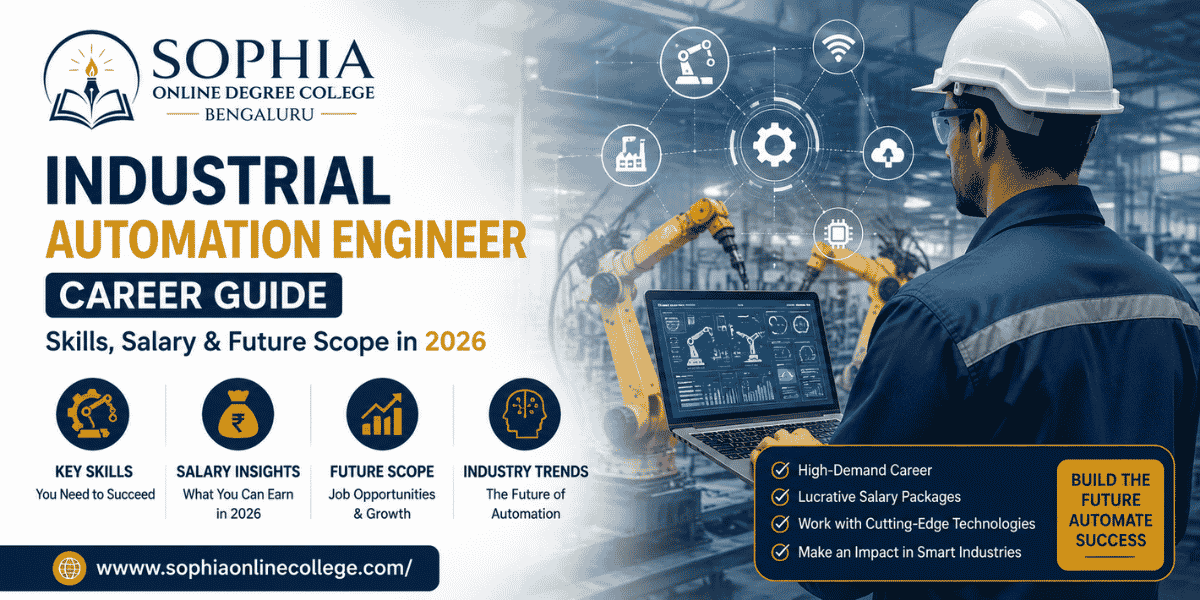
The manufacturing industry is undergoing a massive digital transformation, creating exciting opportunities for professionals who can design, manage, and optimize automated systems. As industries embrace smart factories, robotics, Industrial IoT (IIoT), and AI-driven production, the demand for an Industrial Automation Engineer Career continues to grow. If you’re passionate about engineering, technology, and innovation, an Industrial Automation Engineer Career offers excellent salary potential, global job opportunities, and long-term stability. In this guide, you’ll learn about the skills, career paths, tools, industries, and future scope that make an Industrial Automation Engineer Career one of the most promising engineering professions in 2026.
What is an Industrial Automation Engineer?
An Industrial Automation Engineer designs, develops, programs, and maintains automated systems that improve manufacturing efficiency and reduce manual intervention. They work with Programmable Logic Controllers (PLCs), SCADA systems, Human Machine Interfaces (HMIs), sensors, robotics, and Industrial IoT devices to automate industrial processes.
An Industrial Automation Engineer Career involves optimizing production lines, reducing downtime, improving product quality, and ensuring workplace safety. These professionals play a crucial role in industries such as automotive, pharmaceuticals, oil & gas, food processing, electronics, and energy.
Students pursuing Engineering distance education can also prepare for this career by gaining practical knowledge through automation certifications, technical workshops, and industrial projects.
Why Choose an Industrial Automation Engineer Career in 2026?
Technology is reshaping every manufacturing sector. Smart factories now rely on intelligent machines that communicate, analyze data, and make real-time decisions. As a result, organizations require skilled automation professionals more than ever before.
Here are the key reasons why an Industrial Automation Engineer Career is an excellent choice:
- Growing adoption of Industry 4.0
- Rising demand for Industrial IoT professionals
- Increasing investment in smart manufacturing
- High salary packages
- Strong global employment opportunities
- Opportunities in robotics and AI integration
- Career growth into management and consulting roles
Graduates from a B.Tech correspondence college in India can strengthen their careers by combining engineering knowledge with industrial automation certifications and hands-on experience.
Traditional Manufacturing vs Smart Industrial Automation
| Traditional Manufacturing | Smart Industrial Automation |
| Manual production processes | Fully automated production lines |
| Higher human intervention | AI-assisted operations |
| Frequent production errors | High precision and consistency |
| Reactive maintenance | Predictive maintenance |
| Slower production cycles | Faster manufacturing output |
| Higher operating costs | Improved efficiency and lower costs |
Is an Industrial Automation Engineer Career Right for You?
Choosing an engineering specialization should align with your interests and career goals. An Industrial Automation Engineer Career is ideal if you:
- Enjoy solving technical problems.
- Have an interest in electrical and electronic systems.
- Like programming and automation technologies.
- Enjoy working with machines and industrial equipment.
- Are curious about robotics and Artificial Intelligence.
- Prefer practical engineering applications over theoretical work.
- Want a career with global opportunities.
Automation engineering combines software, electronics, mechanical systems, and industrial processes, making it one of the most dynamic engineering careers today.
Essential Skills Required for an Industrial Automation Engineer Career
Success in an Industrial Automation Engineer Career requires a combination of technical expertise and professional skills.
Technical Skills
PLC Programming
Programmable Logic Controllers (PLCs) are the foundation of industrial automation. Engineers must understand programming, troubleshooting, and system integration.
SCADA Systems
Supervisory Control and Data Acquisition (SCADA) systems help monitor and control industrial operations remotely.
HMI Development
Human Machine Interface (HMI) software allows operators to interact with automated systems effectively.
Industrial Robotics
Knowledge of robotic arms, automated assembly lines, and robotic process control is increasingly valuable.
Industrial IoT (IIoT)
Connected devices collect and analyze real-time production data, improving operational efficiency.
Control Systems
Understanding PID controllers, motors, drives, sensors, and actuators is essential.
Electrical Engineering Fundamentals
Strong knowledge of electrical circuits, instrumentation, and industrial wiring supports automation system design.
Basic Programming
Python, C, and industrial programming languages help automate tasks and integrate systems.
Students pursuing IT distance education can improve their automation knowledge by learning programming alongside industrial technologies.
Soft Skills That Employers Value
Technical knowledge alone isn’t enough. Employers also seek professionals with strong interpersonal abilities.
Important soft skills include:
- Analytical Thinking
- Problem Solving
- Team Collaboration
- Communication Skills
- Leadership
- Time Management
- Adaptability
- Continuous Learning
Automation engineers frequently work with multidisciplinary teams, making communication and teamwork essential.
Best Software & Tools Every Automation Engineer Should Learn
Learning industry-standard software improves employability and career growth.
Popular automation tools include:
- Siemens TIA Portal
- Allen-Bradley RSLogix
- Wonderware SCADA
- Ignition SCADA
- Factory I/O
- AutoCAD Electrical
- MATLAB
- Python
- WinCC
- Schneider EcoStruxure
- ABB Automation Studio
Hands-on experience with these platforms gives aspiring engineers a competitive advantage during recruitment.
Career Opportunities After Learning Industrial Automation
An Industrial Automation Engineer Career opens doors to numerous specialized roles across industries.
PLC Programmer
Designs and develops PLC programs for industrial automation systems.
Automation Engineer
Implements automation solutions for manufacturing plants.
SCADA Engineer
Develops monitoring and supervisory control systems.
Control Systems Engineer
Designs and optimizes industrial control systems.
Robotics Engineer
Works with industrial robots used in manufacturing and production.
Industrial IoT Engineer
Develops connected automation solutions using smart sensors and cloud platforms.
Commissioning Engineer
Installs, tests, and validates industrial automation equipment before production begins.
Maintenance Automation Engineer
Ensures smooth operation of automated production systems and minimizes downtime.
Industries Hiring Industrial Automation Engineers
Automation has expanded beyond manufacturing into multiple industries.
Major recruiters include:
- Automotive Manufacturing
- Electronics Manufacturing
- Oil & Gas
- Pharmaceuticals
- Food & Beverage
- Chemical Industries
- Power Plants
- Renewable Energy
- Aerospace
- Smart Manufacturing Companies
- Logistics & Warehousing
Students pursuing Diploma in Engr correspondence college in India programs can also enter automation careers by developing practical PLC, SCADA, and industrial control skills.
How Education Supports an Industrial Automation Engineer Career?
A strong educational foundation helps professionals understand automation principles and emerging technologies. Students can begin with diploma programs, undergraduate engineering degrees, or postgraduate specializations. Those studying through distance education in bangalore can enhance their learning by completing industry-recognized certifications, internships, and project-based training.
Likewise, professionals enrolled in an M.Tech correspondence college in Karnataka can deepen their expertise in automation, control systems, and Industrial IoT, making them well-prepared for leadership roles in smart manufacturing and Industry 4.0 environments.
Industrial Automation Engineer Salary in India
One of the biggest reasons students choose an Industrial Automation Engineer Career is the attractive salary and long-term growth potential. As more industries adopt smart manufacturing, Industrial IoT, robotics, and AI-driven production systems, companies are willing to offer competitive compensation to skilled automation professionals.
Fresh graduates usually begin with entry-level positions such as PLC Programmer or Junior Automation Engineer. As professionals gain experience in PLC programming, SCADA, robotics, and industrial networking, their salaries increase significantly.
Average Salary Based on Experience
| Experience | Average Annual Salary |
| Fresher | ₹4–6 LPA |
| 1–3 Years | ₹6–10 LPA |
| 3–5 Years | ₹10–15 LPA |
| 5–8 Years | ₹15–22 LPA |
| 8+ Years | ₹25–40+ LPA |
Professionals who specialize in Industrial IoT, Robotics, or Automation Consulting often receive even higher salary packages.
Industrial Automation Engineer Salary in India Per Month
Many students prefer understanding monthly earnings before planning their careers. The monthly income of an automation engineer depends on technical skills, company, location, certifications, and industry experience.
Approximate monthly salaries include:
- Freshers: ₹35,000–₹50,000
- 1–3 Years: ₹50,000–₹85,000
- Mid-Level Engineers: ₹85,000–₹1.25 Lakhs
- Senior Automation Engineers: ₹1.5–₹3 Lakhs+
Professionals who continuously upgrade their knowledge through certifications and industrial projects usually experience faster salary growth.
Industrial Automation Engineer Salary in Dubai
Dubai has become one of the fastest-growing destinations for automation professionals due to large investments in smart infrastructure, oil & gas, logistics, and advanced manufacturing.
Typical salary ranges include:
- Entry-Level Engineers: AED 6,000–9,000 per month
- Mid-Level Engineers: AED 10,000–18,000 per month
- Senior Engineers: AED 18,000–30,000+ per month
Besides attractive salaries, professionals often receive additional benefits such as accommodation allowances, medical insurance, transportation, and annual air tickets.
An Industrial Automation Engineer Career in Dubai is ideal for engineers looking for international exposure and tax-free income.
Industrial Automation Engineer Salary in Canada
Canada has a growing demand for Industrial Automation Engineers due to increasing automation across manufacturing, automotive, aerospace, mining, and renewable energy sectors.
Average salaries include:
- Entry-Level: CAD 60,000–75,000 annually
- Mid-Level: CAD 75,000–95,000 annually
- Experienced Engineers: CAD 100,000–130,000+ annually
Automation professionals with expertise in PLCs, robotics, Industrial IoT, and smart factory technologies are particularly valued in Canada’s expanding industrial sector.
Industrial Automation Engineer Salary in Germany
Germany is globally recognized for advanced manufacturing and Industry 4.0 innovation, making it one of the best countries for automation professionals.
Average salaries include:
- Freshers: €45,000–55,000 annually
- Experienced Engineers: €60,000–80,000 annually
- Senior Automation Specialists: €90,000–110,000+ annually
German industries actively recruit engineers skilled in Siemens PLCs, SCADA systems, industrial robotics, and intelligent manufacturing technologies.
Step-by-Step Career Roadmap
Building a successful Industrial Automation Engineer Career requires a combination of education, technical knowledge, certifications, and practical experience.
Step 1: Complete Your Engineering or Diploma
Begin with Electrical Engineering, Electronics Engineering, Mechanical Engineering, Mechatronics, Instrumentation, or related disciplines. Students pursuing Engineering distance education can also prepare effectively through practical learning and certifications.
Step 2: Learn PLC Programming
Master Siemens, Allen-Bradley, Schneider Electric, and Mitsubishi PLC platforms.
Step 3: Understand SCADA & HMI
Learn monitoring systems like WinCC, Wonderware, Ignition, and FactoryTalk View.
Step 4: Explore Industrial IoT
Gain knowledge of connected sensors, cloud monitoring, predictive maintenance, and smart factories.
Step 5: Develop Programming Skills
Basic knowledge of Python, SQL, and industrial networking improves automation capabilities.
Step 6: Build Practical Projects
Create PLC simulations, SCADA dashboards, robotic automation projects, and IIoT applications.
Step 7: Earn Professional Certifications
Industry-recognized certifications greatly improve employability.
Step 8: Apply for Internships
Real industrial experience strengthens technical confidence and enhances career prospects.
Best Certifications for Industrial Automation Engineers
The right certifications help professionals stand out in the competitive job market.
Recommended certifications include:
- Siemens Certified PLC Programmer
- Rockwell Automation Certification
- Schneider Electric EcoStruxure Certification
- ISA Certified Automation Professional (CAP)
- ABB Robotics Certification
- Industrial IoT Professional Certification
- AWS Cloud Practitioner
- Microsoft Azure Fundamentals
Students from a B.Tech correspondence college in India often combine these certifications with academic qualifications to improve job opportunities.
Future Scope of Industrial Automation Engineer Career in 2026
The future of an Industrial Automation Engineer Career looks exceptionally strong. Industry 4.0 continues transforming factories into intelligent production environments where machines communicate, analyze data, and make automated decisions.
Emerging trends include:
- Smart Manufacturing
- AI-powered Production Systems
- Collaborative Robots (Cobots)
- Digital Twins
- Predictive Maintenance
- Industrial Cybersecurity
- Cloud-based Manufacturing
- Sustainable Smart Factories
These innovations will continue creating thousands of high-paying engineering jobs across India and globally.
Why Choose Sophia Online College?
Building a successful engineering career begins with choosing the right educational guidance. Sophia Online College supports students and working professionals by helping them explore flexible, recognized academic programs aligned with industry requirements.
Whether you are pursuing IT distance education, upgrading your qualifications through distance education in bangalore, or enrolling in an M.Tech correspondence college in Karnataka, Sophia Online College provides guidance that helps learners prepare for emerging careers in Industrial Automation, Robotics, Artificial Intelligence, and Industry 4.0.
With flexible learning opportunities and career-focused support, Sophia Online College helps students confidently move toward future-ready engineering careers.
Conclusion
The demand for skilled automation professionals is increasing rapidly as industries adopt advanced technologies and smart manufacturing practices. An Industrial Automation Engineer Career offers excellent salary potential, international opportunities, and continuous career growth. By learning PLC programming, SCADA systems, Industrial IoT, robotics, and automation technologies, aspiring engineers can build rewarding careers across manufacturing, healthcare, automotive, energy, and logistics sectors. Whether you pursue a diploma, engineering degree, or specialized certification, continuous learning and practical experience remain the keys to success in this exciting field.
Start Your Industrial Automation Journey Today
Looking to build a successful engineering career in automation, robotics, and smart manufacturing? Sophia Online College helps students choose flexible and recognized educational pathways that align with the latest industry demands. Take the first step toward a future-ready career by exploring programs designed to support your professional growth and technical expertise.
FAQs
1. What does an Industrial Automation Engineer do?
An Industrial Automation Engineer is responsible for designing, programming, testing, and maintaining automated systems used in manufacturing plants and industrial facilities. These professionals work with PLCs, SCADA systems, HMIs, robotics, sensors, and Industrial IoT technologies to improve productivity, reduce operational costs, and ensure smooth production processes. They also troubleshoot equipment, optimize machine performance, and support digital transformation initiatives within organizations. Students pursuing Engineering distance education can prepare for this career by developing practical automation skills through certifications, industrial training, and real-world projects. Strong technical expertise and continuous learning help automation engineers build successful careers across multiple industries.
2. Is Industrial Automation a good career in 2026?
Yes, Industrial Automation is expected to remain one of the fastest-growing engineering careers in 2026 due to the rapid adoption of Industry 4.0, smart factories, robotics, and Industrial IoT. Companies worldwide are investing in automation technologies to improve efficiency, reduce production costs, and increase operational safety. This growing demand has created excellent job opportunities for skilled automation professionals. Students graduating from a B.Tech correspondence college in India or traditional engineering programs can strengthen their career prospects by learning PLC programming, SCADA systems, and industrial robotics. With attractive salaries, global demand, and long-term career stability, Industrial Automation offers an excellent future.
3. Which engineering branch is best for Industrial Automation?
Several engineering branches provide an excellent foundation for Industrial Automation, including Mechanical Engineering, Electrical Engineering, Electronics Engineering, Instrumentation Engineering, Mechatronics, and Computer Science. Each discipline contributes valuable technical knowledge required for automation systems, robotics, control engineering, and Industrial IoT applications. However, success in this field depends not only on academic qualifications but also on practical experience and certifications. Students pursuing an M.Tech correspondence college in Karnataka program can further specialize in automation technologies, control systems, and smart manufacturing, enabling them to qualify for advanced engineering and leadership positions in industrial automation.
4. What skills are required for Industrial Automation Engineers?
Industrial Automation Engineers require a strong combination of technical and professional skills. Essential technical competencies include PLC programming, SCADA, HMI development, industrial networking, robotics, electrical control systems, Industrial IoT, and basic programming languages such as Python. Soft skills like analytical thinking, communication, teamwork, troubleshooting, and project management are equally important because automation engineers often work on complex industrial projects. Students pursuing IT distance education can strengthen their technical expertise by learning automation software, participating in practical workshops, and earning globally recognized certifications, making them more competitive in today’s evolving engineering job market.
5. What is the average salary of an Industrial Automation Engineer in India?
Industrial Automation Engineers enjoy competitive salaries due to the increasing demand for skilled professionals in smart manufacturing and Industry 4.0. Fresh graduates typically earn between ₹4–6 LPA, while engineers with three to five years of experience often receive ₹10–15 LPA. Senior professionals specializing in Industrial IoT, robotics, and automation consulting can earn ₹20 LPA or more. Salary growth depends on technical expertise, certifications, project experience, and the industry sector. Professionals who continuously upgrade their skills through industrial training and practical automation projects generally experience faster career progression and higher earning potential.
6. Can diploma students become Automation Engineers?
Yes, diploma holders can successfully build careers in Industrial Automation by developing practical technical skills and gaining industry experience. Students graduating from a Diploma in Engr correspondence college in India or regular diploma programs can learn PLC programming, SCADA systems, HMI design, industrial instrumentation, and robotics through specialized training. Many employers value hands-on knowledge, troubleshooting abilities, and automation certifications alongside academic qualifications. By completing internships, working on industrial projects, and continuously upgrading technical expertise, diploma graduates can secure rewarding positions as PLC Programmers, Automation Technicians, Maintenance Engineers, and Industrial Automation Engineers.
7. Which certifications are best for Industrial Automation?
Professional certifications significantly improve employability and technical expertise in Industrial Automation. Popular certifications include Siemens PLC Certification, Rockwell Automation Certification, Schneider Electric EcoStruxure Certification, ISA Certified Automation Professional (CAP), ABB Robotics Certification, Industrial IoT Professional Certification, AWS Cloud Practitioner, and Microsoft Azure Fundamentals. These programs provide practical knowledge of automation systems, industrial communication, robotics, and cloud technologies used in modern manufacturing. Students pursuing Engineering distance education can complement their academic learning with these certifications to strengthen their resumes, improve technical skills, and increase opportunities for high-paying automation careers in India and abroad.
8. Which industries hire Industrial Automation Engineers?
Industrial Automation Engineers are employed across a wide variety of industries that rely on automated production systems and smart manufacturing technologies. Major recruiters include automotive manufacturers, pharmaceutical companies, oil and gas organizations, food processing industries, renewable energy companies, electronics manufacturers, aerospace firms, logistics providers, chemical industries, and power plants. As automation continues expanding globally, demand for engineers skilled in PLC programming, robotics, Industrial IoT, and control systems remains exceptionally strong. Students pursuing distance education in bangalore can prepare for these opportunities by combining academic qualifications with automation certifications, practical projects, and industry-focused technical training, ensuring excellent long-term career prospects.