

An educational and career guide for students, graduates, working professionals and learners returning to higher education.
Environmental Science is more than the study of forests, wildlife or pollution. It helps us understand how the natural world works, how human activities affect it and what can be done to create healthier, more sustainable communities. For students exploring science-related education, it can open pathways into conservation, environmental research, sustainability, waste management and environmental planning.
If you are comparing science programmes, researching BSc Environmental Science distance learning options or looking at online degree courses in Bangalore, it is important to understand the subject before choosing a qualification. The right course should match your educational background, interests and career plans – not simply offer a convenient mode of study.
This guide explains what Environmental Science involves, which courses students can consider, the skills they may develop, eligibility requirements and the career opportunities available in India.
What Is Environmental Science?
Environmental Science is the study of the environment and the relationships between living organisms, natural resources and human activities. It combines ideas from biology, chemistry, physics, geography, geology and social sciences to understand environmental conditions and address ecological challenges.
Think about the air you breathe, the water you drink, the food you eat and the land on which your community is built. All these elements are connected. A change in one part of the environment can affect several others.
For example, when a lake becomes polluted, the impact is not limited to the water. Fish and other aquatic organisms may be affected, nearby communities may lose a water source, and local livelihoods can suffer. Environmental Science helps us investigate these connections and understand how such problems can be prevented or managed.
The subject explores questions such as:
- How does air pollution affect human health and ecosystems?
- Why are forests important for biodiversity and climate regulation?
- What happens when groundwater is used faster than it can be replenished?
- How can cities manage waste more responsibly?
- What can industries do to reduce their environmental impact?
- How can communities prepare for climate-related risks?
Rather than focusing on only one natural resource, Environmental Science looks at the wider picture. It studies how natural systems function and how people can make informed decisions about protecting them.
Why Does Environmental Science Matter Today?
Environmental concerns are no longer limited to scientists or conservation organisations. They influence public health, agriculture, urban development, business operations, government planning and everyday life.
Consider the environmental challenges people encounter around them.
Climate change: Changes in temperature and rainfall patterns can affect agriculture, water availability, coastal areas and ecosystems. Understanding these changes helps communities and organisations plan for environmental risks.
Air and water pollution: Industrial emissions, vehicle exhaust, untreated wastewater and other pollutants can affect the quality of natural resources. Environmental professionals help study pollution sources and support monitoring and management measures.
Loss of biodiversity: Habitat destruction, pollution, invasive species and changing climate conditions can put plants and animals under pressure. Conservation work helps protect ecosystems and maintain ecological balance.
Waste management: Growing cities produce large quantities of household, commercial and industrial waste. Responsible collection, segregation, recycling and treatment are important parts of environmental management.
Resource conservation: Water, forests, soil and minerals support human life and economic activity. Their responsible use is essential for long-term development.
These challenges explain why Environmental Science is relevant to several sectors. It provides knowledge that can support environmental protection, responsible development and better resource management.
How Environmental Science Connects Nature, People and Technology?
One reason this field is interesting is that it does not operate in isolation. Environmental problems often involve natural processes, human behaviour and technical solutions at the same time.
| Area of study | What students explore | Practical relevance |
| Ecology | Relationships between organisms and their surroundings | Understanding ecosystems and biodiversity |
| Environmental Chemistry | Chemical substances in air, water and soil | Studying contamination and pollution |
| Climate Science | Climate patterns and environmental change | Understanding climate risks |
| Environmental Geography | Land use, natural resources and spatial patterns | Supporting environmental planning |
| Environmental Management | Planning and managing environmental responsibilities | Supporting organisations and communities |
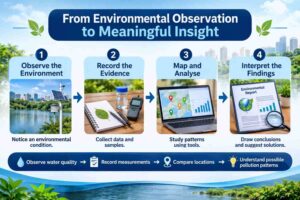
Technology also plays an important role. Geographic Information Systems (GIS), satellite imagery, environmental sensors, laboratory instruments and data analysis tools can help professionals monitor environmental conditions.
For example, satellite images can help researchers observe changes in forest cover. Water-testing equipment can help identify contamination. Mapping tools can help planners understand areas exposed to flooding.
This combination of scientific knowledge and practical tools makes Environmental Science a broad and evolving subject.
Skills Needed to Understand and Solve Environmental Problems
A student does not need to know everything about environmental protection before entering this field. However, developing certain abilities can make learning more effective and prepare students for future responsibilities.
Scientific curiosity: Environmental Science involves asking questions, observing natural processes and understanding why environmental changes occur.
Analytical thinking: Students learn to interpret information, compare findings and identify possible reasons behind environmental problems.
Research skills: Reading scientific material, collecting information, reviewing reports and presenting findings are useful across academic and professional roles.
Communication: Environmental professionals often explain technical issues to communities, colleagues, government bodies and organisations. Clear communication helps turn scientific information into practical action.
Problem-solving: Environmental challenges rarely have one simple solution. Students need to consider environmental, social and economic factors before suggesting improvements.
Data and digital skills: Basic computer knowledge, spreadsheets, mapping tools and data interpretation can support environmental research and reporting.
Teamwork: Field studies, research projects and environmental initiatives often involve people from different academic and professional backgrounds.
These skills can develop through coursework, projects, practical assignments, field exposure and professional experience. Students should therefore look beyond the course title and examine the actual learning opportunities offered by a programme.
Environmental Science in Everyday Life: A Few Practical Examples
The subject becomes easier to understand when connected to familiar situations.
- A city studying its waste collection system may use environmental data to identify areas that need better waste segregation.
- A farmer adopting soil and water conservation methods may reduce resource loss and support more sustainable agricultural practices.
- A company reviewing its energy use may identify opportunities to reduce waste and improve efficiency.
- A local organisation restoring a lake may work with environmental experts to understand water quality and ecosystem conditions.
Each example demonstrates that environmental knowledge can contribute to decisions made at different levels—from neighbourhood initiatives to large organisations.
What Do Environmental Science Students Learn?
Environmental Science programmes generally introduce students to the natural environment, ecological systems, environmental challenges and methods of managing resources.
The exact subjects depend on the university, course level and curriculum. An undergraduate programme usually establishes scientific foundations, while postgraduate study may provide more specialised or research-oriented learning.
Some commonly covered subject areas include:
- Fundamentals of Environmental Science
- Ecology and Ecosystem Studies
- Biodiversity and Conservation
- Environmental Chemistry
- Environmental Pollution
- Climate Change and Global Warming
- Natural Resource Management
- Environmental Impact Assessment
- Waste Management
- Environmental Laws and Policies
- Research Methods and Data Interpretation
Students may also encounter practical assignments, case studies, laboratory work, field observations or research projects, depending on the programme.
For example, a lesson on water pollution may introduce the sources of contamination, how water quality is assessed and why polluted water affects ecosystems and communities. A later project might ask students to examine a local environmental issue and present possible management approaches.
When comparing programmes, check whether the syllabus offers a useful balance of scientific foundations, practical learning and current environmental topics.
Types of Environmental Science Courses Available
Students can enter the field at different educational levels. The right choice depends on their previous qualification and how deeply they want to study the subject.
| Course type | Typical entry level | Main learning direction |
| Certificate course | Varies by institution | Introduction to a specific environmental topic |
| Diploma course | Varies by programme | Applied knowledge in selected environmental areas |
| BSc Environmental Science | After Class 12, subject to eligibility | Undergraduate scientific foundations |
| MSc Environmental Science | After a relevant bachelor’s degree, subject to eligibility | Advanced study, specialisation and research |
| PhD in Environmental Science | After the required postgraduate qualification | Independent research and specialised investigation |
Certificate and diploma programmes
Short-term programmes may introduce topics such as environmental awareness, waste management, sustainability, conservation or environmental management. They can be useful for learners who want focused knowledge, although they are not automatically equivalent to a bachelor’s or master’s degree.
Bachelor of Science in Environmental Science
A BSc programme provides a foundation in environmental systems, ecology, pollution, biodiversity and related scientific subjects. It may suit students who have completed Class 12 and want to begin their higher education in this area.
Master of Science in Environmental Science
An MSc programme builds on undergraduate knowledge. Depending on the institution, students may study advanced environmental management, climate science, conservation, pollution control, research methods and related topics.
Students researching online msc specializations should examine whether the programme is genuinely offered in their preferred mode, whether the institution is authorised to offer it and whether the curriculum matches their career plans.
Doctoral research
Students interested in academic research or specialised investigation may consider doctoral study after meeting the relevant admission requirements. Research areas may include climate adaptation, biodiversity, environmental chemistry, water management or sustainable development.
Eligibility: Who Can Study Environmental Science?
Eligibility varies across universities and programmes. Students should always refer to the official admission prospectus for the specific academic session.
After Class 12
Students who have completed higher secondary education may be eligible to apply for an undergraduate Environmental Science programme, depending on the institution’s subject and minimum-mark requirements.
Some universities prefer applicants with a science background, while eligibility rules can differ across programmes.
After graduation
Graduates who want to specialise may consider an MSc in Environmental Science or a related discipline. Depending on the university, eligible undergraduate backgrounds may include Environmental Science, Biology, Chemistry, Zoology, Botany, Geography, Agriculture or other relevant subjects.
For working professionals
Working professionals may explore flexible learning options if they meet the programme’s eligibility criteria. Before enrolling, they should check whether the course includes mandatory practical sessions, laboratory attendance, fieldwork or examinations at designated centres.
For students returning to education
Learners who have taken a break after school or graduation should not assume that they have lost the opportunity to continue studying. They can review current admission rules, required documents and any applicable age or subject conditions.
Can You Study Environmental Science Through Distance or Online Learning?
Flexible learning can be attractive to students who cannot attend a regular college every day. Working professionals, people with family responsibilities and learners returning to education may find online or distance programmes worth exploring.
However, there is an important distinction between studying environmental concepts online and completing a qualification that requires practical scientific training.
Environmental Science may involve laboratory procedures, field observations, sample collection, environmental monitoring and project work. These activities can be important parts of a programme, so students should not assume that every course can be completed entirely from home.
If you are searching for online degree courses in karnataka, compare the programme’s official recognition, delivery method, practical requirements, examination arrangements and student support.
Similarly, learners exploring online degree courses in Bangalore should verify that the institution is authorised to offer the particular programme in the chosen mode for the relevant academic session.
The phrase BSc Environmental Science distance learning may appear in course searches, but the availability and approval of a specific programme must be confirmed directly with the university. Do not treat a general online science degree as an automatic substitute for a practical Environmental Science qualification.
What Should You Check Before Choosing a Flexible Programme?
A course may look convenient on a website, but students should investigate the details before making an admission decision.
Use these points as a guide:
- Recognition and approval: Verify the institution and programme through the relevant official regulatory information for the academic session.
- Mode of delivery: Understand whether the programme is online, distance, regular or blended.
- Practical requirements: Check whether laboratory work, field visits, internships or project submissions are compulsory.
- Examination arrangements: Find out how assessments are conducted and whether you must attend an examination centre.
- Curriculum: Compare subjects, electives and research components.
- Student support: Review access to academic guidance, learning materials and administrative assistance.
- Progression options: Check whether the qualification meets the eligibility requirements for further study.
For official information on environmental programmes and related government initiatives, students can explore the Ministry of Environment, Forest and Climate Change. It provides a useful starting point for understanding India’s environmental policy and institutional landscape.
Practical Learning: Why It Matters in This Field
Environmental Science is not only about reading theories. It also involves understanding how environmental conditions are observed, measured and interpreted.
Depending on the course, practical learning may include:
Laboratory activities: Students may learn about water, soil or other environmental samples and the basic principles behind testing and analysis.
Field observations: Visits or field exercises can help students understand ecosystems, local pollution sources, land use and conservation challenges.
Research assignments: Students may collect information, review existing studies, organise evidence and communicate their findings.
Case studies: Reviewing real environmental projects can help students understand how environmental decisions are made and what challenges professionals encounter.
Digital tools: Mapping applications, spreadsheets and data visualisation tools can help organise and interpret environmental information.
For learners considering flexible study, it is especially important to understand how a programme handles these practical components. A course that explains its learning and assessment arrangements clearly can help students make a more informed decision.
Career Opportunities After Environmental Science
Environmental Science can lead towards several career areas. However, the job a graduate can pursue depends on their qualification level, practical experience, technical skills and the requirements of the employer.
Some roles are suitable for entry-level graduates, while others may require postgraduate education, specialised training, professional experience or additional certifications.
Here are some broad career directions to explore.
Environmental Research Assistant
Research assistants support studies involving environmental conditions, ecosystems, pollution or natural resources. Their responsibilities may include collecting information, organising data, reviewing research and assisting senior researchers.
Environmental Consultant
Environmental consultants help organisations understand environmental responsibilities and assess the potential effects of projects or business activities. Depending on the role, they may contribute to environmental assessments, compliance documentation and management recommendations.
Some consultancy positions require specific technical expertise and experience, so a degree alone may not be sufficient.
Environmental Officer or Coordinator
Environmental officers and coordinators may support environmental procedures within organisations. Their work can involve documentation, monitoring, awareness programmes, compliance support and coordination with different teams.
Conservation and Biodiversity Assistant
People interested in wildlife, habitats and ecosystems may explore opportunities with conservation projects, research organisations and environmental initiatives. These roles may involve field observations, documentation and community engagement.
Waste Management and Resource Management Professional
Waste management organisations, local bodies and industries need people who understand waste segregation, treatment, recycling and responsible resource use. Graduates may support operational, research or coordination activities.
Sustainability Coordinator
Sustainability-related roles may involve tracking resource consumption, supporting environmental initiatives, preparing reports and helping organisations improve their environmental practices.
Employers may prefer candidates with additional knowledge of sustainability reporting, data analysis or environmental management systems.
Where Can Environmental Science Graduates Work?
The field is connected to several sectors, so career opportunities are not limited to one type of employer.
| Sector | Possible work areas |
| Government departments | Environmental programmes, research support and resource management |
| Environmental consultancies | Environmental assessments, documentation and monitoring |
| Research institutions | Environmental studies, laboratory support and data collection |
| NGOs and development organisations | Conservation, community projects and awareness programmes |
| Industries | Environmental compliance, waste management and sustainability support |
| Education and outreach | Environmental education, communication and project support |
| Conservation organisations | Biodiversity, habitat protection and field-based initiatives |
Government-related opportunities may be advertised through recruitment notifications, project appointments, research fellowships and other selection processes. Requirements vary, and some posts require postgraduate qualifications or examinations.
Students interested in environmental regulation and public-sector work can explore the Central Pollution Control Board website. It provides information about pollution monitoring, environmental standards and related activities in India.
Salary Expectations: What Can Environmental Science Graduates Earn?
Salary expectations are an important part of career planning, but there is no single salary figure that applies to every Environmental Science graduate.
Earnings can differ depending on:
- Educational qualification and specialisation.
- Type of employer and industry.
- Location of the job.
- Practical and technical skills.
- Relevant internships or work experience.
- Responsibilities associated with the position.
- Whether the role is project-based, permanent or research-focused.
For example, an entry-level research assistant may have different responsibilities and compensation from an experienced environmental consultant. A professional working in an industrial sustainability team may need a different combination of skills from someone involved in field-based conservation.
Instead of choosing a course based only on advertised salary figures, students should research actual job descriptions and identify the qualifications employers expect.
A useful approach is to review several job advertisements for the career area that interests you. Note the degree requirements, software skills, experience expectations and additional training mentioned. This will give you a more realistic picture of what you may need to develop.
Emerging Opportunities: Sustainability, Climate Action and Environmental Management
Environmental concerns are increasingly connected with how organisations plan their operations and use resources. As a result, students may wish to explore newer areas alongside traditional environmental science roles.
Climate adaptation and resilience
Communities and organisations need to understand climate-related risks and prepare for possible effects on agriculture, infrastructure, water resources and livelihoods.
Corporate sustainability
Businesses may recruit professionals to support resource efficiency, environmental reporting, waste reduction and sustainability initiatives.
Renewable energy and resource efficiency
The transition towards cleaner energy and more efficient resource use creates opportunities across technical, research, project coordination and environmental assessment activities.
Environmental data and mapping
Digital mapping, satellite imagery and data analysis can support work involving land use, forest monitoring, disaster risk and environmental planning.
Water and waste management
Growing urban populations and industrial activity increase the importance of water conservation, wastewater treatment, recycling and responsible waste management.
Environmental education and community engagement
Public awareness and participation are important to environmental initiatives. Professionals who can communicate environmental information clearly may contribute to educational programmes and community projects.
India’s environmental programmes and biodiversity priorities can also be explored through the National Biodiversity Authority. Its resources provide context on biodiversity conservation and the country’s approach to protecting biological resources.
How to Choose the Right Environmental Science Course
Choosing a course is a decision that deserves more attention than simply comparing fees or study duration. Your current qualification, preferred career area and learning requirements should guide the process.
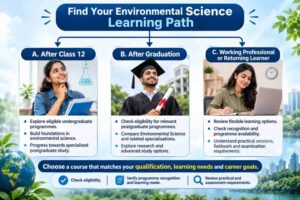
Start with your academic background
If you have completed Class 12, investigate undergraduate programmes and their subject requirements. If you already hold a bachelor’s degree, compare relevant postgraduate programmes and their eligibility conditions.
Decide what interests you most
Environmental Science covers a wide range of subjects. Ask yourself whether you are more interested in:
- Wildlife and biodiversity.
- Climate change and environmental research.
- Pollution monitoring and control.
- Water and waste management.
- Sustainability and environmental planning.
- Environmental policy and community development.
Your preferred area can help you identify useful subjects and specialisations.
Compare the syllabus
Look beyond the programme name. Read the course structure and identify the subjects, electives, practical work and project requirements.
Check the learning format
If you need flexibility, explore whether a recognised online or distance programme is available in your chosen subject. Do not assume that a course is offered in every mode.
Understand the total cost
Compare tuition fees, examination charges, practical expenses, learning materials and any other applicable costs. Students searching for affordable online degrees should consider the overall value and recognition of the qualification, not just the lowest advertised fee.
Investigate future study options
If you plan to pursue postgraduate study or research, check whether the undergraduate qualification meets the entry requirements of the programmes you may want to join later.
Review career requirements
Look at job advertisements, employer expectations and relevant professional requirements. This can help you decide whether you need additional practical training, software knowledge or a specialisation.
How SODC Can Help You Explore Higher-Education Options?
Choosing a course becomes easier when you first understand your academic background, learning preferences and future goals.
For students, working professionals and learners returning to education, Sophia Online Degree College Bangalore can be a starting point for exploring higher-education options and understanding available learning pathways.
If you are comparing online degree courses in bangalore, take time to understand the programme, eligibility requirements, mode of learning and recognition before making an admission decision.
Sophia Online Degree College Bangalore encourages learners to make informed academic choices based on their interests and long-term plans. Students interested in science-related education should verify the specific programme availability and eligibility rather than assuming that every subject is offered in every learning mode.
You can explore the available courses through SODC and contact the institution for guidance on suitable programmes.
For anyone considering a course in Environmental Science, remember that academic study is only one part of career preparation. Practical exposure, research ability, technical skills and a clear understanding of the chosen career area can also make a difference.
Your Next Step: Make an Informed Course Decision
Environmental Science is a field for people who want to understand the relationship between nature, society and development. It brings together scientific knowledge and practical problem-solving, with applications in conservation, research, sustainability, pollution management and environmental planning.
You do not need to finalise a career direction immediately. Begin by understanding the subject, checking the eligibility requirements and comparing the courses that match your educational background.
If you are a Class 12 student, explore suitable undergraduate options. If you are already a graduate, investigate relevant postgraduate programmes. If you are working or returning to education after a break, compare flexible learning options while checking practical and recognition requirements carefully.
“Students interested in building a career in library management and information services can explore Library Science courses to understand the eligibility requirements, course options and career opportunities in this field.”
Frequently Asked Questions about Environmental Science
1. What is Environmental Science in simple words?
Environmental Science is the study of the natural environment and how humans interact with it. It covers topics such as air, water, soil, ecosystems, climate change, pollution and conservation.
2. Is Environmental Science a good course to study?
It can be a suitable choice for students interested in nature, scientific research, sustainability and environmental problem-solving. The value of the course depends on the student’s interests, the programme quality and the skills developed during study.
3. What can I do after completing a BSc in Environmental Science?
Graduates may explore entry-level opportunities in research support, environmental monitoring, conservation projects, waste management, sustainability coordination and environmental documentation. Some roles require further study or specialised training.
4. What is the eligibility for BSc Environmental Science?
Eligibility depends on the university. Many undergraduate programmes require completion of Class 12, with subject requirements and minimum marks determined by the institution.
5. Can I study Environmental Science after completing a BA or BCom?
It depends on the programme. Some postgraduate courses require a science-related bachelor’s degree, while other environmental or sustainability programmes may accept graduates from broader academic backgrounds. Always check the official eligibility criteria.
6. Is Environmental Science available through distance education?
Availability varies by university and academic session. Students should verify whether the specific programme is approved in distance or online mode and whether practical sessions, fieldwork or laboratory activities are required.
7. What is the difference between Environmental Science and Environmental Studies?
Environmental Science generally places greater emphasis on scientific concepts, ecological processes, environmental chemistry and research methods. Environmental Studies may take a broader interdisciplinary approach that includes social, economic, political and policy perspectives. However, course content can overlap.
8. Can I pursue an MSc in Environmental Science after BSc Biology?
Many universities consider relevant Biology graduates for MSc Environmental Science, subject to their admission requirements. Check the specific programme’s accepted undergraduate subjects and minimum marks.
9. What skills are useful for an Environmental Science career?
Useful skills include research, analytical thinking, scientific observation, communication, data interpretation, problem-solving and teamwork. Depending on the role, GIS, laboratory techniques and environmental reporting skills may also be valuable.
10. What are the career opportunities in Environmental Science in India?
Possible career areas include environmental research, pollution monitoring, conservation, sustainability, waste management, environmental consulting, environmental education and resource management. Specific job eligibility depends on the employer and role.
Take the next step towards your education with Sophia Online Degree College Bangalore. Visit SODC to explore available courses or contact us to understand the options that may suit your academic goals.