
A ship may travel across oceans, but its journey depends on the complex machinery working below deck. A Marine Engineer is one of the professionals responsible for keeping that machinery safe, efficient and operational. If you enjoy engineering, problem-solving and understanding how large machines work, marine engineering could be an interesting career direction. However, before choosing a course, it is important to understand the qualifications, practical training and professional requirements involved. Students exploring an online engineering degree in India should also know that a general online engineering programme does not automatically qualify someone to work as a licensed marine engineer aboard a ship.
This guide explains the profession, available education routes, eligibility requirements, career opportunities, salary expectations and future developments in the maritime industry. It is designed to help students after Class 12, engineering graduates, diploma holders and working professionals make a more informed decision.
What Is Marine Engineering?
Marine engineering is a specialised branch of engineering concerned with the operation, maintenance, inspection and improvement of machinery and technical systems used on ships and other marine vessels.
Think about a large cargo ship travelling for several weeks. It needs a propulsion system to move, generators to supply electricity, pumps to manage water, cooling systems to control temperature and safety equipment to respond to emergencies. Marine engineers help ensure that these systems work correctly throughout the voyage.
Their responsibilities can include:
- Operating and maintaining main engines and auxiliary machinery.
- Inspecting pumps, compressors, boilers and other equipment.
- Monitoring fuel consumption and machinery performance.
- Identifying technical problems and arranging repairs.
- Following onboard safety procedures and environmental regulations.
- Maintaining technical records and coordinating with other engineering crew members.
Marine engineering is not limited to working on ships. Qualified professionals may also explore opportunities in shipyards, marine equipment companies, offshore operations, technical management and vessel maintenance.
What Does a Marine Engineer Actually Do on a Ship?
The engine room is one of the most important technical areas of a vessel. It contains machinery that supports propulsion, electrical power, temperature control and several other essential functions.
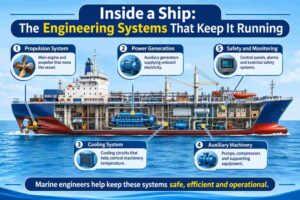
A marine engineer’s working day may involve routine inspections, equipment monitoring, maintenance planning and responding to unexpected machinery problems.
| Technical area | What the engineer looks after |
| Main propulsion system | Machinery responsible for moving the vessel |
| Auxiliary engines | Equipment supporting electricity generation |
| Pumps and compressors | Systems used for water, air and other onboard operations |
| Cooling systems | Temperature control for engines and machinery |
| Fuel and lubrication | Fuel handling, lubrication and machinery protection |
| Safety equipment | Machinery-related safety checks and emergency readiness |
For example, if a cooling system is not operating properly, the engineer must identify the cause before it affects the performance of connected machinery. This requires technical knowledge, careful observation and the ability to make decisions under pressure.
The work is practical rather than purely theoretical. Engineers must understand how systems operate, recognise warning signs and follow the correct procedures when equipment needs attention.
Marine Engineering vs. Other Engineering Fields
Students sometimes confuse marine engineering with mechanical engineering, naval architecture and general maritime studies. Although these areas are connected, their responsibilities are different.
| Engineering field | Main area of work |
| Marine Engineering | Operation and maintenance of machinery on ships |
| Mechanical Engineering | Machines, manufacturing systems and mechanical equipment across industries |
| Naval Architecture | Design, construction and performance of ships and marine structures |
| Electrical Engineering | Electrical equipment, power systems and control systems |
| Ocean Engineering | Engineering systems and structures used in ocean environments |
Mechanical engineering provides a broad technical foundation, while marine engineering focuses on machinery and systems used in the maritime environment.
Naval architecture, on the other hand, is more closely associated with ship design, structure, stability and hydrodynamic performance. These disciplines may work together during vessel construction, testing and operation.
Skills You Should Develop Before Entering the Field
Marine engineering requires more than an interest in ships. Professionals must understand technical systems and work responsibly in an environment where safety is important.
The following skills can help students prepare for this field.
Mechanical understanding: Knowledge of engines, machines, pumps, valves and mechanical systems helps engineers understand how equipment functions.
Problem-solving: Machinery problems may occur unexpectedly. Engineers need to identify possible causes and select appropriate solutions.
Mathematical ability: Engineering calculations, measurements and technical analysis require a good foundation in mathematics.
Attention to detail: Small changes in pressure, temperature, vibration or machinery performance can indicate a developing problem.
Communication: Engineers coordinate with other crew members, supervisors, technicians and shore-based teams.
Teamwork and discipline: Shipboard work involves shared responsibilities, established procedures and cooperation across departments.
Adaptability: Working at sea may involve long periods away from home, changing weather conditions and demanding schedules.
A student who enjoys practical science, machinery and technical problem-solving may find this profession worth exploring..
Which Courses Can Help You Become a Marine Engineer?
The appropriate course depends on your current education, intended job and the professional requirements of the maritime sector.
Students after Class 12 generally explore a dedicated undergraduate marine engineering programme. Engineering graduates may have other entry routes, depending on their branch, academic record and the current rules of the relevant authority.
A. B.Tech in Marine Engineering
A Bachelor of Technology in Marine Engineering is a specialised undergraduate programme designed to develop the engineering knowledge needed for marine machinery and shipboard operations.
The course commonly covers areas such as:
- Marine diesel engines.
- Thermodynamics.
- Fluid mechanics.
- Marine auxiliary machinery.
- Electrical and electronic systems.
- Ship construction and marine equipment.
- Engineering drawing and workshop practice.
- Safety and environmental studies.
The programme combines classroom learning with laboratory work, workshops and other practical components. The exact curriculum and training arrangements vary between institutions.
B. Diploma in Marine or Related Engineering
Diploma programmes can provide technical knowledge in engineering areas such as mechanical, electrical or marine-related systems.
However, students must understand that a diploma does not automatically provide eligibility for a seagoing marine engineer officer position. Entry into a specific maritime training pathway depends on the qualification accepted by the relevant authority and the approved course requirements.
Students researching online diploma courses in bangalore should carefully distinguish between general technical diplomas and maritime-approved training programmes. A course that teaches mechanical concepts online may be useful for learning, but it should not be assumed to meet the practical and regulatory requirements for shipboard employment.
C. Graduate Marine Engineering (GME) or Other Approved Graduate Routes
Some engineering graduates may be eligible for a Graduate Marine Engineering pathway or another approved route, depending on their degree discipline and the current admission requirements.
For example, mechanical engineering graduates may find postgraduate or conversion routes worth investigating. However, the exact accepted branches, minimum marks, age conditions, medical standards and training requirements must be checked before applying.
D. Postgraduate Study in Marine Engineering
Postgraduate study may help qualified engineers develop advanced technical knowledge or prepare for specialised roles.
Options can include marine engineering, marine engineering and management, naval architecture or related technical areas. The suitability of a postgraduate programme depends on the student’s previous degree and intended career.
Students looking for mtech courses in bangalore should compare the actual specialisation, eligibility and career outcomes rather than choosing a programme only because it has an engineering-related title.
Eligibility After Class 12
For students planning to enter marine engineering directly after school, the usual starting point is the science stream with Physics, Chemistry and Mathematics.
The exact eligibility conditions depend on the programme, institution, admission year and applicable maritime regulations.
Common requirements may include:
- Completion of Class 12 or an equivalent qualification.
- Physics, Chemistry and Mathematics as required subjects.
- Minimum aggregate marks in the specified subjects.
- Required marks in English.
- Meeting the prescribed age conditions.
- Medical fitness as applicable to the chosen programme.
- Qualifying through the relevant admission or entrance process.
For example, Indian Maritime University’s published course information for B.Tech Marine Engineering lists PCM subject requirements, minimum academic marks and medical-related conditions. Candidates should always refer to the current admission prospectus rather than relying on old eligibility information.
Can Diploma Holders and Engineering Graduates Enter Marine Engineering?
Yes, some candidates with existing technical qualifications may be able to explore alternative entry routes. However, eligibility is not the same for every diploma or engineering branch.
A mechanical engineering graduate, for instance, may have access to a graduate-level marine engineering pathway if the qualification and other conditions are accepted. A candidate with a different engineering specialisation may need to check whether their degree is recognised for the intended programme.
| Your current qualification | What you should investigate |
| Class 12 with PCM | Undergraduate Marine Engineering admission |
| Diploma in Mechanical Engineering | Accepted lateral-entry or graduate pathways, if available |
| B.E./B.Tech in Mechanical Engineering | Approved graduate marine engineering routes |
| B.E./B.Tech in another branch | Whether the specific branch is accepted |
| Existing marine engineering qualification | Advanced training and professional certification options |
Working professionals should also consider whether they can meet the practical training and sea-service requirements associated with a seagoing career.
If you are researching mtech for working professionals in bangalore, remember that a postgraduate engineering degree may support technical development, but it does not replace the specific maritime training and certification required for a shipboard engineering officer role.
Course Duration, Subjects and Practical Training
Marine engineering programmes combine engineering theory with practical exposure. The duration depends on the qualification and route selected.
| Course route | Typical study duration | Main learning focus |
| B.Tech Marine Engineering | Usually 4 years | Marine machinery, engineering fundamentals and practical training |
| Diploma in a related engineering field | Commonly 2–3 years, depending on entry level | Technical and mechanical fundamentals |
| Graduate Marine Engineering route | Programme-specific | Marine engineering preparation for eligible graduates |
| M.Tech in a related specialisation | Commonly 2 years | Advanced technical and research-oriented learning |
These are general course patterns, not a guarantee of eligibility for a maritime licence or seagoing position. Always verify the specific programme structure and its approval status.
Marine engineering students may study:
Marine propulsion: How engines and propulsion systems help ships move.
Thermodynamics: How heat, energy and mechanical work relate to engine operation.
Fluid mechanics: How liquids and gases behave in pipes, pumps and other systems.
Marine electrical systems: How electrical power is generated, distributed and used onboard.
Auxiliary machinery: How supporting equipment contributes to vessel operations.
Maintenance and repair: How machinery is inspected, serviced and restored.
Safety and environmental protection: How to reduce operational risks and comply with relevant maritime requirements.
Practical learning is particularly important because engineers must apply their knowledge to real equipment and operating conditions.
Why Approval and Recognition Matter
One of the most important decisions is selecting an institution and course that match your intended career.
Marine engineering is a regulated professional area. A programme may have an engineering-related name without being approved for the maritime training pathway you want to enter.
Before paying admission fees, check:
- Whether the institution is recognised or approved for the intended programme.
- Whether the specific course is approved for the relevant maritime training purpose.
- Whether the programme meets the current eligibility requirements.
- Whether practical training and workshop facilities are available.
- Whether sea training or other required training arrangements are explained clearly.
- Whether the institution provides transparent information about examinations and certification.
The Directorate General of Shipping provides information about approved maritime training institutes and courses. Use its official information to verify the institute and course rather than relying only on advertisements or admission agents.
Can an Online Engineering Degree Help You Become a Marine Engineer?
Online education can make engineering-related learning more accessible to students and working professionals. It may help learners develop theoretical knowledge, improve technical understanding or continue higher education while managing other responsibilities.
However, there is an important distinction between an academic engineering qualification and a professional maritime qualification.
A general online engineering degree in india should not be treated as an automatic route to becoming a licensed seagoing marine engineer. Shipboard engineering careers involve specific course approvals, practical training, medical fitness requirements, sea service and professional examinations.
Online learning may be useful for:
- Strengthening engineering fundamentals.
- Studying related technical subjects.
- Continuing education while working.
- Developing knowledge for suitable shore-based roles.
- Exploring further academic qualifications where eligible.
It is not a substitute for mandatory hands-on marine training or professional certification.
Students exploring online degree courses in bangalore or online degree courses in karnataka should therefore identify their intended career first. If the goal is to work aboard a merchant ship as an engineering officer, they should follow the relevant maritime-approved route. If the goal is a broader engineering or management career, they can compare recognised academic programmes that suit that direction.
Medical Fitness and Other Maritime Requirements
Academic eligibility is only one part of entering the seagoing profession. Candidates may also need to meet medical and physical fitness standards.
These standards are important because shipboard engineers work in an environment that can involve machinery noise, heat, confined spaces, rotating equipment and emergency situations.
Depending on the course and intended role, medical assessment may cover:
- General physical health.
- Hearing.
- Eyesight.
- Colour vision, where applicable.
- Other medical conditions relevant to safe shipboard duties.
The exact requirements can vary by programme and maritime rules. Candidates should obtain medical guidance from the appropriate authorised medical examiner and verify the current standards before making an admission decision.
What Happens After Completing Marine Engineering?
Completing an academic programme is an important milestone, but it may not be the final step towards becoming a qualified shipboard engineering officer.
Depending on the route, graduates may need to complete approved training, onboard experience, mandatory safety courses, documented sea service and professional examinations.
A simplified view of the journey may look like this:
| Career stage | What it involves |
| Academic education | Completing the required marine engineering programme |
| Approved practical training | Developing hands-on technical and safety knowledge |
| Initial shipboard training | Gaining supervised experience in the engine department |
| Professional examinations | Meeting the requirements for the relevant Certificate of Competency |
| Watchkeeping responsibilities | Taking on approved engineering duties at sea |
| Senior engineering roles | Progressing through required sea service, examinations and experience |
The exact sequence depends on the candidate’s entry route and applicable regulations. Students should ask their chosen institution how its programme connects with the required training and certification process.
Career Opportunities in Marine Engineering
Marine engineering can lead to different types of professional opportunities. Some involve working directly aboard ships, while others are based in ports, shipyards, technical offices and marine equipment companies.
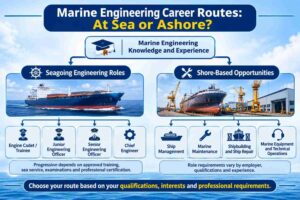
A. Seagoing Engineering Careers
Seagoing roles involve operating and maintaining the machinery onboard commercial vessels.
Possible career stages include:
- Engine Cadet or Trainee: Learns shipboard routines and assists with supervised engineering tasks.
- Fourth Engineer: Takes responsibility for assigned machinery and engineering duties after meeting the applicable requirements.
- Third Engineer: Handles greater technical responsibilities and machinery operations.
- Second Engineer: Supports the Chief Engineer and manages significant engine-room activities.
- Chief Engineer: Leads the ship’s engine department and holds major responsibility for machinery operations and technical safety.
Progression is based on required sea service, professional examinations, competence and experience. It is not simply a promotion that happens automatically after completing a degree.
B. Shore-Based Career Opportunities
Not every marine engineering professional remains at sea throughout their career. Technical knowledge and industry experience can also be relevant to land-based roles.
| Career area | What the work may involve |
| Ship Management | Coordinating vessel maintenance and technical operations |
| Marine Maintenance | Inspecting, repairing and servicing marine equipment |
| Shipbuilding and Shipyards | Supporting vessel construction, machinery installation and testing |
| Technical Superintendent | Monitoring vessel performance and maintenance from shore |
| Marine Equipment Companies | Working with engines, pumps, control systems and related products |
| Port and Offshore Operations | Supporting engineering and technical activities |
| Marine Surveying | Inspecting vessels and equipment, subject to relevant qualifications |
| Technical Training | Sharing engineering knowledge with students and trainees |
Some positions may require additional professional qualifications, industry experience or specialised certification.
Marine Engineer Salary Expectations in India
Salary is an important consideration, but marine engineering compensation can vary considerably. A trainee, a newly qualified watchkeeping engineer and an experienced Chief Engineer do not earn the same amount.
The earning potential may depend on:
- Professional rank and Certificate of Competency.
- Years of relevant experience and sea service.
- Shipping company and employment contract.
- Type of vessel, such as cargo, tanker, container or gas carrier.
- Flag state and operating region.
- Technical specialisations and additional certifications.
- Whether the role is seagoing or shore-based.
Seagoing compensation may be structured around active contracts and may include allowances or other benefits. Shore-based salaries are more likely to follow the employer’s location, role and experience requirements.
Rather than relying on a single salary figure found online, candidates should compare current job advertisements and verify whether quoted compensation refers to monthly pay while onboard, annual salary, contract earnings or total compensation.
A practical point: Higher professional ranks may offer stronger earning potential, but reaching them requires the necessary sea service, examinations, experience and responsibility. A course advertisement should never be treated as a salary guarantee.
Future Scope of Marine Engineering
The maritime industry is changing as shipping companies work towards better efficiency, improved safety and lower environmental impact.
These developments are creating new technical challenges and learning opportunities for marine engineering professionals.
Cleaner Fuels and Sustainable Shipping
The industry is exploring alternative fuels and technologies to reduce emissions. These include options such as green hydrogen, ammonia, biofuels and other lower-carbon energy pathways.
Engineers will need to understand fuel systems, equipment compatibility, operating procedures and safety requirements associated with changing technologies.
Automation and Digital Monitoring
Modern vessels increasingly use digital systems to monitor machinery performance. Sensors and monitoring platforms can help engineering teams identify unusual operating patterns and plan maintenance.
Knowledge of automation, control systems and data interpretation can therefore support technical development.
Energy Efficiency
Reducing fuel consumption and improving machinery performance are important priorities for shipping companies.
Marine engineers may contribute through equipment maintenance, operational improvements, performance monitoring and efficient system management.
Environmental Compliance
Ships must follow applicable environmental rules covering emissions, waste, pollution prevention and other operational areas.
Engineers play a role in maintaining equipment and supporting compliance with these requirements.
The Directorate General of Maritime Administration highlights India’s green shipping initiatives, including work on alternative marine fuels and shore-to-ship power systems. These developments show why environmental awareness and knowledge of new technologies are becoming relevant to the sector.
How to Choose the Right Marine Engineering Course
Choosing a course should begin with your career goal, not just the course title or advertised fee.
A student after Class 12 may need a different route from a mechanical engineering graduate or a working professional seeking further education.
Use the following checklist before applying:
- Identify the job you want
Decide whether you want to work aboard a ship, enter a shipyard, support marine equipment companies or pursue a broader engineering career.
- Check your current eligibility
Review your subjects, marks, age and other admission requirements. If you are a graduate or diploma holder, confirm whether your existing qualification is accepted for the intended route.
- Verify course approval
For a seagoing career, confirm the current approval status of the institute and the specific programme. Do not assume that every marine-related course leads to professional maritime certification.
- Review practical training arrangements
Ask about laboratories, workshops, equipment exposure, onboard training and the process for completing required sea service.
- Understand the total cost
Compare tuition fees, examination charges, accommodation, uniforms, training costs and other expenses where applicable.
- Ask about certification requirements
Understand which examinations and certificates are needed after completing the academic programme.
- Compare future options
If you are interested in shore-based engineering or technical management, compare the academic and professional qualifications relevant to those roles.
For learners who are not pursuing a seagoing marine engineering qualification, an online engineering degree in india may be worth considering for suitable broader academic or technical career goals, provided the programme is recognised and appropriate for the intended role.
How SODC Can Support Your Further-Education Planning?
Choosing the right educational route can be confusing, particularly when students are comparing traditional engineering programmes, professional training and flexible higher education.
Sophia Online Degree College Bangalore can help learners explore suitable higher-education options based on their current qualification and future plans. Students and working professionals should first identify whether they need a specialised maritime training route or a broader academic qualification.
For example, a learner interested in shipboard engineering must follow the relevant maritime-approved education and certification process. A learner interested in general engineering knowledge, management or another academic direction may explore recognised programmes that match those goals.
Sophia Online Degree College Bangalore encourages students to understand programme eligibility, recognition, learning mode and career relevance before making an admission decision.
If you are comparing flexible learning options, explore the programmes available through SODC and check whether a particular course matches your educational background and long-term plans.
Conclusion
Marine engineering is a specialised profession that connects mechanical knowledge, practical training and the safe operation of ship machinery. From understanding propulsion systems to maintaining auxiliary equipment, marine engineers contribute to the technical functioning of vessels and the wider maritime industry.
For students after Class 12, a dedicated marine engineering programme may provide the starting point. Diploma holders and engineering graduates can investigate other approved routes, depending on their qualifications and current eligibility. Working professionals should also distinguish between academic upskilling and the professional requirements for seagoing employment.
The most important step is to choose an education pathway that genuinely matches your career goal. Verify course approval, understand practical training requirements and research the professional certification process before enrolling.
If you need guidance on choosing a suitable higher-education programme, contact us at Sophia Online Degree College Bangalore to discuss your learning goals and explore the options available through SODC.
Confused between pursuing a B.Tech or a Diploma in Engineering? Explore the key differences, career opportunities and course benefits in our blog:B.Tech vs Diploma in Engineering: Which Path Fits Your Career Goals?.
Frequently Asked Questions (FAQs)
1. What qualifications are required to become a marine engineer in India?
Students generally need to complete Class 12 with Physics, Chemistry and Mathematics for the undergraduate marine engineering route. Minimum marks, English requirements, age conditions and medical standards depend on the programme and current maritime rules.
2. Can I become a marine engineer after Class 10?
Class 10 alone is generally not the direct academic entry route for a B.Tech Marine Engineering programme. Students usually need to complete the required Class 12 science subjects or investigate an eligible technical diploma route and its accepted progression options.
3. Is PCM compulsory for marine engineering?
For the standard undergraduate B.Tech Marine Engineering route, Physics, Chemistry and Mathematics are required subjects. Always check the current prospectus of the institution and the applicable admission rules.
4. How many years does it take to become a marine engineer?
A B.Tech Marine Engineering programme generally takes four years. However, the complete route to a professional seagoing engineering role can take longer because additional practical training, sea service and professional examinations may be required.
5. Can a mechanical engineer become a marine engineer?
Some mechanical engineering graduates may be eligible for approved graduate-level marine engineering pathways. Eligibility depends on the degree, marks, age and other current requirements, so candidates should verify the specific route before applying.
6. Is an online engineering degree enough to become a marine engineer?
No. A general online engineering degree does not automatically qualify someone for a licensed seagoing marine engineering position. The professional route involves specific approved education, practical training, sea service and maritime certification.
7. What subjects are taught in marine engineering?
Common subjects include thermodynamics, fluid mechanics, marine diesel engines, marine auxiliary machinery, electrical systems, ship construction, maintenance, safety and environmental studies.
8. What is the difference between marine engineering and naval architecture?
Marine engineering focuses mainly on the operation and maintenance of ship machinery and engineering systems. Naval architecture focuses more on ship design, structure, stability and performance.
9. Can marine engineers work on land?
Yes. Depending on their qualifications and experience, marine engineering professionals may work in shipyards, ship management companies, marine equipment firms, technical maintenance, port operations, surveying and training.
10. What is the salary of a marine engineer in India?
Salary depends on professional rank, sea service, certification, vessel type, employer and contract terms. Trainee engineers, junior officers and senior engineers have different earning levels, so candidates should compare current job offers rather than rely on a single advertised salary.
Start Your Higher-Education Journey with SODC
Planning a career in marine engineering or exploring further education in the engineering field? Choosing the right course is the first step towards building your future. Whether you are a student, graduate or working professional, understanding your eligibility, learning options and career goals can help you make a confident decision.
At Sophia Online Degree College Bangalore, we encourage learners to explore recognised higher-education programmes that match their academic background and professional aspirations. Explore the available courses through SODC and contact us for guidance in choosing a suitable learning pathway.