
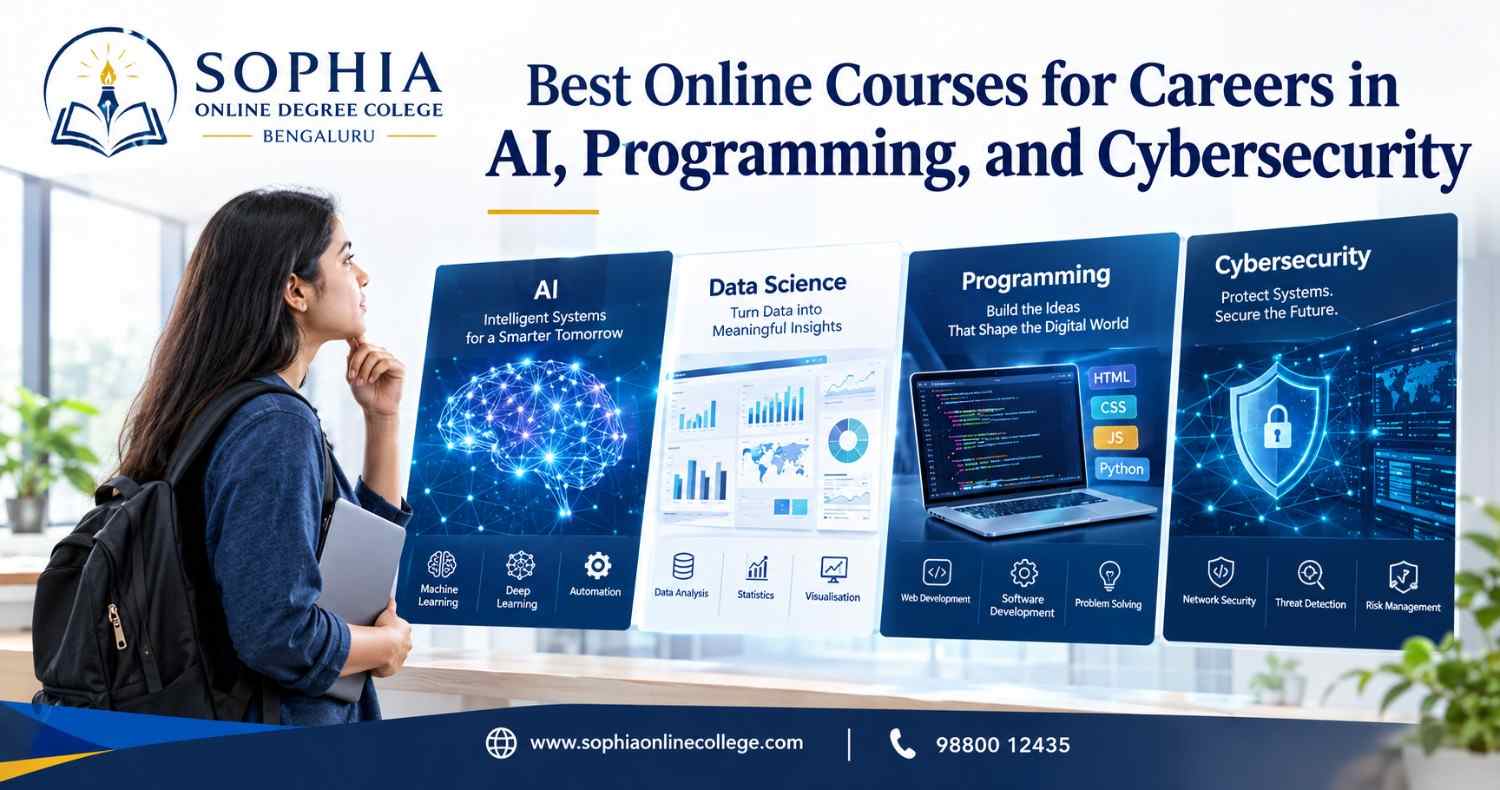
A student who enjoys technology may be interested in artificial intelligence, while another may prefer building websites and applications. A working professional, meanwhile, may want to understand cybersecurity to move into an IT role. Although these interests are connected, the right learning path can be different for each person.
Choosing a course becomes easier when you know what you will learn, which skills you need first, and what the qualification actually provides. Some learners need a structured academic degree, while others want focused training to develop a particular skill. For students comparing affordable online degrees, it is important to look beyond the course name and understand its curriculum, recognition, total cost, and practical learning opportunities.
This guide explains the main learning options for Artificial Intelligence (AI), Programming, Data Science, and Cybersecurity. It also covers how beginners, graduates, freshers, and working professionals can compare courses and choose a realistic next step.
Why Consider Online Learning for a Technology Career?
Online learning can help learners explore a new subject, strengthen existing knowledge, or study towards a formal qualification without necessarily attending a classroom every day. It may be useful for students who have other responsibilities, graduates planning a career change, and working professionals who need to balance study with employment.
However, an online course is not automatically suitable just because it is convenient. The learning format, course structure, practical exercises, assessments, and academic support all matter.
Before enrolling, check whether the course offers:
- A clear syllabus explaining the topics covered.
- Beginner-friendly learning material, where appropriate.
- Assignments, exercises, coding practice, or supervised labs relevant to the subject.
- A transparent assessment and examination process.
- Information about faculty or learner support.
- A clear duration, schedule, and expected weekly workload.
- Complete fee information, including any additional charges.
- A certificate, diploma, or degree whose status is clearly explained.
Online learning can be a practical way to begin, but it still requires regular effort. Watching lessons without practising the concepts may provide familiarity without building the ability to use those concepts independently.
Learners considering a full qualification should also distinguish between the organisation providing guidance or admission support and the institution that actually awards the qualification. For online or distance degrees, check the relevant programme and admission session through the University Grants Commission (UGC) before making a decision.
Understanding AI, Programming, Data Science, and Cybersecurity
Before comparing courses, understand what each field involves. The names may appear together in technology advertisements, but the day-to-day work and foundational skills are not identical.
Artificial Intelligence: AI involves methods that enable computer systems to perform tasks such as recognising patterns, generating text, making predictions, or supporting decisions. Machine learning is one area within AI. Learners may eventually explore data, algorithms, model evaluation, and responsible AI use.
Programming: Programming means writing, testing, debugging, and maintaining instructions that tell software how to work. It supports websites, mobile applications, business systems, databases, and many AI tools.
Data Science: Data Science focuses on using data to answer questions, identify patterns, build analyses, and support decisions. It often combines statistics, programming, data preparation, visualisation, and—in some roles—machine learning.
Cybersecurity: Cybersecurity focuses on protecting systems, applications, networks, and information from unauthorised access, disruption, misuse, and other digital threats. It includes areas such as defensive monitoring, access control, incident response, application security, and risk management.
These fields overlap. A cybersecurity analyst may use scripts to review system logs. An AI learner may need programming and statistics. A software developer may use data analysis to understand application performance.
The best starting point is not necessarily the field with the most attention online. It is the one that matches your interests and gives you a practical route from your current knowledge to your intended goal.
Artificial Intelligence Courses: What Will You Learn?
An Artificial Intelligence course can introduce learners to how computer systems identify patterns, make predictions, and support tasks that would otherwise require more manual analysis. It can be a starting point for people curious about machine learning, intelligent applications, automation, and AI-assisted tools.
The syllabus varies by provider. A beginner-level course may focus on core concepts and introductory tools, while a more technical programme may require programming, mathematics, and data handling.
Subjects worth looking for
A well-structured introductory AI learning path may cover:
- Basic computer and technology concepts.
- AI terminology, applications, and limitations.
- Introduction to machine learning.
- Data types, data quality, and pattern recognition.
- Basic Python programming, if included in the syllabus.
- How to evaluate an AI-generated result.
- Responsible use of AI, including privacy and bias.
- Small practical exercises or projects.
Do not assume that every course covers all these subjects. Read the actual curriculum and ask the provider to clarify any missing details.
Who should consider an AI course?
AI may suit students who enjoy exploring how technology can identify patterns, automate tasks, or support decisions. It may also interest working professionals who want to understand how AI tools could be used in their current industry.
A learner with no programming experience can begin by learning the basic concepts and gradually developing coding skills. Someone aiming for a more technical machine-learning role may need a deeper foundation in programming, mathematics, statistics, and data management.
What can you build while learning?
Begin with a small, understandable project rather than trying to create a complex AI product immediately. For example, you could organise a simple dataset, compare patterns, document how an AI tool responds to different prompts, or build a basic prediction exercise if your course covers the required methods.
Record what you attempted, what worked, what failed, and how you checked the result. This helps you demonstrate your learning more clearly than a list of course names alone.
An AI learning option at SODC
SODC’s official course listing includes an Artificial Intelligence learning category described as covering AI concepts, machine learning, automation, and modern technology applications. The website displays a duration of 6 months to 1 year for this listing. Confirm the current syllabus, eligibility, delivery format, assessment, fee details, and the exact qualification or completion document before enrolling through the SODC courses.
The listing should not be interpreted as confirmation that every AI specialisation or undergraduate AI degree is available. If you specifically want a BCA in AI and Machine Learning or a B.Sc. in AI, ask for the exact programme name and awarding institution in writing before proceeding.
Data Science Courses: Learn to Work with Information
Data Science may suit learners who enjoy numbers, logical questions, research, and finding useful patterns in information. Organisations collect data through transactions, websites, customer interactions, operations, and many other activities. Data-related work helps turn that information into something people can understand and use.
For example, a retailer may want to know which products are frequently purchased together. A service team may study customer complaints to identify recurring issues. A business may compare monthly performance to understand where processes need improvement.
These examples involve more than producing a chart. Learners must also consider whether the data is accurate, whether important information is missing, and whether the conclusions are reasonable.
Subjects worth exploring
A beginner learning pathway may include:
- Spreadsheet skills and data organisation.
- Basic statistics and numerical reasoning.
- Data cleaning and preparation.
- Data visualisation and reporting.
- SQL or other database fundamentals.
- Introductory Python, where relevant.
- Interpreting results and communicating findings.
- Basic machine-learning concepts in more advanced learning stages.
The exact order depends on the course. Beginners may find it easier to start with spreadsheets, basic statistics, and simple charts before progressing to coding-heavy work.
Who should consider Data Science?
Students interested in analytical work may want to explore this field. Graduates from commerce, science, business, economics, or computing backgrounds may also find relevant learning opportunities, depending on the course prerequisites and the kind of role they want.
A non-computing graduate does not necessarily need to master every advanced tool at the beginning. However, a technical Data Science position may require stronger programming, statistics, and mathematical knowledge than an introductory data-reporting role.
Build a simple portfolio project
Choose a publicly available or personally created sample dataset that does not expose private information. Organise the data, identify a question, create a chart, and write a short explanation of what the results show—and what they do not prove.
For example, a learner could analyse monthly expenses from a fictional household budget. The project can demonstrate data organisation, calculations, visualisation, and clear communication without requiring advanced machine learning.
A Data Science learning option at SODC
SODC lists a Data Science category described as covering data analysis, statistics, machine learning, and data-driven decision skills. The website displays a duration of 6 months to 1 year. Because course details can change, verify the current syllabus, entry requirements, learning format, assessment methods, fees, and credential details directly with SODC.
If you are comparing affordable online degrees, do not assume that this listing is equivalent to a B.Sc. or another formal degree. A skills-focused programme and an academic qualification can serve different purposes. Ask what exactly is awarded and which institution is responsible for it.
Programming Courses: A Foundation for Software Development
Programming is a useful starting point for learners who want to understand how software works. It also supports further study in AI, Data Science, web development, mobile applications, automation, and several cybersecurity activities.
A programming course teaches learners how to break a problem into smaller steps and translate those steps into instructions that a computer can execute. It also develops the habit of testing a solution, finding mistakes, and improving the code.
Which programming topics should beginners learn?
A sensible introductory pathway may include:
- Variables, data types, and operators.
- Conditions and loops.
- Functions and reusable code.
- Lists, dictionaries, and other data structures.
- Debugging and error handling.
- Basic file handling.
- Problem-solving exercises.
- Version control and project documentation as the learner progresses.
Python is often used for introductory programming and is also relevant to AI, Data Science, and automation. JavaScript is useful for web development, while other languages may be relevant to specific software environments. You do not need to learn several languages at once. Start with one and practise its fundamentals before switching for a clear reason.
What projects can beginners build?
Useful starter projects include a calculator, a quiz application, a personal expense tracker, a simple webpage, or a basic task manager. As skills improve, learners can add features, store data, test edge cases, and document how the application works.
A project does not have to be complicated to be valuable. A small project that you can explain, test, and improve is more useful than a copied project you cannot describe.
What about BCA or another formal computing degree?
Students who want a structured undergraduate education may consider an appropriate computer applications or computing degree, provided they meet its entry requirements and the exact programme is available through a recognised route.
A degree can offer broader academic foundations, while a short programming course can target a particular skill. They are not interchangeable. If you are researching a BCA, use SODC’s existing BCA after Class 12 guide for general course-selection context, then independently verify the current programme details, awarding institution, delivery mode, and recognition before applying.
Do not assume that a BCA with an AI or machine-learning specialisation is available through every institution. Ask for the exact title, syllabus, eligibility, and official programme details.
Cybersecurity Courses: Learn to Protect Digital Systems
Cybersecurity is about protecting digital systems and information. It is not limited to ethical hacking. Professionals may work on access controls, security monitoring, system configuration, vulnerability management, incident documentation, user awareness, or the protection of cloud and web applications.
A learner interested in cybersecurity should be prepared to understand how computers and networks work before moving into more specialised topics.
Foundational subjects to look for
An introductory cybersecurity pathway may cover:
- Computer hardware and operating-system basics.
- Networking concepts, including IP addresses and common protocols.
- Linux fundamentals.
- Password security, authentication, and access control.
- Common types of cyber threats and social engineering.
- Basic security monitoring and log analysis.
- Introductory scripting or automation.
- Data protection and incident response.
- Safe, authorised security testing.
These foundations help learners understand why a security issue occurs and how it can be investigated. A course that focuses only on tool demonstrations may not provide enough context for independent problem-solving.
Who should consider Cybersecurity?
Cybersecurity may appeal to learners who enjoy investigating problems, understanding how systems behave, following evidence, and documenting findings carefully. It can be relevant to IT students, computing graduates, and professionals who want to develop security knowledge alongside existing technical experience.
A beginner may first aim to understand networks, operating systems, and basic defensive practices. More specialised work—such as penetration testing or security engineering—can require additional study, supervised practice, and experience.
All security practice must be legal and authorised. Use training labs, deliberately vulnerable practice environments, or systems for which you have explicit permission. Never test a real website, network, account, or device without permission.
For practical security awareness and advisories, learners can refer to the Indian Computer Emergency Response Team (CERT-In), India’s national agency for responding to computer security incidents.
A Cyber Security learning option at SODC
SODC lists a Cyber Security category described as covering cybersecurity, network protection, ethical hacking, and digital safety skills. The website displays a duration of 6 months to 1 year. Before enrolling, verify the programme’s detailed syllabus, practical lab arrangements, entry requirements, assessment process, fees, and exact credential.
SODC’s blog also offers related reading on starting a cybersecurity career without experience and how AI is transforming cybersecurity careers. Use these as career-planning resources, not as substitutes for checking a course’s official details.
AI, Programming, Data Science, or Cybersecurity: Which Should You Choose?
The right option depends on the kind of problems you want to solve. A learner who enjoys building applications may prefer programming. Someone interested in patterns and evidence may prefer Data Science. A learner curious about intelligent systems may explore AI, while a person interested in protecting digital services may begin with cybersecurity.
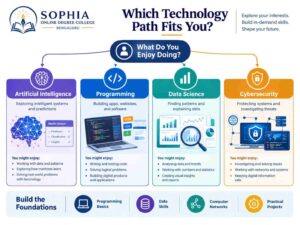
The comparison below is a starting guide, not a ranking of the fields.
| Learning path | Useful starting subjects | Skills to develop | Possible career directions | Important consideration |
| Artificial Intelligence | Programming basics, data concepts, mathematics as required | Python where relevant, model evaluation, data handling | AI application support, junior AI-related development after further preparation | Technical AI roles may require stronger mathematics, programming, and project experience |
| Programming / Software Development | Computer fundamentals and one programming language | Coding, debugging, problem-solving, testing, version control | Junior developer, web developer, software testing or support roles depending on skills | A portfolio and demonstrable coding ability matter alongside qualifications |
| Data Science | Spreadsheets, basic statistics, data organisation | Data cleaning, SQL, visualisation, Python where relevant | Data reporting, junior data analysis, analytics support | Role requirements vary; advanced Data Science can require substantial statistical and coding knowledge |
| Cybersecurity | Computer systems, networking, operating systems | Security fundamentals, log analysis, access control, authorised lab practice | IT support moving towards security, security operations trainee, junior analyst where suitable | A short introductory course alone may not meet the requirements for specialist security roles |
A simple way to decide
Ask yourself these questions:
- Do I want to build applications and tools? Begin with programming.
- Do I want to analyse information and explain patterns? Explore Data Science.
- Do I want to understand how intelligent systems learn from data or generate outputs? Explore AI, after checking the required foundations.
- Do I want to protect networks, applications, and information? Start with networking and cybersecurity fundamentals.
You can move between these areas later. Learning Python, for example, can support AI, Data Science, automation, and some security tasks. However, related fields still require their own subject knowledge.
Which Course Is Suitable for Your Current Education Level?
A good choice depends on what you already know, not just your intended job title.
If you have completed Class 12
If you are considering an undergraduate degree, first compare the qualification, entry criteria, curriculum, and long-term study options. A formal computing degree may provide a broader academic foundation, while a shorter course can help you explore a subject or learn a specific tool.
Do not choose a degree solely because its title contains “AI” or “Cybersecurity.” Review the actual subjects and practical components. If you want a degree with a particular specialisation, confirm that the institution offers that exact programme and that the programme is valid for your intended admission session.
If you are a beginner with no coding experience
Start with computer fundamentals and basic programming. Learn how variables, conditions, loops, and functions work. Complete small exercises before attempting advanced AI or security tools.
If you are more interested in cybersecurity, learn basic networking and operating-system concepts alongside introductory security principles. If AI interests you, build programming and data foundations before moving into more mathematical or technical content.
If you are a graduate from a non-computing background
You may be able to explore technology through beginner-friendly courses, depending on the subject and provider’s prerequisites. Your previous degree may also give you useful domain knowledge. For example, someone familiar with finance may explore data analysis in financial contexts, while a professional in operations may study automation for repetitive workflows.
Before choosing a postgraduate qualification, check the eligibility criteria carefully. Not every graduate is eligible for every technical programme, and some courses expect prior mathematics, computing, or programming knowledge.
If you are a fresher preparing for a first job
Choose one practical learning direction and build evidence of your skills. Complete exercises, document projects, practise explaining your decisions, and prepare a CV that describes what you actually did.
For programming, be ready to explain and modify your code. For Data Science, explain how you cleaned and interpreted data. For AI, describe the problem, the method used, and how you evaluated the result. For cybersecurity, demonstrate your knowledge through authorised labs, clear notes, and an understanding of basic defensive practices.
A course can support preparation, but completing it does not guarantee employment.
If you are a working professional
Start by deciding whether you need a new academic qualification or a specific skill for your current role. A formal degree may be relevant to long-term education plans, while targeted training may be more suitable when you need to learn one tool or technical concept.
Check the real workload rather than assuming that every online course is self-paced. Ask about live sessions, deadlines, assessments, practical requirements, attendance rules, and examination arrangements. Consider how study will fit around work and family commitments before paying fees.
Degree, Diploma, Certificate, or Short-Term Course: What Is the Difference?
The terms degree, diploma, certificate, and course are sometimes used loosely in advertisements. They do not necessarily represent the same academic level or outcome.
| Learning option | Main purpose | Typical scope | What to verify | When it may be suitable |
| Undergraduate degree | Broad academic qualification after school | Foundational and advanced subjects over a structured programme | Awarding institution, programme recognition, eligibility, duration, curriculum | Students planning a longer-term academic pathway |
| Postgraduate degree | Advanced study after an eligible prior qualification | Specialised or higher-level academic study | Required prior qualification, subject prerequisites, programme recognition | Graduates who meet entry requirements and need further academic study |
| Diploma | Structured study in a defined area | Depends on level, institution, and syllabus | Exact qualification level, awarding body, eligibility, assessment | Learners seeking focused formal study where the diploma meets their goals |
| Certificate or short-term skills course | Introduction to a subject or development of specific skills | Often narrower than a full academic degree | Who issues it, what it certifies, practical work, assessment, recognition where relevant | Beginners exploring a field or professionals developing targeted skills |
Duration and fees vary by programme, so they should be checked individually rather than assumed from the category name. A short-term certificate does not automatically equal a recognised undergraduate or postgraduate degree.
A degree and a skills course can complement each other. For instance, a student may pursue a computing qualification while also practising Python or completing a cybersecurity lab course. The key is to understand what each component contributes and not confuse training completion with a formal academic award.
How to Compare Affordable Online Degrees Without Compromising Quality
Affordability is important, particularly for students and working professionals managing a limited budget. However, the lowest advertised fee is not always the lowest total cost, and a higher fee does not automatically mean better teaching or outcomes.
When comparing affordable online degrees, review the complete cost and the educational value.
Calculate the total cost
Ask whether the quoted fee includes registration, examinations, learning materials, project charges, and other mandatory costs. Check payment deadlines and refund conditions. If you need a laptop, software, internet access, or travel for any required activity, include those expenses in your planning.
Compare the curriculum with your goal
A course title alone cannot tell you whether the programme covers the skills you need. Read the subject list and look for practical assignments, projects, relevant tools, and assessment methods.
For a programming pathway, look for opportunities to write and debug code. For Data Science, check whether learners work with data. For AI, review the balance between introductory concepts and technical prerequisites. For cybersecurity, check whether the course includes networking foundations and safe practical exercises.
Check recognition and the awarding institution
For a formal degree or diploma, confirm the exact institution that awards it and the applicable programme recognition for the admission session. The All India Council for Technical Education (AICTE) provides official information relevant to technical education; however, learners should verify the specific programme and the regulatory requirements that apply rather than relying on a general logo or claim.
If an organisation helps with admissions, ask whether it is the awarding institution, an authorised partner, or a counselling provider. Get the details in writing before paying.
Evaluate support and assessment
A course should explain how learners receive help when they get stuck. Check whether support is provided through faculty, mentors, help desks, scheduled sessions, or another method. Understand how assignments are graded and how examinations or practical assessments are conducted.
Do not judge value by price alone
A suitable course should match your current level, future goals, schedule, budget, and the type of qualification you need. It is better to compare two or three options carefully than to enrol immediately because an advertisement promises a low fee or a fast career change.
Exploring Online UG Degree Courses in India
An undergraduate qualification can provide a structured foundation for learners who want to continue higher education or develop a broader academic base before specialising. The best option depends on the subject, the student’s background, and the programme’s eligibility requirements.
When comparing online UG degree courses in India, check the following:
- Exact degree title: Confirm the qualification you will receive.
- Awarding institution: Identify the university or authorised institution responsible for the award.
- Entry requirements: Check required subjects, minimum marks, and any other criteria.
- Curriculum: Review the actual modules and how they connect to your intended path.
- Delivery mode: Confirm whether the programme is offered online, through distance learning, or in another format.
- Assessment: Understand assignments, examinations, projects, and any practical components.
- Total cost: Review published fees and additional charges.
- Recognition: Verify the relevant status for the institution, programme, and admission session.
Not every undergraduate degree contains an AI, programming, or cybersecurity specialisation. Some programmes offer broader computing subjects, while others may not cover the technical depth needed for a particular role. A degree title should therefore be one part of the decision, not the only factor.
If you want to study a technology subject formally, ask the institution for its current programme brochure and official details. If you are mainly looking to learn one practical skill, a shorter course may be a better starting point—but it should not be represented as equivalent to a degree.
How to Evaluate Online Degree Courses in Karnataka and Bangalore
Students searching for online degree courses in Karnataka or online degree colleges in Bangalore should separate the institution’s location from the programme’s authorised delivery mode. An institution may have an office or campus in Bangalore, but that does not prove that every programme is available online or that every qualification suits a particular learner.
The same principle applies when searching for online diploma courses in Bangalore. Verify the exact diploma, the institution responsible for it, and how the course is delivered before making a decision.
Use this checklist:
- Confirm the legal name of the awarding institution.
- Ask for the exact programme title and current syllabus.
- Verify the institution’s and programme’s applicable recognition or approval.
- Check eligibility and admission-session requirements.
- Confirm whether classes are live, recorded, self-paced, or a combination.
- Ask how examinations and practical assessments are conducted.
- Get the complete fee schedule and payment conditions.
- Confirm which certificate, diploma, or degree is awarded on completion.
SODC can be used to explore the categories currently displayed by the institution. If a particular degree or specialisation is not clearly listed, contact the institution and request written confirmation instead of assuming it is available.
A Practical Way to Become Job-Ready While Studying
A course provides structure, but learners also need practice. The most useful preparation is linked to the type of work they hope to do.
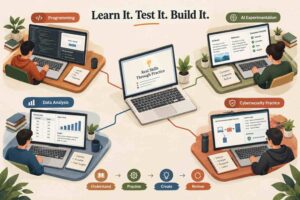
For programming, practise solving small problems and build applications you can explain. For AI, start with simple data-based exercises and learn how to check outputs. For Data Science, prepare a dataset, analyse it, and present your findings clearly. For cybersecurity, use authorised labs to practise networking, system basics, log interpretation, and defensive concepts.
Try following a repeatable learning routine:
Learn the concept → practise it → build something small → review mistakes → document the result.
This approach encourages active learning. It also helps you identify gaps before moving to more advanced topics.
Create a simple portfolio
A portfolio does not need to be a large website at the beginning. It can be a collection of project files, code, screenshots, reports, or written explanations, depending on the subject. Keep it organised and do not include private information, confidential workplace material, or data you do not have permission to share.
For each project, explain the problem you tried to solve, the tools or methods you used, the outcome, and what you would improve next time. Be honest about which parts you completed yourself and which tools or tutorials helped you.
Prepare to explain your learning
Employers may ask how you approached a problem, why you chose a method, how you tested the result, and what you learned from mistakes. Practice explaining your work in simple language. Clear communication and careful documentation are useful alongside technical knowledge.
Continue learning without collecting courses endlessly
It can be tempting to enrol in many courses because each one promises a new skill. A better approach is to finish a suitable course, practise the concepts, and create evidence of what you learned before choosing the next one.
How SODC Can Fit into Your Course-Selection Process
Sophia Online Degree College (SODC) provides an online platform through which learners can explore the course categories displayed on its website. For this topic, its listed Artificial Intelligence, Data Science, and Cyber Security categories are relevant starting points for enquiries about technology learning.
The right next step is to match the available programme details to your own goal. If you want to explore AI, ask about the subjects, technical prerequisites, and practical exercises. If you are interested in Data Science, ask about statistics, data handling, and project work. If Cyber Security interests you, ask about networking foundations, authorised practical labs, and security topics.
Before making a payment, confirm the following directly with SODC:
- The exact name of the course and qualification or certificate awarded.
- The institution responsible for awarding it.
- Eligibility and any prior knowledge expected.
- Current duration, learning format, and assessment method.
- Full fee details and additional charges.
- Relevant recognition or approval, where applicable.
- Available academic or learner support.
You can begin by reviewing the SODC courses and the SODC blogs for further educational guidance. The website’s displayed categories are a starting point for enquiry; always confirm the latest details before enrolling.
Final Checklist Before Choosing a Technology Course
Before deciding, write down your immediate goal. Do you want to explore a subject, learn a practical skill, prepare for a first technology role, or earn a formal qualification? That answer will help you narrow the options.
Next, compare your current knowledge with the course prerequisites. A beginner-friendly programme should explain how learners are expected to start, while an advanced programme may require programming, mathematics, networking, or previous academic study.
Review the syllabus and practical work. Make sure the course gives you opportunities to apply what you learn, not only read or watch lessons. Check the total cost, time commitment, assessment process, support arrangements, and credential details.
Finally, verify the programme before paying. For formal degrees, check the awarding institution and the relevant recognition for your admission session. Do not rely only on a course title, promotional statement, or a general approval logo.
The best course is not necessarily the longest, shortest, or cheapest. It is the one that fits your background, teaches relevant material, provides a clear learning outcome, and supports your next realistic step.
Frequently Asked Questions
1. Which online course is best for a career in AI?
It depends on your current knowledge and goal. Beginners can start with AI fundamentals and basic programming. Learners aiming for technical machine-learning work may need stronger programming, mathematics, statistics, and data skills. Check the syllabus and prerequisites before choosing.
2. Can I start learning programming without previous experience?
Yes. Start with computer fundamentals and one beginner-friendly programming language. Learn variables, conditions, loops, functions, and debugging, then practise through small projects. Consistent practice is more useful than trying to learn several languages at the same time.
3. Is Data Science suitable for students from a non-computing background?
It may be, depending on the course requirements and the role you want to pursue. Start with spreadsheets, basic statistics, data organisation, and visualisation. More technical roles may require programming, mathematics, and additional study.
4. Is a short cybersecurity course enough to become a cybersecurity professional?
Not necessarily. A short course can introduce important concepts, but many roles require networking knowledge, operating-system skills, practical experience, and further preparation. Specialist roles may have additional requirements. Practise only in authorised environments.
5. What is the difference between an online degree and a certificate course?
An online degree is a formal academic qualification awarded by an eligible institution through an authorised programme. A certificate course typically documents completion of a defined course or training. Their academic level, scope, recognition, and purpose can differ, so verify exactly what is being awarded.
6. How can I compare affordable online degrees?
Compare total fees, eligibility, curriculum, delivery format, assessment methods, academic support, and the exact awarding institution. For formal degrees, verify applicable recognition for the programme and admission session. A low advertised fee alone does not establish quality or suitability.
7. Are online degree courses in Karnataka automatically available to students across India?
No. Availability depends on the institution, programme, and delivery mode. Check the official eligibility and admission conditions for the exact course. Do not assume that a local office or campus means every programme can be studied online from anywhere.
8. Does completing an online technology course guarantee a job?
No. A course can support learning, but employment depends on several factors, including skills, practical ability, qualifications, communication, experience, and the requirements of a particular employer. Building projects and practising how to explain your work can help you prepare more effectively.
Conclusion
AI, Programming, Data Science, and Cybersecurity each offer different ways to develop technology skills. The right choice starts with understanding what you enjoy, what you already know, and whether you need a formal qualification or focused skills training.
Compare the curriculum, practical learning, cost, schedule, eligibility, and credential details before enrolling. If you are exploring SODC’s technology learning categories, request the latest programme information and confirm the exact qualification or certificate being offered.
“A thoughtful choice can help you build a stronger foundation for further study or career development—one practical step at a time.”