Library Science is a field that goes beyond managing books and maintaining library shelves. It focuses on organising information, helping people access knowledge, managing digital resources and supporting education and research. For students exploring career-oriented education, Library Science offers an interesting professional direction. If you are considering a correspondence college in Bangalore, understanding the available courses, eligibility requirements and career opportunities can help you make a better decision. Whether you have completed Class 12, hold a graduation degree or are a working professional looking for a new career direction, this field offers different learning pathways worth exploring.
Could Library Science Be the Career You Haven’t Considered?
When students think about career opportunities, popular choices such as engineering, management, commerce and computer applications often come to mind. However, several professional fields receive less attention despite playing an important role in education, research and information management.
Library Science is one such field.
Every school, college, university and research institution depends on organised information. Books, journals, research papers, historical documents and digital publications need to be collected, classified, preserved and made accessible to the people who need them. Library professionals help manage this entire process.
The profession has also changed considerably. Modern libraries are no longer limited to physical books. They use digital catalogues, electronic journals, institutional databases and specialised software to manage information.
This creates opportunities for people who enjoy organising information, supporting learners, working with research materials and using technology.
For students and graduates exploring education options, the important question is not simply whether Library Science is a good career. It is whether the course matches their interests, educational background and long-term goals.
What Is Library Science? Understanding the Field Beyond Bookshelves
Library Science, also known as Library and Information Science (LIS), is an academic and professional discipline concerned with collecting, organising, managing, preserving and sharing information.
Its purpose is to make information easy to locate, understand and use.
A library professional does much more than issue and receive books. They organise resources, maintain records, assist visitors, manage digital collections and help students and researchers find relevant information.
For example, imagine a university student preparing a research project. They may need academic journals, reference books, government publications and research papers. A library professional helps organise these resources and makes them accessible through appropriate cataloguing systems and search facilities.
Similarly, a school librarian ensures that students can find suitable reading materials according to their academic requirements and interests.
Some important areas covered by Library Science include:
- Collection Development: Selecting books, journals, newspapers and other learning materials according to institutional requirements.
- Cataloguing: Creating organised records of available resources so users can identify and locate them.
- Classification: Arranging information according to established classification systems and subject categories.
- Library Management: Managing library operations, membership records, circulation and resource maintenance.
- Information Retrieval: Helping users locate relevant information through catalogues, databases and reference services.
- Digital Resource Management: Managing e-books, online journals, digital archives and electronic databases.
- Preservation and Documentation: Maintaining valuable documents, manuscripts and historical information for future reference.
These responsibilities make the field relevant to educational institutions, research organisations and other information-focused workplaces.
How Has Library Science Changed in the Digital Era?
The traditional image of a librarian working among bookshelves does not represent the entire profession anymore.
Technology has changed how information is stored, searched and distributed. Libraries now combine physical collections with digital resources, making information available through multiple platforms.
Consider some important developments:
- Digital Libraries
Digital libraries provide access to electronic books, research publications, journals and other digital learning materials. Professionals need to understand how digital collections are organised and maintained.
- Library Automation
Library automation software helps institutions manage book records, memberships, circulation and catalogues more efficiently.
- Institutional Repositories
Universities and research organisations maintain digital collections of dissertations, research papers, academic publications and other scholarly work.
- Online Information Services
Students and researchers increasingly depend on online databases and electronic resources. Library professionals help them identify reliable information.
- Digital Preservation
Important documents and records must be preserved in digital formats so they remain accessible over time.
The field is therefore developing alongside educational technology and information management. Students interested in both knowledge organisation and technology can find this combination particularly interesting.
Students and researchers can also explore the National Digital Library of India, a digital learning resource platform that provides access to educational materials across different subjects and academic levels.
Skills That Make Someone a Good Library Professional
A Library Science qualification provides academic knowledge, but professional success also depends on practical skills.
You do not necessarily need advanced technical expertise before entering the field. However, developing certain abilities can help you perform better in library and information-related roles.
- Organisation and Time Management
Libraries contain different categories of information and resources. Professionals must maintain accurate records, organise collections and complete daily responsibilities systematically.
- Communication Skills
Librarians interact with students, teachers, researchers and other visitors. Clear communication helps them understand what users need and guide them towards suitable resources.
- Research and Information Search
Finding accurate information is an important part of the profession. Professionals should understand how to search catalogues, databases and reference materials.
- Digital Literacy
Knowledge of computers, internet-based research, electronic resources and library management software is increasingly useful.
- Attention to Detail
Small errors in catalogue entries, classification numbers or records can make information difficult to locate. Accuracy is therefore important.
- Problem-Solving Ability
A visitor may struggle to find a particular publication or access a digital resource. Library professionals should be able to identify the problem and suggest practical solutions.
- Customer Service and User Support
Libraries serve different categories of people. Understanding user requirements and providing helpful assistance are valuable professional qualities.
- Adaptability
As technology and information systems change, professionals must remain willing to learn new tools and methods.
These skills can be developed gradually through academic learning, practical exposure, internships and workplace experience.
Which Library Science Course Should You Choose?
Once you understand the field, the next step is identifying a suitable qualification.
Library Science offers different academic pathways depending on your current education level and career goals. Some programmes introduce basic library operations, while others provide advanced knowledge of information management, research and digital library systems.
Before selecting a programme, understand the purpose of each course.
- Certificate Course in Library and Information Science
A certificate course is generally suitable for learners who want to understand the fundamentals of library operations.
It can introduce:
- Basic library organisation.
- Book arrangement and classification.
- Introduction to cataloguing.
- Library administration.
- Reference and information services.
- Basic digital library concepts.
For example, IGNOU offers a Certificate Programme in Library and Information Science (CLIS), with eligibility beginning at 10+2. Its published programme information specifies a minimum duration of six months and a maximum duration of 24 months.
This type of programme may be useful for people seeking foundational knowledge or entry-level library support skills. However, a certificate should not automatically be considered equivalent to a professional bachelor’s qualification when applying for librarian positions.
To understand how technology supports modern library operations, learners can refer to this INFLIBNET learning resource on library automation, which explains digital cataloguing, circulation systems and automated library services.
- Diploma in Library and Information Science
A diploma programme provides more structured learning in library operations and information management.
Depending on the institution, subjects may include:
- Library organisation and management.
- Classification and cataloguing.
- Information sources.
- Library administration.
- Documentation techniques.
- Introduction to library automation.
Eligibility and duration differ between institutions. Some diploma programmes accept candidates after Class 12, while others may require graduation or additional qualifications.
A diploma can be useful for developing specialised knowledge, but candidates should check whether the qualification satisfies the requirements of their intended employment.
- Bachelor of Library and Information Science (BLIS / B.Lib.I.Sc.)
The Bachelor of Library and Information Science is a professional qualification designed to develop knowledge and skills required for library and information services.
It generally covers:
- Library and information science foundations.
- Information organisation.
- Library classification.
- Cataloguing practices.
- Reference services.
- Library management.
- Information technology applications.
- Digital library concepts.
Many universities offer BLIS as a one-year programme after graduation. However, duration, eligibility and admission requirements depend on the university.
For example, Panjab University’s published course information lists a one-year Bachelor of Library and Information Science programme with specified graduation eligibility.
This qualification is an important pathway for graduates interested in professional library positions.
- Master of Library and Information Science (MLIS / M.Lib.I.Sc.)
The Master of Library and Information Science is an advanced qualification for students who have completed the relevant undergraduate-level library science programme or an accepted equivalent.
It provides deeper knowledge of information systems, research support, digital libraries and advanced library administration.
Common areas of study include:
- Advanced information organisation.
- Digital library management.
- Research methodology.
- Information storage and retrieval.
- Knowledge management.
- Academic and specialised library services.
- Information technology applications.
MLIS can support career progression towards more specialised and senior positions, depending on recruitment requirements and experience.
Understanding the Difference Between Library Science Courses
| Course | General Entry Requirement | Main Learning Purpose |
| Certificate in Library Science | Often Class 12 | Basic library operations and introductory knowledge |
| Diploma in Library Science | Class 12 or graduation, depending on the institution | Structured learning in library management |
| BLIS / B.Lib.I.Sc. | Usually graduation | Professional library and information science knowledge |
| MLIS / M.Lib.I.Sc. | Relevant BLIS or equivalent qualification | Advanced information management and research knowledge |
Important: Course names, duration and eligibility are not identical across universities. Always check the latest prospectus before applying.
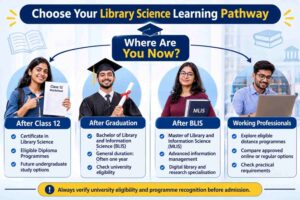
Library Science Courses After 12th, Graduation and Postgraduation
One common question among students is whether Library Science can be pursued immediately after Class 12 or whether graduation is necessary.
The answer depends on the programme.
Different institutions offer different entry-level qualifications. Understanding your current educational position can help you avoid choosing a course that does not match your eligibility.
If You Have Completed Class 12
Students who have passed Class 12 can explore introductory Library Science programmes.
Possible options include:
- Certificate courses in Library and Information Science.
- Eligible diploma programmes.
- General undergraduate degree programmes followed by professional Library Science qualifications.
If you are interested in becoming a professional librarian, remember that many institutions and recruitment notifications require a recognised BLIS qualification or an equivalent professional degree.
Therefore, it is important to plan your education beyond an introductory certificate.
If You Have Completed Graduation
Graduates generally have more direct options for professional Library Science education.
Depending on the university’s admission requirements, you can explore:
- Bachelor of Library and Information Science.
- Bachelor-level professional qualifications in Library and Information Science.
- Relevant diploma programmes.
- Other specialised information management courses.
Graduates from commerce, arts, science and other academic backgrounds may be eligible for certain programmes.
For example, a B.A. graduates interested in academic institutions may consider Library Science as an additional professional qualification. Similarly, a B.Com graduate may find information management an interesting alternative to conventional commerce-related careers.
If You Already Have a Library Science Qualification
Candidates who have completed BLIS or an accepted equivalent qualification can consider postgraduate study.
An MLIS programme may help them develop advanced knowledge and prepare for more specialised responsibilities.
Some professionals may also pursue research qualifications, NET-related eligibility where applicable, or specialised training depending on their academic and career ambitions.
The most important thing is to choose a qualification that builds logically on your existing education.
Eligibility: Can You Study Library Science After Any Graduation?
Yes, graduates from different academic streams may be eligible for Library Science programmes, depending on the admission rules of the university.
The discipline is not limited to students who have studied a particular subject in Class 12.
However, eligibility should never be assumed to be identical across institutions.
Here is a general overview of possible learning routes:
- Class 12 in Arts: Explore certificate or eligible diploma programmes.
- Class 12 in Commerce: Check introductory courses and programmes accepting 10+2 candidates.
- Class 12 in Science: Explore eligible diploma or certificate programmes.
- B.A. Graduate: Check eligibility for BLIS or an accepted equivalent programme.
- B.Com Graduate: Explore professional Library Science programmes accepting graduates.
- B.Sc. Graduate: Check the university’s graduation requirements for BLIS.
- BLIS Graduate: Explore MLIS admission requirements.
- Working Professional: Choose a suitable programme according to previous education and study-mode eligibility.
Depending on the institution and programme, applicants may need to provide:
- Class 10 and Class 12 marksheets.
- Graduation marksheets, where applicable.
- Degree certificates.
- Identity proof.
- Passport-sized photographs.
- Transfer or migration certificates, if required.
- Other documents specified in the university admission guidelines.
Some universities also specify minimum percentage requirements.
For instance, certain BLIS programmes require graduation with a prescribed minimum aggregate, while others may accept additional recognised qualifications.
A useful suggestion: Before paying an admission fee, verify the exact course eligibility, recognition status, programme duration and examination requirements directly with the university.
Regular, Distance or Online Learning: Which Study Mode Works for You?
Choosing the right learning mode is just as important as choosing the course.
Not every student can attend regular college classes. Some are working professionals, some have family responsibilities, and others may have discontinued their education and want to return to studies.
Flexible education options can help such learners continue their academic journey.
However, the suitability of a particular learning mode depends on the programme and the university’s approval.
Regular Learning
Regular programmes involve attending classes and participating in scheduled academic activities.
They may be suitable for students who:
- Prefer classroom-based learning.
- Want direct interaction with teachers.
- Can attend college regularly.
- Want access to campus facilities and practical activities.
Distance Learning
Distance education allows students to study through learning materials, assignments and scheduled examinations without attending daily classroom sessions.
It can be helpful for:
- Working professionals.
- Students living away from educational institutions.
- Individuals managing family responsibilities.
- Learners returning to education after a break.
However, candidates should check whether the specific Library Science programme is approved in the distance mode for the relevant academic session.
Online Learning
Online education uses digital learning platforms, electronic study materials and other internet-based academic resources.
Depending on the programme, students may access:
- Online learning materials.
- Recorded lectures.
- Digital academic resources.
- Online assessments.
- Faculty support.
- Scheduled online sessions.
Not every course can be offered in every mode. Practical components, university regulations and programme-specific approvals must be considered.
There is no single learning mode that works for everyone. If you are comparing online degree courses in Karnataka, look beyond flexibility. Check the awarding university, programme recognition, curriculum and examination arrangements.
Students exploring online UG degree courses in India should also understand the difference between a general undergraduate degree and a professional Library Science qualification.
A general degree may help fulfil the graduation requirement for a BLIS programme, while a professional qualification provides specialised Library Science knowledge.
How to Find the Right College for Library Science?
Choosing an educational institution requires more attention than comparing advertisements or admission offers.
A course may appear affordable and convenient, but students must understand what qualification they will receive and whether it is accepted for their intended career.
If you are exploring a correspondence college in Bangalore, consider the following points before making a decision.
- Check University Recognition
Verify whether the university awarding the qualification is recognised and whether the specific programme is permitted in the chosen mode.
- Verify Programme Approval
For distance and online programmes, check the UGC Distance Education Bureau’s recognition information for the relevant academic session.
The official UGC Distance Education Bureau FAQ explains why students must verify the institution and programme for the particular admission session. Recognition in one academic year does not automatically establish recognition for another.
- Understand the Course Curriculum
Review the subjects included in the programme.
A good Library Science curriculum should provide relevant knowledge of cataloguing, classification, library administration, information services and digital resources.
- Compare Course Fees
Look at the complete fee structure instead of considering only the initial admission amount.
Check examination charges, registration fees, study materials and other applicable expenses.
- Understand Practical Learning Requirements
Library Science involves practical knowledge. Students should understand whether the programme includes practical sessions, assignments, project work or other activities.
- Check Student Support
Academic guidance, access to learning materials, examination assistance and communication with the university are important considerations.
- Understand the Qualification’s Career Relevance
Review actual job notifications to identify the qualifications required for the positions you want to pursue.
A certificate, diploma, BLIS and MLIS may serve different professional purposes.
Students comparing online degree colleges in Bangalore should use these points as a starting checklist rather than selecting an institution based only on convenience.
Similarly, affordable online degrees should be evaluated according to their recognition, academic quality and suitability for the learner’s goals.
A lower fee is useful only when the programme meets the student’s actual educational requirements.
Where Can Library Science Graduates Work?
Once students complete an appropriate qualification, they can explore employment opportunities in different types of organisations.
Libraries are not restricted to schools and colleges. Many institutions maintain information centres, research collections and specialised documentation departments.
The nature of the work depends on the organisation and the candidate’s qualification.
- Schools
Schools maintain libraries to support students’ reading habits, classroom learning and academic development.
A school librarian may:
- Maintain books and learning resources.
- Organise reading activities.
- Assist students in finding suitable books.
- Maintain membership and circulation records.
- Support teachers with educational resources.
- Colleges and Universities
Higher education institutions require organised academic libraries containing textbooks, journals, research publications and digital learning materials.
Library professionals help students, teachers and researchers access relevant information.
Some institutions may require BLIS or MLIS qualifications and additional experience for specific positions.
- Government and Public Libraries
Public libraries provide reading and information services to communities.
Professionals working in these institutions may handle resource management, membership services, public information access and library administration.
Government recruitment generally follows specific educational qualifications, age limits, selection procedures and other eligibility conditions.
- Research Organisations
Research centres require specialised information services to support academic and scientific activities.
Library professionals may organise research publications, technical documents, databases and reference materials.
- Museums and Archives
Museums and archival institutions preserve historical records, manuscripts, photographs, documents and other valuable materials.
People with relevant additional knowledge may explore documentation, archival support and preservation-related positions.
- Corporate Information Centres
Some companies maintain internal knowledge centres and specialised information collections.
These workplaces may require professionals who can organise business information, research materials and digital resources.
- Specialised Libraries
Hospitals, law firms, scientific organisations and professional institutions may maintain specialised libraries.
Their information requirements differ from those of general libraries, making subject knowledge and research skills particularly valuable.
The Government of India’s Employment News publication on careers in Library and Information Science also describes employment possibilities across academic institutions, government libraries, museums, archives and research organisations.
This shows that the field has applications across several professional environments.
Career Opportunities After Library Science: Job Roles Explained
Library Science qualifications can lead to different job roles depending on the candidate’s education, practical knowledge, experience and the recruitment requirements of the employer.
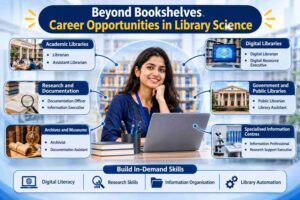
Understanding these positions can help students identify which qualification they should pursue.
- Librarian
A librarian manages the daily activities of a library and ensures that users can access the required information.
Typical responsibilities include:
- Managing books, journals and other resources.
- Maintaining library records.
- Supervising circulation activities.
- Helping visitors locate information.
- Organising library resources.
- Supporting reading and research activities.
- Library Assistant
Library assistants support the daily operations of a library.
Their responsibilities may include maintaining records, issuing and receiving books, organising shelves and assisting visitors.
This can be an entry-level opportunity for candidates who meet the employer’s qualification requirements.
- Assistant Librarian
Assistant librarians help manage library services and support senior library professionals.
Their work may involve supervising library activities, maintaining collections, assisting with digital resources and supporting administrative functions.
The required qualification and experience depend on the organisation.
- Digital Librarian
Digital librarians work with electronic information resources.
Their responsibilities may include:
- Managing e-books and electronic journals.
- Organising digital collections.
- Maintaining online catalogues.
- Supporting digital information access.
- Working with library automation systems.
Knowledge of digital platforms and information technology is useful for this role.
- Cataloguer
Cataloguers create and maintain organised records of books, journals, documents and other resources.
They help ensure that users can identify and locate materials efficiently.
Accuracy and knowledge of classification and cataloguing practices are particularly important.
- Documentation Officer
Documentation officers manage important documents, reports, publications and information records.
They may work in research organisations, educational institutions, government departments and specialised information centres.
- Information Executive
Information executives help collect, organise and distribute information within an organisation.
The work may involve maintaining databases, preparing information reports and supporting internal information requirements.
- Archivist
Archivists work with historical records, manuscripts, photographs and other valuable documents.
They focus on preserving, organising and maintaining archival materials.
Additional training in archival studies and preservation can be useful.
Career Options at a Glance
| Job Role | Main Responsibility | Useful Qualification or Skill |
| Librarian | Overall library management | BLIS / MLIS, as required |
| Library Assistant | Daily library support | Relevant certificate, diploma or degree |
| Assistant Librarian | Supporting library administration | BLIS / MLIS, depending on the post |
| Digital Librarian | Managing electronic collections | Library Science and digital skills |
| Cataloguer | Organising information records | Cataloguing and classification |
| Documentation Officer | Managing documents and records | Information management |
| Information Executive | Organising organisational information | Research and database skills |
| Archivist | Preserving historical materials | Library Science and archival knowledge |
Remember: A course qualification does not guarantee a particular job title. Employers may require additional qualifications, experience, computer knowledge or competitive examination performance.
What Salary Can You Expect After a Library Science Course?
Salary is an important factor when selecting a career. Students naturally want to understand the earning possibilities before investing time and money in a qualification.
In Library Science, salaries vary depending on the job role, employer, location, qualification and experience.
A librarian working in a small private school may receive a different salary from a professional employed by a university, government institution or specialised research organisation.
For general career planning, the following figures can be treated as broad indicative annual salary ranges rather than guaranteed earnings.
| Job Role / Experience | Indicative Annual Salary |
| Entry-level Library Assistant | ₹1.8–3 lakh |
| Junior Librarian | ₹2–3.5 lakh |
| School Librarian | ₹2–4 lakh |
| Assistant Librarian | ₹3–5 lakh |
| Digital Library / Information Executive | ₹3–6 lakh |
| Experienced Librarian | ₹4–7 lakh |
| Senior Library Professional | ₹6–10 lakh or more |
These are approximate career-planning estimates, not official pay scales or verified offers. Actual salaries can be lower or higher depending on the employer, city, experience, responsibilities and qualifications.
What Influences a Library Professional’s Salary?
- Educational Qualification
A candidate with an advanced qualification may be eligible for positions that require postgraduate Library Science education.
- Work Experience
Professionals with experience in library administration, resource management and information services may qualify for more responsible roles.
- Employer Type
Government institutions, universities, private schools and specialised organisations follow different salary structures.
- Digital Skills
Knowledge of library automation, electronic databases, digital cataloguing and information management can improve professional suitability.
- Additional Qualifications
Research experience, specialised training and relevant professional development can help candidates pursue certain advanced positions.
What About Government Library Jobs?
Government library positions may offer structured pay levels, allowances and other employment benefits according to applicable recruitment rules.
However, candidates must check the specific recruitment notification for:
- Required educational qualifications.
- Minimum work experience.
- Age limits.
- Computer knowledge requirements.
- Selection procedures.
- Applicable pay level.
For example, senior library positions may require a postgraduate qualification, professional experience and specialised administrative skills.
Students should therefore plan their qualifications according to the type of position they eventually want to pursue.
Future Scope: Will Library Science Remain Relevant in a Digital World?
With the growth of the internet, digital learning and artificial intelligence, some students may wonder whether traditional library careers will continue to be relevant.
The answer lies in understanding how the profession is changing.
Information is increasing rapidly, but finding reliable and relevant information is becoming an important challenge.
Educational institutions, research organisations and businesses still need professionals who can organise information, manage digital resources and support users.
This creates opportunities for Library Science professionals who are willing to develop modern skills.
- Growth of Digital Libraries
Educational institutions are increasingly using digital platforms to provide access to books, journals, research papers and other learning materials.
Digital library management requires knowledge of electronic resources, cataloguing and information retrieval.
- Research and Academic Support
Universities and research institutions depend on organised academic resources.
Library professionals help researchers locate publications, identify reference materials and access relevant databases.
- Information Management
Organisations create and maintain large amounts of information.
Professionals who understand documentation, records management and information organisation may find opportunities in specialised workplaces.
- Digitisation and Preservation
Historical documents, rare publications and institutional records may need to be digitised and preserved.
This creates scope for people with relevant knowledge of digital documentation and archival practices.
- Library Automation
Automated systems help institutions manage library collections and services.
Professionals who understand library software and information systems can contribute to these operations.
- AI-Assisted Information Discovery
Artificial intelligence is changing how users search for and discover information.
However, technology does not remove the need for accurate classification, reliable information sources, organised records and responsible information management.
Library professionals who understand digital tools and information quality can adapt to these developments.
The future of Library Science is not limited to physical libraries. It also involves digital information, research support, documentation and knowledge management.
How to Choose the Right Library Science Course for Your Career Goals
By now, you may have a better understanding of the field, qualifications and possible career opportunities.
However, selecting the right course requires connecting your current educational background with your future ambitions.
A programme that works for a Class 12 student may not be the right choice for a graduate or working professional.
Instead of choosing a course simply because it is available, follow a practical decision-making approach.
Route 1: If You Have Completed Class 12
If you have recently completed Class 12 and are interested in Library Science, start by understanding the entry-level programmes available.
Your possible approach:
- Explore certificate or eligible diploma courses.
- Understand the eligibility for professional Library Science qualifications.
- Consider completing a recognised bachelor’s degree if required.
- Plan for BLIS when you meet the admission conditions.
This route is useful for students who want to enter the field with a clear academic plan.
Route 2: If You Have Completed B.A., B.Com or B.Sc.
Graduates can explore professional Library Science programmes directly, subject to university requirements.
Your possible approach:
- Review BLIS eligibility.
- Compare university curricula.
- Understand the practical components.
- Select a suitable learning mode.
- Explore relevant employment opportunities after completing the qualification.
For graduates who want to add a professional qualification to their existing degree, this can be a practical direction.
Route 3: If You Are a Working Professional
Working professionals may want to explore Library Science because they are interested in information management, documentation or educational services.
Your possible approach:
- Identify your current educational qualification.
- Check whether you qualify for a certificate, diploma, BLIS or MLIS programme.
- Compare regular, distance and online learning options.
- Review the time commitment and examination arrangements.
- Select a recognised programme that fits your professional responsibilities.
If you cannot attend regular classes, distance learning may be worth considering, provided the specific programme is approved in that mode.
Route 4: If You Have Discontinued Your Education
Returning to education after a break can seem challenging, but your previous qualification can help you identify the next academic step.
You do not necessarily need to start from the beginning.
For example:
- If you completed Class 12, explore eligible introductory courses or undergraduate pathways.
- If you completed graduation, check BLIS admission requirements.
- If you completed BLIS, explore eligible postgraduate options.
The key is to identify where you stopped and select a course that builds on your existing academic progress.
A Simple Career Decision Framework
| Your Current Situation | Recommended Next Step | Long-Term Direction |
| Completed Class 12 | Check introductory courses and degree eligibility | Build the required academic foundation |
| B.A. / B.Com / B.Sc. graduate | Explore BLIS | Professional library services |
| BLIS graduate | Explore MLIS | Advanced library and information management |
| Working professional | Compare flexible approved programmes | Career development or transition |
| Education after a break | Verify your previous qualification | Resume studies through an eligible pathway |
This approach makes it easier to choose a course based on your actual requirements rather than following a general admission trend.
Build Your Educational Path with Sophia Online Degree College
Choosing the right educational institution is an important part of building a successful career. Students should look for an institution that understands their educational goals and helps them make informed decisions about further studies.
Sophia Online Degree College Bangalore focuses on supporting students, working professionals and learners who want to continue their education through flexible learning opportunities.
If you are exploring Library Science or related academic pathways, it is important to understand the difference between professional Library Science qualifications and general undergraduate degree programmes.
SODC can help prospective learners explore suitable educational options according to their academic background and career interests.
Before selecting a programme, consider the following:
- Understand Your Academic Requirements: Identify whether you need a general undergraduate degree, professional qualification or postgraduate programme.
- Explore Flexible Learning: Consider study options that allow you to balance education with employment and personal responsibilities.
- Compare Course Options: Review eligibility, curriculum, fees and the qualification awarded.
- Check Recognition: Verify the university and programme approval before enrolling.
- Plan Your Next Academic Step: Choose a course that supports your long-term educational and professional objectives.
Students looking for affordable online degrees should also compare the complete course cost and academic benefits instead of making decisions based only on advertised fees.
If you are searching for a correspondence college in Bangalore, take time to understand your requirements and explore the available educational pathways.
You can explore SODC to learn more about educational opportunities and student support.
Conclusion: Your Next Step Towards a Career in Information Management
Library Science is an interesting academic and professional field for people who enjoy organising information, supporting education and working with knowledge resources.
Its scope has expanded beyond traditional libraries into digital information management, research support, documentation and electronic resource management.
Students after Class 12 can begin by exploring suitable introductory programmes, while graduates can consider professional qualifications such as BLIS. Those who have already completed BLIS may explore MLIS for advanced learning.
Working professionals and individuals returning to education can also investigate flexible learning opportunities, provided the selected programme meets the relevant recognition and eligibility requirements.
The most important part of your decision is understanding your current educational background and choosing a course that supports your career direction.
A qualification is the starting point, but the right knowledge, practical skills and continuous learning help you build a meaningful professional journey.
“Students exploring undergraduate programmes after completing their 12th can also read our guide on Online BA After 12th: Eligibility, Subjects, Course Duration and Career Opportunities in 2027 to understand the course structure, admission requirements and future career prospects.”
Frequently Asked Questions About Library Science
- What is Library Science?
Library Science is the study of organising, managing, preserving and providing access to information resources. It covers areas such as cataloguing, classification, library administration, digital libraries, information retrieval and documentation.
- Can I study Library Science after 12th?
Yes. Students who have completed Class 12 can explore certificate programmes and eligible diploma courses. However, many professional BLIS programmes require a bachelor’s degree. Admission requirements vary between universities.
- Which course is best for becoming a librarian?
A Bachelor of Library and Information Science (BLIS) is a common professional qualification for librarian-related careers. Some advanced positions require an MLIS degree, relevant experience or additional qualifications.
- What is the difference between BLIS and MLIS?
BLIS is a bachelor’s-level professional qualification that introduces students to library and information management. MLIS is a postgraduate qualification that provides advanced knowledge of digital libraries, research, information systems and library administration.
- Can a B.A. or B.Com graduate pursue Library Science?
Yes. Graduates from arts, commerce, science and other disciplines may be eligible for BLIS programmes, depending on university admission requirements and minimum marks.
- How long does a Library Science course take?
The duration depends on the qualification and university. Certificate programmes may take six months or longer, while many BLIS programmes take one year. MLIS programmes commonly take one or two years, depending on the institution.
- Can I study Library Science through distance education?
Yes, certain universities offer Library Science programmes through Open and Distance Learning (ODL). However, students should verify whether the specific programme and university are recognised for the relevant academic session.
- What are the career opportunities after Library Science?
Graduates can explore opportunities such as librarian, library assistant, assistant librarian, digital librarian, cataloguer, documentation officer, information executive and archivist. The eligibility requirements differ according to the job position and employer.
- What is the salary after completing a Library Science course?
Entry-level professionals may earn approximately ₹1.8 lakh to ₹3 lakh annually, depending on the role and employer. Experienced professionals and those working in universities or government institutions may earn more. Actual salaries depend on qualifications, experience, location and recruitment rules.
- Is Library Science a good career option in the digital age?
Yes. Libraries and information centres increasingly use digital catalogues, electronic journals, online databases and automated systems. Professionals with knowledge of information management and digital technologies can explore opportunities in these areas.
Take the Next Step Towards Your Educational Goals!
Interested in exploring further education opportunities? Whether you are a student after Class 12, a graduate planning your next qualification, a working professional or someone returning to education after a break, choosing the right academic pathway is an important first step.
Sophia Online Degree College Bangalore is here to help you explore educational opportunities and make informed decisions about your future.
Visit SODC to learn more about available programmes and admission guidance.
Have questions about eligibility, courses or learning options? Contact us today and get the guidance you need to plan your next step.