
A BBA in Digital Marketing can be a useful starting point for students who enjoy business, communication, creativity and the way people discover products online. As companies increasingly connect with customers through websites, search engines, social media and digital advertisements, understanding online marketing has become an important business skill. If you are comparing a BBA, a BBA in marketing and finance, or a specialised digital marketing programme, it helps to understand what each route teaches and where it may lead.
For students after Class 12, graduates exploring business-related learning and working professionals planning a career change, digital marketing offers an opportunity to combine business knowledge with practical digital skills. The right course should help you understand not just how to promote a product, but also why customers respond to certain messages and how businesses measure results.
What Is Digital Marketing and Why Do Businesses Need It?
Think about how you decide to buy a phone, choose a restaurant or compare online courses. You might search on Google, watch a product review, read customer comments or visit a company’s social media page before making a decision.
These activities show how digital platforms influence customer awareness and purchasing decisions.
Digital marketing refers to promoting products, services and brands through internet-based channels. Businesses use it to reach potential customers, communicate information, build relationships and encourage actions such as enquiries, registrations or purchases.
Unlike traditional marketing, which may rely on newspapers, television, radio and physical advertising, digital marketing allows businesses to communicate through several online platforms and measure different aspects of campaign performance.
Some important digital marketing channels include:
- Search engines: Helping people discover websites when they search for information or products.
- Social media: Building brand awareness and engaging with audiences through platforms such as Instagram, Facebook, LinkedIn and YouTube.
- Content marketing: Sharing useful articles, videos, guides and other information to attract and educate customers.
- Email marketing: Communicating with interested customers through newsletters, updates and promotional messages.
- Paid advertising: Displaying advertisements to selected audiences through digital advertising platforms.
- E-commerce marketing: Promoting products and improving the online shopping experience.
- Affiliate marketing: Working with partners who promote products or services in exchange for agreed commissions.
For example, a small clothing business may use Instagram to showcase its products, a website to receive orders, search engine optimization to attract visitors and email campaigns to communicate with previous customers.
Each channel serves a different purpose, but they work together towards a common business goal.
How Does a BBA in Digital Marketing Connect Business Knowledge with Online Promotion?
Digital marketing is not simply about posting regularly on social media or creating attractive advertisements. It involves understanding customers, business objectives, competition, budgets and the results of marketing activities.
A BBA in Digital Marketing combines general business education with specialised marketing knowledge. Students learn how organisations operate while exploring the digital methods businesses use to attract and retain customers.
The business foundation may include:
- Principles of management
- Business communication
- Financial accounting
- Marketing management
- Business economics
- Human resource management
- Business statistics
- Entrepreneurship
- Organisational behaviour
The specialised learning may include:
- Search engine optimisation
- Social media marketing
- Content marketing
- Digital advertising
- Email marketing
- Marketing analytics
- E-commerce
- Online brand management
This combination helps students understand the wider business environment instead of looking at marketing as an isolated activity.
Digital Marketing vs Traditional Marketing
| Area | Traditional marketing | Digital marketing |
| Main channels | Television, newspapers, radio and print | Search engines, websites, social media and email |
| Audience reach | Often based on location or publication audience | Can be targeted using digital audience settings |
| Communication | Frequently one-way | Can support direct interaction |
| Measurement | Often uses surveys, circulation and estimated reach | Can use clicks, visits, conversions and engagement |
| Campaign changes | May take time to implement | Many online campaigns can be adjusted during execution |
Neither approach is automatically better in every situation. Businesses select marketing channels according to their audience, budget, objectives and products.
What Makes Digital Marketing an Interesting Career Field?
One of the interesting aspects of digital marketing is that it brings different types of work together.
A campaign may begin with market research, move into content creation, involve advertising and end with performance analysis. This gives professionals opportunities to explore creative, analytical and business-related responsibilities.
Consider a company launching a new product.
First, the marketing team identifies the intended customers. Next, it develops messages that explain the product’s value. The team then chooses suitable platforms, creates promotional material and monitors audience responses.
If the campaign receives attention but does not generate enquiries, the team may need to review the message, audience or landing page.
This process requires more than creativity. It also needs planning, communication, observation and decision-making.
That is why students who enjoy both business and technology may find the field worth exploring.
Ten Important Skills to Develop for a Digital Marketing Career
A degree provides academic knowledge, but becoming comfortable with practical marketing activities also requires skill development.
Here are ten useful areas to work on.
- Communication skills
Digital marketers communicate with customers, colleagues, designers, business owners and other professionals. Clear writing and speaking help them explain ideas and prepare marketing messages.
- Creativity
A marketer needs to find interesting ways to present information. Creativity is useful when developing campaign concepts, social media content, advertisements and brand messages.
- Search engine optimisation
SEO involves improving website content and structure so that search engines can understand pages and users can discover relevant information.
- Social media management
Professionals should understand how different platforms work, what audiences expect and how to plan content that suits each platform.
- Content development
Writing articles, creating captions, preparing video ideas and organising website information are common content-related activities.
- Data interpretation
Marketers use campaign information to understand visits, engagement, enquiries and conversions. Basic analytical thinking helps them identify what may need improvement.
- Advertising knowledge
Understanding paid campaigns, audience targeting, budgets and performance measures can support work in search and social media advertising.
- Time management
Marketing activities often involve multiple deadlines, campaigns and content schedules. Organising work helps professionals complete tasks consistently.
- Customer understanding
Knowing what customers need, what questions they ask and what influences their decisions helps marketers create relevant communication.
- Adaptability
Digital platforms and marketing practices change. Professionals need to keep learning, test new approaches and update their knowledge.
What Subjects Are Covered in a BBA in Digital Marketing?
The syllabus varies between universities and institutions. However, most programmes combine business administration subjects with specialised marketing topics.
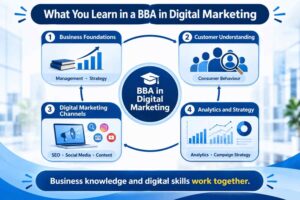
The following table gives a general idea of what students may study.
| Subject area | What students learn |
| Principles of Management | How organisations plan, coordinate and manage activities |
| Marketing Management | Market needs, product positioning and promotional decisions |
| Business Communication | Professional writing, presentations and workplace communication |
| Financial Accounting | Basic financial records and business transactions |
| Business Economics | Economic concepts affecting businesses and markets |
| Consumer Behaviour | How customers think, compare and make purchasing decisions |
| Search Engine Optimisation | Website visibility and search-related content practices |
| Social Media Marketing | Platform selection, content planning and audience engagement |
| Digital Advertising | Online campaign planning, targeting and budget concepts |
| Content Marketing | Creating useful information for audiences |
| Marketing Analytics | Understanding campaign data and performance indicators |
| E-commerce | Online selling, digital customer journeys and business operations |
Some universities also include internships, projects, case studies and practical assignments. Students should review the actual syllabus before applying because subject names and semester arrangements differ.
What Practical Activities Can Students Learn During the Course?
Understanding concepts is important, but students should also learn how those concepts are used in real business situations.
A practical learning approach may include the following activities:
Website and SEO exercises
Students can examine a sample website, identify its main pages and understand how headings, page descriptions and useful content support search visibility.
Social media content planning
Learners can prepare a simple content calendar for a sample business. They may decide what to publish, which audience to reach and what purpose each post should serve.
Digital advertising exercises
Students can study how online advertisements are structured, how audiences are selected and why campaign budgets need monitoring.
Email campaign planning
A learner may create a sample newsletter or promotional email and understand the importance of subject lines, clear messages and relevant calls to action.
Campaign performance reporting
Students can practise reading simple reports containing website visits, clicks, enquiries and other performance indicators.
These activities help connect classroom learning with the responsibilities found in marketing roles.
What Is the Difference Between BBA in Digital Marketing and BBA in Marketing and Finance?
Students sometimes compare different BBA specialisations because they want a qualification that offers a suitable combination of business knowledge and career options.
Although both specialisations belong to business administration, their areas of emphasis are different.
A BBA in marketing and finance generally combines marketing principles with financial knowledge. It may suit students interested in business development, financial services, marketing operations or roles that involve both customer and financial understanding.
A Digital Marketing specialisation focuses more directly on online customer acquisition, digital communication, content, advertising and marketing technology.
| Comparison | BBA in Digital Marketing | BBA in Marketing and Finance |
| Main focus | Online promotion and digital customer engagement | Marketing principles and financial knowledge |
| Key learning areas | SEO, social media, content and digital advertising | Marketing management, finance and accounting |
| Useful interests | Online platforms, communication, creativity and analytics | Business strategy, numbers, finance and customer needs |
| Possible career directions | SEO, social media, content and digital advertising | Marketing, finance support, sales and business operations |
Neither option is universally better. The right choice depends on your interests and the type of work you want to explore.
If you enjoy understanding online customer behaviour and working with digital campaigns, Digital Marketing may be worth considering. If you are more interested in financial concepts alongside general marketing, a BBA in marketing and finance may be a closer match.
Eligibility for BBA in Digital Marketing After Class 12
Students who have completed Class 12 can explore undergraduate business programmes, including digital marketing specialisations.
In many institutions, applicants from Commerce, Science and Arts or Humanities streams may be eligible. However, admission requirements are determined by the university offering the programme.
Common eligibility considerations include:
- Completion of Class 12 or an equivalent examination from a recognised board.
- Meeting the minimum marks specified by the university.
- Providing the required academic documents.
- Meeting any applicable entrance examination or selection requirements.
Some institutions offer admission based on Class 12 marks, while others may use entrance tests, interviews or additional selection procedures.
Students should not assume that every university follows the same eligibility rules. Always check the current admission notification and programme details.
Can Commerce, Arts and Science Students Choose Digital Marketing?
Yes, students from different academic streams may be able to apply, subject to the institution’s eligibility criteria.
Commerce students
Commerce students may already have some understanding of business, accounting, economics and marketing. These subjects can help them understand customer decisions and business operations.
Arts and Humanities students
Students from Arts or Humanities backgrounds may bring useful strengths in writing, communication, observation and understanding people. These abilities can support content development and audience research.
Science students
Science students may be comfortable with logical thinking, structured problem-solving and working with information. These strengths can be useful when learning analytics and campaign measurement.
Digital marketing includes several types of work, so students do not need to come from only one academic stream to explore the field.
Course Duration and Learning Options
A conventional BBA is commonly structured as a three-year undergraduate programme, although some universities offer different structures, including four-year honours pathways under their academic framework.
The exact duration, credit structure and subject combinations depend on the institution.
Students may come across different learning arrangements while comparing programmes:
- Regular or campus-based learning: Students attend scheduled classes and participate in campus-based academic activities.
- Online learning: Students access learning materials and academic activities through digital platforms, according to the programme’s structure.
- Distance learning: Students study through approved distance-learning arrangements and complete assessments as prescribed by the university.
Those researching Online UG degree courses in India should verify the university’s recognition and whether the specific programme is approved for the chosen learning mode and academic session.
Similarly, students comparing online degree courses in Karnataka should check programme availability, admission requirements, examinations and academic support before making a decision.
Do not assume that every BBA specialisation is offered in every mode. The specific programme must be checked.
What Should Students Look for in a Digital Marketing Course?
A course should offer more than an attractive title. Students should understand what they will actually study and how the programme supports their academic goals.
Before choosing, examine the following:
- Curriculum: Does it include business fundamentals and relevant digital marketing subjects?
- Academic recognition: Is the degree awarded by a recognised university, and is the programme authorised in the chosen mode?
- Practical exposure: Are there projects, assignments, case studies or internship opportunities?
- Faculty and academic support: Can students access guidance when they need help?
- Assessment structure: Understand examinations, assignments and attendance or participation requirements.
- Learning resources: Check access to course materials and digital learning facilities.
- Total cost: Compare tuition fees, examination charges and other applicable expenses.
Students exploring online courses for commerce students should also distinguish between a full university degree and a short-term skill course. Both can be useful, but they serve different educational purposes.
How Can Students Learn About Digital Marketing Qualifications and Skills?
Alongside a university degree, students may explore skill-based learning opportunities to understand specific areas of digital marketing.
The Government of India’s National Qualification Register includes recognised skill qualifications in areas such as digital sales, marketing, e-commerce and analytics.
For example, the National Qualification Register’s Digital Sales and Marketing qualification outlines learning areas that include digital marketing planning, e-commerce marketing, affiliate marketing, marketing analytics and generative AI.
This can help learners understand the types of practical competencies associated with digital marketing-related work. It is a skills qualification reference, not a replacement for checking university degree requirements.
What Career Opportunities Are Available After a BBA in Digital Marketing?
After completing a relevant degree and developing practical abilities, graduates may explore several entry-level roles. The responsibilities differ depending on the employer, industry and experience required.
- Digital Marketing Executive
Digital marketing executives support online campaigns and promotional activities. Their work may involve coordinating content, monitoring campaign performance, updating websites and preparing reports.
- SEO Executive
SEO executives work on website visibility in search engines. Common responsibilities include keyword research, content optimisation, basic website checks and performance monitoring.
- Social Media Executive
Social media executives help manage brand accounts, schedule posts, respond to audience interactions and monitor engagement.
- Content Marketing Executive
Content marketing professionals prepare and organise content such as blogs, website pages, newsletters and other informational material.
- Digital Advertising Executive
These professionals support paid online campaigns, help monitor advertising budgets and review campaign results.
- Email Marketing Executive
Email marketing executives help plan newsletters, promotional messages and customer communication campaigns.
- E-commerce Executive
E-commerce executives support online product listings, promotional activities, website updates and customer-facing digital operations.
- Marketing Analyst
Marketing analysts examine campaign and customer information to identify trends and prepare reports that support marketing decisions.
- Brand Executive
Brand executives help maintain brand communication, coordinate promotional activities and support marketing campaigns.
- Digital Marketing Coordinator
This role may involve organising campaign schedules, coordinating with content and design teams, tracking deliverables and supporting marketing operations.
The job title does not always reflect the complete responsibility. Students should read job descriptions carefully and understand the expected skills before applying.
Where Can Digital Marketing Graduates Work?
Digital marketing is used across many industries because businesses need to communicate with customers and maintain an online presence.
| Industry | Examples of digital marketing work |
| E-commerce | Product promotion, online campaigns and customer engagement |
| Education | Course awareness, student enquiries and admission campaigns |
| Healthcare | Service information, awareness campaigns and online communication |
| Banking and finance | Product communication and customer education |
| Retail | Promotions, product launches and customer engagement |
| Travel and hospitality | Destination promotion, bookings and customer communication |
| IT and technology | Product marketing, lead generation and brand communication |
| Media and entertainment | Audience growth, content promotion and digital campaigns |
| Start-ups | Brand building, online visibility and customer acquisition |
Small businesses, agencies, established companies and start-ups may all have different marketing requirements.
The Government of India’s MSME Ministry has also highlighted initiatives supporting digital marketing capabilities and e-commerce integration for micro and small enterprises. Its TEAM Scheme announcement describes efforts to support market access, branding and digital commerce for MSMEs.
This is one example of how digital capabilities can be relevant beyond large companies and advertising agencies.
Salary Expectations After a BBA in Digital Marketing
Salary is an important consideration for students planning their careers. However, there is no fixed salary attached to a BBA specialisation.
Earnings depend on the role, location, employer, practical skills, experience and the level of responsibility.
As an indicative market reference, recent India salary reporting places many fresher digital marketing executive roles around ₹2.5 – ₹3 lakh per annum, although actual offers can fall below or above this range. Specialist and managerial roles may offer higher compensation as professionals gain experience and demonstrate their abilities.
The following table is a broad guide, not a guaranteed salary scale.
| Career stage | Illustrative annual salary range |
| Entry-level or fresher roles | ₹2–₹3.5 lakh |
| Professionals with developing experience | ₹3–₹6 lakh |
| Experienced specialists | ₹5–₹9 lakh or more |
| Senior or managerial responsibilities | ₹8–₹12 lakh or more |
These figures are indicative and can vary substantially across employers and job roles. They should not be treated as guaranteed outcomes for graduates.
What Can Influence a Digital Marketer’s Salary?
Practical experience: Candidates who have worked on projects, internships or real campaign activities may be better prepared to demonstrate their abilities.
Specialisation: Skills in areas such as SEO, performance advertising, analytics and marketing automation may influence opportunities.
Communication: Professionals who can explain campaign performance and coordinate with teams may take on broader responsibilities.
Location: Salary offers can vary between Bengaluru, Mumbai, Delhi, Hyderabad, Chennai and other employment markets.
Industry: A digital marketer working in an agency may have different responsibilities and compensation from someone working in an e-commerce company or an in-house marketing team.
Results and responsibility: Professionals who can manage campaigns, budgets and measurable business objectives may progress towards more specialised or senior roles.
Rather than selecting a course based on an advertised salary figure, focus on building relevant knowledge and practical experience.
Can You Work as a Freelancer or Start Your Own Digital Marketing Business?
Yes. Digital marketing knowledge can also support independent work and entrepreneurship, provided you develop the necessary skills and understand how to manage client expectations.
Some possible independent work areas include:
- Social media content planning.
- Basic SEO support.
- Website content writing.
- Email campaign assistance.
- Digital advertising support.
- Content calendar development.
- Online brand communication.
- Marketing reports and performance summaries.
A beginner may start by creating sample projects and building a portfolio. As experience develops, they can explore working with small businesses, local brands or independent clients.
However, freelancing involves more than knowing marketing tools. It also requires client communication, pricing, deadlines, project management and clear agreements about deliverables.
Students interested in entrepreneurship should learn how to identify a business need, explain the value of their service and maintain professional relationships.
What Is the Future Scope of Digital Marketing?
Digital marketing continues to evolve as customer behaviour, technology and online business models change.
The future of the field is not limited to social media posting or search engine optimization. Several areas are becoming increasingly relevant.
Artificial intelligence in marketing
AI-based tools can help marketers generate content ideas, organise information, analyse campaign data and support repetitive tasks. Professionals still need to review outputs for accuracy, originality and relevance.
Marketing analytics
Businesses want to understand which campaigns generate meaningful results. The ability to interpret data and explain performance can therefore be valuable.
E-commerce and digital business
Online shopping and digital services create opportunities for professionals who understand product promotion, customer experience and online sales processes.
Personalised customer communication
Businesses may use customer preferences and behaviour to make messages more relevant. Marketers need to understand how to balance personalisation with privacy and responsible data use.
Video and creator-led marketing
Short-form video, educational content and creator partnerships have become important communication formats for many brands.
Marketing automation
Automation tools can support email sequences, lead management and customer communication. Understanding how these systems work can help marketers coordinate campaigns more effectively.
Responsible advertising and consumer trust
Digital marketing professionals must also understand transparency and ethical communication. The Government of India’s Department of Consumer Affairs has published guidance on endorsements and social media promotions. Its Endorsement Know-hows! guidance explains the importance of clear disclosures for paid and sponsored endorsements.
This is particularly relevant for professionals working with influencers, brand partnerships and online promotions.
The future of digital marketing will reward people who combine technical knowledge with customer understanding, creativity and responsible decision-making.
How to Choose the Right BBA Programme for Your Goals
Choosing an undergraduate course is an important decision, especially for students who are beginning their higher-education journey or returning to education after a break.
Use these points to compare your options.
Understand your interests
Ask yourself whether you enjoy communication, business strategy, customer behaviour, creativity, financial concepts or technology. Your interests can help you identify the right specialisation.
Compare the curriculum
Review the subjects semester by semester. Check whether the programme covers business fundamentals and the digital marketing areas you want to learn.
Verify recognition and approval
Confirm the university’s recognition and the programme’s approval for the selected mode of learning and academic session.
Check eligibility
Read the current admission criteria instead of relying on general statements about BBA eligibility.
Review practical learning
Look for projects, internships, case studies and other opportunities to apply concepts.
Understand the learning mode
If you need flexibility, compare the available learning arrangements and understand how classes, examinations, assignments and academic support are organised.
Compare total costs
Consider tuition fees, examination charges, study materials and other expenses. A low advertised fee may not represent the complete cost.
Consider future study
Think about whether you may want to pursue an MBA, a specialised postgraduate programme or additional professional training later.
Students comparing Online degree colleges in Bangalore should evaluate the specific university and programme rather than selecting an institution only because it appears in a search result.
Is Digital Marketing Suitable for Working Professionals and Students Returning to Education?
Digital marketing is not limited to students entering college immediately after Class 12.
Working professionals from sales, customer service, administration, retail and other business areas may explore the field if they want to build new skills or move towards marketing-related responsibilities.
For example, someone working in sales may already understand customer questions and product communication. Learning digital marketing can help that person understand how online campaigns generate enquiries and support sales activities.
Similarly, a person returning to education after a break can begin by reviewing basic computer skills, communication and business concepts before moving into specialised subjects.
A realistic learning plan should consider:
- Existing educational qualifications.
- Available study time.
- Programme eligibility.
- Preferred learning mode.
- Career goals.
- Practical learning requirements.
A degree can provide an academic foundation, while additional practice helps learners become familiar with the tools and activities used in the workplace.
How SODC Can Help You Explore Higher-Education Options
Selecting the right programme is an important first step towards building a career in business and marketing.
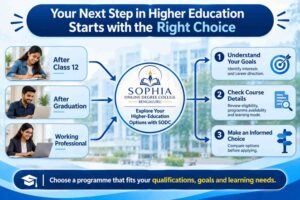
Sophia Online Degree College Bangalore encourages students to understand their interests, educational qualifications and long-term plans before choosing a higher-education pathway.
Students who are exploring business administration can compare available programme details, eligibility requirements and learning arrangements before making a decision.
Sophia Online Degree College Bangalore can be a starting point for learners who want to understand their higher-education options and identify an academic route that matches their goals.
If you are researching Online degree courses in Bangalore, review the recognition, programme availability, learning mode and admission requirements carefully. A specialised digital marketing career may also require practical projects and additional skill development alongside your academic studies.
You can explore available information through SODC and contact us for guidance about suitable higher-education options.
For students interested in exploring management specialisations, our guide on MBA in HR Management: Subjects, Skills and Career Opportunities provides insights into the curriculum, essential skills and career opportunities in human resource management.
Frequently Asked Questions About BBA in Digital Marketing
1. What is a BBA in Digital Marketing?
It is an undergraduate business administration programme that combines general management subjects with digital marketing topics such as SEO, social media marketing, online advertising, content marketing and analytics. The exact syllabus depends on the university.
2. Is BBA in Digital Marketing a good course after Class 12?
It may suit students interested in business, communication, online platforms, branding and customer behaviour. Before applying, compare the curriculum, eligibility, recognition and practical learning opportunities.
3. Can students from Arts and Science streams pursue a BBA in Digital Marketing?
Many institutions accept students from Commerce, Arts and Science backgrounds, subject to their admission rules. Check the specific university’s eligibility criteria before applying.
4. What subjects are taught in BBA Digital Marketing?
Common subjects may include management, accounting, marketing, business communication, consumer behaviour, SEO, social media marketing, content marketing, digital advertising and marketing analytics.
5. What is the duration of a BBA in Digital Marketing?
Many BBA programmes follow a three-year structure, while some universities offer four-year honours pathways. The duration depends on the university’s academic framework.
6. What jobs can I get after a BBA in Digital Marketing?
Graduates may explore roles such as Digital Marketing Executive, SEO Executive, Social Media Executive, Content Marketing Executive, Digital Advertising Executive, E-commerce Executive and Marketing Analyst, depending on their skills and employer requirements.
7. What is the salary after BBA in Digital Marketing in India?
Entry-level salaries vary by employer, location and role. Some fresher digital marketing executive positions may offer around ₹2–₹3.5 lakh per year, while experienced specialists and managers may earn more. These are indicative figures, not guaranteed outcomes.
8. Is BBA in Digital Marketing better than a general BBA?
Neither is automatically better. A general BBA offers broader business education, while a digital marketing specialisation provides more focused exposure to online marketing. Choose according to your interests and career plans.
9. What is the difference between BBA in Digital Marketing and BBA in Marketing and Finance?
Digital Marketing focuses on online promotion, digital campaigns, customer engagement and marketing analytics. Marketing and Finance combines marketing knowledge with financial subjects such as accounting and finance. They are different specialisations.
10. Can I pursue digital marketing after a BBA in another specialisation?
Yes. Graduates from other BBA specialisations may learn digital marketing through additional training, practical projects or professional courses. Their existing business knowledge may also be useful.
Take the Next Step Towards a Business and Marketing Career
A career in digital marketing can begin with an interest in business, communication or online platforms. But long-term growth comes from understanding how customers think, how organisations operate and how marketing decisions affect business outcomes.
If you are a student after Class 12, start by comparing undergraduate programmes and understanding their subjects. If you are a working professional, identify the skills that connect with your current experience. If you are returning to education, choose a realistic learning route that matches your qualifications and responsibilities.
Sophia Online Degree College Bangalore encourages learners to make informed academic decisions based on their interests and future plans.
Explore SODC, review the available higher-education information and contact us to take the next step towards your academic goals.