
Society is constantly changing. From the way people work and communicate to the growth of cities, changing family structures and new social challenges, there is always something worth understanding. An MA in Sociology helps learners explore these changes through research, observation and social analysis. For graduates considering further education, online degree courses in Bangalore and flexible postgraduate study options can make higher education easier to plan alongside personal or professional responsibilities. Understanding Distance MA admission in India is also useful for learners who want to continue studying without following a traditional classroom routine.
An MA in Sociology is not limited to learning definitions or studying social theories. It encourages students to ask meaningful questions, understand different viewpoints and examine how communities, institutions and social systems influence everyday life. Whether you have recently completed graduation, are working in a different field or are returning to education after a break, this postgraduate programme can help you build a deeper understanding of society.
This guide explains what Sociology involves, the subjects you may study, eligibility requirements, flexible learning routes, admission considerations, career opportunities, salary expectations and future scope. It will also help you decide whether this course matches your academic interests and long-term goals.
What Is Sociology and Why Does It Matter?
Sociology is the systematic study of society, social relationships, institutions, communities and human behaviour. It examines how people interact, how social groups develop and how factors such as education, culture, family, economy, religion and public policy influence everyday experiences.
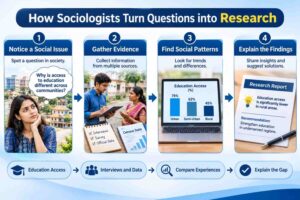
Think about a few familiar situations:
- Why do people from different communities follow different customs and traditions?
- How does migration change the culture and economy of a city?
- Why do educational opportunities differ between rural and urban areas?
- How do social media and technology influence relationships?
- What causes inequality, social exclusion or changes in family structures?
These are examples of questions that Sociology encourages learners to investigate. Instead of accepting assumptions, students learn to look at evidence, understand social patterns and consider different explanations.
The subject is relevant because social change affects almost every sector. Governments study communities while planning public programmes. Non-profit organisations examine local needs before starting development projects. Businesses try to understand customers, employees and workplace culture. Educational institutions explore how social and economic conditions influence learning.
Sociology provides a framework for understanding these connections.
What Does an MA in Sociology Help You Learn?
A Master of Arts in Sociology is a postgraduate programme that develops advanced knowledge of social theories, research methods and contemporary social issues.
During the programme, students generally move beyond introductory concepts and explore how societies function at local, national and global levels. They learn to connect theoretical ideas with real situations.
For example, a student studying urban sociology may examine how migration, employment, housing and transport influence city life. Someone exploring the sociology of education may investigate how family background, social conditions and access to resources affect educational experiences.
The exact curriculum depends on the university, but the learning experience commonly includes:
- Understanding classical and contemporary sociological theories.
- Studying social institutions and relationships.
- Exploring Indian society and social transformation.
- Examining rural and urban communities.
- Learning the basics of social research.
- Understanding development, inequality and social change.
- Analysing social data and presenting research findings.
The programme is suitable for learners who enjoy reading, asking questions, understanding people and examining issues from more than one perspective.
How Sociology Connects with Everyday Life and Different Industries
One of the interesting aspects of Sociology is that it is connected to situations people experience every day. The subject is not restricted to academic discussions.
Consider the following examples:
| Everyday situation | What Sociology helps us understand |
| People moving from villages to cities | Migration, urbanisation and changing communities |
| Differences in educational access | Social inequality and educational opportunities |
| Changing family structures | Family relationships and social transformation |
| Workplace diversity | Organisational culture and social interaction |
| Community development programmes | Local needs, participation and social change |
| Digital communication | Technology, identity and changing relationships |
These connections also explain why Sociology can be relevant across different professional environments.
In a non-profit organisation, sociological knowledge may help a team understand the needs of a community before planning an intervention. In a research organisation, it can support surveys, interviews and social studies. In a company, an understanding of people and workplace relationships may be useful in human resources, employee engagement or corporate social responsibility.
However, the degree alone does not automatically qualify someone for every specialised role. Employers may also expect practical experience, research skills, additional training or knowledge of a particular sector.
Skills You Can Develop Through an MA in Sociology
The value of postgraduate study is not limited to the subjects listed in the syllabus. It also comes from the abilities students develop while completing assignments, research activities and academic projects.
Here are some important skills associated with Sociology:
Social observation: You learn to notice patterns in communities, institutions and human interactions rather than judging situations only by first impressions.
Critical thinking: Sociological study encourages you to question assumptions, compare viewpoints and examine the reasons behind social events.
Research and information gathering: You may learn how to frame research questions, collect information through interviews or questionnaires and review existing studies.
Communication: Explaining research findings in a clear and organised manner is an important part of academic and professional work.
Data interpretation: Depending on the programme, you may develop experience in organising information, reading basic statistics and presenting findings.
Empathy and cultural understanding: Studying different communities and social experiences can help you understand perspectives that may be different from your own.
Report writing: Research assignments and project work can improve your ability to prepare structured reports and communicate conclusions.
These skills can be useful in research, education, development projects, administration and other people-focused sectors.
Who Should Consider Studying Sociology?
An MA in Sociology may be worth exploring if you are interested in understanding people, communities and social issues.
It can be relevant to:
- Recent graduates: Students who have completed a bachelor’s degree and want to specialise in a social science subject.
- Working professionals: Employees interested in development, research, education, human resources or community-related work.
- Career changers: Graduates who want to move towards social research, public policy support or non-profit sector opportunities.
- Learners returning after a break: People who want to resume their education and build a postgraduate qualification.
- Aspiring researchers: Learners who want to explore social issues through academic study and research projects.
You do not necessarily need to have studied Sociology at the undergraduate level. Some universities accept graduates from different disciplines, while others may have specific eligibility conditions. Always check the admission rules of the university and programme you are considering.
MA in Sociology Eligibility: Who Can Apply?
The first practical question for most applicants is whether their previous education meets the admission requirements.
In many universities, admission to an MA in Sociology requires a recognised bachelor’s degree. Some institutions accept graduates from any discipline, while others may specify a minimum percentage, subject background or other conditions.
A general overview is provided below. Treat it as a guide rather than a universal admission rule.
| Eligibility factor | What applicants should check |
| Educational qualification | A bachelor’s degree from a recognised university |
| Undergraduate subject | Whether graduates from all disciplines are accepted |
| Minimum marks | Whether a minimum percentage or CGPA is required |
| Entrance examination | Whether admission is merit-based or entrance-based |
| Language requirements | Available medium of instruction |
| Additional conditions | Any university-specific documents or rules |
Can You Study MA Sociology After a BA?
Yes, BA graduates are commonly among the applicants for postgraduate Sociology programmes. Students who studied Sociology, Political Science, History, Economics, Psychology or other humanities and social science subjects may find some concepts familiar.
However, a BA in a different subject does not necessarily prevent you from applying. Certain universities accept graduates from any recognised discipline.
Can B.Com or B.Sc Graduates Apply?
Some universities allow graduates from Commerce, Science, Management and other streams to apply for an MA in Sociology. This can be an option for people who developed an interest in social issues after completing their first degree.
For example, a B.Com graduate may be interested in studying workplace relationships, labour, inequality or the social impact of economic development. A B.Sc graduate may wish to understand public health, communities or environmental issues from a social perspective.
The deciding factor is the university’s published eligibility criteria, not simply the title of your undergraduate degree.
Can Working Professionals Apply?
Working professionals may consider flexible postgraduate study if they want to continue their education without leaving their current employment.
Before applying, check class schedules, examination arrangements, assignment deadlines and the time required for independent study. A flexible programme still requires consistent academic effort.
MA in Sociology Subjects: What Will You Study?
The subjects in an MA in Sociology programme are designed to help learners understand society through different theoretical and practical perspectives.
The syllabus varies between universities. Some programmes organise subjects by year, while others use a semester-based structure. The following table describes common areas of study rather than a fixed syllabus.
| Subject area | What you may learn |
| Sociological theories | Classical thinkers, contemporary perspectives and major concepts |
| Sociology in India | Social institutions, communities and social change in India |
| Research methodology | Research design, interviews, surveys and methods of collecting information |
| Rural sociology | Rural communities, social structures and development |
| Urban sociology | Cities, migration, urbanisation and housing |
| Sociology of development | Development processes, inequality and social transformation |
| Sociology of education | Education systems and their relationship with society |
| Gender and society | Gender relations, identity and social institutions |
| Sociology of religion | Religious institutions, beliefs and social relationships |
| Globalisation | Global connections, migration and changing communities |
Understanding the Main Subject Areas
Sociological theories: This area introduces the ideas and perspectives used to understand social behaviour and institutions. Students learn how different thinkers explain social order, inequality, power and change.
Sociology in India: This subject explores Indian social structures, communities, institutions and changing social relationships. It may include discussions about caste, class, family, religion, social movements and development.
Research methodology: Students learn how social research is planned and conducted. Topics may include selecting a research problem, preparing questionnaires, conducting interviews, reviewing literature and interpreting information.
Rural and urban sociology: These areas examine how communities function in different settings. Rural sociology may focus on village institutions, livelihoods and development, while urban sociology explores migration, housing, employment and city life.
Sociology of development: This area considers how development affects people and communities. It may explore inequality, access to resources, social change and the relationship between policy and everyday life.
Specialised electives: Depending on the university, students may be able to study topics such as education, religion, gender, diaspora, globalisation or social movements.
For an example of how a university structures its postgraduate Sociology curriculum, applicants can review the IGNOU MA Sociology programme and course structure. Its published programme information includes areas such as sociological theories, research methodologies, Sociology in India, development and specialised electives.
Online, Distance and Correspondence MA: Understanding the Difference
Students often use the words online, distance and correspondence interchangeably. However, the delivery methods can differ.
Understanding these differences is important before selecting a programme.
| Study mode | How learning is generally delivered | What to consider |
| Online learning | Digital learning platforms, online classes and electronic study resources | Internet access, online assessments and scheduled sessions |
| Open and distance learning (ODL) | Self-learning materials, academic support and specified contact or online activities | Study-centre arrangements and examination requirements |
| Correspondence learning | Printed or digital learning materials with limited scheduled classroom interaction | Assignment submission, learner support and examination arrangements |
The exact arrangement depends on the institution. Some distance programmes include online academic support, while some online programmes may still require examinations or other activities at designated locations.
Is an Online MA in Sociology Suitable for Working Professionals?
It may be suitable if the programme’s schedule and assessment system fit your working routine.
For example, an employee working regular office hours may prefer access to digital learning resources that can be reviewed after work. A person living away from a university campus may prefer a recognised distance programme with clearly defined learner support arrangements.
Before enrolling, check whether attendance is compulsory, how often live sessions take place, how examinations are conducted and whether the programme requires fieldwork or project activities.
What About Correspondence Study?
A correspondence-based learning route may appeal to students who prefer independent study and do not need frequent live classes. However, the label alone does not establish the quality or recognition of a programme.
If you are comparing a correspondence college in bangalore with an online or distance university programme, look beyond the location and advertised flexibility. Confirm which university awards the degree, whether the programme is officially offered in the chosen mode and how academic support is provided.
Distance MA Admission in India: A Practical Application Guide
The admission process can differ from one university to another, but most applicants can prepare by following a few common steps.
Step 1: Shortlist Suitable Universities
Start by identifying institutions that offer an MA in Sociology through the study mode you prefer. Compare the programme structure, duration, eligibility, fees and academic support.
Students researching online degree colleges in Bangalore should also check whether the institution actually offers the specific postgraduate programme they want. A college’s general online education services do not automatically mean that it offers an MA in Sociology.
Step 2: Check Recognition and Programme Approval
This is one of the most important steps.
Do not rely only on advertisements, brochures or statements that a university is recognised. Verify the institution and the specific programme for the relevant academic session and mode of delivery.
For online and open-distance programmes, check the applicable regulatory requirements and official recognition information. Confirm that the degree-awarding university is authorised to offer the programme in that mode.
Also be careful with third-party admission agents. A private service provider cannot simply claim to award a university degree on behalf of an institution.
Step 3: Review the Eligibility Conditions
Read the current admission notification carefully. Check the accepted undergraduate qualifications, minimum marks, entrance requirements and any additional conditions.
If your bachelor’s degree is from a different stream, contact the university’s admissions office before submitting an application.
Step 4: Prepare Your Documents
Applicants are commonly asked to provide some of the following:
- Class 10 and Class 12 mark sheets.
- Bachelor’s degree certificate or provisional certificate.
- Undergraduate mark sheets.
- Government-issued identity proof.
- Recent photograph and signature.
- Category certificate, if applicable.
- Migration or transfer certificate, if required.
- Other documents specified by the university.
Keep scanned copies ready if the application process is online.
Step 5: Complete the Application
Fill in the application form using accurate personal and academic details. Upload the required documents in the specified format and review the information before submitting.
If the university requires an entrance examination or interview, follow the published instructions and deadlines.
Step 6: Pay the Applicable Fees and Track Admission
Pay the fee through the university’s official payment channel. Save the receipt and application reference number.
After submission, check the admission portal or official communication for document verification, confirmation and further instructions.
Step 7: Understand the Study and Examination Schedule
Before classes or academic activities begin, review the programme calendar, subject materials, assignment deadlines, examination dates and learner-support arrangements.
A clear understanding of the schedule can help you balance study with work and personal responsibilities.
What Should You Compare Before Applying?
| Admission factor | Why it matters |
| University recognition | Helps establish the legitimacy of the degree |
| Programme approval | Confirms permission for the specific mode and session |
| Course curriculum | Shows whether the subjects match your interests |
| Total fee | Helps you plan the complete education cost |
| Duration | Helps you understand the expected study commitment |
| Examination method | Allows you to plan travel or online assessment requirements |
| Learner support | Helps you access academic guidance when needed |
Planning Distance MA admission in India becomes easier when you compare these details before paying an application or admission fee.
Duration, Fees and Study Planning
Many MA programmes are designed as two-year postgraduate courses. However, the permitted maximum duration, fee structure and academic calendar depend on the university and its regulations.
For example, IGNOU’s published MA Sociology programme information describes a minimum duration of 24 months and a maximum duration of 48 months. Its fee and examination arrangements should be checked directly on the current programme page before applying.
Do not assume that every university follows the same fee structure or duration.
Your total education cost may include:
- Admission or registration charges.
- Tuition fees.
- Examination fees.
- Study material or other academic charges.
- Project-related expenses, where applicable.
- Travel costs if examinations or activities are conducted at a designated centre.
Learners looking for affordable online degrees should compare the complete cost rather than choosing a programme only because its advertised first-year fee is low.
A practical study plan is equally important. Set aside regular time for reading, assignments and revision. Sociology involves understanding concepts and applying them to real situations, so studying only before examinations may not be enough.
Career Opportunities After an MA in Sociology
An MA in Sociology can support career exploration across several sectors because the subject develops an understanding of people, communities, institutions and social change.
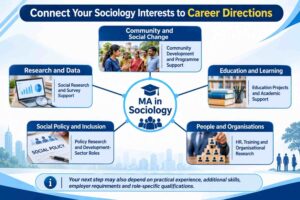
However, career outcomes depend on more than the degree. Employers may consider practical experience, research ability, communication, technical skills, additional qualifications and the specific responsibilities of a role.
Here are some career areas graduates may explore.
1. Social Research Assistant or Research Associate
Research organisations, universities, development agencies and non-profit groups may work on studies involving education, health, migration, employment, gender, housing and community development.
Depending on the organisation and role, responsibilities may include:
- Collecting information through surveys or interviews.
- Reviewing research papers and reports.
- Organising field data.
- Supporting research projects.
- Preparing summaries and presentations.
Strong research methods, writing and data-handling skills can be useful in this area.
2. NGO and Community Development Roles
Non-governmental organisations often work with communities on issues such as education, public health, livelihood development, social inclusion and awareness.
Sociology graduates may explore roles involving project coordination, community outreach, field research, documentation or programme support.
Some positions require additional experience or specialised training, particularly when they involve social work, counselling or direct service delivery.
3. Corporate Social Responsibility (CSR)
Companies may undertake community development and social-impact initiatives through their CSR teams or partner organisations.
Possible responsibilities include coordinating community programmes, communicating with stakeholders, supporting project documentation and monitoring activities.
A Sociology background may help professionals understand community needs and social impact. Employers may also prefer candidates with project management, development-sector or CSR experience.
India’s government-run Employment News has discussed CSR opportunities across corporate, public, non-profit and research settings. Applicants can explore its overview of career opportunities in Corporate Social Responsibility.
4. Social Policy and Development Support
Policy and development organisations examine how programmes affect different sections of society.
Depending on the role, graduates may support research, documentation, programme evaluation, stakeholder communication or development projects.
A postgraduate degree in Sociology can provide useful subject knowledge, but policy analyst positions may require strong research, quantitative analysis, economics, public policy or other specialised skills.
5. Human Resources and Employee Relations
Sociology explores group behaviour, social relationships, institutions and workplace interactions. These areas can be relevant to people-focused functions in organisations.
Graduates may consider entry-level or support roles in recruitment coordination, employee engagement, training administration or workplace research, depending on their experience and additional skills.
A specialised HR qualification may be useful for roles that require detailed knowledge of employment practices and organisational management.
6. Market and Social Research
Research agencies and businesses may study consumer behaviour, public opinion, community preferences and changing social trends.
Sociology graduates with practical experience in survey design, interviews, data interpretation and report writing may explore research support roles.
Learning spreadsheet tools, basic statistics and data visualisation can strengthen this career direction.
7. Education and Academic Research
An MA in Sociology can be a foundation for further academic study. Graduates interested in teaching or research may consider relevant eligibility examinations, research programmes and doctoral study.
However, an MA alone does not automatically qualify a person for every college or university teaching position. Candidates must meet the applicable recruitment and eligibility requirements.
Government Jobs and Competitive Examination Pathways
Some learners choose Sociology because they are interested in public administration, social development and government-related work.
A postgraduate degree may help deepen subject knowledge, but it does not provide automatic entry into government employment.
Depending on the recruitment notification, graduates may explore:
- Civil services and other competitive examinations.
- Research and project positions in government institutions.
- Social development programme roles.
- Posts involving community research or public policy support.
- Academic and research opportunities, subject to eligibility.
Always read the official recruitment notification for the required degree, subject, age limit, experience, examination and selection process.
Can Sociology Help with Civil Services Preparation?
Sociology is a subject that can help candidates understand social institutions, inequality, development, communities and social change. These areas may be useful when preparing for questions related to society and social issues.
Some candidates also choose Sociology as an optional subject in competitive examinations where it is available. However, selecting an optional subject requires a separate assessment of interest, syllabus, preparation time and examination strategy.
The MA programme and a competitive examination are different academic and selection processes.
Can You Become a Sociology Teacher After an MA?
An MA in Sociology can be an important academic qualification for people interested in teaching and research. However, the required eligibility depends on the level and type of institution.
For college and university teaching, candidates generally need to meet the applicable postgraduate subject requirements and qualifying examination or other regulatory conditions. UGC-NET is one of the recognised routes for determining eligibility for Assistant Professor and/or Junior Research Fellowship, subject to the current rules.
Candidates should check the latest official examination bulletin and recruitment requirements before planning a teaching career.
Those interested in school teaching may need separate teacher education qualifications, depending on the subject, level and applicable recruitment rules.
Salary Expectations After an MA in Sociology
Salary is an important consideration when choosing a postgraduate course. However, there is no single salary figure that applies to every MA Sociology graduate.
Pay can differ significantly according to the job role, employer, location, experience, sector and additional skills.
For example, a research assistant working on a short-term project may have a different compensation structure from an experienced programme coordinator in a development organisation. A candidate with specialised data analysis skills may also be considered for roles with different responsibilities.
The following table provides a general way to understand how compensation can vary. It is not a salary guarantee or a fixed market scale.
| Career area | Factors that may influence salary |
| Research assistance | Research experience, project funding and technical skills |
| NGO and development work | Organisation size, project responsibilities and field experience |
| CSR coordination | Employer, programme scope and stakeholder-management skills |
| HR and employee relations | Industry, organisational role and HR knowledge |
| Market research | Survey skills, data analysis and reporting ability |
| Academic and research roles | Eligibility, institution, experience and research qualifications |
| Policy and programme support | Specialisation, analytical ability and project experience |
What Can Improve Your Career Prospects?
A postgraduate degree provides subject knowledge, but building practical skills can make your profile more relevant to employers.
Consider developing:
- Research writing and report preparation.
- Survey design and interview techniques.
- Spreadsheet and data organisation skills.
- Basic statistics and data interpretation.
- Presentation and communication.
- Project coordination and documentation.
- Knowledge of development programmes and social issues.
- Internship or field experience, where possible.
Instead of choosing a course based only on expected salary, consider whether it helps you build the skills required for the type of work you want to pursue.
Future Scope of Sociology in India
Society is changing through technology, migration, urban growth, education, economic development and changing workplace practices. These changes create a continuing need to understand how people and communities respond to new conditions.
Sociological knowledge can be relevant in several emerging areas.
Urban development: Growing cities bring questions about housing, transport, migration, public services and community relationships. Understanding these issues can support research and development planning.
Education and social inclusion: Researchers and organisations continue to examine access to education, learning inequalities and the relationship between family and social conditions.
Digital society: Online communication, digital communities, technology use and changing social relationships are important areas for social research.
Gender and social development: Questions involving participation, opportunity, representation and inclusion remain relevant across institutions and communities.
Public health and communities: Social factors influence access to healthcare, health awareness and community responses to public programmes.
Corporate responsibility: Businesses increasingly engage with communities, employees and stakeholders. Understanding social impact can be useful in CSR and related work.
Research and policy support: Government bodies, academic institutions and development organisations may require research and documentation to understand social needs and evaluate programmes.
The future opportunities available to an individual will still depend on qualifications, experience, practical abilities and the requirements of the employer.
Further Study Options After an MA in Sociology
Some graduates may wish to continue studying after completing their master’s degree. The next step should depend on the area they want to specialise in.
| Further study option | Who may consider it? |
| PhD in Sociology | Learners interested in advanced research and academic careers |
| Research methodology courses | Graduates who want to strengthen research skills |
| Public policy programmes | Learners interested in governance and policy-related work |
| Development studies | People interested in social and community development |
| Social work qualifications | Learners aiming for professional social work roles |
| Data analysis training | Graduates interested in research and evidence-based roles |
| Gender studies or related specialisations | Learners interested in specialised social research |
An MA in Sociology can provide a foundation for further academic and professional learning, but admission to advanced programmes depends on the eligibility conditions of the institution.
How to Choose the Right MA Sociology Programme
Selecting a university is as important as choosing the subject. A programme may look attractive in an advertisement, but applicants should examine the academic and administrative details before enrolling.
Use this checklist to compare your options.
- Verify the degree-awarding university
Identify which university will issue the final degree. Do not assume that a study centre, admission partner or private training provider is itself the degree-awarding institution.
- Confirm recognition for the chosen mode
Check whether the university is authorised to offer the specific programme through online or ODL mode for the relevant academic session.
- Read the syllabus carefully
Look for subjects that match your interests. If you want to work in research, check whether the programme includes research methodology, data analysis and project work.
- Compare the complete fee
Include tuition, registration, examination and other applicable charges. Understand the refund policy and payment schedule.
- Check academic support
Find out how students can contact faculty members, access study materials, receive assignment guidance and resolve academic questions.
- Understand examination arrangements
Check whether examinations are online or conducted at designated centres. Confirm whether you may need to travel.
- Match the programme to your career plan
A learner interested in research may prioritise methodology and project work. Someone interested in development-sector opportunities may look for subjects connected to social change, communities and development.
What If You Are Comparing Institutions in Bengaluru or Karnataka?
Applicants exploring online degree courses in karnataka should compare institutions based on the exact programme, mode, recognition, curriculum and support system rather than location alone.
Similarly, people searching for online degree courses in bangalore should verify whether the programme they want is actually available through an approved online or distance mode. A university may offer some programmes online but not every course in its portfolio.
If you are comparing online ug degree courses in india with postgraduate options, remember that an MA is a postgraduate qualification. You generally need to complete a recognised bachelor’s degree before applying.
The right choice is the programme that meets your academic needs and is officially approved for the mode in which you intend to study.
How SODC Can Help You Plan Your Higher-Education Journey
Choosing a postgraduate course often leads to a wider question: what should you study next, and how can you make that decision fit your current responsibilities?
Students and working professionals exploring Sophia Online degree College Bangalore can use the institution’s website to learn more about its higher-education information and available academic options.
If you are comparing degree pathways, take time to understand the qualification you need, the recognition of the institution and the learning format that fits your schedule. Do not assume that every college offers every postgraduate programme or that a general online degree option is equivalent to a specialised MA in Sociology.
You can explore the courses and information available through SODC and contact the institution to clarify programme availability, eligibility and admission-related questions.
A well-informed decision begins with understanding your academic background and the kind of work you hope to do in the future.
Make Your Next Academic Decision with Clarity
An MA in Sociology can help you understand society through structured study, research and critical thinking. It may be relevant to learners interested in social research, development, education, CSR, community programmes and further academic study.
Before applying, compare the subjects, eligibility, duration, fees and recognition of the programme. If you are balancing education with employment or family responsibilities, review the learning schedule and examination requirements carefully.
For students exploring Distance MA admission in India, the most useful first step is to shortlist recognised universities and compare their current admission notifications. Take time to understand the programme before making a payment or submitting your documents.
“Students planning to pursue higher education after Class 12 can also explore our guide on Online BA after 12th to understand the eligibility criteria, course duration, subjects, and career opportunities.”
Frequently Asked Questions About an MA in Sociology
1. What is an MA in Sociology?
An MA in Sociology is a postgraduate degree that studies society, social relationships, institutions, communities and social change. It commonly covers sociological theories, research methods, Indian society, development and specialised areas such as urbanisation or education.
2. What is the eligibility for an MA in Sociology?
Many universities require applicants to hold a bachelor’s degree from a recognised university. Some accept graduates from any discipline, while others may specify minimum marks or subject requirements. Always check the current admission notification.
3. Can I study MA Sociology after completing a B.Com or B.Sc?
Some universities accept graduates from Commerce, Science and other streams for MA Sociology. Admission depends on the institution’s eligibility rules, so check whether your undergraduate qualification is accepted.
4. How long does an MA in Sociology take?
Many MA programmes have a minimum duration of two years. The maximum permitted duration may vary by university and study mode. Check the official programme details before applying.
5. What are the main subjects in an MA Sociology programme?
Common subject areas include sociological theories, Sociology in India, research methodology, rural sociology, urban sociology, development, education, gender, religion and globalisation. The exact syllabus differs between universities.
6. Is an online MA in Sociology available in India?
Some recognised higher education institutions offer postgraduate programmes through online or open and distance learning modes. Availability can change by academic session. Verify the university and the specific programme’s approval before enrolling.
7. Can working professionals pursue an MA in Sociology?
Yes, working professionals may consider online or distance programmes if the schedule, assessments and examination arrangements fit their routine. They should review the academic workload before admission.
8. What is the difference between online and distance MA Sociology?
Online programmes generally use digital learning platforms and online academic activities. Open and distance learning may use self-learning materials and different forms of academic support. The exact delivery and examination arrangements depend on the university.
9. What jobs can I get after an MA in Sociology?
Graduates may explore research assistance, social research, NGO programme support, community development, CSR coordination, market research, HR-related support and academic research. Eligibility depends on the role and may require additional skills or experience.
10. Can I become a lecturer after an MA in Sociology?
An MA can be an important academic qualification, but candidates must meet the applicable requirements for college or university teaching. UGC-NET or other recognised eligibility routes may be relevant, depending on current regulations and recruitment rules.
An MA in Sociology is an opportunity to understand how society works, why social changes happen and how communities respond to different challenges. It can support further learning and career exploration in research, development, education, CSR and other people-focused areas.
The best programme is not simply the one with the most attractive advertisement. It is the one that offers a suitable curriculum, recognised qualification, clear academic support and a learning format you can manage.
At Sophia Online degree College Bangalore, learners can explore higher-education information and consider academic options that match their goals. Visit SODC to review the available information and contact us if you need guidance about the next step in your education.
“Explore your options carefully, understand the admission requirements and choose your next academic step with confidence.”