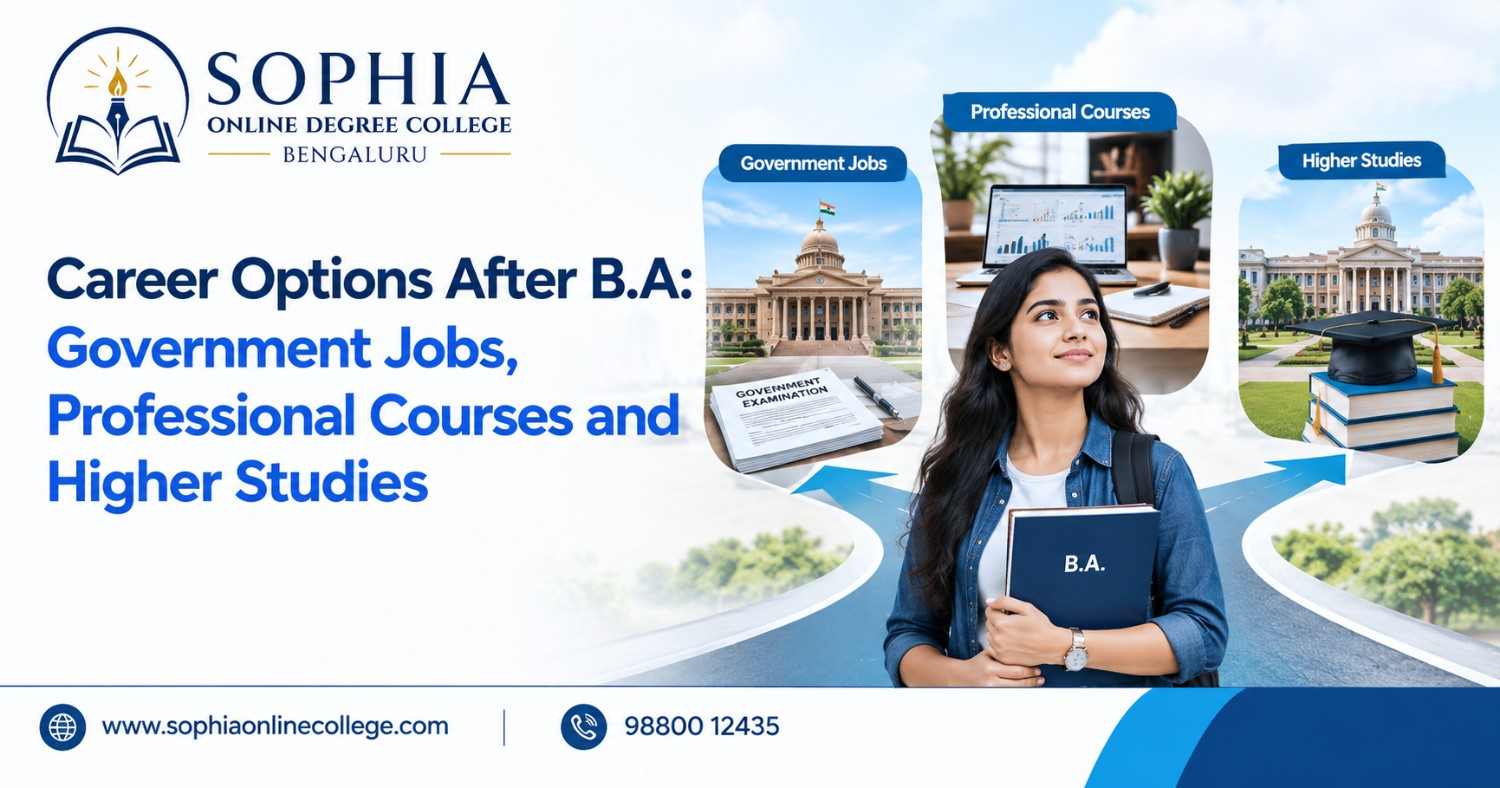
Completing a B.A. is an important academic milestone, but it can also bring a difficult question: what should you do next? Some graduates want the stability of a government job, while others prefer professional courses, corporate careers or higher studies. The good news is that online ba degree courses and other flexible learning options have made it easier for students and working professionals to continue their education while planning their next move.
A Bachelor of Arts degree can provide a foundation in communication, research, social sciences, languages, critical thinking and subject knowledge. These abilities can be useful across different sectors. However, your next qualification should depend on the kind of work you want to pursue, not simply on what other graduates are choosing.
If you have recently completed your B.A., are preparing for competitive examinations, have taken a break from education or are working while considering further studies, this guide will help you understand the possibilities. Instead of treating every career as an equally suitable option, let’s explore the routes based on your interests, qualifications and long-term plans.
Your B.A. Is Complete. Which Direction Should You Take Now?
A B.A. does not lead to only one profession. Your subject combination, interests, additional skills and willingness to study further can influence the opportunities available to you.
For example, a Political Science graduate may be interested in public administration, civil services or policy-related work. An English graduate may explore content, communication, publishing or teaching. Someone who studied Psychology or Sociology may consider human resources, social work or research after obtaining the appropriate additional qualifications.
The important point is that your undergraduate subject can be a starting advantage, but it does not have to define your entire career.
Before choosing a course or applying for a job, consider three broad directions:
The Three Career Directions After B.A.
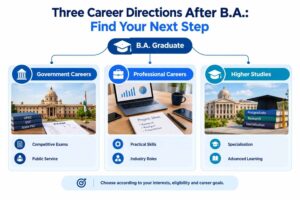
| Career direction | What it involves | A practical first step |
| Block 1: Government and public-sector opportunities | Preparing for competitive examinations and recruitment processes for administrative, banking, staff selection, railway and state-level roles. | Identify examinations for which your graduation is eligible. Compare the syllabus, age limits and selection stages before beginning preparation. |
| Block 2: Professional courses and employment-focused skills | Learning a specific professional discipline such as digital marketing, human resources, journalism, law, design, communication or business management. | Select a career area, identify the skills employers expect and shortlist a relevant course or qualification. |
| Block 3: Higher studies and academic progression | Pursuing postgraduate education or professional degrees such as MA, MBA, MSW, LLB or B.Ed., depending on eligibility and career goals. | Decide whether you want deeper subject knowledge, a specialised profession, research opportunities or a change in career direction. |
These three directions can also overlap. A graduate may prepare for a government examination while completing a relevant postgraduate programme. Another may take a professional course and start working before deciding whether an MBA is necessary.
You do not have to make a lifelong decision immediately. You need to identify the most useful next step for your present situation.
Government Jobs After B.A.: Opportunities for Graduates
For many graduates, government employment is attractive because it offers structured recruitment, defined responsibilities and the possibility of long-term career progression. A B.A. can meet the basic educational requirement for several graduate-level examinations, provided the candidate satisfies the other conditions mentioned in the relevant notification.
However, completing a B.A. does not automatically qualify you for every government post. Some recruitments require particular subjects, technical qualifications, physical standards, professional registration or additional experience.
Here are some major examination routes worth exploring.
1. UPSC Civil Services Examination
The Union Public Service Commission conducts the Civil Services Examination to recruit candidates for services such as the Indian Administrative Service, Indian Police Service and Indian Foreign Service, along with other services notified for the examination.
A B.A. graduate can consider this route because the examination covers areas such as history, geography, polity, economics, society, current affairs and general studies. Your undergraduate subjects may help you build familiarity with some topics, although the examination requires preparation beyond your university syllabus.
What should you understand before preparing?
- A recognised bachelor’s degree or an equivalent qualification is generally required, subject to the examination rules.
- Candidates must satisfy the prescribed age and other eligibility conditions.
- The selection process includes preliminary examination, main examination and personality test.
- Preparation requires consistent study, current-affairs awareness, answer-writing practice and revision.
Students who studied History, Political Science, Economics, Sociology or Geography may find some overlap with the general studies syllabus. However, candidates from other B.A. specialisations can also prepare if they meet the eligibility requirements.
Before purchasing coaching material or beginning a preparation programme, read the latest notification on the official UPSC Site. Examination dates, vacancies and eligibility conditions can change between recruitment cycles.
2. SSC CGL and Other Staff Selection Examinations
The Staff Selection Commission conducts examinations for recruitment to various posts in central government departments and organisations.
The Combined Graduate Level Examination, commonly called SSC CGL, is one of the options graduates can explore. Depending on the post, recruitment may involve responsibilities related to administration, auditing, taxation, investigation, accounts and office operations.
A B.A. graduate may be eligible for many posts where a bachelor’s degree is the prescribed qualification. Some specialised posts can have additional subject or qualification requirements.
What should you prepare for?
- Quantitative aptitude
- General intelligence and reasoning
- English comprehension
- General awareness
- Computer-related or other qualifying requirements, where applicable
If you are more comfortable with language, reading and general awareness than advanced mathematics, you can still explore this route. However, do not ignore quantitative aptitude. Regular practice is important for improving speed and accuracy.
Check the latest recruitment notice and post-wise requirements through the official SSC portal. Avoid relying only on coaching advertisements or old eligibility summaries.
3. Banking and Insurance Examinations
Banking can be another option for B.A. graduates interested in financial services, customer operations and administrative responsibilities.
Recruitment examinations conducted by organisations such as IBPS and public-sector banks may offer opportunities for graduate candidates, depending on the specific notification.
Possible career directions include:
- Probationary Officer
- Clerk or Customer Service Associate
- Specialist Officer, where the required qualification is met
- Insurance Assistant or Officer
- Other administrative and financial-service positions
A general B.A. degree may satisfy the graduation requirement for some generalist posts. Specialist positions can require a particular educational background or professional qualification.
Banking examinations generally test reasoning ability, quantitative aptitude, English language skills and general or banking awareness. Candidates should also understand the role’s responsibilities, such as customer service, documentation, financial transactions and compliance procedures.
This path may suit graduates who enjoy structured work, numerical reasoning and interacting with customers.
4. State Public Service Commission Examinations
If you want to work within your state, consider the recruitment examinations conducted by the relevant State Public Service Commission.
These examinations may recruit candidates for administrative, revenue, departmental and other state government roles. The available posts, examination pattern and eligibility conditions differ between states.
For graduates in Karnataka, for example, state-level recruitment notifications may be relevant depending on the post and recruitment cycle. Candidates should check the official state commission and department websites for current information.
A B.A. in Political Science, History, Economics or Public Administration may help you understand topics related to governance and society. Nevertheless, the examination syllabus and notification should guide your preparation.
5. Railway and Other Central Government Recruitment
Railway recruitment is another area graduates can investigate. Different recruitment notifications cover different levels of posts, and educational requirements vary.
Some positions require Class 10 or Class 12 qualifications, while graduate-level categories may require a bachelor’s degree. Technical and specialised positions can require additional qualifications.
Other central government recruitment opportunities may also be available through departmental examinations and individual ministry notifications.
A useful rule: Do not assume that every government job accepts every B.A. specialisation. Check the educational qualification, age limit, nationality conditions, selection process and other requirements for the exact post.
Professional Courses After B.A.: Build a Career Beyond Your Degree Subject
Not every graduate wants to spend the next few years preparing for competitive examinations or pursuing another traditional academic degree. Some want to enter the private sector, develop a professional skill or change their career direction.
Professional courses can help bridge the gap between undergraduate learning and the practical requirements of a specific role. The right choice depends on the work you want to do.
Digital Marketing
Digital marketing may suit graduates who enjoy communication, creativity, research and understanding customer behaviour.
The field includes several areas:
- Search engine optimisation (SEO)
- Social media marketing
- Content marketing
- Email marketing
- Paid advertising
- Website analytics
- Digital campaign planning
A beginner can start by learning the fundamentals of marketing, content creation and online audience behaviour. Practical exercises such as preparing a content calendar, conducting keyword research or analysing a sample campaign can help demonstrate your learning.
A certificate alone may not be enough to establish professional ability. A small portfolio of sample projects can help you explain what you have learned.
Human Resource Management
Human Resource Management can be a suitable direction for graduates interested in people, workplace communication, recruitment and employee development.
A professional course or postgraduate qualification in HR can introduce topics such as:
- Recruitment and selection
- Employee engagement
- Training and development
- Performance management
- Payroll fundamentals
- Workplace policies
- Human resource information systems
B.A. graduates from Psychology, Sociology, English and related disciplines may find some of these topics familiar. However, students from other specialisations can also explore HR through suitable education and practical training.
For learners interested in progressing towards management responsibilities, an MBA with an HR specialisation may be worth considering, subject to admission eligibility.
Journalism, Media and Communication
If you enjoy writing, storytelling, current affairs or public communication, media-related education may be worth exploring.
Possible learning routes include postgraduate programmes, diplomas and specialised courses in journalism, mass communication, public relations and digital media.
Potential career directions include:
- Content writer
- Editorial assistant
- Reporter
- Social media executive
- Public relations assistant
- Communication executive
- Media researcher
The nature of work varies considerably. Journalism may require reporting and fact-checking, while corporate communication can involve writing announcements, preparing presentations and managing communication channels.
A portfolio containing writing samples, articles, interviews or other relevant projects can help demonstrate your abilities.
Law and Legal Studies
Graduates who are interested in legislation, public policy, legal research and justice-related work can explore law as a professional direction.
A three-year LL.B. programme is a common route for graduates who want to pursue legal education after completing an undergraduate degree. Admission requirements and selection processes vary between institutions.
After completing the required legal education, graduates must meet the applicable professional requirements to practise as advocates in India.
Law can also lead to areas such as legal research, compliance, corporate legal support and policy work. The appropriate route depends on the role and its professional requirements.
Design and Creative Technology
A B.A. graduate with an interest in visual communication, creativity or digital products may consider professional learning in:
- Graphic design
- UI/UX design
- Animation
- Video editing
- Visual communication
- Content production
These areas often require practical demonstrations of ability. A learner should practise using relevant tools, understand design principles and build projects that show the process behind the final work.
For example, someone interested in UI/UX design could create a sample mobile-app layout, explain the user problem and show how the design addresses it.
Business and Management
If you are interested in business operations, marketing, sales, administration or team coordination, management education may provide a useful direction.
A graduate can explore an MBA or a relevant postgraduate diploma, depending on eligibility and career objectives. Some learners may begin with shorter courses in business communication, project coordination, customer relationship management or operations.
An MBA is not compulsory for every management-related entry-level job. It should be considered when the programme offers relevant learning and supports the kind of professional progression you want.
“Graduates interested in expanding their career opportunities in the business and corporate sectors can also explore an MBA in Business Analytics to develop management and analytical skills. Read our guide on MBA in Business Analytics: Course, Syllabus, Eligibility Criteria and Fees to learn more about the programme.”
Higher Studies After B.A.: Which Qualification Matches Your Goal?
If you enjoy academic learning or want to qualify for a specialised profession, higher studies can be a valuable next step.
The important question is not simply which postgraduate course is popular. It is whether the qualification supports your intended career.
Master of Arts (M.A.)
An M.A. allows graduates to deepen their knowledge in a chosen subject.
Common specialisations include:
- English
- History
- Political Science
- Economics
- Sociology
- Psychology
- Geography
- Public Administration
An M.A. may suit learners interested in research, teaching-related pathways, subject expertise, policy work, writing or further academic study.
For certain teaching and academic positions, additional qualifications, eligibility tests and recruitment requirements may apply. An M.A. alone does not automatically qualify someone for every teaching role.
Master of Business Administration (MBA)
An MBA is a postgraduate management qualification that can help graduates move towards business and organisational roles.
Depending on the institution and programme, learners may study areas such as:
- Marketing management
- Human resource management
- Financial management
- Operations management
- Business analytics
- General management
A B.A. graduates can explore an MBA if they satisfy the institution’s admission requirements. Some institutions may require an entrance examination, while others may follow different selection procedures.
For working professionals and graduates who need flexibility, online degree courses in Bangalore may be one of the study formats to investigate. Before enrolling, compare the programme’s recognition status, curriculum, assessment pattern, student support and total fees.
Bachelor of Education (B.Ed.)
Graduates interested in school teaching may explore a B.Ed. programme, subject to the applicable eligibility conditions and regulations.
The programme focuses on educational theory, teaching methods, classroom practice, assessment and learner development.
However, the eligibility requirements for B.Ed. admission and the qualifications required for particular teaching posts can differ. Candidates should check the current rules of the institution, relevant authorities and recruitment body before making a decision.
If your goal is to become a teacher, also investigate the relevant teacher eligibility tests and subject-specific requirements.
Master of Social Work (MSW)
An MSW may suit graduates who want to work in social development, community programmes, public welfare, healthcare support or non-governmental organisations.
The programme generally introduces areas such as social work methods, community development, social policy, counselling foundations and fieldwork.
Practical exposure is important in this field. Before choosing a programme, understand its fieldwork structure, specialisations and institutional support.
LLB After B.A.
Graduates interested in legal practice or legal studies can consider a three-year LL.B. programme, subject to admission requirements.
This route is different from the five-year integrated law programme generally pursued after Class 12. A graduate who already holds a bachelor’s degree can investigate the graduate-entry law pathway.
Before admission, verify the institution and programme’s applicable recognition and professional requirements. Completing a law course and becoming eligible to practise are connected but distinct steps.
Which Course Should You Choose? A Practical Comparison
The following comparison can help you shortlist a direction based on your interests and the kind of work you want to pursue.
| Your main interest | Courses or route to explore | Possible career direction |
| Public service and administration | UPSC, SSC, State PSC preparation | Administrative and government roles |
| Banking and financial services | Banking examination preparation, relevant finance learning | Banking and financial-service roles |
| Teaching and subject expertise | M.A., B.Ed. and applicable eligibility tests | Teaching and academic pathways |
| Business and management | MBA or relevant management programme | HR, marketing, operations and business roles |
| Writing and communication | Journalism, mass communication, content and digital marketing courses | Media, content and communication roles |
| Social development | MSW and related specialised learning | Social work and development-sector roles |
| Legal profession | Three-year LL.B. | Legal practice and law-related careers |
| Creative and digital work | UI/UX, graphic design, animation or video editing | Design and digital creative roles |
Remember that these are possible pathways, not guaranteed career outcomes. Some occupations require additional examinations, registration, internships, portfolios or experience.
Eligibility: What Can You Study After a B.A.?
Most graduates can explore a range of postgraduate and professional programmes, but eligibility is not identical across institutions.
Some programmes accept graduates from any recognised discipline. Others require a particular subject combination, minimum marks, entrance-test scores or relevant experience.
| Programme or route | General eligibility consideration |
| M.A. | A recognised bachelor’s degree; subject-specific conditions may apply. |
| MBA | A recognised bachelor’s degree; minimum marks and entrance or selection requirements vary. |
| B.Ed. | Graduation and the applicable subject, marks and admission conditions. |
| Three-year LL.B. | A recognised bachelor’s degree and the relevant admission requirements. |
| MSW | A bachelor’s degree; institution-specific eligibility applies. |
| Professional certificates | Depends on the course provider and level of training. |
| Government examinations | Depends on the examination, post, age limit and notification. |
If you completed your B.A. Several years ago, you could still investigate higher education options. A break in education does not automatically prevent you from applying. What matters is whether you meet the current admission requirements.
Students who are still completing their final year should also check whether provisional applications are permitted and when proof of graduation must be submitted.
Can You Study Further Through Flexible or Online Education?
Not every graduate can attend a college campus every day. Some are already employed, some have family responsibilities, and others live away from their preferred institution.
Flexible education can help such learners continue studying while managing their existing commitments.
When comparing online ug degree courses in India, graduates should distinguish between undergraduate programmes and postgraduate programmes. If you have already completed a B.A., you may be looking for a postgraduate qualification, a second undergraduate degree for a specific purpose or a supplementary professional course.
The format should match your learning needs:
Online learning: May offer digital study materials, online classes, recorded sessions and online assessments, depending on the programme.
Distance learning: Often uses self-learning materials and scheduled academic support, with the exact structure varying by institution.
Regular campus learning: Provides in-person classroom interaction and campus-based academic activities.
Learners exploring online degree courses in karnataka should not select a programme only because it is advertised as flexible. Verify the institution, the exact programme, the academic session and the applicable recognition or approval requirements.
Also check whether the programme provides access to faculty support, study resources, examination information and a clear process for resolving student queries.
How Much Can You Earn After a B.A.?
Salary is one of the most common concerns for graduates choosing between government jobs, professional courses and higher studies.
There is no single salary figure for all B.A. graduates. Earnings depend on the role, employer, location, experience, specialisation, skills and recruitment process.
A graduate starting in content writing may have a different salary structure from someone entering HR, sales, digital marketing or customer operations. Government roles follow the applicable pay levels and allowances for the post, while private-sector salaries vary between organisations.
The following table gives broad illustrative expectations for some entry-level private-sector directions. These are not guaranteed salary offers or fixed market rates.
| Career direction | What can influence starting pay |
| Content and communication | Writing ability, language proficiency, portfolio and employer |
| Digital marketing | Practical campaign knowledge, SEO skills, analytics and project experience |
| HR and recruitment | Communication, coordination, recruitment knowledge and software familiarity |
| Customer support and operations | Language skills, process knowledge, shift requirements and organisation |
| Design and creative roles | Portfolio quality, design tools and practical ability |
| Research and programme support | Subject knowledge, research skills, writing and project experience |
For government jobs, salary depends on the specific post, pay level, allowances and applicable service rules. Do not compare a government recruitment advertisement with a private-sector entry-level salary without considering the complete compensation structure.
If you need help exploring job roles, the Government of India’s National Career Service provides job-search and career-related services. It can be a useful starting point for understanding vacancies and career information. Always verify recruitment details with the employer or official recruiting authority.
Future Scope: How Can a B.A. Graduate Stay Relevant?
A B.A. provides a foundation in understanding people, society, language, communication and different areas of knowledge. These capabilities remain relevant across many professional settings.
However, the workplace continues to change. Employers increasingly expect graduates to combine academic knowledge with practical skills and the ability to adapt.
A few areas worth exploring include:
Digital communication: Organisations need people who can prepare clear content, communicate with audiences and understand online platforms.
Human resource operations: Recruitment coordination, employee communication and training support can offer opportunities to graduates interested in workplace management.
Research and public policy: Research organisations, development programmes and institutions may require people who can collect information, interpret findings and prepare reports.
Business support and administration: Communication, documentation, coordination and organisational skills can be useful across departments.
Education and learning support: Graduates interested in teaching or educational services can explore the appropriate additional qualifications.
Creative and digital services: Design, media, content production and digital marketing can provide opportunities for people who build practical skills and a portfolio.
The future scope of your B.A. depends partly on what you add to it. A postgraduate qualification, professional course, internship, project or relevant work experience can help you move towards a more clearly defined career direction.
What If You Have a Career Gap or Are Returning to Education?
A career gap does not mean you have lost the opportunity to continue your education or build a career.
Some learners take a break after graduation because of family responsibilities, financial limitations, relocation, personal circumstances or uncertainty about their next step. Others begin working in an unrelated role and later decide to pursue a qualification that better matches their interests.
If you are returning to education, begin with a realistic assessment.
- Review your previous qualification: Keep your degree certificate, marksheets and other required academic documents ready.
- Identify your current goal: Decide whether you want a government job, a private-sector role, a professional qualification or higher studies.
- Check eligibility: Confirm that your previous degree meets the admission requirements of the programme.
- Consider flexible learning: If you are employed or have other responsibilities, compare online and distance-learning options.
- Build current skills: Develop communication, digital literacy, subject knowledge or role-specific abilities.
- Create evidence of learning: Prepare a writing portfolio, project report, presentation or other relevant work where appropriate.
You do not need to study everything at once. A focused course and a realistic weekly learning schedule can be more useful than enrolling in several unrelated programmes.
How to Choose the Right Course After B.A.
Before enrolling, compare the programme against your career objective. A course that is popular among other graduates may not be the right choice for you.
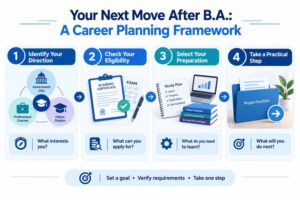
Use the following questions as a practical selection guide.
1. Does the Course Match Your Career Goal?
Start with the role or career direction you want to explore.
If you want to work in teaching, investigate the required teaching qualifications. If you want to enter management, compare MBA specialisations and their curriculum. If you want to work in digital marketing, examine whether the course includes practical campaign work.
A course should have a clear connection to your intended direction.
2. Is the Institution and Qualification Recognised?
This is especially important when choosing online or distance education.
Check the institution’s status and the applicable recognition or approval for the exact programme and academic session. Do not assume that every programme offered by an institution automatically has the same status.
Read the programme information carefully and clarify any doubts before paying admission fees.
3. What Will You Actually Learn?
Look beyond the course title.
Review the syllabus, subjects, learning outcomes, assessment pattern and practical components. A programme in management, for example, should be evaluated based on the subjects it teaches and how they connect with your intended career.
If possible, review sample study materials or speak with the institution’s academic support team.
4. Can You Manage the Fees and Study Schedule?
Compare the complete cost, not only the advertised admission fee.
Consider tuition, examination fees, learning resources and any other applicable charges. Also understand the class schedule, assignment deadlines and examination arrangements.
Learners searching for affordable online degrees should balance cost with recognition, academic support and curriculum quality. The lowest fee is not automatically the best value.
5. Will the Course Help You Demonstrate Your Ability?
For professional courses, practical work can make a difference.
A digital marketing learner can prepare a sample campaign. A content learner can build writing samples. Someone studying HR can practise preparing recruitment documents or interview questions.
For academic and government examination pathways, the relevant preparation, subject knowledge and examination performance remain important.
Choose a programme that helps you move towards a demonstrable next step rather than collecting certificates without a clear purpose.
How SODC Can Support Your Next Education Decision
Choosing what to do after a B.A. can feel confusing when several options appear equally attractive. The right decision becomes easier when you first understand your career objective, available study time, budget and eligibility.
At Sophia Online Degree College Bangalore, learners can explore flexible higher-education opportunities while considering how further study may fit into their personal and professional responsibilities.
Whether you are a recent graduate, a working professional or someone returning to education after a break, it is useful to compare the programme details before applying. Review the course structure, eligibility, learning format, academic support and applicable recognition information.
If you are considering online degree courses in bangalore, take time to understand how the programme fits your next academic or career step. You can explore the available information through SODC and contact us to clarify course-related questions.
Your next qualification should be selected with a clear purpose. It should support the direction you want to take, not simply extend your education without a plan.
Frequently Asked Questions
1. What are the best career options after B.A. in India?
B.A. graduates can explore government examinations, banking, administration, content writing, digital marketing, human resources, media, research, social work and other private-sector roles. Higher-study options include MA, MBA, MSW, B.Ed. and LLB, subject to eligibility. The best option depends on your interests, skills and career objective.
2. Can I get a government job after completing B.A.?
Yes. A recognised B.A. can meet the graduation requirement for several government examinations, including many UPSC, SSC, banking and state-level recruitment routes. However, eligibility varies by examination and post. Always read the latest official notification for age limits, educational qualifications and other conditions.
3. Which professional course is useful after B.A.?
The right professional course depends on the career you want to pursue. Digital marketing may suit graduates interested in online communication, while HR courses can support those exploring recruitment and employee management. Journalism, design, business management, law and social work are other areas to investigate.
4. Can I pursue an MBA after B.A.?
Yes, many MBA programmes accept graduates from different academic backgrounds, including Arts. However, admission requirements, minimum marks and entrance examinations vary between institutions. Review the eligibility criteria and specialisations before applying.
5. Can I study online after completing my B.A.?
Yes. Depending on your career objective, you can explore online postgraduate programmes, additional degrees or professional courses. Verify the institution and the programme’s applicable recognition or approval for the relevant academic session before enrolling.
6. Are online degree courses suitable for working professionals?
They may be suitable for working professionals who need flexibility to manage education alongside employment. However, the learner should review class schedules, assessment methods, examination arrangements, academic support and the time required for independent study.
7. Can I pursue higher studies after a gap of several years?
Yes, a gap after graduation does not automatically prevent you from pursuing higher studies. You must meet the current admission requirements of the institution and programme. Check whether there are subject, marks, entrance-test or other conditions.
8. Is an MA better than an MBA after B.A.?
Neither qualification is universally better. An MA may suit someone who wants deeper subject knowledge, research or an academic pathway. An MBA may be more relevant to someone interested in business, management, marketing, HR or operations. Choose according to your intended career.
9. Can I become a teacher after B.A.?
Yes, teaching can be a possible career direction, but the required qualifications depend on the level and type of teaching role. A B.Ed. and relevant teacher eligibility or recruitment requirements may apply. Check the current rules before choosing a programme.
10. How do I choose an affordable online degree college in Bangalore?
Compare the institution’s recognition, programme eligibility, curriculum, complete fee structure, learning resources, examination process and student support. Do not make a decision based only on a low advertised fee. The programme should also match your academic and career goals.
Conclusion: Make Your B.A. the Starting Point of Your Next Career Move
A B.A. can lead towards several possibilities, from government recruitment and professional courses to postgraduate education and private-sector careers. The challenge is not finding a long list of options. It is identifying the direction that matches your interests, qualifications, financial situation and long-term plans.
If you prefer public service, research the relevant government examinations and prepare according to their official requirements. If you want to enter a professional field, choose a course that develops skills you can demonstrate. If you want deeper subject knowledge or management education, compare suitable higher-study programmes.
For students, working professionals and graduates returning after a break, flexible education can make continuing studies more manageable. Explore your options carefully, verify the programme details and take one purposeful step at a time.
“Your B.A. is not the end of your academic journey. It can be the foundation for the next one.”