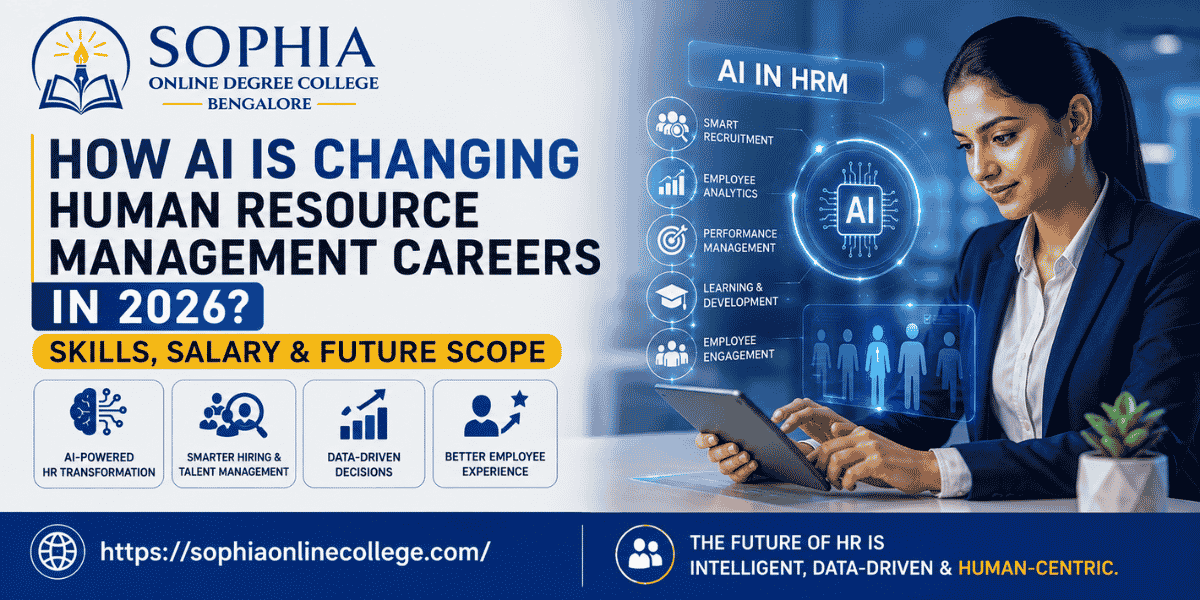
Human Resource Management Careers are evolving faster than ever as Artificial Intelligence (AI) reshapes the modern workplace. Today, HR professionals are no longer limited to recruitment, payroll, and employee management. AI-powered technologies are helping organizations automate repetitive tasks, improve hiring accuracy, analyze employee performance, and enhance workforce planning. As a result, Human Resource Management Careers have become more strategic, technology-driven, and data-focused. Whether you are a BBA graduate, an MBA aspirant, or a working professional planning to enter HR, understanding AI’s impact is essential. This guide explores how AI is transforming HR roles, the skills employers expect, salary trends, career opportunities, and the future scope of Human Resource Management Careers in 2026.
Why AI Is Transforming Human Resource Management Careers?
Businesses today are investing heavily in Artificial Intelligence to improve efficiency, reduce hiring costs, and create better employee experiences. HR departments are adopting AI-powered tools that simplify recruitment, onboarding, performance evaluation, and workforce planning.
This transformation has significantly increased the demand for professionals who understand both HR principles and modern technology.
Major reasons behind this shift include:
- Faster recruitment processes
- Data-driven hiring decisions
- Improved employee engagement
- Automated administrative tasks
- Better workforce planning
- Predictive employee analytics
Instead of spending hours manually screening resumes or preparing reports, HR professionals now focus on strategic decision-making and employee development.
This makes Human Resource Management Careers one of the fastest-growing business careers today.
Human Resource Management Definition
Human Resource Management (HRM) is the process of managing an organization’s employees effectively to achieve business objectives while ensuring employee satisfaction and professional growth. It includes recruiting talent, training employees, managing performance, handling compensation, maintaining workplace policies, and building a positive organizational culture.
Modern Human Resource Management Careers extend beyond traditional HR responsibilities. AI-powered HR professionals now work with advanced technologies to improve hiring accuracy, employee engagement, and workforce productivity.
Core functions of Human Resource Management include:
Recruitment & Talent Acquisition
Finding qualified candidates through:
- Job portals
- Social media
- Employee referrals
- AI-powered recruitment software
Employee Onboarding
Helping new employees integrate smoothly into the organization through:
- Digital documentation
- Online training
- AI-powered onboarding systems
Performance Management
HR professionals evaluate employee performance, identify skill gaps, and recommend career development opportunities.
AI helps managers generate performance insights using employee data.
Learning & Development
Organizations continuously train employees to improve productivity and prepare future leaders.
AI recommends personalized learning programs based on employee performance.
Employee Engagement
Modern HR focuses on improving workplace satisfaction through:
- Surveys
- Feedback systems
- Wellness initiatives
- Recognition programs
Workforce Planning
Companies use AI to forecast hiring needs, identify skill shortages, and improve resource allocation.
As technology continues advancing, Human Resource Management Careers increasingly combine business knowledge with analytics and automation.
Traditional HR vs AI-Powered HR
Earlier, HR teams spent significant time performing repetitive administrative tasks. Artificial Intelligence now automates many of these activities, allowing HR professionals to focus on strategy and employee development.
Traditional HR vs AI-Powered HR
| Traditional HR | AI-Powered HR |
| Manual resume screening | AI-powered candidate screening |
| Paper-based onboarding | Digital onboarding platforms |
| Manual attendance tracking | Automated workforce management |
| Standard employee training | Personalized AI learning programs |
| Manual performance reviews | Predictive performance analytics |
| Reactive HR decisions | Data-driven workforce planning |
The evolution of AI has made Human Resource Management Careers more analytical, strategic, and technology-focused than ever before.
How AI Is Improving Human Resource Management?
Artificial Intelligence supports HR professionals throughout the employee lifecycle.
AI-Based Recruitment
AI recruitment software automatically:
- Screens resumes
- Matches candidates
- Ranks applicants
- Reduces hiring bias
- Speeds up recruitment
This allows HR teams to focus on interviewing the most suitable candidates.
HR Chatbots
AI chatbots answer employee questions regarding:
- Leave policies
- Payroll
- Benefits
- Company guidelines
They improve employee satisfaction while reducing HR workload.
Employee Analytics
AI analyzes employee performance to identify:
- High performers
- Training needs
- Retention risks
- Productivity trends
These insights help businesses make informed workforce decisions.
Workforce Planning
Organizations use predictive analytics to estimate future hiring requirements based on business growth.
This improves workforce planning and reduces recruitment costs.
Learning Personalization
AI recommends customized learning paths for employees based on:
- Job role
- Skill gaps
- Performance reviews
- Career goals
Continuous learning improves employee productivity and retention.
Top AI Technologies Used in Modern HR
Several technologies are driving the future of Human Resource Management Careers.
Generative AI
Used for:
- Writing job descriptions
- Drafting HR policies
- Creating employee communication
- Preparing interview questions
Machine Learning
Helps HR teams predict:
- Employee turnover
- Recruitment success
- Skill shortages
- Performance trends
HR Analytics
Converts employee data into actionable business insights.
Predictive Analytics
Forecasts future workforce requirements using historical employee data.
AI Recruitment Software
Popular recruitment platforms automatically shortlist candidates based on required skills and experience.
Employee Sentiment Analysis
AI analyzes employee feedback and surveys to measure workplace satisfaction and improve organizational culture.
Students pursuing management distance education in Bangalore can gain a competitive advantage by combining HR knowledge with AI technologies, analytics, and digital business skills demanded by today’s employers.
Why HR Professionals Need AI Skills?
Modern organizations no longer hire HR professionals based only on recruitment experience.
Employers increasingly value candidates who understand:
- AI recruitment platforms
- HR analytics
- Data interpretation
- Employee engagement technologies
- Workforce automation
- HR software systems
Professionals planning Human Resource Management Careers should continuously update their knowledge to stay competitive in the evolving job market.
Human Resource Management For MBA
An MBA specializing in Human Resource Management equips students with advanced leadership, strategic planning, organizational behavior, and workforce management skills. However, in 2026, employers also expect HR professionals to understand AI, analytics, automation, and digital HR platforms.
Pursuing Human Resource Management Careers after an MBA opens opportunities in multinational companies, consulting firms, startups, healthcare organizations, IT companies, and financial institutions.
MBA students learn subjects such as:
- Human Resource Planning
- Talent Acquisition
- Organizational Development
- Performance Management
- Compensation & Benefits
- Employee Relations
- Leadership Management
- HR Analytics
To stay competitive, MBA graduates should also develop expertise in AI-powered recruitment, workforce analytics, and HR automation.
Students enrolled in MBA distance education in Bangalore can enhance their academic knowledge by completing HR certifications, learning AI tools, and participating in internships. This combination makes them highly attractive to recruiters seeking modern HR professionals.
Essential Skills Required for Human Resource Management Careers
A successful HR professional requires a balanced mix of business knowledge, communication skills, analytical thinking, and technical expertise.
Below are some of the most valuable skills employers look for.
Communication Skills
HR professionals interact with employees, management, job applicants, and stakeholders every day.
Strong communication helps in:
- Recruitment
- Conflict resolution
- Employee engagement
- Leadership
Recruitment & Talent Acquisition
Understanding hiring strategies remains one of the most important responsibilities in Human Resource Management Careers.
Professionals should know:
- Interview techniques
- Candidate screening
- Employer branding
- Recruitment software
HR Analytics
Modern HR depends heavily on data.
Professionals should understand:
- Employee performance metrics
- Workforce trends
- Hiring reports
- Employee retention analysis
Artificial Intelligence
AI is becoming an essential HR skill.
Professionals should learn how to use:
- AI recruitment software
- HR chatbots
- Resume screening platforms
- Workforce analytics tools
Excel & Power BI
Data visualization helps HR teams create meaningful reports for management.
Knowledge of Excel and Power BI improves reporting accuracy.
Problem Solving
Every organization experiences workplace challenges.
HR professionals solve issues involving:
- Employee conflicts
- Workforce planning
- Policy implementation
- Organizational development
Leadership Skills
HR leaders guide organizational culture while supporting business growth.
Leadership becomes increasingly important as professionals move into senior HR roles.
Students pursuing BBA correspondence college in Karnataka can begin developing these competencies early through internships, leadership activities, HR workshops, and practical projects.
Human Resource Management Salary in India (2026)
One of the biggest attractions of Human Resource Management Careers is the steady salary growth available with experience and specialized skills.
Approximate salary ranges include:
| Job Role | Average Salary |
| HR Executive | ₹3–6 LPA |
| Talent Acquisition Specialist | ₹4–8 LPA |
| HR Analyst | ₹6–10 LPA |
| HR Business Partner | ₹10–18 LPA |
| HR Manager | ₹12–22 LPA |
| AI HR Specialist | ₹15–28 LPA |
Salary depends on:
- Educational qualifications
- Industry
- AI knowledge
- HR certifications
- Company size
- Work experience
- Leadership abilities
Professionals who combine HR expertise with AI, analytics, and automation generally receive higher salary packages.
Best AI Tools Used by HR Professionals
Technology has become an integral part of Human Resource Management Careers.
Here are some widely used AI-powered HR tools.
ChatGPT
Supports HR professionals by helping with:
- Job descriptions
- HR policies
- Employee communication
- Interview questions
Microsoft Copilot
Improves productivity by automating reports, presentations, and HR documentation.
LinkedIn Recruiter AI
Helps recruiters identify suitable candidates faster using AI-powered recommendations.
Zoho Recruit
Simplifies:
- Applicant tracking
- Resume management
- Interview scheduling
- Candidate communication
BambooHR
Popular HR software used for:
- Employee records
- Attendance
- Performance management
- Workforce reporting
Workday AI
Enterprise HR platform supporting:
- Workforce planning
- Employee analytics
- Payroll
- Talent management
SAP SuccessFactors
Large organizations use this platform for:
- HR operations
- Learning management
- Recruitment
- Performance evaluation
Career Opportunities in AI-Powered HR
Artificial Intelligence has created several exciting career paths.
Popular job roles include:
- HR Executive
- Talent Acquisition Specialist
- HR Data Analyst
- HR Technology Consultant
- People Analytics Specialist
- Learning & Development Manager
- HR Business Partner
- Employee Experience Manager
- Organizational Development Consultant
- AI Recruitment Specialist
These roles continue expanding as businesses automate HR operations.
Professionals pursuing Human Resource Management Careers can also transition into consulting, HR technology implementation, leadership development, and workforce analytics.
HR Skill vs Career Opportunity
| Skill | Career Opportunity |
| Recruitment | Talent Acquisition Specialist |
| HR Analytics | HR Data Analyst |
| AI Recruitment Tools | AI HR Specialist |
| Power BI | HR Reporting Analyst |
| Employee Engagement | HR Business Partner |
| Leadership | HR Manager |
Top HR Certifications to Boost Career Growth
Certifications help candidates stand out during recruitment.
Some of the most valuable options include:
- SHRM Certified Professional (SHRM-CP)
- HRCI Certifications
- Google Data Analytics
- Microsoft Power BI
- HR Analytics Certification
- AI for Business
- LinkedIn Learning HR Courses
- Talent Management Certification
Professionals who continuously upgrade their skills build stronger Human Resource Management Careers and remain competitive in the evolving HR industry.
Students studying through MA correspondence college in India can also transition into Human Resource Management by combining humanities knowledge with HR certifications, AI skills, and practical business exposure.
Human Resource Management Online Course
Enrolling in a Human Resource Management Online Course is one of the best ways to prepare for modern HR careers. Since Artificial Intelligence is transforming recruitment, employee engagement, and workforce planning, HR professionals must continuously upgrade their knowledge to remain competitive.
A good online HR course should combine traditional HR concepts with practical AI applications.
Topics typically include:
Recruitment & Talent Acquisition
Learn how organizations:
- Source candidates
- Screen resumes
- Conduct interviews
- Build employer branding
HR Analytics
Understand:
- Employee performance metrics
- Hiring reports
- Workforce planning
- Predictive analytics
AI-Powered HR Tools
Students gain practical exposure to:
- ChatGPT
- Microsoft Copilot
- BambooHR
- Workday
- SAP SuccessFactors
- Zoho Recruit
Employee Engagement
Learn techniques for:
- Improving workplace satisfaction
- Retaining employees
- Building organizational culture
- Measuring employee performance
Labor Laws & HR Policies
Modern HR professionals should also understand compliance, ethics, workplace regulations, and employee rights.
Professionals studying through distance education in Bangalore can conveniently combine flexible learning with HR certifications and AI-focused courses, helping them become job-ready while balancing work or personal commitments.
Future Scope of Human Resource Management Careers After 2026
The future of Human Resource Management Careers looks extremely promising as organizations increasingly adopt Artificial Intelligence and digital transformation strategies. HR professionals are no longer limited to administrative responsibilities—they are becoming strategic business partners who influence workforce planning, employee experience, leadership development, and organizational growth.
Emerging opportunities include:
AI Recruitment
Companies increasingly rely on AI-powered recruitment software to identify qualified candidates faster.
HR Automation
Automation reduces repetitive HR tasks like:
- Payroll processing
- Leave management
- Attendance tracking
- Employee documentation
People Analytics
Organizations analyze workforce data to improve:
- Employee retention
- Productivity
- Performance
- Hiring strategies
Employee Experience
HR teams now focus on creating positive workplace environments using AI-driven feedback systems and employee engagement platforms.
Global HR Opportunities
Remote work has increased international HR positions, allowing professionals to work with global organizations.
Professionals building Human Resource Management Careers with expertise in AI, analytics, automation, and leadership will remain highly valuable in the coming years.
Common Mistakes HR Freshers Should Avoid
Many aspiring HR professionals make avoidable mistakes that slow career growth.
Ignoring AI Tools
Modern HR requires knowledge of AI-powered recruitment and workforce management platforms.
Learning Only Theory
Employers value practical HR experience more than memorized concepts.
Gain exposure through:
- Internships
- HR projects
- Certifications
- Simulations
Weak Communication Skills
HR professionals constantly interact with employees and management.
Strong communication builds trust and improves workplace relationships.
Not Learning Analytics
Data-driven decision-making has become essential in Human Resource Management Careers.
Professionals should understand reporting and employee analytics.
Ignoring Professional Networking
Connecting with HR professionals through LinkedIn and industry events creates valuable career opportunities.
Avoiding Continuous Learning
Technology changes rapidly.
HR professionals should continuously update their knowledge through certifications and workshops.
Why Choose Sophia Online College?
Building successful Human Resource Management Careers requires both academic knowledge and practical skills. Sophia Online College offers flexible learning programs designed for students and working professionals who want to prepare for today’s technology-driven business environment.
Whether you’re pursuing MBA distance education in Bangalore, management distance education in Bangalore, BBA correspondence college in Karnataka, MA correspondence college in India, or looking for a trusted Correspondence college in India, Sophia Online College provides quality education that aligns with modern industry requirements.
The curriculum focuses on business fundamentals while encouraging students to develop practical skills in HR, analytics, Artificial Intelligence, leadership, and communication. By combining academic qualifications with certifications, internships, and AI knowledge, students become well-prepared for evolving HR careers.
With flexible learning options and career-focused education, Sophia Online College helps learners confidently prepare for future-ready Human Resource Management roles.
Conclusion
Artificial Intelligence is redefining the future of Human Resource Management Careers by making HR functions smarter, faster, and more strategic. From AI-powered recruitment and workforce analytics to employee engagement and automation, HR professionals now play a critical role in driving organizational success.
Students and professionals who combine HR expertise with AI knowledge, analytics, communication skills, and leadership abilities will enjoy excellent career opportunities across industries. Continuous learning, certifications, and practical experience remain essential for long-term career growth.
If you are passionate about working with people while embracing modern technology, Human Resource Management Careers offer one of the most rewarding and future-proof career paths in 2026 and beyond.
Start Your HR Career with Sophia Online College
Ready to build successful Human Resource Management Careers in the AI era?
Sophia Online College offers flexible programs that help students gain industry-relevant knowledge while balancing education and career goals. Whether you’re interested in MBA distance education in Bangalore, management distance education in Bangalore, BBA correspondence college in Karnataka, MA correspondence college in India, Correspondence college in India, or distance education in Bangalore, you’ll find programs designed to support your professional growth.
Enroll today and prepare for a successful HR career powered by AI, innovation, and leadership.
FAQs
1. What is AI in Human Resource Management?
AI in Human Resource Management refers to the use of Artificial Intelligence technologies to automate, optimize, and improve various HR functions, including recruitment, employee onboarding, workforce planning, performance management, payroll support, and employee engagement. AI-powered tools help HR teams screen resumes, schedule interviews, analyze workforce data, and predict future hiring needs with greater accuracy. This enables HR professionals to focus more on strategic decision-making and employee development rather than repetitive administrative tasks. As businesses continue embracing digital transformation, Human Resource Management Careers increasingly require professionals who understand AI tools, HR analytics, and technology-driven workforce management.
2. How AI Is Changing Human Resource Management Careers?
Artificial Intelligence is transforming Human Resource Management by making HR departments more efficient, data-driven, and strategic. Instead of spending hours on manual recruitment, payroll processing, or attendance tracking, HR professionals now use AI to automate repetitive tasks and gain valuable workforce insights. AI assists in resume screening, employee engagement analysis, predictive hiring, and performance evaluation, allowing organizations to make smarter business decisions. These technological advancements have also created new HR roles focused on analytics and automation. Professionals pursuing Human Resource Management Careers should therefore develop AI knowledge alongside traditional HR skills to remain competitive in the evolving workplace.
3. Is HR a good career after MBA in 2026?
Yes, Human Resource Management remains one of the most rewarding career options after completing an MBA in 2026. Organizations increasingly seek HR professionals who possess leadership skills, business knowledge, workforce management expertise, and familiarity with AI-powered technologies. MBA graduates specializing in HR can explore opportunities in recruitment, talent management, employee relations, learning and development, HR consulting, and people analytics. As businesses adopt digital HR systems, professionals with AI knowledge enjoy stronger career prospects and higher salaries. Building expertise in Human Resource Management Careers through certifications, internships, and practical experience further improves long-term employability and career growth.
4. Which AI tools are used in Human Resource Management?
Modern HR departments rely on several AI-powered tools to simplify recruitment, employee management, and workforce analytics. Popular platforms include ChatGPT for drafting HR communications, Microsoft Copilot for documentation, LinkedIn Recruiter AI for candidate sourcing, BambooHR for employee management, Workday AI for workforce planning, SAP SuccessFactors for enterprise HR operations, Zoho Recruit for applicant tracking, and HireVue for AI-assisted interviews. These technologies help reduce manual effort while improving recruitment quality and employee experience. Learning these platforms significantly strengthens Human Resource Management Careers, as employers increasingly prefer professionals who can effectively utilize AI-powered HR solutions.
5. What skills are required for AI-powered HR jobs?
Professionals entering AI-powered HR roles require a combination of technical, analytical, and interpersonal skills. Essential competencies include recruitment, employee engagement, HR analytics, AI tool proficiency, Excel, Power BI, communication, leadership, workforce planning, conflict resolution, and problem-solving. Knowledge of HR software systems, data interpretation, and digital recruitment platforms is becoming equally important. Continuous learning through certifications, workshops, and practical HR projects helps professionals stay updated with industry trends. Developing these in-demand skills strengthens Human Resource Management Careers, enabling candidates to contribute effectively to modern organizations adopting Artificial Intelligence in HR operations.
6. What is the salary of an AI HR professional in India?
The salary of AI HR professionals in India varies depending on experience, technical expertise, certifications, and industry. Fresh graduates generally earn between ₹4–7 LPA, while HR Analysts, Talent Acquisition Specialists, and HR Business Partners with several years of experience can earn ₹10–18 LPA. Senior AI HR Specialists, HR Technology Consultants, and HR Managers working in multinational companies often receive ₹20–28+ LPA. Professionals who specialize in HR analytics, AI recruitment platforms, workforce automation, and people analytics usually command higher salaries. Building expertise in Human Resource Management Careers significantly enhances earning potential over time.
7. Can distance education students build a career in HR?
Absolutely. Students pursuing flexible education programs can build successful careers in Human Resource Management by combining academic qualifications with practical skills, internships, professional certifications, and AI knowledge. Today, employers focus more on a candidate’s abilities, communication skills, leadership qualities, and practical experience than on the mode of education. Distance learning also allows students to complete industry-recognized HR certifications and gain real-world exposure simultaneously. Those who continuously upgrade their knowledge in HR analytics, recruitment, AI tools, and workforce management can establish strong Human Resource Management Careers across multiple industries and organizations.
8. Which certifications are best for AI-based HR careers?
Several professional certifications can significantly improve career opportunities in AI-powered Human Resource Management. Popular options include SHRM-CP, HRCI Professional Certifications, HR Analytics Certification, Google Data Analytics, Microsoft Power BI, AI for Business, LinkedIn Learning HR programs, Talent Management Certification, and People Analytics courses. These certifications develop practical expertise in recruitment, workforce analytics, AI-powered HR systems, employee engagement, and organizational development. Employers highly value candidates who combine academic qualifications with recognized certifications and practical experience. Earning these credentials helps professionals strengthen Human Resource Management Careers while improving employability, credibility, and long-term career advancement.