
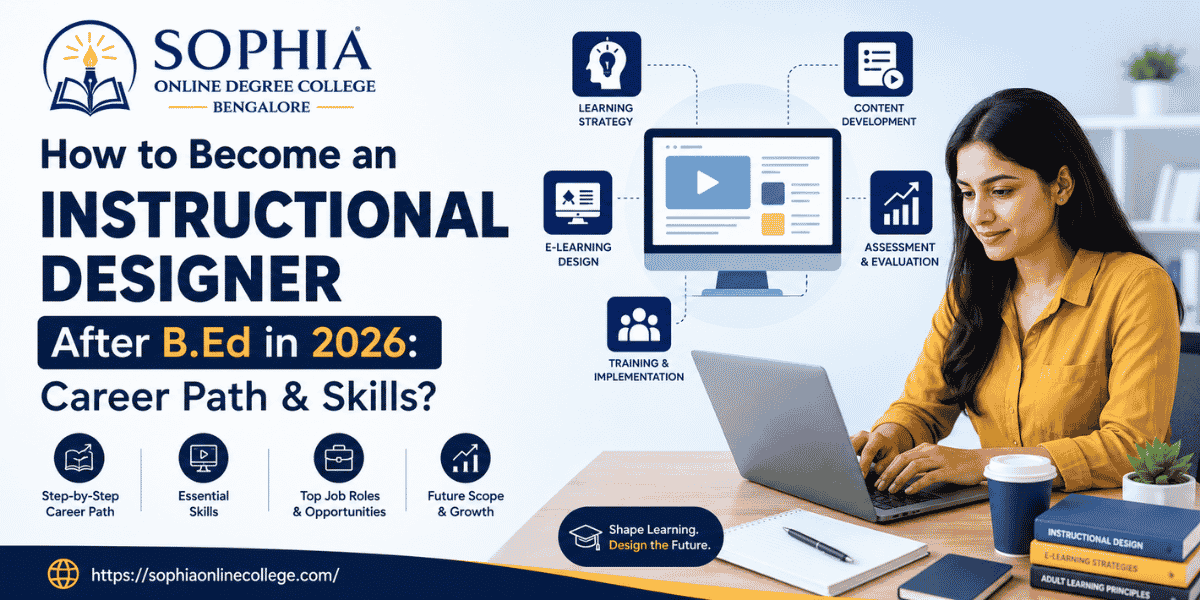
A B.Ed degree opens more career opportunities than teaching in traditional institutions. With e-learning, corporate training, digital courses, and blended learning becoming mainstream, Instructional Designer After B.Ed is an attractive option for those willing to advance their teaching career in the corporate and digital space. Instructional Designer After B.Ed is not a career shift, but a specialization of existing learning and teaching knowledge into a practical and attractive career with great career progression. If you are wondering about Instructional Designer After B.Ed, this guide covers everything you need to know, from eligibility and skills to tools, portfolio, jobs, salary, and career options expected in 2026.
What Is an Instructional Designer?
An instructional designer develops learning experiences that enable learners to gain new knowledge, practice, and demonstrate their skills. An instructional designer supports the process of learning and understanding new information compared to a teacher who teaches the class and then assesses the learning outcome. While traditional teaching involves presenting the lesson plan to the participants, an instructional designer goes through the process of developing e-learning content. This may either be in the form of a course, a unit, a training, an assessment, a video lesson, a digital workbook, or a complete learning program.
An instructional designer is a combination of teacher, author, psychologist, communicator, tech-operations, and content designer. Additionally, an instructional designer works closely with teachers, subject matter experts, graphics designers, programmers, and corporate trainers to develop instructional material.
Therefore, for those wondering about the scope of Instructional Designer After B.Ed, it is a lucrative career that involves understanding the knowledge needs of the target audience and developing effective learning options for them to acquire the desired information. An instructional designer considers what the learner should know, how the information should be presented, what the learner should do to demonstrate their competence and how the assessment should be designed. This makes Instructional Designer After B.Ed an attractive career option for those with a background in teaching.
Why B.Ed Graduates Can Move Into Instructional Design?
A B.Ed graduate possesses information on effective teaching methods lacking in most technology-based learning options. During the B.Ed course, aspiring teachers gain insight into lesson planning, learning theories, classroom management, assessments, curriculum development, psychology, and communication. All these skills are applied in developing digital learning options making Instructional Designer After B.Ed a career path best suited for ex-teachers.
In simple terms, an instructional designer applies the following skill set relevant in regular teaching:
- Planning
- Methodology
- Management
- Assessment
- Curriculum
- Psychology
- Communication
- Engagement
- Resources
These skills can be transferred into digital learning environments.
Additionally, an instructional designer applies technology and software in developing effective digital content. Therefore, while a regular teacher presents information to the class, an instructional designer considers how the information is delivered and assesses its effectiveness depending on the audience’s response.
Instructional Designer After B.Ed: What Changes in Your Career?
The transition becomes easier when you understand how your existing teaching experience translates into instructional design.
| Your B.Ed Experience | Instructional Design Application |
| Lesson planning | Course planning |
| Classroom activities | Interactive learning activities |
| Student assessments | Online quizzes and assessments |
| Teaching materials | E-learning resources |
| Curriculum planning | Learning pathways |
| Student feedback | Learner experience improvement |
| Explaining concepts | Instructional writing |
| Classroom technology | Digital learning tools |
This is why Instructional Designer After B.Ed does not necessarily mean starting your professional life from zero.
A teacher who has already created lesson plans, worksheets, presentations, activities, and assessments may have more relevant experience than they initially realise. The next step is learning how to convert those skills into digital learning projects.
How to Become an Instructional Designer After B.Ed: Step-by-Step Roadmap?
To pursue Instructional Designer After B.Ed, start with a step-by-step roadmap of learning the profession, acquiring the necessary tools, developing a portfolio, gaining practical experience, and landing the best instructional design jobs.
Becoming an instructional designer requires the following progressive skills:
Step 1: Understanding Instructional Design
Instructional design entails the fundamental concepts and principles of developing learning content. To become an instructional designer, start by comprehending the theories and models of learning and how they can be applied.
Some of the basic concepts of instructional design include:
- Learning objectives
- Bloom’s Taxonomy
- Adult learning theory
- Cognitive psychology
- Assessment strategy
- Learner analysis
- Content organisation
Additionally, it is important to identify the different instructional design models and how they are applied in developing e-learning content and courses. For example, the ADDIE instructional design model is applied in all stages of instructional design including analysis, design, development, implementation, and evaluation. Having a good foundation in the basic principles and models of instructional design makes Instructional Designer After B.Ed more than just a career switch.
Step 2: Learn How Digital Courses Are Created
Unlike traditional teaching methods where the instructor explains and demonstrates how to perform a certain task, online learning requires instructional designers to consider the best way of presenting the information to the target audience.
An instructional designer should have a foundation in the following:
- Microlearning
- Microlearning video
- Interactive learning
- Online assessments
- Scenario-based activities
- Self-paced courses
- Learning paths
- Learning and development specialists
This way, a candidate pursuing Instructional Designer After B.Ed understands what the various employers expect.
Step 3: Learn Common Instructional Design Tools
When it comes to the best tools for instructional design, there is no one-size-fits-all approach; therefore, it is advisable to start with a few, master them, and then move on to others.
Below are some of the common tools used in instructional design:
- Authoring tools: Articulate Storyline, Articulate Rise, Adobe Captivate
- Visual design tools: Canva and Adobe tools creative suite
- Video tools: Camtasia and other video editors
- LMS tools: Moodle, Canvas and other learning management systems
- Project collaboration tools: Microsoft Teams, Google Workspace suite, and other project management tools
Indeed’s career advisors highlight authoring tools, LMS platforms, multimedia tools, graphic design, and communication as the key skills required in instructional designers. Therefore, for Instructional Designer After B.Ed, the focus should be on developing digital learning content rather than being involved in software development.
Skills You Needed for Instructional Designer After B.Ed
The best candidates for instructional design jobs include those with teaching expertise, technology skills, and communication skills among other competencies.
1. Instructional Design Skills
These skills are applicable in developing learning content using instructional design models and methods.
The following skills are required for Instructional Designer After B.Ed:
- ADDIE skills
- Learning objectives
- Assessment skills
- Course design
- Storyboarding skills
- Learning theories
- Learner analysis
2. Communication Skills
Communication skills enable instructional designers to talk to subject matter experts and other teams to develop the best learning content. Therefore, good communication skills allow a candidate to identify the information needed and present it appropriately to another team.
3. Writing Skills
Excellent writing skills are vital for instructional designers since one will never design learning content using pictures only. Good writing skills allow the instructional designer to effectively deliver the content without the learner having to read and reread the material.
4. Technology Skills
An instructional designer must be technologically savvy. One should be familiar with LMS systems, authoring tools, presentation tools, and other technology-related aspects of instructional design.
5. Visual Thinking
Though one does not need to be a professional graphic designer, having fundamental design-thinking skills enables one to understand the basics of layout, typography, spacing, design elements, and icons.
6. Analytical Thinking
An instructional designer should have analytical skills to identify and solve instructional problems faced while developing the learning content. The professional should be able to interpret learner analytics and identify whether the issue stems from poorly presented content, assessment problems, or low motivation.
By combining teaching expertise, technology skills, and communication competencies, the skills mentioned above make Instructional Designer After B.Ed a viable career option instead of just a certificate.
AI and Instructional Design in 2026
Artificial Intelligence is transforming the creation of learning content. For Instructional Designer After B.Ed, AI literacy is an emerging auxiliary skill.
AI can be leveraged for:
- Coming up with course ideas
- Drafting course outlines
- Coming up with quiz questions
- Creating scenarios
- Rewriting content for different reading levels
- Drafting scripts
- Summarizing long documents
- Personalizing learning activities
However, human oversight is required to ensure that the final content is accurate, engaging, accessible, and aligns with learning objectives and biases. For Instructional Designer After B.Ed, this makes the most sense, as their background enables them to critically evaluate whether a particular learning activity is fit for purpose.
How to Build an Instructional Design Portfolio?
One of the critical ways to stand out as an Instructional Designer After B.Ed is to build a portfolio before the hunt for jobs begins. The good news is that you do not have to rely on your future employer to generate examples of your work; you can create them.
Here are some project ideas:
Portfolio Project 1: Convert a lesson into a learning module
Imagine you have taught a lesson in the past. Take it upon yourself to convert it into a 10-minute digital learning module. You can create a learning objective, introduction, explanation, visual, activity, and quiz.
Portfolio Project 2: Storyboard
Create a storyboard that demonstrates how you would design a video or e-learning module.
Portfolio Project 3: Microlearning Course
Design a microlearning course that has five learning units related to a specific topic.
Portfolio Project 4: Build an Assessment
Build different types of questions and explain what learning outcome they are designed to measure.
A portfolio is always a good way to impress potential employers, and it can be especially useful for those in the Instructional Designer After B.Ed bracket. It highlights your teaching credentials and validates your experience with a solid body of work.
Do You Need Another Degree to Become an Instructional Designer?
Not necessarily.
While some people may benefit from a formal degree, others do not. A B.Ed provides a solid foundation, whereas certificates, postgraduate studies, experience, and a portfolio can fill other gaps.
If you are considering a postgraduate program, M.Ed can be a good option for those wishing to understand more about education as a field.
When it comes to researching an M.Ed correspondence college in Bangalore, the most important consideration is the syllabus, as well as the flexibility and support on offer.
A postgraduate degree can be a good complement to a B.Ed, but it is best combined with digital-learning skills.
Flexible in Education for Working B.Ed Graduates
Many working professionals hesitate to pursue additional studies due to various factors, such as the need to continue working. However, there are options, such as a B.Ed course for working professionals . Similarly, Teaching distance education is a useful avenue for those wishing to continue working while pursuing further studies. In this regard, students researching distance education in Bangalore should note that there are a number of options, but the most important consideration is the syllabus, as well as the level of support and flexibility on offer.
A similar rationale applies to traditional distance education in Bangalore, which can be a good alternative for those wishing to pursue further studies but with limited ability to attend regular classes. As such, distance education in Bangalore is ideal for working professionals, such as those considering Instructional Designer After B.Ed.
Can a Correspondence College Help a Working Professional to Reroute Their Career?
There is no doubt that a correspondence college in India can be useful for working professionals with various commitments, such as family, that prevent them from attending regular classes. However, it is important to remember that the course itself is only part of the solution. When it comes to a career as an Instructional Designer After B.Ed , it is best to take advantage of the time and resources to also build a portfolio and develop digital-learning competencies.
Instructional Design Tools to Learn in 2026
| Skill Area | Tools/Platforms to Explore | Why It Matters |
| Course authoring | Articulate Storyline, Rise | Creating interactive courses |
| Visual design | Canva, Adobe tools | Improving learning materials |
| Video | Camtasia and similar tools | Creating video lessons |
| LMS | Moodle, Canvas | Delivering online courses |
| Collaboration | Teams, Google Workspace | Working with distributed teams |
| AI assistance | AI writing and productivity tools | Faster content development |
Don’t try to learn all of them simultaneously. Pick one tool from each category and build something with it.
That practical approach is far more useful for Instructional Designer After B.Ed than collecting dozens of tool names without being able to demonstrate your skills.
What Entry-Level Jobs Can You Get After Completing B.Ed in Instructional Design?
After developing relevant skills and a portfolio, one can consider applying for entry-level positions, such as:
- Junior Instructional Designer
- Instructional Designer
- E-learning Content Developer
- Learning Content Developer
- Curriculum Developer
- Digital Learning Specialist
- Learning and Development Coordinator
- Training Content Developer
- Learning Experience Designer
Instructional Designers can work in a variety of settings, such as education, corporate, e-learning, universities, and other settings. As such, Instructional Designer After B.Ed is more than just a career in the EdTech space, as it cuts across a variety of industries that intersect with education.
Instructional Designer Salary in India in 2026
Salary depends on experience, location, employer, technical skills, portfolio quality and specialisation.
Indeed’s January 2026 salary data reports an average base salary of about ₹7.19 lakh per year in India, although the figure is based on a limited number of reported salaries and should not be treated as a guaranteed market rate.
A broad career picture can look like this:
| Career Stage | Typical Role |
| Entry level | Junior Instructional Designer |
| Early career | Instructional Designer |
| Mid career | Senior Instructional Designer |
| Experienced | Learning Experience Designer / L&D Specialist |
| Leadership | Learning Design Lead / L&D Manager |
For Instructional Designer After B.Ed, salary growth usually comes from building deeper expertise rather than simply accumulating years of experience.
Specialisation in areas such as learning technology, corporate training, e-learning development, learning analytics, or learning experience design can strengthen long-term opportunities.
Where Can an Instructional Designers Work?
One of the benefits of a career as an Instructional Designer After B.Ed is the ability to work in a variety of fields and settings, including:
- EdTech
- Universities
- Schools and educational organizations
- Corporate L&D divisions
- Training companies
- Technology firms
- Healthcare organizations
- Publishing companies
- Government departments with training functions
- Professional bodies administering qualifications
The National Qualification Register even lists instructional-design roles and responsibilities, ranging from designing training interventions, conducting needs analysis, and developing learning materials. As such, Instructional Designer After B.Ed offers broad career opportunities beyond the traditional education sector.
Why Sophia Online College Can Be Part of Your Education Journey?
To build a career, you need to make choices in favor of your education. As you compare your options, Sophia Online College can be part of your learning journey.
You have to invest in the most relevant learning opportunities and skills to support your future. If you aim for an Instructional Designer After B.Ed, it is advisable to complement your course with practical learning, digital competencies, and portfolio development.
A flexible study plan can help working students to continue their professional growth without interrupting their current jobs.
Instructional Designer After B.Ed: A Practical Career Path
Your career path is not a straight line.
It is advisable to build a learning pathway that will help you achieve your career goals. One of the possible options for an Instructional Designer After B.Ed is:
- B.Ed
- Instructional Design Fundamentals
- Digital Tools
- Portfolio
- Internship/Entry-Level Job
- Instructional Designer
- Senior Designer
- L&D Specialist
The timeline depends on the individual’s experience and knowledge. For example, someone who has been teaching already has relevant competencies and skills, while someone with a B.Ed but no experience will need more practical knowledge. Your career planning for Instructional Designer After B.Ed will be unique, depending on your learning needs and interests.
For an Instructional Designer After B.Ed, a portfolio can become a powerful tool to demonstrate one’s practical skills and competencies.
How to Stand Out From Other Instructional Design Candidates?
The instructional-design field is not just about knowing software.
To stand out, show that you can solve a learning problem.
Instead of saying:
“I know the Articulate Storyline.”
Show:
“I used an authoring tool to create an interactive module that teaches a difficult concept through scenarios, practice and feedback.”
Instead of saying:
“I understand pedagogy.”
Show:
“I redesigned a lesson into a learner-centred digital experience.”
This practical mindset can make Instructional Designer After B.Ed candidates more convincing during interviews.
You can also strengthen your profile by learning accessibility principles, writing clearly, understanding learner data, experimenting with AI responsibly, and keeping your portfolio updated.
Is Instructional Design a Good Career After B.Ed in 2026?
For graduates who enjoy education but want to move beyond conventional classroom teaching, Instructional Designer After B.Ed can be a career option.
The field covers multiple areas that are converging: education, technology, content, employee training, online learning, and learner experience.
Current career guidance also mentions instructional design as a role that blends education, corporate training and e-learning. However, it is not a shortcut career. You will need to keep learning.
The most useful combination is:
B.Ed knowledge + instructional design principles + technology + communication + portfolio + practical experience.
If you like asking “How can this be taught better?” you may already have the mindset of Instructional Designer After B.Ed.
Conclusion
A B.Ed does not have to define you as only fit for classroom teaching. Your understanding of learners can build a foundation for digital courses, employee training, online programs, assessments and engaging learning experiences.
If Instructional Designer After B.Ed appeals to you, start small: learn one instructional design model, explore one authoring tool, create one digital learning project, and begin building a portfolio.
Then add more skills as your confidence grows.
If you are researching a Correspondence college India or other options, focus on how the program can meet your career needs and time constraints. A qualification becomes more valuable when you can combine it with practical skills and projects.
Sophia Online College can be part of that broader learning journey for students and working professionals who seek to pursue flexible learning and career opportunities. Instructional Designer After B.Ed candidates can leverage additional skills in technology, portfolio development, and practical experience in digital learning projects.
Ready to Take the Next Step?
Don’t wait until you feel that you know everything. Start with your existing B.Ed knowledge and add instructional design, technology and portfolio skills. Explore your education options, strengthen your professional skills, and take the first step toward a modern learning-design career with Sophia Online College. Study your options and prepare yourself for the next stage in your career. You can start right away with Sophia Online College. Explore your learning options now and take advantage of an evolving career landscape. Get started with Sophia Online College.
FAQs
1. Can I become an instructional designer after B.Ed?
Yes. A B.Ed can be the starting point since you already have an understanding of students, objectives, assessment, curriculum, pedagogy, and related concepts. Now, you need to build skills in instructional design models, digital learning, authoring tools, e-learning platforms, storyboarding, and even visual design and portfolio building. For Instructional Designer After B.Ed, it helps to have applied projects since it will showcase your ability to convert your B.Ed learnings into digital assets for learners. Moreover, you may want to pursue a postgraduate program in instructional design or a related field, as recruiters may ask for a related graduate degree, though it is not mandatory.
2. What skills are required for instructional design after B.Ed?
The primary skills that you need for instructional design after B.Ed are instructional design, learning theory/storyboarding, curriculum, assessment design, communication, writing, research, and digital content development. Moreover, knowledge of LMS platforms and authoring tools, along with basic design skills, is also desirable. For Instructional Designer After B.Ed, your B.Ed has provided you with teaching/learning skills, but you will need to demonstrate that you know how to apply your learning in e-learning or digital contexts. Another critical area is artificial intelligence, and if you can demonstrate some knowledge of AI, it can be an added advantage since it can facilitate rapid digital content development.
3. Do instructional designers need coding skills?
No, for Instructional Designer After B.Ed, coding is typically not required. Most often, instructional designers do not need to code since they tend to rely on authoring tools to develop digital content. However, having basic coding skills and understanding web-development basics could be beneficial. While not required, these skills can be leveraged to custom-develop digital assets and enhance your marketability. When considering coding for Instructional Designer After B.Ed, it helps to begin with the fundamentals of HTML/xhtml, the web, css, and accessibility. Then, explore options like responsive design, advanced css, javascript/jQuery, and more.
4. Which tools should I learn for instructional design?
It is critical to identify tools that will help you achieve your organizational or professional goals. So, for Instructional Designer After B.Ed, it helps to begin with the most popular tools in the market. These include Articulate 360 (Storyline and Rise), Captivate, LMS platforms, Canva, and video-editing tools. It is also essential to begin practicing and building a diverse portfolio. Employers care more about your ability to execute than the number of tools that you know. So, when learning tools for Instructional Designer After B.Ed, focus on practicing with 2-3 tools and being able to demonstrate your skills with those rather than knowing a lot of tools. Create sample projects with the tools and then build your portfolio.
5. Is an M.Ed useful for instructional design?
Yes, an M.Ed (Master’s in Education) can be great for an instructional designer since the field of instructional design often overlaps with education. However, for Instructional Designer After B.Ed, it is essential to understand that M.Ed is not mandatory. Specialized training in instructional design, coupled with digital skills, experience, and portfolio, can be sufficient to kick-start your instructional design career. If you are considering M.Ed correspondence college in Bangalore, it is critical to evaluate the syllabus and even the mode of learning before making the commitment. Remember, your decision should be informed by the purpose of pursuing the program rather than being driven by the desire to pursue another degree.
6. What is the salary of an instructional designer in India?
An instructional designer’s salary varies depending on multiple factors, including their qualifications, experience, organization, and even location. As of January 2026, Indeed India salary Insights report shows that the average base salary in India is ₹7,19,289 per annum based on 3 reported salaries. For freshers, this could be even lower, while for experienced instructional designers, there is also potential to negotiate a higher salary. Additionally, the salary also depends on your specialization. So, for Instructional Designer After B.Ed, it is essential to invest in advanced training, particularly in authoring tools, to enhance your skill set. Additionally, developing a portfolio, having business smarts, and gaining experience can also support you in earning a higher salary.
7. Can teachers work as instructional designers?
Yes, teachers can become instructional designers after B.Ed since many of their skills are transferable. These include skills in planning, designing, assessment, delivery, communication, engagement, and more. The main difference is that an instructional designer creates digital or electronic content, as opposed to a teacher who typically delivers face-to-face content. So, for Instructional Designer After B.Ed, the primary challenge is to learn how to leverage their teaching skills in the digital medium. So, to begin with, teachers can consider taking up a project, such as converting their existing lesson plan into digital content, developing a storyboard for a class or lesson, creating a quiz, or even building a micro-course. They can then use these as a part of their portfolio and apply for various instructional design roles.
8. Can I study while working as a teacher?
Yes, while studying and working as a teacher might be challenging, it is eminently possible, especially with a B.Ed course for working professionals. So, if you are considering a B.Ed course for working professionals, you need to explore your options. While there are a variety of options, including correspondence courses, B.Ed distance education, etc., for someone considering B.Ed distance education in Bangalore, it is vital to identify the best options in light of their professional and academic goals. For example, there are options for working professionals who want to pursue Teaching distance education. It is critical to understand the nuances of the program, which includes the mode of study, evaluation methodology, etc., prior to enrolling. Similarly, for Instructional Designer After B.Ed, it is critical to pursue distance education courses in tandem with projects so that you continue to develop skills and update your resume with practical evidence of your learning.