
Choosing to become a Teacher after Class 12 can be the beginning of a meaningful career built around learning, communication, and helping students grow. However, before enrolling in a course, students need to understand which qualifications are required for different teaching levels. An online bed course in india may seem like a convenient starting point, but a Bachelor of Education (B.Ed.) is generally a postgraduate-entry professional qualification, not a course that students can begin immediately after Class 12.
For students, working professionals, school dropouts who have completed their schooling later, and graduates considering a career change, the right pathway depends on their present qualification and the age group they want to teach. Some routes begin with a teacher-training diploma, while others combine a bachelor’s degree with professional teacher education.
This guide explains the available courses, eligibility requirements, online learning options, entrance examinations, and career possibilities in simple language. It also helps you distinguish between courses that build your academic foundation and qualifications that prepare you for school teaching.
Before Choosing a Course, Decide What Kind of Teacher You Want to Become
Imagine two students who have just completed Class 12. One wants to teach young children how to read and develop basic mathematical skills. The other wants to teach Biology to secondary or senior-secondary students. Although both want to enter teaching, their academic preparation and professional qualification requirements may be different.
That is why your first decision should not be which college to join. Instead, think about the teaching environment in which you would like to work.
Primary and elementary school teaching
Primary teachers introduce children to foundational subjects such as language, mathematics, environmental studies, and basic social skills. Their work involves explaining concepts patiently, understanding different learning speeds, and making lessons interesting.
If you want to work with younger children, an elementary teacher-education pathway may be appropriate. Depending on the institution and applicable rules, this could involve a Diploma in Elementary Education (D.El.Ed.), a Bachelor of Elementary Education (B.El.Ed.), or an integrated teacher-education programme.
Middle-school and secondary teaching
Middle-school teachers work with students who are beginning to understand subjects in greater depth. Secondary teachers usually need a strong academic foundation in the subject they intend to teach, together with the professional teaching qualification required for their intended post.
For example, someone who hopes to teach Mathematics or Science should plan their academic route around the relevant subject requirements, rather than selecting a teaching course without checking its eligibility rules.
Senior-secondary teaching
Teaching Classes XI and XII often requires a relevant postgraduate qualification or other prescribed academic qualifications, together with the required teacher-training credential where applicable. The exact conditions vary according to the school, subject, recruiting authority, and applicable regulations.
If your long-term goal is to teach senior-secondary students, plan beyond your first qualification. A bachelor’s degree may be only one stage of the journey.
Preschool and early-childhood education
Preschool educators help young children develop language, coordination, social interaction, curiosity, and early learning habits. Courses in early-childhood care and education or recognised preschool teacher education may be relevant.
However, do not assume that every short certificate in nursery teaching qualifies you for every school position. Check the course’s recognition, duration, and suitability for the role you want.
Special education
Special educators support learners with disabilities and different educational needs. They may work with students who have hearing or visual impairments, intellectual disabilities, autism, or specific learning disabilities, depending on their training and specialisation.
This pathway requires particular care when selecting a qualification. A general teaching course and a recognised special-education qualification are not automatically interchangeable.
Three Main Course Pathways After Class 12
Once you understand the type of teaching you want to pursue, compare the available educational routes. These pathways differ in duration, academic requirements, and the roles for which they may prepare you.
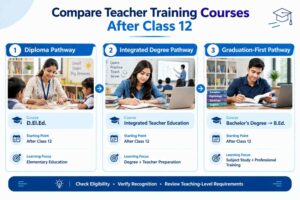
Compare the major teaching-course pathways
| Course pathway | When to consider it | What to understand before admission |
| Diploma in Elementary Education (D.El.Ed.) | After Class 12, for an elementary teaching pathway | Admission requirements and eligibility for specific teaching posts must be checked. |
| Four-year integrated teacher-education degree, such as BA B.Ed. or B.Sc. B.Ed. | After Class 12, if you want to combine subject study with teacher education | Programme availability, entrance requirements, institution recognition, and intended teaching stage matter. |
| Bachelor’s degree followed by B.Ed. | If you want to complete graduation first and then undertake professional teacher education | Your graduation subject, marks, B.Ed. eligibility, and intended school level must align. |
These are not identical qualifications, and one cannot always replace another. Before applying, read the latest admission notification and recruitment rules for the teaching posts you may want to pursue.
Route 1: Diploma in Elementary Education (D.El.Ed.)
D.El.Ed. is a professional teacher-education diploma associated with elementary education. It typically includes educational theory, child development, teaching methods, classroom practice, and school internship.
The course is worth investigating if you have completed Class 12 and want to work towards elementary teaching. However, eligibility depends on the applicable admission rules, and completing the diploma does not automatically qualify you for every primary or upper-primary post.
In particular, teaching eligibility can differ between Classes I–V and Classes VI–VIII. The relevant academic degree, teacher-training qualification, and recruitment conditions must all be considered.
Students searching for a d ed online course near me should first establish which recognised diploma programmes are available to them. Search results and advertisements alone cannot confirm that a programme is approved or suitable for government-school recruitment.
Route 2: A four-year integrated teacher-education degree
An integrated teacher-education programme allows students to combine undergraduate subject study with professional preparation for teaching.
For example, an integrated BA B.Ed. combines arts-related academic study with teacher education, while an integrated B.Sc. B.Ed. connects science study with professional teaching preparation. Other approved programme structures may also be available depending on the institution.
The four-year Integrated Teacher Education Programme (ITEP) is an important option for students who decide on teaching after Class 12. Admission to participating institutions may require the National Common Entrance Test (NCET), depending on the programme and current admission rules.
The National Testing Agency provides official information about the examination and participating institutions through its NCET portal.
An integrated degree may be useful if you want a more direct academic route into teacher education instead of completing a separate undergraduate degree and then a B.Ed. Compare the curriculum, subject specialisation, teaching-stage preparation, and recognition status before deciding.
Route 3: Complete graduation first and then pursue B.Ed.
Some students are not ready to commit to teaching immediately after Class 12. Others want to study English, History, Mathematics, Commerce, Science, or another subject before deciding whether education is the right profession.
For these learners, completing a bachelor’s degree first can provide flexibility. After graduation, they can investigate B.Ed. programmes for which they meet the admission requirements.
A B.Ed. develops professional teaching knowledge, including lesson planning, educational psychology, classroom management, assessment, and teaching practice. It is commonly relevant to secondary-school teaching pathways, subject to the applicable qualification and recruitment rules.
The main advantage of this route is that students can build subject knowledge before moving into professional teacher education. The trade-off is that the overall pathway generally takes longer than a four-year integrated programme.
Can You Become a Teacher Through an Online Course?
Online learning has made academic education more accessible to students who live far from institutions, have work commitments, or need greater flexibility in managing their studies. However, there is an important distinction between earning an academic degree online and completing a professional qualification that prepares someone for regulated school teaching.
An online bed course in india should not be treated as an automatic entry route for a student who has just passed Class 12. B.Ed. admission normally requires a bachelor’s degree or another specifically permitted qualification, in addition to meeting the applicable admission conditions.
Furthermore, online or Open and Distance Learning (ODL) B.Ed. programmes may have additional eligibility restrictions. Some approved ODL pathways are intended for trained, in-service teachers who already hold specified qualifications. They are not necessarily open to fresh graduates or anyone looking for a fully remote first teacher-training qualification.
The National Council for Teacher Education (NCTE) publishes information on teacher qualifications, recognised programme structures, and regulations. Consult its official minimum-qualifications information and the relevant current regulations before enrolling.
What should you check before choosing online study?
Start by identifying the qualifications you need. If you have completed only Class 12, investigate eligible diploma or integrated degree programmes first. If you already hold a bachelor’s degree, check whether you meet the entry conditions for the particular B.Ed. programme.
Next, verify the institution and the exact programme. Recognition of a university does not, by itself, mean that every course or delivery mode offered by it is approved for your intended purpose.
Ask the institution these questions:
- Is the specific programme recognised or approved by the relevant authority for the admission year?
- Is the programme offered through regular, online, or ODL mode?
- Does the programme accept fresh candidates, or is it restricted to trained, in-service teachers?
- Are school internships, practical teaching, contact sessions, or examinations compulsory?
- Will the qualification meet the requirements of the teaching post or recruitment examination I intend to pursue?
A reliable answer to these questions is more valuable than an advertisement promising an easy degree.
Is an online B.Ed. suitable for working professionals?
It can be relevant for some eligible working teachers, but suitability depends on the exact programme and current regulations. Someone working full-time in a non-teaching profession should not assume they qualify for an ODL B.Ed. simply because the course is advertised as flexible.
If you have not yet completed graduation, consider whether an online bachelor’s degree in a relevant subject, where appropriately recognised, fits your broader academic plan. You would still need to complete the required professional teacher education later.
Students exploring a bachelor of education online india option should therefore compare entry requirements, mode of delivery, practical training arrangements, and recognition before making a decision.
Understanding Eligibility: What Do You Need Before Applying?
Eligibility is not simply a question of how many marks you obtained in Class 12. It depends on the course you choose, your previous qualifications, the institution’s admission rules, and the teaching position you eventually want.
If you have just completed Class 12
You can begin by exploring eligible elementary teacher-education diplomas and integrated teacher-education degrees. Some programmes may require a minimum percentage, an entrance test, or additional subject-specific conditions.
Do not assume that all institutions use the same cutoff or admission procedure. State-level rules and institution-specific notifications can differ.
If you already have a bachelor’s degree
You can investigate B.Ed. eligibility based on your graduation subject, marks, and the programme’s entry criteria. Some institutions may specify minimum marks or particular subject combinations.
If you are planning to teach Mathematics, Science, English, or another school subject, check whether your academic background supports the subject and teaching stage you have in mind.
If you are returning to education after a break
A gap in education does not necessarily mean that teaching is no longer an option. You may first need to complete any missing academic qualification and then progress to an appropriate teacher-training course.
For example, someone who left education after Class 10 would generally need to complete the required senior-secondary qualification before pursuing most post-Class-12 teaching pathways.
The sensible approach is to establish your current qualification, identify the next eligible course, and plan one stage at a time.
If you are already working
Working professionals should evaluate the time required for classes, assignments, examinations, and practical teaching. A course that looks convenient on paper may still require in-person activities or school-based training.
If your job is unrelated to teaching, check eligibility especially carefully before paying a registration fee for a flexible B.Ed. programme.
Entrance Examinations and Teacher Eligibility Tests
Another common source of confusion is the difference between admission examinations and teacher eligibility tests.
An entrance examination may determine whether you can enter a teacher-education programme. A teacher eligibility test, on the other hand, assesses eligibility for certain teaching recruitment pathways. Neither should be assumed to replace the professional qualification required for a particular post.
National Common Entrance Test (NCET)
NCET is used for admission to participating four-year Integrated Teacher Education Programme institutions. The institutions accepting scores, admission conditions, and the examination process are specified in the applicable year’s notification.
Check the National Testing Agency’s NCET website for current information rather than relying on outdated admission dates or third-party summaries.
Teacher Eligibility Tests (TETs)
Teacher Eligibility Tests, including CTET and relevant State TETs, may apply to particular teaching roles. Their applicability depends on the level of teaching, school type, recruitment rules, and the governing regulations.
Candidates should confirm which test is required for the positions they want to apply for. Qualifying a TET does not, by itself, guarantee appointment or remove the need to hold the prescribed academic and professional qualifications.
Recruitment-specific examinations
Some government recruitment processes include additional examinations, merit lists, document verification, or subject-specific conditions. Private schools may use their own selection procedures, although they must still follow the rules applicable to the school and post.
The important lesson is to work backwards from the role you want. Identify the recruitment conditions first, then select a course and examination plan that supports them.
How to Choose Between Teaching Courses When You Have Different Goals
A course that suits a school leaver may not be the best option for a graduate or working professional. The following comparison connects common learner situations with the next practical step.
Find a pathway that matches your current situation
| Your situation | A sensible next step | What to verify |
| You have passed Class 12 and want to teach younger children | Explore eligible D.El.Ed. or integrated teacher-education programmes | Age group, admission requirements, course recognition, and recruitment eligibility |
| You have passed Class 12 and want to teach a school subject | Compare integrated degrees and the graduation-first route | Subject combinations, programme availability, entrance requirements, and teaching stage |
| You have completed a bachelor’s degree | Investigate suitable B.Ed. programmes | Graduation marks, subject eligibility, mode of study, and recognition |
| You work full-time and want to move into teaching | Map the required qualifications before selecting flexible study | ODL eligibility, practical training, attendance, and examination requirements |
| You want to support learners with disabilities | Research recognised special-education qualifications | Specialisation, professional recognition, practical experience, and eligible roles |
| You left school or college and now want to return | Complete any missing qualification in the correct sequence | Entry requirements, recognised institutions, time, and affordability |
Notice that these pathways are not interchangeable. Your current qualification determines where you can begin, while your intended teaching role determines which qualifications you should eventually obtain.
Special Education: A Different Route for a Different Purpose
Teaching is not limited to conventional classroom instruction. Special educators help create learning environments that respond to students’ individual needs and abilities. The work can involve adapting instructional materials, supporting communication, developing learning strategies, and collaborating with families and other professionals.
If this is your preferred direction, research recognised programmes in the relevant specialisation rather than choosing a general teaching course simply because it is easier to find.
The search phrase online b.ed. in special education can lead to different programme listings, but you should check the exact qualification, mode, duration, eligibility conditions, and professional recognition.
The Rehabilitation Council of India (RCI) publishes information about recognised rehabilitation and special-education programmes. Its official distance-mode course information lists programme categories and should be consulted alongside the current rules applicable to the course you are considering.
What should you consider before enrolling?
First, identify the learner group you want to support. Specialisations can differ according to the needs addressed and the professional scope of the qualification.
Second, verify whether the course is approved for the intended mode and academic session. The availability of a course in a distance-learning listing does not mean that every institution can offer it or that every learner meets the entry conditions.
Third, understand the practical component. Special education requires more than theoretical knowledge; supervised practice and an understanding of individual learning needs are important parts of professional preparation.
For prospective educators, this pathway can be meaningful, but it calls for careful course selection and a genuine interest in inclusive education.
What About an M.Ed. or Further Study in Education?
Once you have obtained the required initial qualifications and gained experience, you may want to deepen your knowledge of teaching methods, educational research, curriculum development, teacher training, or school leadership.
This is where postgraduate study may become relevant.
An M.Ed. is a postgraduate qualification in education. It is not a substitute for the initial qualifications required to enter school teaching, and it is not the immediate next step for someone who has completed only Class 12.
Before considering an online m.ed course, check the admission requirements, the permitted mode of delivery, programme recognition, and whether your existing qualifications satisfy the institution’s conditions. Eligibility can depend on the specific programme and current regulations.
Further study may support career development in education-related roles, but the outcome depends on your experience, the programme you complete, and the requirements of the role you seek.
Skills That Help You Become a Better Teacher
Formal qualifications establish an important foundation, but effective teaching also depends on how you communicate, organise learning, and respond to students.
Explain ideas clearly
A teacher must be able to turn a difficult concept into an explanation that students can understand. This involves using examples, checking comprehension, and presenting information in manageable steps.
Understand different learning needs
Students do not all learn at the same speed. Some understand a topic through visual examples, while others benefit from discussion, practice, or repetition. Patience and adaptability help teachers respond to these differences.
Plan lessons with a clear purpose
Good lessons have an objective, an organised sequence, opportunities for practice, and a way to check whether students have understood the topic.
Manage classrooms fairly
Classroom management is not only about maintaining discipline. It also involves setting clear expectations, encouraging participation, resolving disagreements, and creating an environment where students feel safe asking questions.
Use educational technology thoughtfully
Digital presentations, learning-management systems, online assignments, and educational resources can make lessons more engaging. Teachers should use technology to support learning rather than allowing tools to replace meaningful interaction.
Keep learning after qualification
Teaching practices and curricula evolve. Reading subject material, participating in professional development, reflecting on lessons, and learning from colleagues can help educators improve over time.
These skills can be developed through teacher education, supervised practice, feedback, and experience. They should complement the formal qualifications required for the role rather than replace them.
What Career Opportunities Can Follow Teacher Education?
The roles available to you depend on your academic background, professional qualification, specialisation, and the employer’s requirements. Not every qualification provides eligibility for every teaching level.
Possible career directions include:
- Primary school teacher: Supports foundational learning and development among younger students.
- Upper-primary teacher: Teaches students at a more advanced elementary level, subject to the relevant qualifications.
- Secondary school teacher: Teaches a subject to older school students when the required academic and professional conditions are met.
- Senior-secondary teacher: Works with students preparing for higher-secondary examinations and further education, where eligible.
- Preschool educator: Supports early childhood development and foundational learning.
- Special educator: Works with learners with disabilities under the scope of the relevant recognised qualification.
- Tutor or academic support educator: Provides subject support, revision, or supplementary learning, subject to the role’s requirements.
- Education content developer: Creates lesson resources, worksheets, learning modules, or educational material.
- Academic coordinator: Supports curriculum planning, teacher coordination, or academic processes when experience and qualifications meet the employer’s expectations.
Some education-related roles may not require the same qualifications as regulated school teaching positions. Always distinguish between general educational work and a school post with prescribed eligibility conditions.
A Practical Action Plan Before You Apply
You do not need to decide every detail of your career immediately. You do, however, need to make your next decision with reliable information.
Your teacher-career preparation checklist
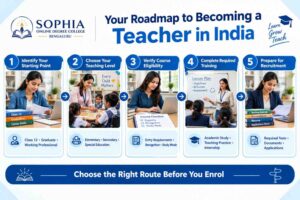
| Step | What to do | Why it matters |
| 1. Identify your starting point | Confirm whether you have completed Class 12, graduation, or previous teacher training | Establishes which courses you may be eligible to enter |
| 2. Choose a teaching stage | Decide whether you are interested in preschool, elementary, secondary, senior-secondary, or special education | Helps narrow the relevant qualifications |
| 3. Compare recognised programmes | Review the latest official programme and admission information | Reduces the risk of enrolling in an unsuitable course |
| 4. Check entrance requirements | Identify any required entrance test, marks, or subject conditions | Helps you prepare before applications open |
| 5. Plan for practical training | Understand internships, teaching practice, attendance, and examinations | Helps you assess the time and travel commitments |
| 6. Calculate the full cost | Compare tuition, examination fees, travel, materials, and other charges | Helps you plan realistically |
| 7. Prepare your application | Organise marksheets, identity documents, photographs, and other requested records | Makes the admission process easier to manage |
| 8. Recheck recruitment rules | Review the requirements for the school or role you eventually want | Connects your course choice with your career goal |
Use this checklist before paying admission or registration fees. If an institution cannot clearly explain the recognition status or eligibility requirements of its programme, pause and verify the information independently.
How Sophia Online Degree College Bangalore Fits Into Your Education Plan
For learners who are comparing higher-education options, Sophia Online degree College Bangalore can be a starting point for exploring academic pathways and understanding how further study may fit into their career plans.
However, prospective teachers should separate the choice of an academic degree from the choice of a recognised professional teacher-education programme. A general undergraduate or postgraduate degree does not automatically qualify someone to become a school teacher.
If you need to complete graduation before applying for teacher education, explore the relevant programmes, eligibility requirements, study mode, and recognition information available through SODC. Confirm that any programme you consider matches your academic needs, and separately verify the professional qualification required for your intended teaching role.
For working professionals and learners returning after an education gap, this distinction is particularly useful. You can plan your academic progress around your current responsibilities while ensuring that each qualification contributes to your long-term goal.
Common Mistakes to Avoid When Choosing a Teaching Course
A little research at the beginning can save time and money later. Keep these mistakes in mind while comparing institutions.
Assuming that B.Ed. starts after Class 12: Most B.Ed. pathways require graduation or another specifically permitted qualification. Students finishing Class 12 should investigate eligible entry-level teacher-education routes.
Choosing a course only because it is online: Flexibility is useful, but professional recognition, eligibility, and practical training are more important than the delivery format alone.
Confusing a teaching certificate with a professional qualification: A short certificate may help develop a skill, but it does not necessarily meet the requirements for a school teaching post.
Ignoring subject requirements: A teaching qualification may not automatically make you eligible to teach every subject or at every school level.
Assuming that passing a TET guarantees employment: Eligibility examinations are only one part of the process. Recruitment may involve additional requirements and selection stages.
Relying on old admission information: Rules, participating institutions, and application dates can change. Always use current official notifications.
Overlooking the practical component: Teaching involves real interaction with learners. Understand the internship, teaching practice, and supervised learning requirements before enrolling.
Add this sentence to your blog “How to Become a Teacher After 12th: Courses and Qualification Pathways” under the section comparing teacher-training courses.
Writing
“Before choosing a teacher-training pathway, understand the key differences between these qualifications by reading our guide on the Difference Between B.Ed and D.Ed, which explains their eligibility requirements, course structure, and career opportunities.”
Conclusion: Build Your Teaching Career One Qualification at a Time
Becoming a teacher after Class 12 is possible through appropriate educational pathways, but the right choice depends on the students you want to teach and the qualifications you already hold. A D.El.Ed. may suit an eligible elementary-teaching route, while a four-year integrated teacher-education degree can combine undergraduate study with professional preparation. Another option is to complete graduation and pursue a suitable B.Ed. programme afterwards.
If you are exploring an online bed course in india, remember to check admission eligibility, delivery mode, programme recognition, and practical training requirements rather than relying on course titles or promotional claims. Online and distance B.Ed. programmes may have restrictions that make them unsuitable for fresh candidates.
Students, working professionals, and learners returning to education can all make progress by identifying their starting point, checking official requirements, and planning their next qualification carefully.
At Sophia Online Degree College Bangalore, prospective learners can explore suitable academic options through SODC. If you need help understanding which academic step may fit your present qualifications, contact us to discuss your education plans. Before enrolling in any professional teacher-training course, independently verify that it meets the requirements for your intended teaching role.
Frequently Asked Questions
1. Can I become a teacher immediately after Class 12?
You can begin an eligible teacher-education pathway after Class 12, such as a suitable D.El.Ed. or integrated teacher-education programme. Whether you can apply for a specific teaching post later depends on the required qualification, teaching level, and recruitment rules.
2. Can I do B.Ed. directly after Class 12?
A conventional B.Ed. generally requires a bachelor’s degree or another qualification specifically permitted by the applicable rules. Students who have completed Class 12 should investigate integrated teacher-education degrees or eligible diploma programmes instead.
3. Is an online B.Ed. valid for teaching jobs in India?
Validity depends on the specific institution, programme, delivery mode, recognition status, and the eligibility rules for the intended post. Some ODL B.Ed. programmes have additional conditions, including prior teacher-training qualifications and in-service teaching status. Always verify the latest official requirements.
4. How long does it take to become a teacher after Class 12?
The timeline depends on the pathway. A four-year integrated teacher-education degree generally combines undergraduate study and professional preparation. A graduation-first route followed by B.Ed. commonly takes longer, while an eligible diploma route has its own prescribed duration. Additional qualifications may be needed for particular posts.
5. Which course is suitable for primary school teaching?
Depending on the intended post and applicable rules, relevant options may include D.El.Ed., B.El.Ed., or an approved integrated teacher-education qualification. Check the academic and professional qualifications prescribed for the specific school level and recruitment process.
6. Can working professionals study for a teaching qualification?
Yes, some pathways may suit working professionals, but eligibility and practical requirements matter. ODL B.Ed. programmes can be restricted to particular categories of candidates. Check the admission rules, attendance, internship, and examination requirements before applying.
7. Is special education a separate teaching pathway?
Yes. Special education involves preparing to support learners with disabilities and specific educational needs. Candidates should check the relevant recognised qualification, specialisation, professional requirements, and practical training arrangements before enrolling.
8. Can I pursue an M.Ed. after Class 12?
No, an M.Ed. is a postgraduate qualification and is not an entry-level course after Class 12. You must first complete the qualifications required for admission to the particular programme. Check the institution’s eligibility conditions and applicable regulations.
9. Do I need to pass CTET or a State TET to become a teacher?
It depends on the teaching post and the recruitment rules. CTET or a State TET may be required for particular school teaching roles, but the applicable examination and eligibility conditions must be checked for each recruitment pathway.
10. What should I check before joining a teacher-training college?
Verify the institution and specific programme’s recognition, eligibility requirements, course duration, teaching-practice arrangements, fees, examination process, and suitability for your intended teaching role. Use official sources and the latest admission notification rather than relying only on advertisements.
Start Your Journey Towards a Teaching Career with SODC
Planning to become a teacher after Class 12? The right educational pathway can help you move closer to your career goals. Whether you are completing your education, returning to studies after a break, or balancing learning with work, choosing the right course is an important first step.
At Sophia Online Degree College Bangalore, explore academic opportunities that align with your educational background and future plans. Understand your eligibility, compare suitable degree options, and plan your next step with confidence.
Ready to take the next step? Visit SODC to explore available programmes, or contact us to discuss your educational goals and find a suitable academic pathway.