
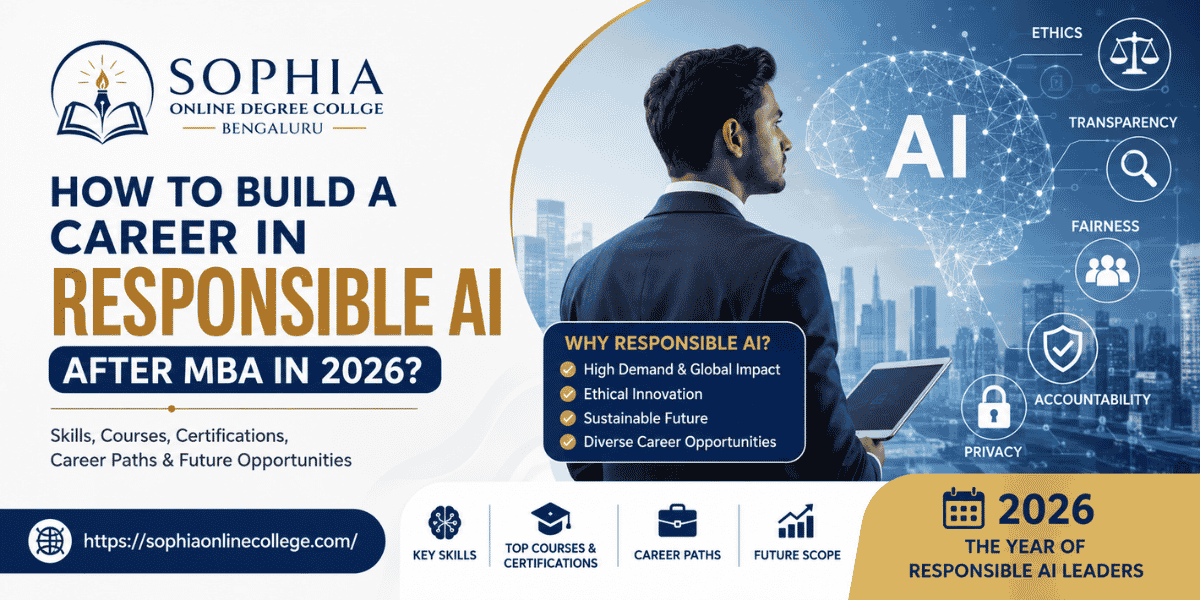
Artificial intelligence is leaving the realm of experimentation and is firmly entering the sphere of business decision-making in a variety of areas from staffing and customer relations to financial planning and marketing analysis. This trend raises the question of who is going to ensure that AI is used responsibly, ethically, safely, and effectively to achieve specific business goals. Thus, Build a career in Responsible AI is a sensible option for an MBA student rather than a distant aspiration.
For an aspiring business leader who has a basic understanding of such concepts as strategic thinking, risk management, operations, communication, and analytics, learning the fundamentals of AI, its governance, ethics, privacy, risk list, and practical applications can provide a solid foundation for a career in the field. This guide aims to give an entry-level perspective on the topic without requiring extensive technical knowledge and offer some ideas for a career in AI for someone who does not plan to become a machine learning model designer.
Why Responsible AI Is Becoming a Business Priority?
Organizations are attracted to the potential of artificial intelligence to generate speed and efficiency, but they are equally concerned about bias, privacy, security, hallucinations, liability, and regulatory risks. Therefore, Build a Career in Responsible AI could be a good choice for an MBA graduate because an MBA trains you to think critically about the initiative, its value, possible negative consequences, who is responsible for what, and how best to navigate this quickly evolving space.
Artificial intelligence touches on many areas, including AI governance, risk management, ethics, data governance, compliance, and policy. So instead of thinking of them as completely separate areas, use the knowledge and skills from an MBA to understand how they intersect and complement each other to further your career.
What Does a Responsible AI Professional Actually Do?
For MBA graduates, Build a Career in Responsible AI begins with the fact that the work of an AI professional often involves decisions, controls, and coordination rather than writing production code.
The work of responsible AI is not only decision-making about whether AI is right or wrong, but much more extensive. In this context, an AI professional can help a business:
- Identify risks before an AI system is deployed
- Evaluate data governance and fitness for purpose
- Assess fairness and potential bias
- Support privacy and regulatory compliance reviews
- Develop AI policies and controls
- Document use of AI
- Ensure human oversight of AI
- Monitor systems for harms and incidents
- Report to senior business leaders on AI risks and
- Liaise with technology, legal, compliance, risk, and business teams.
In other words, Build a Career in Responsible AI is about helping an organisation to innovate whilst being aware of the human and societal impact of that innovation.
Why an MBA Gives You a Useful Head Start?
One reason Build a Career in Responsible AI is attractive after an MBA is that responsible AI is cross-functional. It needs people who understand business decisions as well as technology.
| MBA Strength | Responsible AI Application |
| Strategy | Aligning AI with business goals |
| Risk management | Identifying and prioritising AI risks |
| Operations | Creating AI governance processes |
| Analytics | Interpreting AI and risk data |
| Finance | Evaluating AI investment and exposure |
| HR | Reviewing AI use in recruitment |
| Marketing | Managing responsible personalisation |
| Communication | Explaining technical risks to leaders |
In the future, you could combine this with an MBA in Build a Career in Responsible AI – it’s not a huge detour from an MBA, but rather a way to add value to it.
Your MBA has given you the ability to take a business problem, work it through, and come out with recommendations to senior management; to understand the stakeholders and risks and opportunities. The next step is working out how that applies when an AI is involved.
The 12 Skills You Should Build
The most optimal way to Build a Career in Responsible AI is to consider these skills as a connected toolkit rather than separate certificates.
1. AI Fundamentals
The understanding of how machine learning works, generative AI, large language models, training data, model outputs, APIs, deployments, and monitoring.
You might not need to be a proficient programmer to understand how AI models function.
2. Responsible AI Principles
- Fairness
- Transparency
- Accountability
- Safety
- Privacy
- Explain ability
- Human oversight
- Robustness
These principles are the foundation of building responsible AI systems.
3. AI Risk Management
Learn to identify risks such as:
- Algorithmic bias
- Hallucinations
- Privacy exposure
- Cybersecurity threats
- Poor data quality
- Model failure
- Misuse
- Third-party risks
Risk management can be especially interesting for an MBA as it touches on business processes around decision-making.
4. AI Governance
Understand policies, who is responsible for what, controls, documentation, approvals, AI registry, monitoring, and accountability.
5. Data Governance
Responsible AI is critically dependent on data and therefore covers key areas such as:
- Data quality
- Data access
- Data lineage
- Data privacy
- Data retention
- Responsible data usage
6. AI Compliance
Raise awareness of regulatory requirements and understand how organisations interpret these and implement them as policies and controls.
7. Business Analytics
You will be able to acquire knowledge of Excel, SQL, Power BI, dashboards, reporting, and data interpretation. These skills can be useful in order to present information concerning the risks of using artificial intelligence and its governance effectively to managers or any other stakeholders.
8. Research
A responsible AI professional should possess such skills as researching regulations, frameworks, industry benchmarks, emerging technologies, and potential risks associated with artificial intelligence.
9. Communication
You should be able to explain a technical issue in simple business language.
For instance, if there is a problem with an AI model’s performance across different subgroups, you should be able to explain why this might be detrimental to the customers, business reputation, compliance, decision quality, or other factors.
10. Stakeholder Management
You may work with:
- Developers
- Product managers
- Lawyers
- Compliance teams
- Data teams
- Executives
- Risk professionals
- Customers
11. Policy Writing
Learn how to design effective AI policies, checklists, assessment templates, and governance documents.
12. Problem-Solving
Designing responsible AI is rarely a binary decision. The most important real world consideration is how to balance innovation, risk, cost, impact to customers and business goals.
The most important lesson of all is that Build a Career in Responsible AI does not require you to be an expert on every possible AI technology. You should have just enough knowledge to be responsible about your decisions.
Build Your Technical Comfort Without Becoming a Developer
A frequent question is: does Build a Career in Responsible AI require coding?
It depends on the role: technical Responsible AI and AI engineering roles can involve significant programming and ML modeling responsibilities, while governance, policy, risk, compliance, consulting, and business-facing roles will focus more on AI literacy, risk, communication, and governance.
If you’re more of a manager, then Build a Career in Responsible AI by gaining enough technical competence to ask better questions.
You should understand:
- How AI models use data
- What machine learning means
- How generative AI creates outputs
- What APIs do
- How models are evaluated
- What the AI lifecycle looks like
- Why monitoring is important
- Where privacy and security risks can be
A good target is technical fluency, rather than unnecessary technical complexity.
Where Different MBA Specialisations Can Take You?
Your MBA specialisation can shape your entry point.
| MBA Specialisation | Potential Responsible AI Direction |
| MBA Finance | AI risk, model risk, financial compliance |
| MBA HR | Responsible recruitment AI, employee data |
| MBA Marketing | AI-generated content, personalisation, privacy |
| MBA Operations | AI process controls, implementation governance |
| MBA Business Analytics | AI risk dashboards, data governance |
| MBA IT/Systems | AI lifecycle governance, technology risk |
This makes Build a Career in Responsible AI very flexible, depending on what kind of MBA you have.
For instance,
if you have an MBA in Human Resource, you would not be competing against other candidates with an AI engineer degree. Instead, you could be specializing in areas such as responsible AI in recruitment, employee analytics, workplace surveillance, and employee-data governance.
Another example is an MBA Finance graduate, they could be considering model risk, fraud analytics, financial AI governance, and compliance.
The Best Learning Path for 2026
A practical way to Build a Career in Responsible AI is to learn in layers: technology first, then risk, then governance, then application.
Do not collect random certifications without knowing how you will use the knowledge.
| Stage | What to Learn | Outcome |
| 1 | AI fundamentals | Understand modern AI |
| 2 | Responsible AI | Understand fairness, safety and accountability |
| 3 | AI risk | Identify and assess common risks |
| 4 | Governance | Learn policies, controls and ownership |
| 5 | Data & analytics | Build reporting and dashboard skills |
| 6 | Frameworks | Understand recognised governance approaches |
| 7 | Projects | Create proof of practical ability |
| 8 | Job preparation | Target relevant roles |
This structured approach makes Build a Career in Responsible AI less overwhelming.
You do not have to learn everything in one month. Build the foundation first, then gradually move towards specialised areas.
Frameworks You Should Know
You probably do not want to memorize each clause of all the standard frameworks. However, it is a good idea to get familiar with the big ones at least on a conceptual level.
Begin your learning path on responsible AI by studying the following:
- NIST AI Risk Management Framework
- ISO/IEC 42001
- Responsible AI principles
- AI risk assessment
- Data governance
- Privacy and data protection
- AI lifecycle governance
- Model evaluation and monitoring
You can also go deeper into the topics of the EU AI Act, OECD AI Principles, UNESCO recommendation, AI assurance, and privacy regulations. The main point for the career path in responsible AI is to understand what these frameworks are trying to accomplish and how a business can translate their principles, guidelines, standards, and risk management approaches into practice.
Build a Portfolio Before You Start Applying
Your portfolio can be used to document your decision to Build a Career in Responsible AI.
Certificates show the employer what you are going to study.
Showcase the work you have done through projects.
Consider working on three or four practical projects.
Project 1: AI Risk Assessment
Take a fictional AI recruitment tool.
Make sure to Identify:
- Biases
- Privacy
- Security
- Transparency
- Accuracy
- Accountability
And recommend controls.
Project 2: Generative AI Usage Policy
This project requires creating a company policy that covers the following:
- Confidential information
- Employee use of public AI tools
- Verification of AI-generated results
- Human review
- Prohibited uses
Project 3: AI Governance Dashboard
This project is about creating an AI governance dashboard in Power BI or Excel containing the following:
- AI systems names
- Risk level
- Department
- Review status
- System owners and
- Compliance date
Project 4: AI Vendor Assessment
This project requires developing a standard checklist when assessing an external vendor on the following:
- Privacy
- Security
- Transparency
- Data use
- Model monitoring
- And Incident management
These projects provide hands-on experience for the Build a Career in Responsible AI program by allowing one to discuss the specific decisions made while completing them during an interview.
Job Roles You Can Target
Once you have developed the necessary skills and portfolio, it is good to start looking into more than one specific job title.
Some of the variations you might look into are:
- Responsible AI Analyst
- AI Governance Analyst
- AI Risk Analyst
- AI Compliance Analyst
- AI Policy Analyst
- Responsible AI Consultant
- AI Governance Consultant
- AI Risk and Controls Specialist
- AI Product Governance Specialist
- AI Governance Manager
The job market will often use different terms to describe the same or similar roles. Similar functions may fall under governance, risk, compliance, data governance, AI policy, technology risk, consulting, or AI strategy. It is advisable to broaden your search to include similar functions and specialisations. Therefore, Build a Career in Responsible AI by looking into similar posts and not just one specific job title.
Where Can These Skills Be Used?
Responsible AI is applicable to all industries and functions where companies make critical decisions using artificial intelligence. Key areas include:
- Banking and financial services
- Insurance
- Healthcare
- IT sector
- Consultancy
- E-commerce
- Telecom
- Manufacturing
- Education
- Technology companies
- Government and public-sector technology
As an MBA graduate, I can combine my domain expertise with the knowledge of responsible AI that I gain from this course. For instance, if one works in the BFSI sector, they could focus on AI-related risks in finance. Meanwhile, an HR graduate could specialise in responsible AI in recruitment, and a marketing graduate could examine ethical issues in personalisation and customer data. Finally, an operations graduate could consider the challenges and opportunities of AI control and implementation.
How to Build a 6-Month Career Roadmap?
Use this roadmap if you want to Build a Career in Responsible AI sequentially rather than randomly trying to learn everything about AI.
Month 1: Learn the basics of AI
Learn about:
- AI
- Machine learning
- Generative AI
- LLMs
- Data
- Model lifecycle
- Common business use cases for AI
Month 2: Responsible AI
Study:
- Fairness
- Transparency
- Accountability
- Explain ability
- Privacy
- Safety
- Human oversight
Month 3: Governance and Risk
Study:
- AI risk management
- Controls
- Documentation
- Data governance
- Compliance
- AI policies
Month 4: Build Projects
Develop the AI risk assessment and an AI governance dashboard.
Month 5: Polish Professional Image
Update such elements are:
- Resume
- Portfolio
- Descriptions of the completed projects
- Skills
Month 6: Apply for Jobs
Look for position using the following keywords:
- Responsible AI
- AI governance
- AI risk
- AI compliance
- Data governance
- AI consulting
- Technology risk
Following these steps make it possible to transform Build a Career in Responsible AI into a six-month plan instead of a vague concept.
How to Make Your MBA Resume Stand Out?
Do not just throw your ‘Responsible AI’ aspirations in the skills section, make sure to demonstrate them with evidence from your experience.
Instead of:
Interested in Responsible AI.
Write something along the lines of:
Developed a responsible AI risk assessment for a simulated recruitment model, addressing fairness, privacy, transparency, and control governance issues.
This way, instead of stating your interest, you show the reader what exactly you did, thus supporting your claims with evidence.
Make sure to highlight your MBA skills as well, such as:
- Strategy
- Analytics
- Risk
- Compliance
- Operations
- Research
- Presentations
- Stakeholder management et cetera.
Your MBA is not something to hide from the recruiters in the AI industry, rather, it can give you an edge over the competition by showcasing your business-minded approach to the field.
What About Distance Education?
Flexible study can help you achieve your ambitions for a career in responsible AI without compromising your personal or professional needs.
When searching for MBA distance courses in Bangalore, one should prioritize programs that develop management skills in combination with analytics and technology knowledge.
Likewise, management distance education in Bangalore can be a good option to consider if you wish to continue working while studying.
When comparing a Correspondence college in India, ensure to review the depth of the program, its accreditation, teaching methods, syllabus, flexibility, and other relevant factors.
Moreover, for those comparing Correspondence degree colleges in Bangalore, one should also consider the relevance of an educational option to one’s broader career prospects instead of prioritizing ease and flexibility.
Distance education in Bangalore can be a good choice for busy professionals who wish to continue working while gaining new skills.
Therefore, when researching IT distance education, it is important to remember that building a career in responsible AI is a multidisciplinary field that involves business, technology, risk management, and governance. Hence, it is paramount to choose the educational track that aligns with your career goals instead of picking up random technologies.
Therefore, if you are reviewing flexible management and technology education options, I suggest that you compare Sophia Online College with your shortlisted options. The most important consideration when choosing between flexible educational programs is to ensure the selection of the track that will allow you to build the required career while providing enough flexibility to gain practical AI knowledge.
Common Mistakes to Avoid
As you Build a Career in Responsible AI, there are certain things that you need to avoid. For instance:
1. You Should Not Think Of Responsible AI As Just an Ethics Issue
Also part of Responsible AI is governance, risk, privacy, security, compliance, documentation, and accountability.
2. Do Not Ignore the Fundamentals of AI
One cannot manage the risk of what they do not understand.
3.Knowing Rules But Not Understanding Business
People who only know legal norms from a book cannot make correct decisions applying them to a realistic business case.
4. Accumulating Certificates Without Accomplissement
A long list of paper certificates hanging on a wall proves nothing, and even less than a single, practical accomplishment.
5. Avoidance of Data and Analytics
AI governance calls for evidence, reporting, monitoring, and data-driven decision-making.
6. Applying to Only One Position’s Title
Do a search on AI risk, AI governance, AI compliance, AI policy positions, responsible technology, and data governance roles.
7. Leverage Generic MBA Resume
One should ensure that his or her resume reflects how one’s MBA skills could be integrated into technology, analytics, risk, and governance.
8. Exaggerated Claims of Advanced AI Competence
A candidate should refrain from lying about his or her experience and level of expertise with regard to advanced AI.
Modifying these errors could make Build a Career in Responsible AI a viable and valuable career option.
Why Choose Sophia Online College?
If your intention is to achieve a convenient learning process and gain experience in career-oriented fields, Sophia Online College can be a strategic choice for getting an education.
The ultimate aim should be to complement your managerial skills with profound knowledge of AI, analytics, governance, and communication.
A student who wants to Build a Career in Responsible AI needs to remember that education is only one pillar of the way to the career. Portfolios, industry insights, frameworks, networks, and continuous improvement should also be included in the plan.
Conclusion
The future of artificial intelligence is not only the future of technology but also the future of humanity’s relationship with technology. For an MBA graduate, this means that there is a meaningful career bridge between management and technology. It does not require you to become a machine learning engineer but instead develop the competencies to understand, evaluate, govern, advise, and contribute to technologies that drive organizations.
By Building a Career in Responsible AI with your MBA, participating in projects, learning about artificial intelligence, acquiring governance competencies, and continuously learning, you will become a valuable expert in the arena that many companies will be entering in the future.
Ready to Build a Career in Responsible AI?
Your MBA can teach you all about business fundamentals. This course covers everything from general business principles to human resources, operations management, and financial accounting, giving students a comprehensive overview of the business world. However, if you want to understand the new field of AI literacy, you need to learn more about governance, risk management, analytics, and responsible technology.
All you have to do is take at least one course on the fundamentals of artificial intelligence, complete a practical governance project, learn at least one recognized framework, and invest time in developing a portfolio that demonstrates your skills.
Therefore, if you are considering non-traditional ways of continuing your education to prepare yourself for the next professional challenge, Sophia Online College can be one option to explore. Make sure to analyze the program structure and think through how it fits your goals.
This way, in combination with your business expertise, you will be able to Build a Career in Responsible AI without wasting time and effort on getting back to the basics of regular business administration.
FAQs
1. Can I Build a Career in Responsible AI after an MBA?
Certainly, you can build a responsible AI career after MBA by targeting business-oriented roles such as governance, risk, compliance, consulting, policy, and responsible AI product management.
2. Do I need coding to Build a Career in Responsible AI?
It is not mandatory to know coding to build a career in responsible AI. However, it is more likely that technical and engineering roles would require advanced coding skills, while business and governance-oriented positions may emphasise risk, policy, and AI literacy.
3. What skills are required for Responsible AI jobs?
Some key skills required for responsible AI careers are fundamentals of AI, responsible AI, AI risk management, governance, data privacy, compliance, analytics, research, communication, and stakeholder management.
4. Which MBA specialisation is best for Responsible AI?
There is no specific specialisation for responsible AI, but you can pick any business-oriented field, such as finance, human resources, marketing, operations, business analytics, and information technology.
5. What projects can I build for a Responsible AI portfolio?
Some examples of responsible AI projects include the AI risk assessment, generative AI usage policy, AI governance dashboard, AI vendor assessment, and AI impact assessment.
6. Is Responsible AI a good career option in 2026?
Organisations are likely to invest more in responsible AI practices such as governance, risk, and compliance to ensure that they utilise AI technologies ethically and responsibly. Therefore, this could be a good career option for individuals interested in business, technology, and risk management.
7. How can an MBA graduate get the first Responsible AI job?
MBA graduates can get their first responsible AI job by building an understanding of AI/ML fundamentals, learning about responsible AI, gaining experience through projects, customising their resume, networking, and looking for various job titles.
8. Can business analytics skills help in Responsible AI?
Business analytics skills can be applicable to responsible AI, specifically in identifying risks, building dashboards and inventories, performing analyses, and supporting governance decisions.