
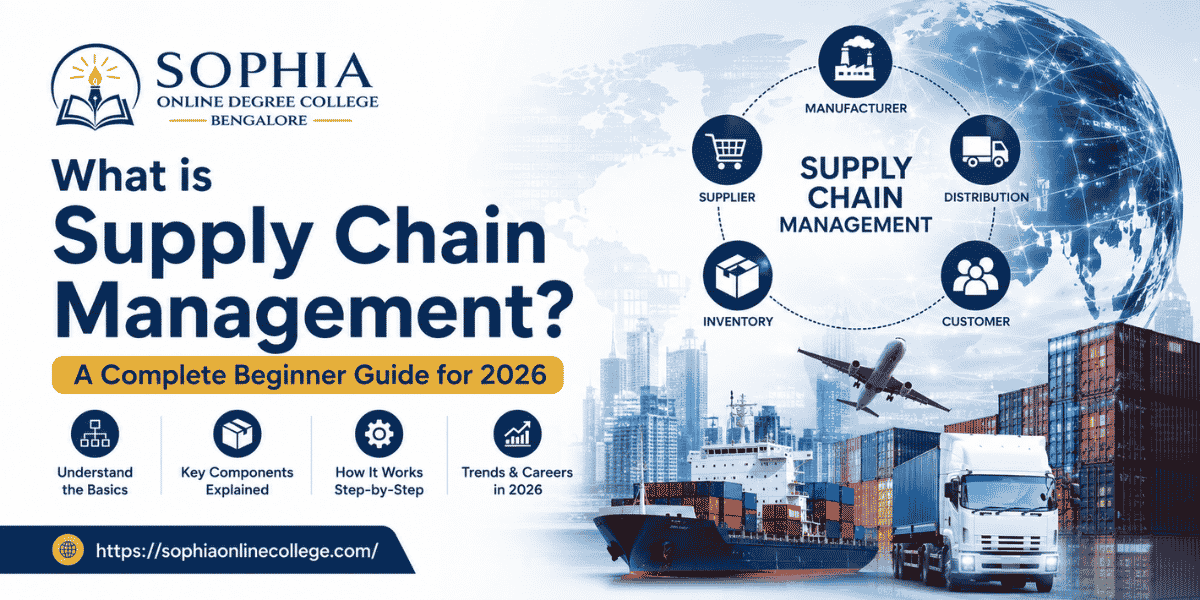
What is Supply Chain Management This is one of the most common questions asked by students, graduates, and professionals exploring modern business operations. What is Supply Chain Management and why has it become such an important part of global business success? In simple terms, Supply Chain Management refers to the process of managing the flow of goods, services, information, and finances from raw material suppliers to the final customer. As businesses continue to expand globally, Supply Chain Management has become a critical function that helps organizations improve efficiency, reduce costs, and deliver products faster.
In 2026, understanding What is Supply Chain Management is more important than ever because industries are increasingly relying on technology, automation, and data-driven decision-making. Whether you are a student, graduate, or working professional, learning What is Supply Chain Management can open doors to exciting career opportunities in logistics, operations, procurement, inventory management, and business analytics. This guide will help beginners understand What is Supply Chain Management, its importance, career scope, skills required, and future opportunities.
Understanding Supply Chain Management in Simple Terms
To understand What is Supply Chain Management, imagine ordering a smartphone online. Before that phone reaches your doorstep, multiple processes take place. Raw materials are sourced, components are manufactured, products are assembled, packaged, transported, stored in warehouses, and finally delivered to customers.
Supply Chain Management (SCM) ensures that every stage works efficiently and smoothly. It coordinates suppliers, manufacturers, distributors, retailers, and logistics providers to ensure products reach consumers on time and at the lowest possible cost.
In today’s digital economy, companies like Amazon, Flipkart, Apple, and Samsung rely heavily on effective supply chain strategies to maintain customer satisfaction and competitive advantage.
Why Supply Chain Management Matters in 2026?
The business landscape is changing rapidly. Global trade, e-commerce growth, and customer expectations have increased the importance of efficient supply chains.
Key Reasons Supply Chain Management Is Important:
- Faster product delivery
- Better customer satisfaction
- Reduced operational costs
- Improved inventory management
- Stronger supplier relationships
- Better risk management
- Increased business profitability
Why Companies Invest in Supply Chain Management?
| Business Challenge | SCM Solution |
| Delivery Delays | Optimized logistics planning |
| High Costs | Better resource allocation |
| Inventory Issues | Improved stock management |
| Supplier Problems | Strong vendor relationships |
| Customer Complaints | Faster order fulfillment |
| Market Uncertainty | Better forecasting and planning |
Businesses that invest in efficient supply chain systems gain a significant competitive advantage in today’s global marketplace.
The Six Core Components of Supply Chain Management
1. Planning
Planning involves forecasting customer demand and determining the resources required to meet market needs efficiently.
2. Sourcing
This stage focuses on selecting suppliers, negotiating contracts, and managing vendor relationships.
3. Manufacturing
Manufacturing transforms raw materials into finished products while maintaining quality standards.
4. Inventory Management
Inventory management ensures the right products are available at the right time without excessive storage costs.
5. Logistics and Transportation
This component handles warehousing, transportation, shipping, and distribution of products.
6. Customer Service and Returns
Customer satisfaction, order tracking, and return management are essential parts of modern supply chain operations.
How Technology is Transforming Supply Chain Management?
Technology has revolutionized supply chain operations in recent years.
Artificial Intelligence (AI)
AI helps businesses forecast demand, optimize inventory, and improve decision-making.
Internet of Things (IoT)
IoT devices provide real-time tracking of goods throughout the supply chain.
Cloud Computing
Cloud-based platforms improve collaboration between suppliers, manufacturers, and distributors.
Data Analytics
Advanced analytics helps businesses identify trends and improve operational efficiency.
Blockchain
Blockchain enhances transparency and security across supply chain networks.
Automation and Robotics
Automation reduces manual tasks and improves productivity in warehouses and manufacturing facilities.
Top Career Opportunities in Supply Chain Management
As organizations continue expanding globally, demand for supply chain professionals is growing rapidly.
Popular career options include:
- Supply Chain Analyst
- Logistics Manager
- Procurement Specialist
- Inventory Manager
- Operations Manager
- Warehouse Manager
- Demand Planner
- Supply Chain Consultant
- Purchasing Manager
- Distribution Manager
Popular Supply Chain Careers in 2026
| Job Role | Average Salary (India) |
| Supply Chain Analyst | ₹5–8 LPA |
| Logistics Manager | ₹6–12 LPA |
| Procurement Specialist | ₹5–10 LPA |
| Operations Manager | ₹8–18 LPA |
| Inventory Manager | ₹5–9 LPA |
| Supply Chain Consultant | ₹10–25 LPA |
These roles offer excellent growth opportunities and strong earning potential.
Skills Required for Supply Chain Management Careers
To succeed in supply chain management, professionals need a combination of technical and soft skills.
Technical Skills
- Supply Chain Planning
- Inventory Management
- ERP Systems
- Data Analytics
- Excel and Business Intelligence Tools
- Logistics Management
- Procurement Strategies
Soft Skills
- Communication
- Leadership
- Problem-Solving
- Negotiation
- Decision-Making
- Time Management
Employers increasingly seek candidates who can combine business knowledge with technology skills.
Educational Pathways for Supply Chain Management Careers
One of the biggest advantages of Supply Chain Management is that students from various educational backgrounds can enter this field. Whether you come from commerce, management, technology, or operations, there are multiple pathways available to build a successful career.
Students pursuing a BBA correspondence college in Karnataka program often gain foundational knowledge in business operations, finance, and management, which directly supports supply chain roles. Similarly, learners enrolled in MBA distance education in bangalore programs can specialize in operations, logistics, and strategic management to prepare for leadership positions.
Working professionals frequently choose management distance education in bangalore programs because they provide flexibility while allowing learners to enhance their qualifications and gain industry-relevant skills.
As organizations increasingly adopt digital technologies, professionals with knowledge of analytics, automation, and supply chain software enjoy a significant advantage in the job market.
How Distance Learning Supports Supply Chain Careers?
The modern workforce values skills and practical knowledge as much as academic qualifications. Flexible education has made it easier than ever for students and professionals to pursue career-focused programs while balancing work and personal commitments.
Many learners choose distance education in bangalore because it provides access to quality education without requiring full-time classroom attendance. Likewise, students studying through a recognized Correspondence college in india can continue their academic journey while developing practical industry skills.
Technology is also transforming supply chain operations, making technical knowledge increasingly valuable. This is why students pursuing IT distance education programs often find opportunities in supply chain analytics, logistics technology, enterprise resource planning (ERP), and digital operations management.
Industries That Hire Supply Chain Professionals
Supply Chain Management is not limited to one industry. Nearly every sector relies on efficient supply chain processes.
Major hiring industries include:
- E-commerce
- Retail
- Manufacturing
- Healthcare
- Pharmaceuticals
- Automotive
- FMCG
- Logistics and Transportation
- Aviation
- Technology
- Telecommunications
- Food and Beverage
As businesses expand globally, professionals with supply chain expertise continue to enjoy strong employment opportunities across sectors.
Future Scope of Supply Chain Management in 2026 and Beyond
The future of Supply Chain Management looks extremely promising. Companies are investing heavily in digital transformation initiatives to improve operational efficiency and customer satisfaction.
Key trends shaping the future include:
AI-Powered Forecasting
Artificial Intelligence is helping businesses predict demand more accurately.
Smart Warehousing
Automation and robotics are transforming warehouse operations.
Sustainable Supply Chains
Organizations are focusing on environmentally responsible practices.
Real-Time Visibility
IoT devices enable businesses to track products throughout the supply chain.
Blockchain Integration
Blockchain improves transparency and security across supply networks.
Data-Driven Decision Making
Advanced analytics allows organizations to optimize inventory and logistics operations.
These innovations are creating new career opportunities for professionals who can combine business knowledge with technology expertise.
Why Choose Sophia Online College?
Choosing the right educational partner can make a significant difference in your career journey.
Sophia Online College helps students and working professionals access flexible learning opportunities designed to meet modern industry requirements. Whether you are exploring management programs, technology-focused courses, or professional development opportunities, Sophia Online College supports learners with career-oriented educational pathways.
Students looking for flexible education options can benefit from programs that align with current business trends and industry demands. With a focus on skill development and career growth, Sophia Online College helps learners prepare for future opportunities in management, operations, logistics, and technology-driven business environments.
Conclusion
Now that you understand What is Supply Chain Management, it becomes clear why this field plays such a vital role in modern business success. From sourcing raw materials to delivering products to customers, supply chain professionals ensure every process operates efficiently and effectively.
As global commerce, e-commerce, automation, and digital transformation continue expanding, demand for skilled supply chain professionals is expected to remain strong throughout 2026 and beyond. Whether you are a student, graduate, or working professional, learning What is Supply Chain Management can open the door to rewarding careers in logistics, operations, procurement, inventory management, and business strategy.
By combining academic qualifications, practical experience, and continuous learning, aspiring professionals can build successful long-term careers in this dynamic and rapidly evolving field.
Ready to Build a Career in Supply Chain Management?
Explore flexible and career-focused educational opportunities with Sophia Online College and take the next step toward a successful future in business operations, logistics, and supply chain management.
Contact Sophia Online College today and start your journey toward a high-growth management career.
FAQs
1. What is Supply Chain Management in Simple Terms?
Supply Chain Management (SCM) is the process of planning, coordinating, and managing the flow of products, services, information, and finances from suppliers to customers. It covers every stage of a product’s journey, including sourcing raw materials, manufacturing, storage, transportation, and final delivery. Effective supply chain management helps businesses reduce costs, improve efficiency, and ensure customer satisfaction. In today’s competitive market, organizations rely on advanced technologies and data analytics to optimize their supply chains. Students pursuing management distance education in bangalore often learn supply chain concepts as part of operations and business management studies, helping them prepare for careers in logistics, procurement, and operations management.
2. Is Supply Chain Management a Good Career in 2026?
Yes, Supply Chain Management is expected to be one of the most promising career fields in 2026. The growth of global trade, e-commerce platforms, and digital transformation initiatives has increased the demand for professionals who can manage complex supply networks efficiently. Companies require experts to oversee inventory, logistics, procurement, forecasting, and vendor relationships. Career roles such as Supply Chain Analyst, Logistics Manager, Procurement Specialist, and Operations Manager offer excellent growth opportunities and competitive salaries. Students pursuing MBA distance education in bangalore can strengthen their career prospects by gaining knowledge of supply chain operations, strategic management, and business analytics, which are highly valued by employers across industries.
3. What Qualifications Are Required for Supply Chain Management?
There is no single qualification required to enter the field of Supply Chain Management. Many professionals begin with degrees in business administration, logistics, operations management, engineering, or commerce. Programs such as BBA and MBA provide strong foundations in management principles, while specialized certifications can further enhance career prospects. Employers also value practical skills in inventory control, procurement, and data analysis. Students studying through a Correspondence college in india can build successful careers in supply chain management by combining academic qualifications with industry certifications and practical experience. Continuous learning and staying updated with emerging technologies can significantly improve career growth in this dynamic field.
4. What is the Difference Between Logistics and Supply Chain Management?
Although the terms are often used interchangeably, logistics and supply chain management are not the same. Logistics primarily focuses on the movement, storage, and transportation of goods from one location to another. Supply Chain Management, however, is a broader function that includes sourcing, production planning, procurement, inventory management, logistics, and customer service. Logistics is essentially one component of the overall supply chain process. Understanding this distinction is important for students interested in operations and business management careers. Many learners pursuing distance education in bangalore explore these concepts to understand how businesses optimize their operations and maintain efficient product delivery systems in competitive markets.
5. Which Industries Hire Supply Chain Professionals?
Supply chain professionals are in demand across a wide range of industries because every business depends on efficient product and service delivery. Major sectors hiring supply chain experts include manufacturing, healthcare, pharmaceuticals, automotive, retail, e-commerce, logistics, aviation, food processing, and technology. Companies need skilled professionals to manage procurement, warehousing, inventory, transportation, and vendor relationships. The rise of global supply networks and digital commerce has further increased employment opportunities in this field. Students pursuing IT distance education programs can also find opportunities in supply chain analytics, ERP systems, and digital logistics solutions, where technology and supply chain operations increasingly overlap.
6. Can Students from a BBA Correspondence College in Karnataka Pursue Supply Chain Careers?
Yes, students graduating from a BBA correspondence college in Karnataka can successfully pursue careers in Supply Chain Management. A BBA program provides essential knowledge in business operations, finance, marketing, and management, all of which are valuable in supply chain roles. Graduates can work in procurement, logistics, inventory management, vendor coordination, and operations planning. To improve employability, students can also earn certifications in supply chain management, logistics, data analytics, or ERP software. Employers generally value practical skills, industry knowledge, and problem-solving abilities. By combining academic qualifications with hands-on experience, BBA graduates can build rewarding careers in the growing supply chain sector.
7. Is MBA Distance Education in Bangalore Useful for Supply Chain Management?
Yes, pursuing MBA distance education in bangalore can be highly beneficial for individuals interested in Supply Chain Management careers. MBA programs help students develop leadership, strategic thinking, operational management, and analytical skills that are essential for managing modern supply chains. Distance learning also offers flexibility, allowing working professionals to continue their careers while upgrading their qualifications. Many MBA programs include subjects such as operations management, logistics, procurement, and business analytics, which are directly relevant to supply chain roles. Combined with practical experience and industry certifications, a distance MBA can help learners qualify for managerial and leadership positions in logistics and operations.
8. Can Distance Education Students Work in Supply Chain Management?
Absolutely. Distance education students can build successful careers in Supply Chain Management if they develop the right skills and industry knowledge. Employers increasingly focus on practical competencies, certifications, and problem-solving abilities rather than solely evaluating the mode of education. Students who gain expertise in logistics, procurement, inventory management, and data analytics can compete effectively in the job market. Learners pursuing distance education in bangalore often benefit from flexible schedules that allow them to gain work experience while studying. By combining academic qualifications with internships, certifications, and hands-on projects, distance education students can secure rewarding opportunities in supply chain and operations management.