
Every organisation depends on people to turn its plans into results. But hiring the right employee, helping a new team member settle in, resolving workplace concerns and developing future leaders require more than basic administration. These responsibilities create opportunities for professionals interested in Human Resource Management and the way people contribute to business success.
For students, graduates and working professionals exploring management education, choosing the right qualification can be an important first step. Someone researching an online mba in bangalore, for example, may want to understand whether a management degree can support a career in recruitment, employee relations, training or HR operations. The right decision depends on educational background, career interests, practical skills and the type of role a person hopes to pursue.
This guide explores HR career options in India, the courses that can support different career stages, the skills employers value and the practical steps candidates can take to prepare for employment. It also explains how to evaluate learning options without assuming that a particular degree automatically guarantees a job.
A Business Runs on People, but People Need the Right Support
Imagine a company hiring 50 employees for a new project. The recruitment team must identify suitable candidates, managers need to explain responsibilities, payroll staff must maintain accurate records, and employees need access to training and workplace support.
Now imagine that several new employees leave within their first few months. The company may need to investigate whether the problem involves unclear responsibilities, unsuitable hiring decisions, inadequate training, management practices or workplace expectations.
These situations demonstrate why HR work extends beyond maintaining employee files.
Human resources professionals help organisations connect their business objectives with the people, capabilities and working practices needed to achieve them. Depending on the organisation, this can involve hiring, onboarding, employee engagement, training, performance management, compensation support, compliance documentation and workforce planning.
For someone considering this profession, the central question is not simply whether they enjoy working with people. It is whether they are interested in helping people and organisations work together effectively, fairly and productively.
What does an HR team contribute to an organisation?
The contribution of an HR department becomes clearer when viewed through everyday business situations:
- When a company expands: HR helps identify workforce requirements, coordinate recruitment and support onboarding.
- When employees need new capabilities: Learning and development teams organise training and help assess whether it addresses actual skill gaps.
- When workplace concerns arise: HR professionals may document complaints, coordinate appropriate discussions and follow organisational procedures.
- When employee performance needs improvement: HR works with managers to support goal-setting, feedback and development processes.
- When policies or employment requirements change: HR teams help maintain appropriate documentation and coordinate implementation with relevant internal specialists.
These responsibilities vary by organisation and seniority. An entry-level HR executive may primarily maintain records or coordinate interviews, while an experienced HR business partner may advise managers on workforce planning and organisational development.
The profession therefore offers several possible directions rather than one fixed career path.
Discover the HR Role That Matches Your Interests
Not every HR professional spends the day interviewing candidates. Some work with spreadsheets and employee records, others design training programmes, and some use workforce data to help managers make decisions.
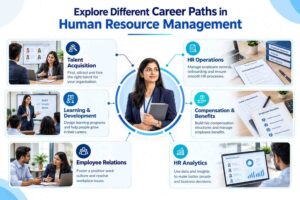
Understanding these differences can help you choose a specialisation before investing time and money in a course.
Recruitment and talent acquisition
Recruitment professionals help organisations find and select suitable candidates. Their work may include understanding job requirements, preparing job descriptions, screening applications, scheduling interviews, communicating with applicants and coordinating offers.
This area may suit people who enjoy communication, organisation, professional networking and evaluating how candidates match a role’s requirements.
A useful beginner exercise is to prepare a sample job description for an entry-level position and create a structured list of interview questions. This develops practical understanding beyond simply learning recruitment terminology.
HR operations and employee administration
HR operations focuses on the processes that support an employee throughout their time at an organisation. Activities can include maintaining employee information, preparing onboarding documents, tracking leave, coordinating employee queries and supporting payroll-related processes.
Accuracy and confidentiality are particularly important because employee records contain sensitive information.
People who enjoy organised workflows, documentation, spreadsheets and consistent procedures may find this area appealing.
Learning and development
Learning and development professionals help employees acquire skills needed for their current responsibilities and future roles. They may identify training needs, coordinate workshops, create learning materials and collect feedback on training effectiveness.
For example, a company introducing a new customer relationship management system may need training that helps employees use it correctly. The learning team can coordinate sessions and assess whether employees understand the new process.
This specialisation may suit people who enjoy teaching, explaining concepts, designing learning experiences and supporting professional growth.
Compensation, benefits and payroll support
This area involves supporting employee compensation processes and benefits administration. Depending on the role, responsibilities may include maintaining salary-related records, checking payroll inputs, assisting with benefits communication and coordinating with finance teams.
Attention to detail, numerical confidence, confidentiality and an understanding of relevant employment requirements are useful here.
Candidates should recognise that payroll processing, compensation design and specialist rewards consulting can require different levels of expertise.
Employee relations and workplace policies
Employee relations professionals help organisations manage workplace concerns, interpret internal policies, support grievance procedures and maintain constructive employee-management relationships.
This work requires careful listening, balanced judgement, clear documentation and an understanding of when a matter needs to be referred to senior HR personnel or legal specialists.
People interested in workplace fairness, conflict resolution and organisational policies may want to explore this direction.
HR analytics and workforce planning
HR analytics uses employee and workforce information to identify patterns that may help organisations make better decisions. Examples include analysing recruitment timelines, training participation, employee turnover and workforce requirements.
A beginner may start with spreadsheets, charts and basic descriptive statistics before progressing to more advanced analytical tools.
This area can suit people who enjoy combining business understanding with data analysis. However, access to employee data must be governed by appropriate privacy, security and confidentiality practices.
HR career options, daily responsibilities and suitable strengths
| HR specialisation | Typical responsibilities | Useful strengths |
| Talent acquisition | Candidate screening, interview coordination and recruitment communication | Communication, organisation and evaluation |
| HR operations | Employee records, onboarding and process coordination | Accuracy, documentation and process management |
| Learning and development | Training coordination, learning materials and feedback | Presentation, teaching and planning |
| Compensation and benefits | Payroll support, benefits administration and salary-related records | Numerical confidence and confidentiality |
| Employee relations | Workplace concerns, policy coordination and grievance documentation | Listening, judgement and clear writing |
| HR analytics | Workforce reports, trend analysis and dashboards | Spreadsheet skills, data interpretation and problem-solving |
Use this comparison to shortlist two areas that interest you. You do not need to select a lifelong specialisation immediately. An entry-level position can help you understand the profession before you decide where to develop deeper expertise.
Which Courses Can Help You Enter the HR Profession?
Your educational route should reflect your current qualification, experience and intended career level. A student completing Class 12, a commerce graduate, an engineering professional and an experienced administrator may all approach HR from different starting points.
There is no single qualification that suits every candidate. What matters is understanding the purpose of each course, its eligibility requirements, its recognition and how well it supports your next career step.
Undergraduate degrees: Build a business foundation
Students who have completed Class 12 can explore undergraduate programmes such as a Bachelor of Business Administration (BBA) or other suitable bachelor’s degrees that introduce business, management, organisational behaviour and communication.
An undergraduate programme can provide a foundation for later study in HR, although the exact subjects and specialisations depend on the institution and programme structure.
Students should check the eligibility criteria, curriculum, assessment method and progression options before applying. If a specific HR specialisation is important, they should confirm whether the course actually offers it rather than assuming that every management degree includes the same content.
MBA in Human Resource Management: Develop management knowledge
An MBA with an HR specialisation is one possible postgraduate route for graduates who want structured learning in management and people-related business functions.
Depending on the curriculum, students may study organisational behaviour, talent acquisition, training and development, performance management, compensation, employee relations, strategic HR and business management.
A postgraduate management qualification may be particularly relevant to candidates who want to build towards broader HR responsibilities. However, employers may also consider prior experience, communication, practical ability and the requirements of the particular vacancy.
Candidates researching an online mba in bangalore should compare the actual programme rather than relying only on the institution’s location or the word online. Review the awarding institution, programme recognition, course structure, examination arrangements, learning support and total fees.
PGDM and postgraduate diploma programmes
A Post Graduate Diploma in Management (PGDM) may offer management education through a diploma structure, with some programmes providing an HR specialisation or related electives.
A pgdm correspondence course may appeal to learners who need a study arrangement compatible with employment or other commitments. Before enrolling, verify the specific programme’s recognition and approval status, delivery method, assessment requirements and acceptance for your intended career or further study.
Do not assume that a PGDM and an MBA are interchangeable in every context. Their recognition, awarding authority, curriculum and suitability for particular opportunities depend on the individual programme and applicable requirements.
HR diplomas and short professional courses
Short courses can help learners develop a focused capability, such as recruitment coordination, payroll fundamentals, Excel, HR information systems or employment documentation.
These programmes may be useful for people who already have a degree and want to strengthen a specific skill. They can also provide introductory exposure before committing to a longer qualification.
However, a short certificate is not automatically equivalent to a bachelor’s degree, MBA or recognised postgraduate diploma. Candidates should evaluate what the course teaches and whether the credential is relevant to the role they are pursuing.
Comparing HR learning routes
| Learning route | Who may consider it | What to examine before enrolling |
| BBA or another suitable undergraduate degree | Class 12 graduates building a business foundation | Eligibility, core subjects, HR electives and progression opportunities |
| MBA with HR specialisation | Graduates seeking postgraduate management education | Recognition, HR curriculum, assessment, fees and learning support |
| PGDM with relevant HR content | Graduates interested in a management diploma | Awarding body, programme approval, specialisation and intended career use |
| HR diploma or short course | Graduates and professionals developing specific capabilities | Practical exercises, instructor expertise, course scope and credential value |
| Professional upskilling | Existing HR employees or career changers | Relevance to the target role, tool proficiency and demonstrable learning outcomes |
How to evaluate an online management programme
Flexible learning can be useful for working professionals and students who need to manage study alongside employment or other responsibilities. But convenience should not be the only selection criterion.
When exploring the best online mba in india, consider these questions:
- Is the awarding institution and the specific programme appropriately recognised for its mode and academic year?
- Does the curriculum include HR subjects relevant to the role you want to pursue?
- Are the classes live, recorded or delivered through a combination of formats?
- How are assignments, examinations and student support managed?
- Does the programme offer case studies, projects or other opportunities to apply concepts?
- What is the complete fee structure, including applicable examination or other charges?
- Will the qualification meet your requirements for further education or a particular employment opportunity?
A course comparison should focus on evidence rather than marketing claims. An institution’s reputation may be one consideration, but the programme’s suitability for your background and goals matters just as much.
For official career exploration, the Government of India’s National Career Service portal provides job-search facilities, career information and employment-related support. You can explore it at National Career Service.
The Skills That Turn HR Knowledge into Workplace Ability
Completing a course is one part of career preparation. Employers also need evidence that candidates can apply what they have learned to routine workplace situations.
The most useful approach is to connect each skill with a practical task. Rather than writing “good communication” on a CV without supporting evidence, show that you can draft a professional email, coordinate a schedule or explain a process clearly.
Communication that supports decisions
HR professionals communicate with candidates, employees, managers and sometimes external service providers. The message may involve an interview invitation, a policy explanation, an onboarding instruction or a sensitive workplace concern.
Good communication means choosing the right level of detail, keeping information clear and maintaining a professional tone. It also means listening carefully and checking that the other person understands the next step.
Practice task: Draft an interview invitation that includes the position, date, time, interview format, contact details and instructions. Review it for accuracy and clarity before treating it as a finished document.
Recruitment and candidate evaluation
Recruitment skills include interpreting job requirements, screening applications against stated criteria, coordinating interviews and communicating professionally with candidates.
Fair evaluation is important. Candidates should be assessed against job-related requirements rather than assumptions about their background or personal characteristics.
Practice task: Create a sample candidate-screening sheet with job-related criteria, evidence from the application and a space for structured notes. Use fictional information and avoid collecting real candidates’ private data.
Excel, spreadsheets and reporting
Spreadsheets are useful for organising employee information, monitoring training participation, tracking recruitment stages and preparing simple workforce reports.
Begin with practical spreadsheet skills:
- Sorting and filtering records.
- Using formulas to calculate totals and averages.
- Applying basic conditional formatting.
- Creating charts that communicate a clear message.
- Checking for missing, inconsistent or duplicated entries.
Practice task: Build a fictional recruitment tracker showing the number of applications, screening outcomes, interviews and offers. Summarise the results in a simple chart and explain what the figures show.
HR systems and digital administration
Many organisations use HR information systems to manage employee records, leave, attendance, recruitment and other processes. The specific software varies by employer.
Beginners do not need to claim expertise in every HR platform. They should understand the purpose of these systems, learn the tools available through their course or workplace and demonstrate that they can follow structured digital processes.
Practice task: Map the steps involved in onboarding a new employee, from the accepted offer to orientation and the completion of required documents. Identify which steps require approval and which need secure recordkeeping.
Employment-law awareness and confidentiality
HR work can involve policies, working conditions, compensation, workplace safety and employment documentation. Relevant requirements vary according to the applicable law, the establishment and the circumstances.
Candidates should learn how to locate reliable official information and recognise when an issue requires specialist guidance. Familiarity with a topic is not a substitute for legal advice or authority to make decisions outside one’s role.
India’s official legal repository, India Code, provides access to central and state legislation. It is a useful starting point for checking legal texts relevant to employment and workplace responsibilities.
Confidentiality is equally important. Employee records, compensation information, identity documents and complaints must be handled through authorised processes. Practical learning projects should use fictional or appropriately anonymised data.
Emotional intelligence and problem-solving
HR professionals may encounter frustrated employees, conflicting expectations or incomplete information. Remaining calm, asking relevant questions and documenting facts can help prevent misunderstandings.
Emotional intelligence does not mean agreeing with everyone. It means listening without making premature assumptions, distinguishing facts from opinions and applying appropriate procedures consistently.
Practice task: Write a response to a fictional employee who says their leave request has not been processed. Acknowledge the concern, explain the information needed and outline the next step without promising an outcome you cannot control.
Business understanding
HR decisions affect more than the HR department. Recruitment delays can affect project delivery, insufficient training can affect performance, and high employee turnover can create additional hiring and onboarding work.
Understanding these connections helps professionals explain why an HR activity matters to the organisation.
For example, instead of reporting only that training took place, an HR team might examine participation, feedback and evidence of improved task performance. The appropriate measure depends on the purpose of the training.
How to Prepare for Your First HR Opportunity
Your first HR role does not have to be a managerial position. Many professionals begin by supporting recruitment, administration, onboarding, training coordination or employee services and then develop specialised knowledge.
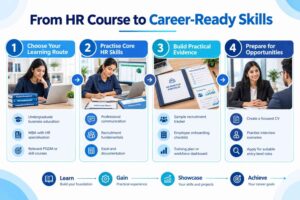
The objective is to demonstrate readiness for the responsibilities of the vacancy you are applying for.
If you are still studying
Use assignments to build evidence of practical ability. A business project can include a sample job description, interview questions, an onboarding checklist or a training-needs analysis.
You can also participate in suitable college activities that involve event coordination, team communication and documentation. Describe your actual responsibilities accurately rather than presenting student activities as formal HR employment.
If you are a recent graduate
Review entry-level vacancies to identify recurring requirements. Look for the tasks employers expect candidates to perform, the software or documentation skills mentioned and the educational qualifications specified.
Create a small portfolio of fictional work samples that demonstrate relevant abilities. For example, a recruitment tracker, an onboarding plan and a training-feedback summary can show that you understand basic HR workflows.
Your portfolio should be clearly labelled as practice work. Never include confidential information from a former employer or real candidate.
If you are changing careers
Previous experience may offer transferable skills. Customer service can involve handling concerns and communicating clearly. Administration can develop documentation and process management. Sales coordination may involve scheduling, follow-ups and stakeholder communication.
Identify the parts of your previous work that relate directly to the HR role you want. Then fill the gaps through suitable study, practical exercises or supervised experience.
A career change does not require you to present yourself as an experienced HR professional immediately. A credible account of transferable skills and a clear learning plan can be more effective than exaggerated claims.
From career interest to practical evidence
| Your immediate goal | Evidence you can prepare | A useful next step |
| Enter recruitment | Sample job description, screening criteria and interview schedule | Apply for suitable recruitment coordinator or talent acquisition support roles |
| Start in HR operations | Onboarding checklist, employee-record template and process map | Practise accurate documentation and spreadsheet management |
| Explore learning and development | Sample training plan and feedback questionnaire | Look for training coordination or learning support opportunities |
| Build HR analytics skills | Fictional workforce spreadsheet and simple dashboard | Develop formula, chart and data-interpretation skills |
| Move from another profession | CV showing relevant transferable skills and a focused learning plan | Target entry-level or adjacent roles that match your existing experience |
Prepare a CV that demonstrates your contribution
A CV should make it easy for an employer to understand your education, practical skills and suitability for the position.
Instead of relying only on broad statements, describe relevant tasks you have actually completed. For example:
- Prepared a sample recruitment tracker using spreadsheet filters and formulas.
- Developed an onboarding checklist as part of a management assignment.
- Coordinated schedules and documentation for a student or workplace activity.
- Created a training presentation and collected structured feedback.
Use these examples only if they reflect work you have genuinely completed. If you have measurable outcomes from legitimate work experience, include them accurately and explain your contribution.
“Students interested in pursuing a management career can explore our guide on MBA in HR vs. MBA in Operations in 2026 to compare these specializations and understand which career path aligns with their professional goals.”
Approach interviews with practical examples
Interviewers may ask how you would handle an interview rescheduling request, incomplete documentation, a confidential employee concern or a disagreement about a process.
A useful response structure is:
- Clarify the situation and the information available.
- Identify the relevant policy, job requirement or procedure.
- Explain the action you would take within your authority.
- Describe how you would document or communicate the next step.
- Recognise when the issue should be escalated.
This approach shows structured thinking without suggesting that a beginner can independently resolve every complex workplace matter.
Where Can HR Professionals Work in India?
HR responsibilities exist across organisations of different sizes and sectors. The work may vary significantly depending on workforce size, business model, industry requirements and organisational structure.
Information technology and technology services
Technology companies may recruit for technical and non-technical positions, coordinate onboarding for distributed teams and support learning as tools and project requirements change.
Recruitment coordination, HR operations, workforce reporting and employee development can all be relevant areas to explore.
Manufacturing and industrial organisations
Manufacturing businesses may need HR support for workforce administration, employee relations, training coordination, shift-related processes and workplace safety initiatives.
The responsibilities depend on the establishment and applicable requirements. Candidates interested in this sector should pay particular attention to documentation, process discipline and the relationship between HR and operational teams.
Banking, financial services and insurance
Financial services organisations may employ HR professionals in recruitment, employee services, learning, performance processes and corporate HR functions.
Candidates should review the eligibility and background requirements of individual vacancies, particularly where an employer specifies relevant sector experience or specialist knowledge.
Healthcare, education and hospitality
Hospitals, educational institutions and hospitality businesses depend on employees with different responsibilities, working schedules and training needs.
HR teams may coordinate recruitment, orientation, employee records, training and internal communication. The specific demands vary by workplace and role.
Start-ups and small businesses
Smaller organisations may have lean HR teams in which one employee supports several processes. This can provide broad exposure, but candidates should understand the expected responsibilities, reporting structure and level of supervision before accepting a position.
Consulting and HR service providers
Consulting firms and HR service providers may support recruitment, HR operations, training, organisational development or other services for client organisations.
The work can involve deadlines, stakeholder communication and managing several assignments. Relevant experience and the ability to work with different processes may be useful.
For candidates exploring opportunities, the Government of India’s National Career Service is one place to investigate vacancies, career resources and employment-related services. Always review the actual employer’s requirements and verify recruitment communications before sharing documents or paying any fee.
How HR Careers Can Develop Over Time
An HR career does not always follow the same progression. Advancement depends on performance, experience, available opportunities, education and the type of specialisation pursued.
A candidate might begin as an HR assistant or recruitment coordinator, progress into an HR executive role and later specialise in talent acquisition, HR operations, employee relations or learning and development.
Another professional might develop expertise in workforce analytics or compensation before moving into a specialist or managerial position.
With broader experience, some professionals take on responsibilities such as:
- Managing a recruitment or HR operations team.
- Advising managers on workforce planning.
- Developing training and talent-management initiatives.
- Coordinating complex employee-relations processes.
- Interpreting workforce data to support business decisions.
- Contributing to organisation-wide people strategies.
These are possible pathways, not guaranteed promotions. A job title can also mean different things at different organisations, so compare the responsibilities and requirements of vacancies rather than relying on titles alone.
What about salary expectations?
HR salaries in India vary according to role, location, industry, organisation size, experience, specialist expertise and the responsibilities attached to a position. There is no single salary figure that accurately represents every HR career.
Entry-level recruitment support and HR administration roles should not automatically be compared with experienced HR business partners or senior HR leaders.
Before setting a salary expectation, research current vacancies for the same job title and experience level in your target location. Compare the responsibilities, required skills and stated compensation where available. Consider the learning opportunities and working conditions as well as the financial offer.
Avoid choosing a course solely because an advertisement associates it with a high salary. A qualification can support learning and progression, but the outcome depends on several factors beyond the credential itself.
Studying HR While Working: Choosing a Flexible Learning Route
Some aspiring HR professionals can study full-time, while others need to continue earning, manage family responsibilities or complete an existing degree. Flexible learning can help some learners balance these commitments, provided they select a programme suited to their circumstances.
For people exploring online degree courses in bangalore, the first step is to clarify the qualification they need. An undergraduate programme may suit a learner beginning after Class 12, while a postgraduate programme may be relevant to a graduate seeking broader management knowledge.
Those comparing online degree colleges in bangalore should check the exact programme, awarding institution, delivery arrangements, student support, examination process and total cost. Location alone does not establish the quality or suitability of an online qualification.
Similarly, learners researching online degree courses in karnataka should distinguish between a programme delivered online, a distance-learning programme and a classroom-based course. These modes may have different requirements, and their suitability depends on the particular institution and programme.
Questions to ask before choosing a course
Before enrolling, make sure you can answer the following questions:
- Does the qualification match my current educational background?
- Is the programme recognised and appropriate for my intended progression?
- Will I study HR subjects or mainly general management?
- Can I realistically manage the study schedule alongside my existing commitments?
- Does the course include assignments, case studies or practical exercises?
- Are the fees, examination charges and other costs clearly explained?
- What support is available if I need academic assistance?
- Can I explain how the course relates to the role I want to pursue?
For working professionals, a flexible format is useful only when the schedule, assessment requirements and learning support are manageable. A programme that looks convenient at first may be difficult to complete if its practical requirements do not fit your circumstances.
Sophia Online Degree College Bangalore is a relevant starting point for learners who want to explore education options and understand which course may align with their academic background and career interests. Review the programme details carefully and seek clarification before making an enrolment decision.
You can explore the institution’s website at SODC and use the available information to identify the next questions you need answered.
Common Mistakes to Avoid When Planning an HR Career
Choosing a course before identifying your goal
A course should support a defined next step. Before enrolling, decide whether you need an undergraduate qualification, postgraduate management education, a specialist diploma or a focused skill course.
You can refine your long-term goal later, but having an immediate objective helps you compare options sensibly.
Assuming that an HR degree is enough
Formal education can introduce important concepts, but practical tasks also matter. Candidates should practise documentation, spreadsheets, professional communication and structured problem-solving.
Treating every HR role as recruitment
Recruitment is only one part of the profession. If you prefer data, training, employee services or policy-related work, investigate those areas rather than choosing a career based on a narrow understanding of HR.
Ignoring confidentiality
Handling employee information requires care. Do not use real employee records in personal projects, share private documents in a portfolio or discuss confidential workplace matters in interviews.
Relying on salary promises
Job outcomes depend on employer requirements, experience, location and individual performance. Verify claims, research actual vacancies and be cautious about any course provider that promises a guaranteed job without clearly explaining the conditions.
Overlooking official information
Employment requirements and programme recognition should not be assessed using informal posts alone. Check official sources when you need to verify legislation, qualifications or career-service information.
For example, the official India Code repository can help readers locate legislation relevant to employment and workplace matters. The correct interpretation and applicability of a legal provision may depend on the circumstances, so consult a qualified professional when necessary.
Frequently Asked Questions About HR Careers in India
1. Is Human Resource Management a good career option in India?
It can be a suitable career for people interested in recruitment, employee development, workplace processes, communication and business operations. Opportunities differ across industries and employers, so candidates should examine current vacancies and the skills required for their preferred role.
2. Which course is best for a career in HR?
The appropriate course depends on your current qualification and career goal. A BBA or another suitable bachelor’s degree can provide a foundation, while an MBA with an HR specialisation or a relevant PGDM may support postgraduate management learning. Short courses can help develop specific skills but should not be assumed to replace a recognised degree.
3. Can I enter HR without an MBA?
Yes, some entry-level HR and recruitment roles accept candidates with a bachelor’s degree and relevant skills. Requirements vary by employer. An MBA may be useful for particular career goals, but it is not a universal requirement for every HR position.
4. Can I study HR through an online programme?
Online study may be an option if the programme is appropriately recognised, matches your educational background and offers a manageable learning format. Check the specific course’s recognition, curriculum, assessment process and fees before enrolling.
5. What skills should an HR fresher learn first?
Begin with professional communication, documentation, spreadsheet skills, recruitment basics, confidentiality and an understanding of workplace procedures. You can then build specialist skills according to the HR role you want to pursue.
6. Is a PGDM correspondence course suitable for working professionals?
It may suit some working professionals who need a flexible study arrangement. Suitability depends on the specific programme’s recognition, delivery method, assessment requirements, curriculum and acceptance for the learner’s intended career or further study.
7. What is the difference between HR operations and talent acquisition?
HR operations generally supports employee administration and internal processes, including onboarding and record management. Talent acquisition focuses on identifying candidates, coordinating selection and supporting recruitment. Some organisations combine both functions within one team.
8. Do HR professionals need to know employment law?
A basic understanding of relevant employment requirements is useful, particularly for roles involving documentation, employee relations or workplace policies. The depth of knowledge required depends on the role. Complex legal matters may need qualified legal advice or specialist support.
9. How can a fresher gain practical HR experience?
Start with fictional practice projects, such as a recruitment tracker, onboarding checklist, interview schedule or training-feedback form. Look for suitable internships or entry-level opportunities and describe your actual experience accurately on your CV.
10. How should I compare online management courses in Bangalore?
Compare the awarding institution, programme recognition, curriculum, eligibility, learning format, assessment process, support services and complete cost. Choose based on the qualification you need and the responsibilities you want to pursue, rather than location or promotional claims alone.
Conclusion: Build an HR Career Around People, Process and Practical Skills
A career in HR can develop in several directions, from recruitment and employee administration to training, employee relations, compensation support and workforce analytics. The best starting point is to understand the work involved, identify the areas that match your interests and choose education that supports your immediate career objective.
Students can build a foundation through suitable undergraduate study, graduates can consider postgraduate management education, and working professionals can explore flexible learning or focused upskilling. In every case, practical ability, ethical handling of information, communication and a willingness to learn remain important.
Sophia Online Degree College Bangalore encourages learners to approach course selection with clear goals and a practical understanding of their options. Before enrolling, compare programme details and confirm that the qualification matches your educational background and intended progression.
If you are exploring management education and want help understanding the available options, visit SODC and contact us for further guidance on the next step in your learning journey.