If you want to become an Ayurvedic Doctor in India, the journey starts much earlier than your first day at an Ayurveda college. Your Class 11–12 subject combination, NEET-UG preparation, counselling choices, college selection, clinical exposure and internship can all influence how your professional journey develops.
For students planning their education in 2026, one fact should be clear from the beginning: BAMS is the primary undergraduate professional route for becoming an Ayurvedic Doctor, and admission to BAMS is linked to NEET-UG. NEET-UG is used for admission to undergraduate BAMS, BUMS and BSMS programmes under the National Commission for Indian System of Medicine framework.
But choosing a healthcare career is not only about clearing an entrance examination. You need to understand what BAMS involves, how long the programme takes, what you study, what happens during internship, what careers are available afterwards and whether clinical healthcare genuinely matches your interests.
There is also another side to career planning.
A student may begin with an interest in medicine and later discover that technology, business, commerce, science or management is a better fit. In that situation, exploring flexible education options such as online degree courses in Bangalore, Karnataka and across India can become relevant.
This guide covers both decisions without confusing them: the actual pathway to becoming an Ayurvedic Doctor and the alternative degree routes students can consider if their career objective changes.
What Is the Actual Pathway to Becoming an Ayurvedic Doctor in 2026?
The professional journey can be viewed as a sequence rather than a single admission decision:
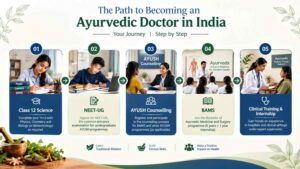
Class 12 with the required science background → NEET-UG → AYUSH counselling → BAMS admission → academic education → clinical training → compulsory internship → applicable registration requirements → professional career
The most important point is that BAMS is not equivalent to a short Ayurveda certificate, wellness course or general online degree.
BAMS stands for Bachelor of Ayurvedic Medicine and Surgery. It is a professional undergraduate programme combining Ayurvedic education with medical and clinical learning.
BAMS is structured as a five-year-six-month programme, including the internship component.
For the 2026–27 admission cycle, AACCC conducts counselling for eligible NEET-UG candidates seeking admission to undergraduate AYUSH programmes, including BAMS, for applicable All India Quota seats.
So, if your objective is specifically to become an Ayurvedic Doctor, the first question should not be:
“Which online degree should I choose?”
It should be:
“Am I eligible and prepared to pursue BAMS?”
Who Should Consider a Career in Ayurveda?
Ayurveda can be a meaningful career for students who are genuinely interested in healthcare, patient interaction and traditional Indian systems of medicine.
However, liking Ayurveda as a wellness concept is not necessarily the same as wanting to practise it professionally.
Before committing to BAMS, consider whether you are comfortable with:
- Studying science and medical subjects
- Learning anatomy and physiology
- Understanding disease and diagnosis
- Studying Ayurvedic principles and classical texts
- Participating in practical training
- Working with patients
- Spending substantial time in clinical environments
- Completing an internship
- Continuing professional education after graduation
- Building a career in healthcare rather than simply obtaining a degree
If your interest is mainly in herbs, nutrition, yoga, wellness or lifestyle content, understand that these interests can be very different from the responsibilities involved in professional medical education.
A BAMS student is preparing for a healthcare profession.
That requires commitment.
What Are the Eligibility Requirements for BAMS in 2026?
The exact admission requirements should always be checked against the current year’s official notification and the institution or counselling authority.
For undergraduate Ayurveda education, the academic foundation generally includes the required science subjects at the senior-secondary level.
The relevant regulatory framework requires candidates to have completed the prescribed 10+2 or equivalent qualification with the required science subjects, including Physics, Chemistry and Biology/Biotechnology, subject to the applicable rules for the admission year.
NEET-UG qualification is also a central part of the admission process.
A Simple BAMS Eligibility Overview
| Requirement | What Students Should Check |
| 10+2 education | Completion of the required senior-secondary qualification |
| Science subjects | Physics, Chemistry and Biology/Biotechnology as applicable |
| NEET-UG | Qualification in the relevant admission year |
| Counselling | Eligibility for the relevant AYUSH counselling process |
| College | Current recognition and admission status |
| Documents | Academic, identity and counselling documents |
| Internship | Completion of the prescribed compulsory internship |
Do not rely on an old eligibility article when applying in 2026.
Admission regulations can change, and the official counselling notification should always take priority.
Why Is NEET-UG Important for BAMS Admission?
One of the most common misconceptions is that NEET is only relevant if you want to study MBBS.
For Ayurveda, that assumption is incorrect.
NEET-UG is the common entrance examination applicable to undergraduate BAMS admissions under the National Commission for Indian System of Medicine framework.
AACCC conducts counselling for eligible candidates for applicable All India Quota seats.
This means your journey does not end after receiving a NEET score.
You still need to navigate the admission stage.
The admission sequence generally looks like this:
- Complete Class 12 with the required subjects.
- Appear for NEET-UG.
- Obtain the required qualification or rank according to the applicable rules.
- Register for the relevant counselling.
- Review available BAMS seats.
- Prepare and submit your choices.
- Participate in seat allotment.
- Complete college reporting and admission requirements.
- Begin the BAMS programme.
For 2026, students should use the official NEET and AACCC portals for the latest eligibility rules, counselling schedules and admission instructions.
How Long Does It Take to Become an Ayurvedic Doctor?
This is one of the most important practical questions students should ask before applying.
BAMS is a five-year-six-month programme, including the compulsory internship component.
That means becoming an Ayurvedic Doctor is a long-term professional education decision.
A simplified view is:
| Stage | Pathway |
| School education | 10+2 with required subjects |
| Entrance | NEET-UG |
| Admission | AYUSH counselling |
| Professional education | BAMS |
| Clinical preparation | Included within the programme |
| Internship | Compulsory internship |
| After graduation | Applicable registration and career pathway |
The precise structure of the professional phases is governed by the current NCISM curriculum and regulations.
The important takeaway for a student is simple:
BAMS is not a three-month, six-month or one-year route to becoming an Ayurvedic Doctor.
It requires several years of academic and clinical preparation.
What Do Students Study During BAMS?
A common misconception about Ayurveda education is that BAMS consists mainly of learning about herbs and traditional remedies.
The actual curriculum is considerably broader.
The BAMS programme includes Ayurvedic subjects alongside areas related to anatomy, physiology, pathology, pharmacology, medicine, surgery, obstetrics and gynaecology, paediatrics, preventive medicine and other medical learning.
Students can expect exposure to areas such as:
- Anatomy
- Physiology
- Ayurvedic fundamentals
- Ayurvedic pharmacology
- Medicinal preparations
- Diagnosis
- Pathology-related learning
- Preventive healthcare
- Internal medicine
- Surgery-related learning
- Paediatrics
- Obstetrics and gynaecology
- Panchakarma
- Research methodology
- Medical statistics
- Clinical training
This combination is important because an aspiring Ayurvedic Doctor needs both a strong understanding of Ayurveda and the clinical knowledge required by the professional programme.
Why Does College Selection Matter for BAMS?
Getting a BAMS seat is only one part of the decision.
Where you study can influence your academic environment and practical exposure.
Instead of choosing a college solely because it appears near the top of a search result, evaluate it using a practical approach.
1. Check Recognition
Confirm the current regulatory status of the institution and programme.
2. Examine Clinical Facilities
Ask where students receive patient exposure.
3. Look at Hospital Facilities
A professional medical programme should provide an environment where students can develop clinical understanding.
4. Ask About Internship
Do not treat internship as a formality.
Find out how it is structured and where students receive practical exposure.
5. Review Faculty
Faculty experience and academic qualifications matter when you are entering a professional healthcare programme.
6. Compare Total Costs
Look beyond tuition.
Consider accommodation, books, examination-related expenses, travel and other costs.
7. Consider Location
The location can affect living expenses, access to clinical facilities and overall student experience.
What Happens During the BAMS Internship?
The internship is one of the most important transitions between academic study and professional practice.
During the academic portion of BAMS, students build theoretical and practical knowledge.
During internship, the emphasis shifts further toward supervised clinical experience.
Depending on the applicable programme structure and institution, students may gain exposure to areas such as:
- Outpatient services
- Inpatient services
- Clinical departments
- Panchakarma
- Community healthcare
- Patient assessment
- Case documentation
- Treatment-related procedures
- Professional communication
This stage helps students understand what healthcare work looks like beyond textbooks.
It is also where students begin to recognise whether they genuinely enjoy patient-facing professional work.
That is why students considering BAMS should not choose the programme solely because they like the idea of Ayurveda.
They should also be comfortable with the reality of healthcare education.
What Can You Do After Becoming an Ayurvedic Doctor?
Completing BAMS can open several career directions.
Private clinical practice is only one possibility.
Depending on qualifications, registration, experience and the requirements of a particular position, graduates can explore areas such as:
Clinical Practice
Some graduates choose to work in Ayurveda clinics or develop their own professional practice after fulfilling the applicable requirements.
Hospitals
Ayurveda graduates may explore roles in healthcare institutions and hospitals offering Ayurvedic services.
Government Healthcare
Government and public-sector opportunities may be available through relevant recruitment processes and eligibility conditions.
Ayurveda and Pharmaceutical Companies
The Ayurveda industry also includes companies working with medicines, formulations, products and healthcare services.
Research
Students interested in evidence, clinical research and academic work can explore research-oriented pathways.
Teaching
Higher qualifications can create opportunities in academic environments.
Wellness and Lifestyle Sector
Some graduates move toward Ayurveda-based wellness, preventive health and lifestyle services, subject to the nature of the role and professional requirements.
Higher Education
BAMS can also become the foundation for further postgraduate study.
The best career route depends on whether your priority is clinical practice, research, academia, industry, public healthcare or another professional direction.
Is Postgraduate Study Useful After BAMS?
For students who want to specialise, postgraduate education can become the next step.
The exact programmes and admission requirements depend on the applicable regulations and institutions.
A postgraduate route can help a graduate develop deeper expertise in a chosen area rather than remaining at a broad undergraduate level.
This can be particularly relevant for students interested in:
- Clinical specialisation
- Academic careers
- Research
- Teaching
- Advanced Ayurveda practice
- Healthcare leadership
The important point is to think about postgraduate study as part of a longer career plan rather than something you decide about at the last minute.
What If You Realise Ayurveda Is Not the Right Career for You?
This is where career planning becomes important.
Suppose you start preparing for NEET because your family expects you to enter healthcare.
Then you discover that:
- You enjoy computers more than biology.
- You prefer business to clinical work.
- You are interested in finance.
- You want a corporate career.
- You want to study while working.
- You prefer technology and software.
- You do not want a patient-facing profession.
That does not mean your career is over.
It means your education strategy needs to change.
A professional degree should be chosen because it supports the career you want—not because it was the first course you considered.
This is where researching online degree courses in Bangalore can become useful for students looking for flexible alternatives.
How Can Online Education Fit Into a Different Career Plan?
Online education is not an alternative route to becoming an Ayurvedic Doctor.
BAMS has its own regulated academic and clinical pathway.
However, online education can be relevant when your intended career belongs to a field that can appropriately be studied through an online or distance-learning format.
For example, a student who decides against medicine may investigate:
- Computer applications
- Computer science
- Business management
- Commerce
- Arts
- Postgraduate management
- Science
- Other eligible academic programmes
SODC’s current course catalogue includes programmes such as BCA, B.Sc Computer Science, MCA, MBA, BBA, B.Com, BA, MA and M.Com, along with other academic pathways.
This makes SODC relevant to students whose career direction is different from clinical medicine.
What Should Students Look for in Online Degree Courses in Bangalore?
Searching for online degree courses in Bangalore can produce a huge number of results.
But the biggest mistake is comparing institutions only by advertisements.
Instead, compare the programme itself.
Check these eight factors:
| Factor | What to Investigate |
| Degree | Exact qualification awarded |
| University | Degree-awarding institution |
| Recognition | Applicable recognition for the programme/session |
| Eligibility | Whether your previous qualification is accepted |
| Curriculum | Subjects and practical/project components |
| Learning format | Online/ODL structure and schedule |
| Assessment | Examination and evaluation process |
| Support | Admission and academic assistance |
This approach helps separate genuine education decisions from marketing claims.
SODC offers flexible education options for students and working professionals, with programmes across management, IT, science, commerce, arts, teaching and other areas.
Is a BSc IT Correspondence Course Suitable for an IT Career?
Students searching for a bsc it correspondence course are usually looking for a flexible route into information technology.
This can be a sensible direction if your actual career interest lies in technology rather than healthcare.
However, students should compare the exact programme details before enrolling.
A useful comparison is:
| Factor | What to Compare |
| Degree title | B.Sc IT vs B.Sc Computer Science vs BCA |
| Programming | Languages and development concepts covered |
| Databases | Database fundamentals and practical exposure |
| Networking | Whether networking forms part of the curriculum |
| Projects | Academic or practical project requirements |
| University | Institution awarding the qualification |
| Study format | Correspondence, distance or online |
| Career target | Software, IT support, data, networking or another field |
SODC also lists BCA and B.Sc Computer Science among its technology-oriented undergraduate options.
So the right decision depends on your desired role—not merely the keyword you searched.
How to Match Your Career Goal With the Right Degree
The right qualification depends on the type of career you want to build. Instead of choosing a course simply because it is popular, start by identifying the direction you want to take.
Healthcare and Ayurveda: If your goal is to become an Ayurvedic Doctor, the appropriate professional pathway is BAMS followed by the required admission, clinical training and registration process.
Technology and IT: Students interested in software, programming, applications or information technology can compare BCA, B.Sc IT and B.Sc Computer Science based on their curriculum and career objectives.
Business and management: BBA can provide an undergraduate foundation for students interested in business, while MBA and other postgraduate management programmes may be appropriate for graduates looking to move into advanced management roles.
Commerce and finance: Students interested in accounting, finance, taxation and business-related areas can consider B.Com and related academic pathways.
Arts and humanities: BA programmes can suit students who want to develop an academic foundation in humanities, social sciences or related disciplines.
Science and postgraduate education: Graduates interested in advanced scientific study can explore suitable MSc programmes and relevant online MSc specializations, provided they meet the programme’s eligibility requirements.
Flexible education: Working professionals or students who need greater flexibility can explore appropriate online or distance-learning programmes that align with their academic background and career plans.
The goal is not to find the course with the most attractive advertisement. It is to find the qualification that creates a logical connection between what you want to learn, the career you want to pursue and the opportunities you want after graduation.
How Should You Choose Among Online Degree Courses in Karnataka?
For students researching online degree courses in Karnataka, the process should begin with the career outcome.
For example:
If You Want a Technology Career
Compare BCA, B.Sc IT and B.Sc Computer Science based on curriculum, eligibility and career relevance.
If You Want Management
Compare BBA at undergraduate level or MBA and other relevant postgraduate management options after meeting the required eligibility.
If You Want Commerce
B.Com can provide a foundation in accounting, finance, business and related subjects.
If You Want Humanities
BA programmes can provide broader study across humanities and social sciences.
If You Are Already a Graduate
Explore appropriate postgraduate options rather than starting another bachelor’s degree without a clear reason.
SODC’s course listings include BBA, MBA, BCA, MCA, B.Sc Computer Science, B.Com, BA, MA and M.Com among its programmes.
What Are Online Degree Colleges in Bangalore Offering in 2026?
Students researching online degree colleges in Bangalore will encounter institutions and education providers offering programmes in different formats.
The important distinction is between the education provider or counselling organisation and the university that actually awards the degree.
Before admission, ask:
Who is awarding my degree?
Then verify the university and the specific programme.
SODC’s current website presents programmes across areas including management, IT, science, commerce, arts, engineering, teaching and other fields.
Its education model is designed to support students who need greater flexibility in pursuing higher education.
That can be particularly useful for learners who are uncertain about:
- Course selection
- Eligibility
- University selection
- Documentation
- Admission procedure
- Learning format
Academic guidance can be valuable when several degree options appear similar but lead toward different career outcomes.
What About Online UG Degree Courses in India?
The search for online ug degree courses in India is broader than searching for a specific city.
At undergraduate level, students may encounter options such as:
| Degree | Broad Career Direction |
| BCA | Computer applications and IT |
| B.Sc Computer Science | Computing and software-related fields |
| B.Sc IT | Information technology |
| BBA | Business and management |
| B.Com | Commerce and finance |
| BA | Arts and social sciences |
| BFA | Fine arts and creative careers |
The important thing is not to choose based on the degree title alone.
Look at what you will actually study.

For example, two technology degrees can have different emphases even though both may lead into the IT sector.
The same applies to management, commerce and science programmes.
India’s National Education Policy 2020 also recognises online and Open Distance Learning as important routes for expanding access to higher education, while emphasising appropriate quality and accreditation standards.
Where Do Online MSc Specializations Fit Into the Career Journey?
The search term online msc specializations generally represents a postgraduate audience.
If you already have a bachelor’s degree and want advanced education in science or technology, an online MSc may be worth investigating where the programme is appropriately offered and you satisfy the eligibility requirements.
However, postgraduate specialisation should follow a logical academic progression.
For example:
Relevant bachelor’s degree → Appropriate MSc specialisation → Practical skills/projects → Career development
Do not choose a master’s specialisation simply because it appears popular.
Ask:
- Does it match my bachelor’s background?
- Does the curriculum match my career objective?
- Does the programme have the appropriate recognition?
- Is online study suitable for the subject?
- Does the university clearly state eligibility?
- Will the programme help me reach my intended role?
The same principle applies to every online qualification.
What Should You Check Before Enrolling in an Online Degree?
Choosing between different online degree courses in Bangalore or online degree courses in Karnataka requires more than comparing tuition fees. Before applying, look at the complete programme rather than judging it by its name.
Start With the Degree
Find out exactly what qualification you will receive after completing the programme. If you are comparing options such as BCA, B.Sc IT and B.Sc Computer Science, examine their curriculum and intended career outcomes rather than assuming they are identical.
Identify the University
Make sure you know which university awards the final degree. This is particularly important when an education provider or learning centre is involved in the admission process.
Verify Current Recognition
Check the applicable recognition and regulatory status for the specific programme and academic session. Do not rely solely on old brochures, advertisements or third-party claims.
Understand the Eligibility
Read the admission requirements carefully. Your Class 12 subjects, previous degree, minimum marks or other qualifications may affect whether you can apply for a particular programme.
Read the Curriculum
Look beyond the course title. Review the subjects, projects, practical components, electives and specialisations to determine whether the programme actually supports your career objective.
Understand How Learning Works
Find out how classes, study materials, assignments, examinations and academic communication are handled. A flexible programme still requires regular study and participation.
Consider Student Support
Good academic support can make a significant difference, particularly for students who are studying independently or balancing education with work.
Look Beyond Admission
Finally, think about what happens after graduation. Consider potential employment areas, higher-study options, skill requirements and whether the qualification fits the career you have in mind.
A strong education decision should answer three questions clearly:
What am I studying?
Who is awarding the qualification?
Where can this qualification take me?
Seven Mistakes Students Should Avoid When Choosing a Degree
Mistake 1: Choosing a Course Because Everyone Else Is Choosing It
A popular course can still be the wrong course for you.
Mistake 2: Confusing Interest With Profession
Liking Ayurveda does not automatically mean you want to become an Ayurvedic Doctor.
Likewise, using computers every day does not automatically mean a BCA or B.Sc IT is the right qualification.
Mistake 3: Ignoring the Admission Route
For BAMS, NEET-UG and the applicable counselling process are fundamental parts of admission.
Mistake 4: Looking Only at Fees
A cheaper course is not automatically better.
Compare curriculum, recognition, support and the qualification awarded.
Mistake 5: Ignoring the University
Always identify the institution awarding the degree.
Mistake 6: Selecting a Specialisation Too Early
First understand the career field.
Then choose the specialisation.
Mistake 7: Treating an Online Degree as Effortless
Flexible education still requires discipline, examinations, assignments, projects and consistent learning.
Before You Choose Your Course: 6 Questions to Ask
Choosing a professional or online degree should be based on more than fees, advertisements or course popularity. Before submitting an application, take a few minutes to answer these six questions.
1. What Career Do I Actually Want?
Start with the destination, not the degree.
If your goal is to become an Ayurvedic Doctor, BAMS and the required admission pathway should be your focus.
If you are more interested in software, business, commerce or another field, explore qualifications that directly support that career.
2. Does the Course Match My Academic Background?
Check the eligibility requirements before applying.
Some programmes have specific subject or qualification requirements, while postgraduate programmes may require a relevant bachelor’s degree.
This is particularly important when comparing courses that appear similar, such as BCA, B.Sc IT and B.Sc Computer Science.
3. Who Awards the Final Degree?
This is one of the most important questions when comparing online degree courses in Bangalore or online degree courses in Karnataka.
Find out the name of the university awarding the qualification and verify the programme’s applicable recognition and eligibility for the academic session in which you are enrolling.
4. What Will I Actually Learn?
Do not choose a programme based only on its title.
Look through the curriculum and ask whether the subjects, projects, practical components and specialisations are relevant to the career you want.
For example, a student comparing a bsc it correspondence course with BCA should look beyond the names and compare programming, databases, networking, software development and other curriculum components.
5. Does the Study Format Fit My Lifestyle?
Online and distance education can provide greater flexibility, but flexibility does not mean there is no academic commitment.
Consider whether you can manage:
- Classes or recorded learning
- Assignments
- Projects
- Examinations
- Self-study
- Deadlines
This is especially important for working professionals and students managing education alongside other responsibilities.
6. Where Can This Qualification Take Me?
Before enrolling, think beyond graduation.
Research the types of roles, higher-education opportunities and professional pathways associated with the qualification.
A good course decision should connect three things:
Your interests → Your qualification → Your intended career
When those three align, choosing a degree becomes much easier—and you are less likely to change direction simply because another course looks more attractive later.
Frequently Asked Questions
1. How Can I Become an Ayurvedic Doctor in 2026?
The standard pathway is to complete the required Class 12 education, qualify NEET-UG, participate in the relevant AYUSH counselling process, secure admission to BAMS, complete the prescribed academic programme and compulsory internship, and fulfil the applicable professional registration requirements.
2. Is NEET Compulsory for BAMS?
NEET-UG is the common entrance examination applicable to undergraduate BAMS admissions under the National Commission for Indian System of Medicine framework. AACCC conducts counselling for eligible candidates for applicable All India Quota seats.
3. How Many Years Is BAMS?
BAMS is structured as a five-year-six-month programme, including the compulsory internship component.
4. Can I Become an Ayurvedic Doctor Through an Online Degree?
A general online degree should not be presented as a replacement for BAMS.
Becoming an Ayurvedic Doctor requires the prescribed professional education, clinical training, internship and applicable registration pathway.
Students should verify the current regulatory requirements before enrolling.
5. What Can I Study If I Decide Not to Pursue BAMS?
Your alternatives depend on your career objective.
Students interested in technology can investigate BCA, B.Sc IT or B.Sc Computer Science. Students interested in business can explore BBA, while commerce students may consider B.Com.
6. Is a BSc IT Correspondence Course Useful for an IT Career?
It can be relevant for students seeking an IT-focused undergraduate qualification, but the exact curriculum, university, recognition and study format should be checked before admission.
7. What Should I Check Before Choosing Online Degree Colleges in Bangalore?
Check the exact degree, awarding university, applicable recognition, eligibility, curriculum, learning format, examination process, student support and total cost.
Avoid choosing solely on advertisements or rankings.
8. Can Working Professionals Study Through Online Education?
Yes, where the chosen programme is appropriately offered in an online or distance format and the learner meets its eligibility requirements.
Flexible programmes can allow working professionals to continue their education while managing employment responsibilities.
Final Thoughts: Choose the Career First, Then the Degree
The biggest mistake students make when planning higher education is starting with the course name instead of the career destination.
If you want to become an Ayurvedic Doctor, understand the professional pathway clearly: the required school education, NEET-UG, AYUSH counselling, BAMS, clinical education, internship and applicable registration requirements.
If, however, you discover that clinical medicine is not the career you want, changing direction early is a strength—not a failure.
A student interested in technology can investigate a bsc it correspondence course, BCA or B.Sc Computer Science.
Someone interested in business can compare BBA and management pathways.
A commerce student can explore B.Com.
Graduates can investigate suitable postgraduate programmes and online msc specializations where eligible.
For learners specifically comparing online degree courses in Bangalore, online degree courses in Karnataka, online degree colleges in Bangalore, or online ug degree courses in India, SODC provides a broader range of academic options across IT, management, commerce, science, arts, teaching and other fields.
The important part is to verify the exact programme and awarding university before making an admission decision.
A degree is a significant investment of time and money.
The right question is therefore not:
“Which course is trending in 2026?”
It is:
“Which recognised qualification is the strongest fit for the career I actually want to build?”
For an aspiring Ayurvedic Doctor, that means understanding BAMS properly before applying.
For students choosing another direction, it means comparing the right degree, learning format and university before enrolling.
That approach creates a much stronger foundation for the next stage of your career.