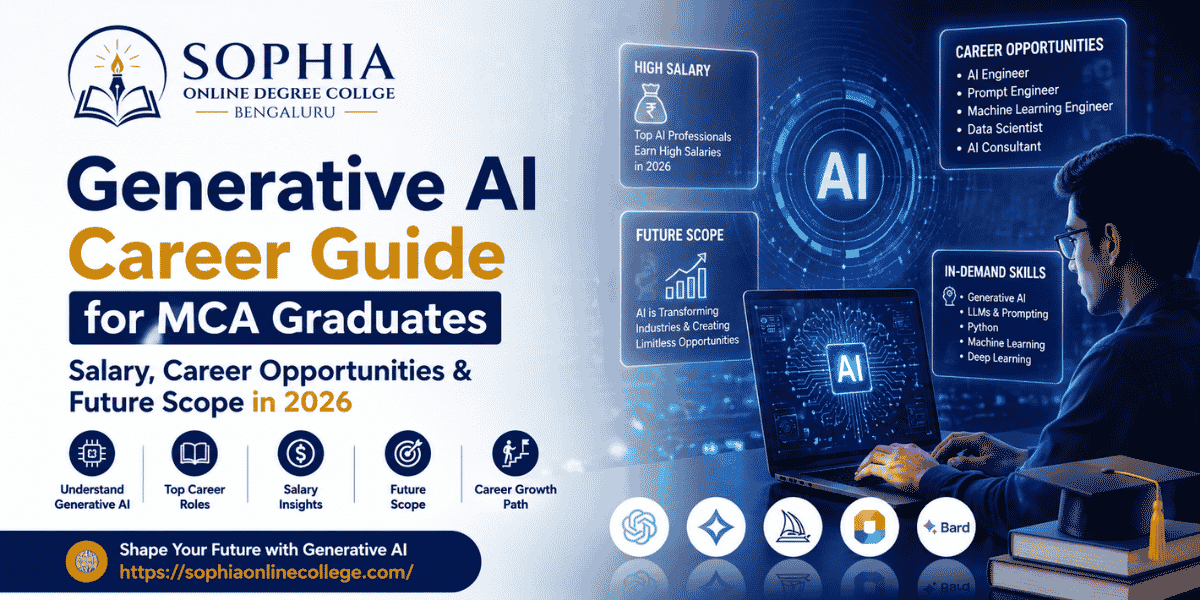
Artificial Intelligence has moved beyond being just a buzzword—it is now transforming industries, businesses, and everyday life. Among its most exciting branches is Generative AI, a technology capable of creating text, images, videos, code, and much more with incredible accuracy. As organizations rapidly adopt AI-powered solutions, the demand for skilled professionals continues to rise. This Generative AI Career Guide for MCA explores why MCA graduates are uniquely positioned to succeed in this fast-growing field. Whether your goal is to become an AI Engineer, Prompt Engineer, or Machine Learning Specialist, this Generative AI Career Guide for MCA will help you understand the required skills, certifications, salary expectations, and future opportunities in 2026.
What is Generative AI?
Generative AI is a branch of Artificial Intelligence that enables computers to generate original content, including text, software code, images, music, and videos. Unlike traditional AI systems that primarily analyze existing information, Generative AI learns from massive datasets to produce new and meaningful outputs.
Popular AI tools such as ChatGPT, Google Gemini, Claude, Midjourney, and GitHub Copilot are examples of Generative AI applications that businesses now use daily. From customer support and content creation to software development and healthcare diagnostics, Generative AI is reshaping how organizations operate.
For students looking to build future-ready careers, understanding this technology is no longer optional—it has become a valuable professional skill.
Why MCA Graduates Have an Advantage in Generative AI?
One of the biggest advantages MCA graduates possess is their technical foundation. Throughout their academic journey, students develop expertise in programming, software engineering, algorithms, operating systems, database management, and application development. These subjects provide an excellent base for learning Artificial Intelligence and Machine Learning.
Unlike beginners entering technology, MCA graduates already understand logical thinking, coding practices, debugging techniques, and software architecture. This allows them to transition into AI-related roles much faster.
Students pursuing IT distance education also develop many of these technical foundations, making Generative AI an achievable career path through continuous learning and practical experience.
As businesses increasingly integrate AI into products and services, professionals with both software development and AI expertise are becoming highly valuable.
Why Generative AI is One of the Hottest Careers in 2026?
Every major technology company is investing billions of dollars in Generative AI. Organizations want professionals who can build AI-powered applications, automate workflows, and improve customer experiences.
Some reasons why demand continues to grow include:
- Rapid AI adoption across industries
- Growth of intelligent automation
- Expansion of AI-powered software development
- Increasing demand for personalized digital experiences
- Enterprise investment in AI productivity tools
- Global shortage of skilled AI professionals
This makes Generative AI Career Guide for MCA especially relevant for graduates planning long-term careers.
Traditional Software Careers vs Generative AI Careers
| Traditional Software Role | Generative AI Career |
| Software Developer | Generative AI Engineer |
| Backend Developer | Large Language Model Engineer |
| QA Engineer | AI Testing Specialist |
| Database Administrator | AI Data Engineer |
| System Analyst | AI Solutions Architect |
| Web Developer | AI Application Developer |
As technology evolves, many traditional software roles are expanding into AI-powered positions, creating exciting career progression opportunities.
Top Career Opportunities in Generative AI
1. Generative AI Engineer
Generative AI Engineers build intelligent systems capable of generating text, code, images, and other digital content. They develop AI applications using frameworks like TensorFlow, PyTorch, and LangChain.
2. Prompt Engineer
Prompt Engineers design optimized instructions that improve the performance of AI models such as ChatGPT and Gemini. This role has gained tremendous popularity over the last two years.
3. Machine Learning Engineer
Machine Learning Engineers develop predictive models that allow systems to learn from data and improve automatically.
4. AI Application Developer
These professionals integrate AI models into business software, websites, mobile applications, and enterprise platforms.
5. AI Product Manager
AI Product Managers bridge the gap between technical teams and business stakeholders by managing AI-powered products throughout their lifecycle.
6. AI Research Associate
Research professionals focus on improving algorithms, testing new AI models, and contributing to innovation.
7. LLM Engineer
Large Language Model Engineers specialize in training, fine-tuning, and deploying advanced AI language models.
These roles demonstrate the vast opportunities highlighted throughout this Generative AI Career Guide for MCA.
Skills Required for Generative AI Careers
Technical knowledge remains the most important requirement for AI professionals.
Essential skills include:
Programming
- Python
- SQL
- Java
- JavaScript
Artificial Intelligence
- Machine Learning
- Deep Learning
- Neural Networks
- Natural Language Processing
AI Frameworks
- TensorFlow
- PyTorch
- Hugging Face
- LangChain
Cloud Platforms
- AWS
- Microsoft Azure
- Google Cloud
Databases
- MySQL
- PostgreSQL
- Vector Databases
Version Control
- Git
- GitHub
In addition to technical knowledge, employers highly value communication, analytical thinking, creativity, and teamwork.
Best Certifications for MCA Graduates
Professional certifications help validate technical expertise and improve employability.
Popular certifications include:
- Google AI Essentials
- IBM AI Engineering Professional Certificate
- Microsoft AI Fundamentals (AI-900)
- AWS Machine Learning Specialty
- TensorFlow Developer Certificate
- NVIDIA Deep Learning Institute Certifications
Students planning advanced education through an M.Tech correspondence college in Karnataka often combine academic learning with these certifications to strengthen their professional profiles.
Industries Hiring Generative AI Professionals
The demand for AI talent extends far beyond technology companies.
Industries actively recruiting include:
- Information Technology
- Banking & Finance
- Healthcare
- Manufacturing
- E-commerce
- Retail
- Education
- Consulting
- Telecommunications
- Media & Entertainment
Students pursuing distance education in bangalore increasingly explore AI careers because opportunities now exist across almost every industry.
Salary Expectations in Generative AI Careers
| Job Role | Average Salary (India) |
| Prompt Engineer | ₹6–10 LPA |
| AI Engineer | ₹8–15 LPA |
| Machine Learning Engineer | ₹12–22 LPA |
| LLM Engineer | ₹18–35 LPA |
| AI Consultant | ₹20–40 LPA |
| AI Solutions Architect | ₹30–60+ LPA |
Salary depends on certifications, practical experience, technical expertise, company size, and location.
Step-by-Step Roadmap for MCA Graduates
Follow these steps to successfully enter Generative AI:
Step 1
Master Python programming.
Step 2
Understand Data Structures and Algorithms.
Step 3
Learn Machine Learning fundamentals.
Step 4
Study Deep Learning concepts.
Step 5
Understand Large Language Models.
Step 6
Learn Prompt Engineering.
Step 7
Build real-world AI projects.
Step 8
Create an impressive GitHub portfolio.
Step 9
Earn industry-recognized certifications.
Step 10
Apply for internships and AI developer positions.
Students from a Correspondence college in india, bca distance education in bangalore, or a distance Msc degree college in bangalore can also follow this roadmap to develop practical AI expertise alongside their academic qualifications.
Future Scope of Generative AI in 2026 and Beyond
The future of Artificial Intelligence is being shaped by Generative AI, making it one of the most exciting career domains for technology professionals. Organizations worldwide are integrating AI into customer service, software development, healthcare, finance, education, manufacturing, and creative industries. As AI adoption accelerates, the demand highlighted in this Generative AI Career Guide for MCA is expected to grow significantly over the coming years.
Experts predict that Generative AI will become a core technology in nearly every business function. Companies are looking for professionals who can build intelligent applications, automate repetitive processes, improve customer engagement, and develop AI-powered business solutions. This means MCA graduates with AI expertise will enjoy better career opportunities, global exposure, and attractive salary packages.
Some emerging areas expected to create new job opportunities include:
- AI-powered software development
- Autonomous AI agents
- Healthcare diagnostics using AI
- AI-assisted cybersecurity
- Personalized education platforms
- AI-powered business intelligence
- Robotics integrated with Generative AI
- Smart manufacturing solutions
- Financial automation
- AI-driven cloud computing
As digital transformation continues worldwide, Generative AI Career Guide for MCA becomes increasingly relevant for graduates preparing for long-term success.
Common Mistakes MCA Graduates Should Avoid
Many students enter the AI field with enthusiasm but often make mistakes that slow their career growth. Avoiding these common pitfalls can significantly improve employability.
Learning Only Theory
Reading about AI concepts is useful, but practical implementation matters much more. Employers expect candidates to demonstrate real-world experience through projects.
Ignoring GitHub Portfolio
Your GitHub profile often serves as your technical resume. Uploading AI projects, code samples, and documentation showcases your abilities.
Skipping Mathematics
Machine Learning relies on statistics, probability, and linear algebra. A basic understanding strengthens problem-solving abilities.
Avoiding Cloud Platforms
Modern AI applications frequently run on cloud environments such as AWS, Azure, and Google Cloud. Learning cloud computing increases job opportunities.
Not Practicing Prompt Engineering
Prompt Engineering has become an important skill in today’s AI landscape. Understanding how to communicate effectively with Large Language Models improves productivity.
Depending Only on Certifications
Certifications enhance your resume but cannot replace practical skills. Employers prefer candidates who have built real AI applications.
Following the guidance provided in this Generative AI Career Guide for MCA helps students avoid these mistakes while building stronger professional profiles.
How Distance Education Students Can Build AI Careers?
One of the biggest misconceptions is that only full-time students can enter Artificial Intelligence. In reality, employers increasingly evaluate candidates based on technical skills, certifications, projects, and practical knowledge rather than the mode of education.
Students pursuing IT distance education can successfully prepare for AI careers by combining their academic studies with self-learning, online certifications, coding practice, and project development.
Likewise, learners enrolled in distance education in bangalore have access to flexible educational opportunities that allow them to balance studies, employment, and skill development simultaneously.
Graduates from a recognized Correspondence college in india can also compete for AI positions by continuously upgrading their programming and machine learning expertise. Many professionals even transition into AI after completing bca distance education in bangalore, demonstrating that dedication and practical learning are key factors for success.
Students interested in advanced technical specialization may also consider programs offered through an M.Tech correspondence college in Karnataka or a distance Msc degree college in bangalore to deepen their knowledge in Artificial Intelligence, Machine Learning, and Data Science.
Why Choose Sophia Online College?
Choosing the right educational guidance is one of the most important decisions for students planning careers in Artificial Intelligence. Sophia Online College helps learners identify flexible educational pathways that align with current industry requirements and long-term career goals.
Whether you are planning to pursue higher education, upgrade your technical skills, or explore career-oriented programs, Sophia Online College provides guidance throughout the admission process, course selection, and educational planning. Students can receive support in choosing programs that match their professional aspirations while maintaining flexibility for work and personal commitments.
With increasing demand for AI professionals, selecting the right educational route has become more important than ever. Sophia Online College focuses on helping learners make informed decisions that strengthen employability and prepare them for future technology careers.
Why Generative AI Is the Right Career Choice for MCA Graduates?
- High salary packages across industries
- Strong global demand for AI professionals
- Remote and international job opportunities
- Growing AI startup ecosystem
- Continuous learning and career advancement
- Long-term career stability and future-proof skills
Conclusion
Artificial Intelligence is no longer a futuristic concept—it is transforming industries today. This Generative AI Career Guide for MCA highlights how MCA graduates can leverage their programming knowledge, software development skills, and analytical thinking to build successful careers in one of the fastest-growing technology domains. From AI Engineering and Machine Learning to Prompt Engineering and AI Product Management, career opportunities continue to expand rapidly across healthcare, finance, education, manufacturing, and cloud computing.
Whether you are pursuing IT distance education, studying through distance education in bangalore, completing bca distance education in bangalore, or planning advanced qualifications from an M.Tech correspondence college in Karnataka or a distance Msc degree college in bangalore, continuous learning, practical projects, and professional certifications will help you remain competitive. As organizations invest more heavily in Artificial Intelligence, the opportunities presented in this Generative AI Career Guide for MCA will continue to grow, offering excellent salaries, global career prospects, and long-term professional stability.
As businesses continue investing in Artificial Intelligence, professionals with Generative AI expertise will enjoy excellent career growth, global opportunities, attractive salaries, and long-term job security. Starting today with the right skills, certifications, and practical projects can position MCA graduates for success in one of the world’s fastest-growing technology fields.
Ready to Build Your Career in Generative AI?
Artificial Intelligence is creating exciting opportunities for skilled professionals, and now is the perfect time to prepare for the future. If you’re planning to pursue an MCA, upgrade your qualifications, or explore flexible higher education options, Sophia Online College can help you make the right academic choice.
Our expert educational guidance helps students select recognized programs that align with today’s industry demands and tomorrow’s career opportunities.
Contact Sophia Online College today and take your first step toward a successful career in Generative AI.
FAQs
1. Can MCA graduates become Generative AI Engineers?
Yes, MCA graduates are well-positioned to become successful Generative AI Engineers because their academic background provides a solid understanding of programming, software engineering, database management, and application development. These core skills make it easier to learn advanced technologies such as Machine Learning, Deep Learning, Prompt Engineering, and Large Language Models (LLMs). By mastering tools like Python, TensorFlow, PyTorch, and Hugging Face, MCA graduates can qualify for high-demand AI roles. Students pursuing IT distance education can further strengthen their expertise through certifications, real-world AI projects, and GitHub portfolios, making them highly competitive in the rapidly growing Artificial Intelligence industry.
2. Is Generative AI a good career in 2026?
Yes, Generative AI is expected to be one of the most promising and high-paying career fields in 2026. Businesses across healthcare, banking, retail, manufacturing, education, and IT are increasingly adopting AI-powered solutions to automate processes and improve decision-making. This growing adoption has created strong demand for professionals with expertise in AI development and intelligent automation. Students enrolled in distance education in bangalore can prepare for these opportunities by developing technical skills, completing industry-recognized certifications, and gaining practical experience through AI projects. With continuous innovation and global demand, Generative AI offers excellent career stability, competitive salaries, and long-term professional growth.
3. Which programming language is best for Generative AI?
Python is widely recognized as the best programming language for Generative AI because of its easy syntax, extensive libraries, and strong support from the global developer community. Popular AI frameworks such as TensorFlow, PyTorch, Hugging Face, and LangChain are built around Python, making it the preferred choice for developing AI models and applications. While knowledge of SQL, JavaScript, and C++ can also be beneficial, Python remains the foundation for most AI projects. Students studying through a Correspondence college in india can improve their career prospects by mastering Python alongside machine learning, deep learning, and natural language processing concepts to build practical AI solutions.
4. What is the average salary of a Generative AI Engineer in India?
Generative AI Engineers are among the highest-paid professionals in India’s technology sector due to increasing demand for AI expertise. Freshers typically earn between ₹8–15 LPA, while professionals with experience in Large Language Models, Machine Learning, and AI deployment can earn ₹20–40 LPA or even higher in leading organizations. Salary growth depends on technical expertise, certifications, project experience, and industry specialization. Students pursuing bca distance education in bangalore or MCA programs can significantly improve their earning potential by developing hands-on AI skills, earning globally recognized certifications, and building a strong portfolio of practical Artificial Intelligence projects.
5. Which certifications are best for Generative AI?
Professional certifications help aspiring AI professionals validate their technical expertise and improve employability in a competitive job market. Some of the most valuable certifications include Google AI Essentials, IBM AI Engineering Professional Certificate, Microsoft AI Fundamentals (AI-900), AWS Machine Learning Specialty, TensorFlow Developer Certification, and NVIDIA Deep Learning Institute certifications. These programs provide practical exposure to machine learning models, cloud-based AI platforms, and real-world applications. Students pursuing higher education through an M.Tech correspondence college in Karnataka can combine academic learning with these certifications to strengthen their technical capabilities and prepare for advanced roles in Generative AI and Machine Learning.
6. Can distance education students build AI careers?
Absolutely. Distance education students can successfully build careers in Artificial Intelligence by combining academic learning with technical certifications, coding practice, and real-world projects. Modern employers increasingly prioritize practical skills, GitHub portfolios, problem-solving abilities, and hands-on experience over the mode of education. Learners pursuing programs through a distance Msc degree college in bangalore can use flexible learning schedules to gain expertise in Python, Machine Learning, Deep Learning, and cloud technologies while continuing their education or professional commitments. With consistent learning and practical exposure, distance education students can secure rewarding opportunities in the growing AI industry.
7. Is coding mandatory for Generative AI jobs?
Yes, coding is an essential skill for most Generative AI careers because professionals are responsible for developing AI applications, training machine learning models, automating workflows, and integrating intelligent systems into software solutions. Python is the most widely used programming language, while knowledge of SQL, JavaScript, APIs, and cloud computing platforms further enhances career opportunities. Students pursuing IT distance education can gradually build their programming skills through project-based learning, coding challenges, and AI-focused certifications. Strong coding abilities not only improve employability but also enable professionals to solve complex business problems using Artificial Intelligence technologies.
8. What industries hire Generative AI professionals?
Generative AI professionals are in demand across numerous industries as organizations increasingly adopt intelligent technologies to improve efficiency and innovation. Technology companies develop AI-powered software, healthcare organizations use AI for diagnostics, financial institutions implement AI for fraud detection, and retailers enhance customer experiences through personalized recommendations. Manufacturing, education, consulting, telecommunications, media, and e-commerce sectors also continue expanding their investment in AI solutions. Students pursuing distance education in bangalore can prepare for these diverse career opportunities by building technical expertise, earning industry-recognized certifications, and developing practical AI projects. This combination significantly improves employability in one of the world’s fastest-growing technology domains.