
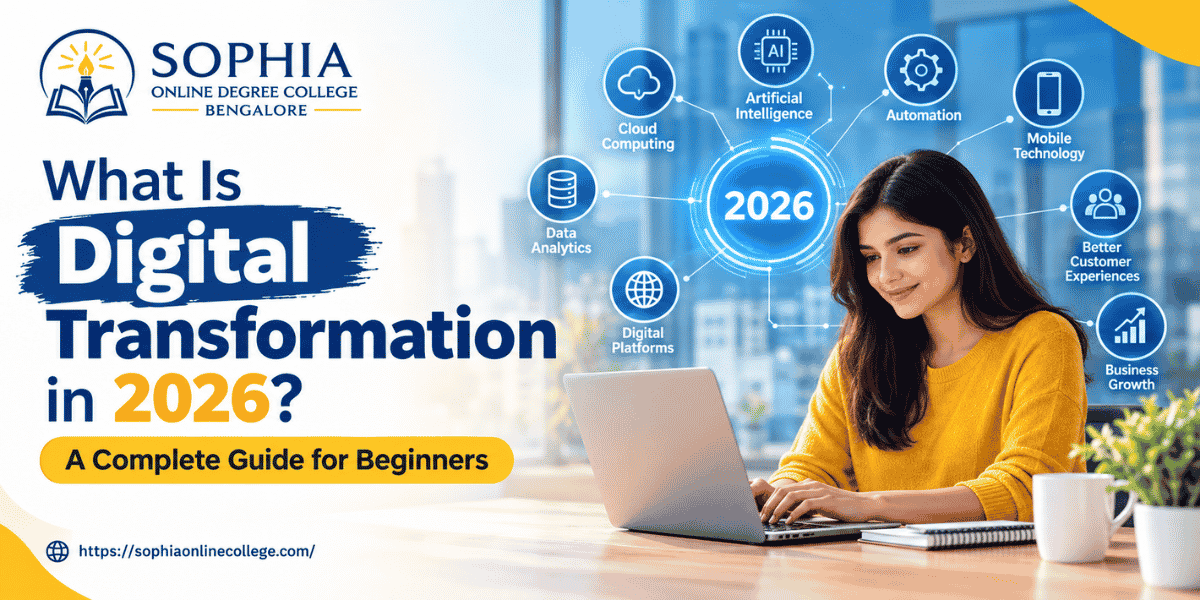
What Is Digital Transformation is a question many students, professionals, and business owners are asking as technology becomes part of everyday work. From AI-powered customer service to cloud-based systems and automated business processes, companies are changing how they operate. What Is Digital Transformation, in simple terms, is the use of digital technology to rethink how an organisation works, serves customers, uses information, and creates value. It is not simply about buying new software or putting old documents online. Current explanations from Google Cloud and other technology sources describe it as a broader change involving processes, customer experiences, operations, culture, and technology.
For beginners, What Is Digital Transformation becomes easier to understand when you imagine a traditional business moving from manual records and disconnected systems to connected digital workflows. The goal is not technology for its own sake. The goal is to solve real problems, improve experiences, make better decisions, and help people work more effectively.
As this change continues in 2026, understanding What Is Digital Transformation can also help students identify useful academic paths and skills for a technology-driven workplace. This guide explains the concept without unnecessary technical language and connects it with practical learning and career options.
What Is Digital Transformation? A Simple Explanation
What Is Digital Transformation can be explained as a business-wide shift in which digital technologies are used to improve or redesign the way work is done. It may affect customer service, marketing, finance, human resources, operations, communication, and decision-making.
A useful way to remember What Is Digital Transformation is this: digitisation changes information, while digital transformation can change the way the business operates. For example, scanning paper invoices is digitisation. Automatically matching invoices with purchase orders, sending them for digital approval, updating accounts, and creating reports is a broader transformation of the workflow.
This distinction matters because What Is Digital Transformation is not just an IT question. People and processes are equally important. A business can purchase advanced tools and still see little improvement if employees are not trained or if old processes remain unchanged. Industry guidance similarly emphasises that transformation combines technology with organisational and process change.
What Is Digital Transformation in Everyday Business?
What Is Digital Transformation becomes much clearer with an ordinary example. Imagine a small retail company that receives customer orders through phone calls, records them in spreadsheets, checks stock manually, and sends updates one by one.
After adopting a connected digital approach, the company could allow customers to order online, update inventory automatically, send order notifications, analyse purchasing patterns, and use a CRM system to manage customer interactions. The technology is important, but the bigger change is the redesigned customer and employee journey.
This is why What Is Digital Transformation is closely connected with digital transformation in business. The transformation can touch several departments at the same time rather than remaining inside the IT team.
Why Is Digital Transformation Important in 2026?
What Is Digital Transformation matters in 2026 because businesses are working in an environment where customers expect convenient digital experiences, employees use collaborative platforms, and organisations have access to increasingly capable AI and analytics tools.
Some important drivers include:
- Faster customer expectations
- Artificial intelligence and generative AI
- Cloud-based working environments
- Data-driven decision-making
- Business process automation
- Digital payments and online services
- Stronger demand for cybersecurity
- Competition from digitally enabled businesses
What Is Digital Transformation is therefore becoming less about simply adopting a trend and more about choosing technology that solves a specific business need.
Key Technologies Behind What Is Digital Transformation
Understanding What Is Digital Transformation also means knowing which technologies commonly support it. No single technology creates transformation. The right combination depends on the organisation, its customers, its processes, and its goals.
Artificial Intelligence and Machine Learning
AI can help businesses automate tasks, analyse information, support customer service, identify patterns, and assist decision-making. Generative AI can also support content creation, communication, knowledge retrieval, and productivity.
Cloud Computing
Cloud platforms allow organisations to access computing resources, applications, and data without depending entirely on traditional on-site infrastructure. Cloud technology is widely associated with flexibility, collaboration, and scalable digital operations.
Data Analytics
Businesses collect information from customers, transactions, websites, applications, and internal operations. Analytics helps turn that information into useful insights that can support planning and decision-making.
Automation and RPA
Automation can handle repetitive activities such as data entry, notifications, invoice processing, and routine workflow steps. Robotic process automation is one approach businesses may use for rule-based tasks.
Internet of Things
IoT connects physical devices and sensors so that organisations can collect and use real-time information. Manufacturing, logistics, healthcare, and smart-building applications can benefit from connected devices.
Cybersecurity
As more operations become digital, protecting systems, accounts, applications, and data becomes an essential part of transformation. Cybersecurity should be considered from the planning stage rather than added only after a problem occurs.
What Is Digital Transformation vs Digitisation and Digitalisation?
What Is Digital Transformation is often confused with two related terms: digitisation and digitalisation.
| Concept | Simple Meaning | Example |
| Digitisation | Converting physical information into digital form | Scanning paper files |
| Digitalisation | Using digital tools to improve an existing process | Using online forms |
| Digital Transformation | Redesigning how the organisation works using digital capabilities | Connecting forms, CRM, analytics, automation, and customer service |
This comparison shows why What Is Digital Transformation is a broader concept. A company may digitise thousands of documents without changing how decisions are made or how customers are served.
What Is Digital Transformation Strategy?
A digital transformation strategy gives an organisation a direction instead of encouraging it to collect random technologies. What is a Digital Transformation strategy should begin with business goals and customer needs.
A practical strategy can follow these steps:
- Identify the problem.
- Understand the current process.
- Set a measurable goal.
- Choose suitable technology.
- Prepare employees for the change.
- Test the solution.
- Measure the results.
- Improve the process continuously.
For example, if customer complaints take three days to resolve, a company should not begin by asking which fashionable technology it can buy. It should first understand why the delay happens and then choose tools that address the actual bottleneck.
Benefits of What Is Digital Transformation
When people ask What Is Digital Transformation, they often want to know what businesses gain from it. The benefits depend on the project, but common outcomes can include:
- Faster workflows
- Better customer experiences
- Reduced manual work
- Improved access to information
- More consistent processes
- Better collaboration
- Data-supported decisions
- Easier scaling
- Opportunities for new digital products and services
Google Cloud notes that transformation can support modernised infrastructure, data management, collaboration, business problem-solving, and cost savings. These benefits are not automatic, however. They depend on suitable implementation and measurable goals.
What Is Digital Transformation for Small Businesses?
What Is Digital Transformation does not only apply to large corporations. Small businesses can begin with one practical improvement instead of attempting to change everything at once.
A local service business might start by introducing online appointment booking. A retailer could connect its inventory system with online sales. A consultancy might move client documents to a secure cloud platform and introduce a CRM. A small accounting firm could automate recurring reminders and reporting.
The important lesson is that What Is Digital Transformation can be gradual. A small business can identify one time-consuming problem, test a solution, measure the outcome, and then decide what should happen next.
Common Challenges in What Is Digital Transformation
What Is Digital Transformation can sound straightforward until an organisation begins implementation. Several challenges can appear during the process.
Resistance to Change
Employees may be comfortable with familiar systems. Clear communication, training, and involvement can make new processes easier to adopt.
Legacy Systems
Older software may not connect easily with modern applications. Businesses may need a phased migration or integration plan.
Skills Gaps
Technology changes quickly, so employees may need opportunities to develop digital and analytical skills.
Data Security
Moving more information into digital systems increases the importance of access controls, security practices, privacy, and monitoring.
Poor Planning
Buying technology without defining the problem can result in unnecessary spending and limited business value.
Lack of Measurement
If an organisation does not define success, it becomes difficult to know whether a transformation project is actually helping.
What Is Digital Transformation in Different Industries?
What Is Digital Transformation can look completely different depending on the industry.
Education: Institutions can use learning platforms, digital assessments, student portals, analytics, and virtual collaboration tools.
Banking: Digital banking, mobile applications, automated services, analytics, and fraud-monitoring systems can reshape customer interactions.
Healthcare: Digital records, telehealth, connected devices, and data systems can support more connected services.
Retail: E-commerce, recommendation systems, digital payments, customer analytics, and inventory systems can change the shopping journey.
Manufacturing: Sensors, connected machinery, predictive maintenance, automation, and analytics can support smarter production environments.
Career Skills Related to What Is Digital Transformation
Learning What Is Digital Transformation can be useful for students because transformation projects require more than coding. Businesses need people who understand technology and can connect it with business goals.
Useful skills include:
- Digital literacy
- Data analysis
- Business analysis
- Project management
- AI awareness
- Cloud fundamentals
- Cybersecurity awareness
- Communication
- Problem-solving
- Change management
Students interested in these areas can explore affordable online degrees, online UG degree courses in India, and online degree colleges in Bangalore while comparing curriculum, recognition, learning format, eligibility, and career relevance.
Online Learning and Digital Transformation Skills
The growth of digital transformation has also influenced the way people learn. Students can now consider flexible academic options alongside skill-based learning.
For learners from commerce backgrounds, online courses for commerce students can provide a starting point for areas such as business analytics, management, finance, marketing, and digital business. Students looking for shorter learning routes may also compare online diploma courses in Bangalore with longer degree programmes.
For learners planning undergraduate study, online degree courses in Karnataka can be another option to research, depending on eligibility and the institution’s applicable recognition. When comparing programmes, students should check the current status and recognition of the specific institution and programme rather than relying only on advertising claims.
Students can also explore online degree courses and related programmes through Sophia Online College when looking for flexible higher-education options. The right choice depends on the learner’s academic background, career goal, budget, schedule, and preferred subject.
Current 2026 education searches also show strong interest in online undergraduate programmes across commerce, business, IT, data science, and related areas.
How to Choose a Digital-Focused Course?
What Is Digital Transformation knowledge becomes more useful when paired with a suitable academic foundation. Before selecting a course, ask:
- Does the curriculum match my career interest?
- Is the institution and programme appropriately recognised?
- What is the eligibility requirement?
- What subjects and practical projects are included?
- Is the learning schedule suitable for me?
- What assessment method is used?
- Are there opportunities to build practical digital skills?
- What are the total fees and other academic costs?
A good course should fit your long-term learning goal rather than being chosen only because a technology name appears in the title.
What Is Digital Transformation Likely to Look Like Beyond 2026?
What Is Digital Transformation will continue to evolve as businesses adopt AI, automation, connected systems, analytics, and cloud technologies. The exact tools will change, but the underlying objective is likely to remain: using digital capabilities to improve how organisations operate and deliver value.
Future transformation projects are likely to place greater attention on responsible AI use, cybersecurity, data quality, employee skills, and integration between systems. This means future professionals may benefit from combining subject knowledge with digital confidence instead of treating technology as a separate skill.
What Is Digital Transformation: A Beginner’s Checklist?
If you are still wondering What Is Digital Transformation, use this simple checklist:
✓ It involves more than buying technology.
✓ It can change processes and customer experiences.
✓ People and skills matter.
✓ Data is an important part of modern decision-making.
✓ AI, cloud, analytics, automation, IoT, and cybersecurity can support transformation.
✓ Businesses should start with real problems.
✓ Results should be measured.
✓ Transformation is usually an ongoing process.
The biggest takeaway is that What Is Digital Transformation is ultimately about meaningful change. Technology provides the tools, but people decide how those tools should be used.
Conclusion
What Is Digital Transformation is no longer a concept limited to technology companies. It is relevant to education, banking, healthcare, retail, manufacturing, professional services, and many other areas. In 2026, organisations are using AI, cloud platforms, analytics, automation, connected devices, and digital workflows to rethink how work gets done.
For students, understanding What Is Digital Transformation can also open the door to a wide range of modern career paths. A strong combination of academic knowledge, digital skills, practical projects, and continuous learning can help learners prepare for changing workplace expectations.
Whether you are a beginner, student, working professional, or small-business owner, the best starting point is simple: identify a real problem, understand the process, choose the right digital solution, and keep improving.
FAQs
1. What Is Digital Transformation in Simple terms?
What Is Digital Transformation means using digital technologies to improve or redesign how an organisation operates, serves customers, manages information, and creates value.
2. Why Is Digital Transformation Important in 2026?
What Is Digital Transformation is important because AI, cloud computing, automation, analytics, and digital customer experiences are changing how many organisations work.
3. What main technologies are associated with What Is Digital Transformation?
Artificial intelligence, machine learning, cloud computing, data analytics, automation, IoT (Internet of Things), and cybersecurity are the main technologies of digital transformation.
4. Is Digital Transformation only applicable to enterprises and giant corporations?
No, it is not. Even small businesses may experience digital transformation, but the scope of digital transformation in small businesses is often limited to a specific area of operation, such as online booking, payments, CRM, automation, or cloud technologies.
5. What skills set should I learn to be able to engage in What Is Digital Transformation?
Such skills as data analysis, business analysis, project management, digital literacy, understanding of AI, cloud computing, and cybersecurity, and communicative abilities are the skills set needed for engagement in digital transformation.
6. What would be the best way to start learning about What Is Digital Transformation?
The one who wants to learn about digital transformation should start with the basic concepts, such as cloud computing, artificial intelligence, data analytics, automation, cybersecurity, and business processes. After that, one should proceed to the practical application of the acquired theoretical knowledge.
Want to build skills that match the changing digital workplace? Explore flexible learning options with Sophia Online College and choose a programme that fits your academic background, career interests, and future goals. Start learning today and take a practical step toward becoming more confident in a technology-driven world.