
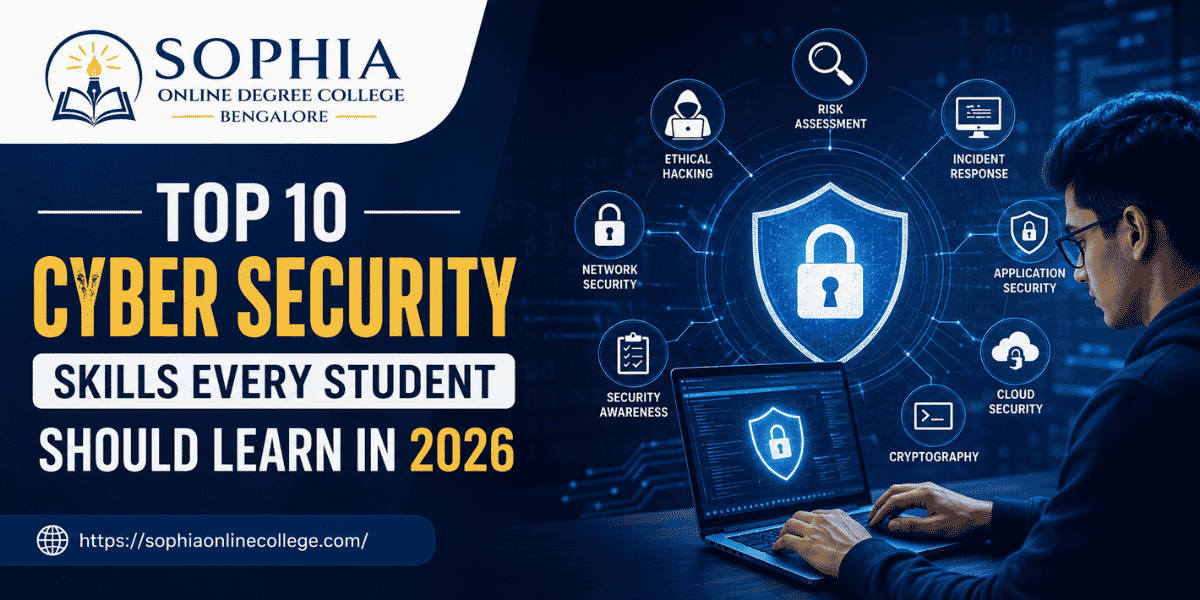
The 10 Cyber Security Skills every student should learn are becoming more important than ever as cyber threats continue to grow across industries. From banking and healthcare to education and e-commerce, organizations need skilled professionals who can protect digital systems and sensitive information. Learning these 10 Cyber Security Skills not only improves your technical knowledge but also opens doors to exciting, high-paying careers. Whether you are a beginner, a college student, or someone planning a technology career, mastering these skills in 2026 can give you a competitive edge in the rapidly evolving cybersecurity industry.
Cyber Security Skills
Cyber security is no longer limited to IT professionals. Today, businesses of every size rely on skilled experts to prevent cyberattacks, secure digital assets, and maintain customer trust. Understanding the 10 Cyber Security Skills can help students prepare for future careers while building practical knowledge that is valuable across multiple industries.
The demand for cybersecurity professionals continues to increase because of:
- Rising ransomware attacks
- Growth of cloud computing
- AI-powered cyber threats
- Digital banking expansion
- Remote work environments
- Government cybersecurity initiatives
- Increasing data privacy regulations
Students who start learning these skills early gain a significant advantage when applying for internships and full-time jobs.
Why Every Student Should Learn Cyber Security?
Cybersecurity is one of the fastest-growing technology fields worldwide. Companies are investing heavily in protecting their digital infrastructure, creating thousands of new job opportunities every year.
Learning the 10 Cyber Security Skills helps students:
- Build future-ready technical skills
- Improve problem-solving abilities
- Understand digital safety
- Increase employability
- Prepare for international certifications
- Qualify for high-paying technology jobs
- Work across multiple industries
Students pursuing Engineering distance education can strengthen their technical knowledge by combining engineering concepts with cybersecurity fundamentals, making them more competitive in today’s technology-driven job market.
Similarly, learners studying through a Correspondence college in India can use online cybersecurity resources, virtual labs, and certification programs to gain practical experience while continuing their education flexibly.
Why Cyber Security Skills Are Important?
| Benefit | Career Impact |
| High Industry Demand | Better Job Opportunities |
| Practical Technical Skills | Strong Resume |
| Global Career Options | International Employment |
| High Salary Potential | Financial Growth |
| Remote Work Opportunities | Better Work-Life Balance |
| Continuous Learning | Long-Term Career Growth |
Top 10 Cyber Security Skills Every Student Should Learn
Below are the first five essential 10 Cyber Security Skills that every student should start learning in 2026.
1. Networking Fundamentals
Every cybersecurity professional must first understand how computer networks work. Networking is the foundation of cybersecurity because most cyberattacks occur through connected systems.
Students should learn:
- TCP/IP
- DNS
- HTTP & HTTPS
- VPN
- Firewalls
- Routers
- Switches
- IP Addressing
- OSI Model
Without networking knowledge, it becomes difficult to understand how hackers exploit vulnerabilities or how security professionals defend against them.
Students pursuing B.Tech correspondence college in India can significantly improve their career prospects by developing strong networking skills alongside their engineering studies.
2. Linux Administration
Most cybersecurity tools and servers operate on Linux. Therefore, learning Linux is considered one of the most valuable 10 Cyber Security Skills.
Students should become comfortable with:
- Linux commands
- Terminal navigation
- User management
- File permissions
- Bash scripting
- Package installation
- System monitoring
Linux skills also make it easier to work with cloud platforms and ethical hacking tools.
3. Programming Fundamentals
Programming enables cybersecurity professionals to automate tasks, analyze malware, and develop security tools.
Popular programming languages include:
- Python
- JavaScript
- Java
- C++
- SQL
- PowerShell
Python remains the most recommended language for beginners because of its simplicity and extensive cybersecurity libraries.
Students enrolled in bca distance education in bangalore can use programming skills to strengthen software development, cybersecurity, and automation knowledge, preparing them for diverse IT roles.
4. Ethical Hacking
Ethical hacking involves identifying vulnerabilities before cybercriminals can exploit them.
Students learn how to:
- Perform penetration testing
- Conduct vulnerability assessments
- Analyze system weaknesses
- Test application security
- Secure network infrastructure
Ethical hackers help organizations improve their security by thinking like attackers while working legally and ethically.
Learning ethical hacking is one of the most practical 10 Cyber Security Skills because it combines theory with real-world applications.
5. Cloud Security
With organizations rapidly moving to cloud platforms, cloud security has become one of the most sought-after cybersecurity specialties.
Students should understand:
- AWS Security
- Microsoft Azure Security
- Google Cloud Security
- Identity and Access Management (IAM)
- Multi-factor Authentication (MFA)
- Cloud Storage Security
- Data Encryption
Cloud security professionals protect sensitive business information stored in cloud environments and ensure compliance with security standards.
Students pursuing distance education in bangalore can access cloud platforms, online labs, and virtual training resources to build practical cloud security skills from anywhere.
6. Security Operations Center (SOC) Skills
A Security Operations Center (SOC) is responsible for continuously monitoring an organization’s IT infrastructure to detect and respond to cyber threats.
Students should learn:
- Security monitoring
- Incident response
- Threat detection
- Log analysis
- Security Information and Event Management (SIEM)
- Security alerts
- Event correlation
SOC Analysts are among the most in-demand cybersecurity professionals because they help organizations identify attacks before they cause significant damage.
Learning SOC operations is one of the most practical 10 Cyber Security Skills for beginners entering the cybersecurity field.
7. Cryptography
Cryptography protects sensitive information by converting readable data into secure encrypted formats.
Important topics include:
- Encryption
- Decryption
- Hash Functions
- Digital Signatures
- SSL/TLS
- Public Key Infrastructure (PKI)
- Authentication Protocols
Cryptography ensures secure online banking, digital payments, messaging applications, and confidential business communications.
Students pursuing Engineering distance education can gain a strong understanding of cryptographic algorithms while studying computer networks and information security concepts.
8. Web Application Security
Most cyberattacks today target websites and web applications. Therefore, understanding web security is one of the most valuable 10 Cyber Security Skills.
Students should become familiar with:
- SQL Injection
- Cross-Site Scripting (XSS)
- Cross-Site Request Forgery (CSRF)
- Authentication vulnerabilities
- Session management
- Secure coding practices
- OWASP Top 10
Learning these concepts helps students understand how attackers exploit web applications and how developers can secure them.
9. Digital Forensics
Digital Forensics focuses on investigating cyber incidents by collecting and analyzing digital evidence.
Students learn how to:
- Recover deleted files
- Analyze system logs
- Investigate malware
- Trace cyber attacks
- Preserve digital evidence
- Generate forensic reports
Digital Forensics professionals work with law enforcement agencies, cybersecurity firms, financial institutions, and corporate security teams.
Students studying through a Correspondence college in India can strengthen their practical knowledge by participating in virtual forensic labs and cybersecurity competitions.
10. AI and Cyber Security
Artificial Intelligence is transforming cybersecurity by helping organizations detect attacks faster and automate security operations.
Students should understand:
- AI-powered threat detection
- Machine Learning basics
- Behavioral analytics
- Automated incident response
- Security automation
- Malware detection using AI
- Predictive cybersecurity
As cyber threats become more sophisticated, AI skills will become increasingly valuable for cybersecurity professionals.
Learning AI completes the 10 Cyber Security Skills every student should develop for future-ready careers.
Why Practical Skills Matter More Than Theory?
Cybersecurity is a hands-on field. While theoretical knowledge builds a strong foundation, employers increasingly look for candidates who can apply concepts in real-world scenarios.
Students should focus on:
- Building home labs
- Practicing on virtual machines
- Participating in Capture the Flag (CTF) competitions
- Using cybersecurity simulation platforms
- Working on personal security projects
- Learning through hands-on experimentation
Combining academic education with practical experience makes students more confident during interviews and prepares them for industry certifications.
Continuing our list of the 10 Cyber Security Skills, here are the remaining five essential skills that students should master to build a successful cybersecurity career in 2026 and beyond.
Best Cyber Security Tools Every Student Should Learn
Practical experience with industry-standard tools significantly improves employability.
Some of the most popular cybersecurity tools include:
- Kali Linux
- Wireshark
- Burp Suite
- Nmap
- Metasploit
- Nessus
- Splunk
- Snort
- OWASP ZAP
- Microsoft Defender
Students pursuing bca distance education in bangalore can use these tools in virtual labs to practice ethical hacking, vulnerability assessment, network monitoring, and system security.
Essential Cyber Security Tools
| Tool | Primary Purpose |
| Kali Linux | Ethical Hacking & Penetration Testing |
| Wireshark | Network Traffic Analysis |
| Nmap | Network Discovery & Port Scanning |
| Burp Suite | Web Application Security Testing |
| Metasploit | Exploitation & Penetration Testing |
| Nessus | Vulnerability Assessment |
| Splunk | Log Monitoring & SIEM |
| Snort | Intrusion Detection System |
Cyber Security Roadmap
Learning cybersecurity becomes much easier when you follow a structured roadmap.
Step 1 – Learn Computer Networking
Understand networking fundamentals, IP addressing, protocols, routers, and firewalls.
↓
Step 2 – Learn Linux
Master Linux commands, shell scripting, file permissions, and system administration.
↓
Step 3 – Learn Programming
Focus on Python, SQL, Bash, and JavaScript to automate tasks and understand application security.
↓
Step 4 – Study Ethical Hacking
Practice vulnerability assessment, penetration testing, and web application security.
↓
Step 5 – Learn Cloud Security
Develop expertise in AWS, Microsoft Azure, and Google Cloud security services.
↓
Step 6 – Practice Using Security Tools
Gain hands-on experience with Kali Linux, Wireshark, Burp Suite, and SIEM platforms.
↓
Step 7 – Earn Professional Certifications
Validate your skills with globally recognized certifications.
↓
Step 8 – Build Real Projects
Create cybersecurity labs, GitHub portfolios, and Capture The Flag (CTF) projects to demonstrate practical expertise.
Best Cyber Security Certifications for Students
Industry certifications improve credibility and increase job opportunities.
Recommended certifications include:
- CompTIA Security+
- Certified Ethical Hacker (CEH)
- Google Cybersecurity Professional Certificate
- Cisco CyberOps Associate
- Microsoft SC-900 Security Fundamentals
- ISC2 Certified in Cybersecurity (CC)
- AWS Certified Security – Specialty
Students pursuing IT distance education can combine these certifications with academic learning to become job-ready for cybersecurity, cloud security, and information security roles.
Likewise, learners enrolled in a B.Tech correspondence college in India or pursuing distance education in Bangalore can strengthen their resumes by earning certifications alongside their degree programs.
Career Opportunities After Learning Cyber Security Skills
Mastering the 10 Cyber Security Skills opens doors to numerous career opportunities across industries. As organizations continue investing in digital security, cybersecurity professionals are among the most sought-after experts worldwide.
Popular job roles include:
- Cyber Security Analyst
- SOC Analyst
- Ethical Hacker
- Penetration Tester
- Security Consultant
- Cloud Security Engineer
- Digital Forensics Analyst
- Incident Response Engineer
- Information Security Analyst
- Cyber Security Auditor
- Security Architect
- Threat Intelligence Analyst
Students with practical skills, certifications, and project experience can secure excellent opportunities in both India and international markets.
Industries Hiring Cyber Security Professionals
Cybersecurity is no longer limited to IT companies. Almost every industry requires professionals to protect digital assets and customer information.
Major recruiters include:
- Information Technology
- Banking & Financial Services (BFSI)
- Healthcare
- Government Organizations
- E-commerce
- Telecommunications
- Manufacturing
- Aviation
- EdTech
- FinTech
- Cloud Service Providers
- Consulting Companies
Leading companies hiring cybersecurity professionals include:
- TCS
- Infosys
- Wipro
- Accenture
- IBM
- Deloitte
- Capgemini
- HCLTech
- Cognizant
- Microsoft
- Amazon Web Services (AWS)
Students who develop the 10 Cyber Security Skills can pursue careers across multiple industries with excellent growth prospects.
Future Scope of Cyber Security
The future of cybersecurity is brighter than ever. As businesses continue adopting cloud computing, artificial intelligence, and digital transformation, the need for skilled cybersecurity professionals will continue to grow.
Major trends shaping the future include:
- Artificial Intelligence in Cyber Security
- Zero Trust Security
- Cloud Security
- DevSecOps
- Threat Intelligence
- Security Automation
- Internet of Things (IoT) Security
- Blockchain Security
- Digital Forensics
- Quantum-Safe Cryptography
Governments and private organizations are significantly increasing cybersecurity investments, creating long-term career opportunities for skilled professionals.
Students pursuing Engineering distance education can combine technical knowledge with cybersecurity certifications to prepare for emerging roles in cloud security, ethical hacking, and digital risk management.
Common Mistakes Beginners Should Avoid
Many students begin learning cybersecurity with enthusiasm but often make avoidable mistakes that slow their progress.
Avoid these common errors:
Learning Tools Before Fundamentals
Many beginners jump directly into hacking tools without understanding networking, operating systems, or security concepts.
Ignoring Linux
Linux powers many servers and cybersecurity tools. Skipping Linux fundamentals can create major learning gaps.
Depending Only on Theory
Cybersecurity is highly practical. Reading books alone is not enough—students should practice in virtual labs and hands-on environments.
Skipping Programming
Programming, especially Python and Bash scripting, helps automate tasks and understand security vulnerabilities more effectively.
Not Building Projects
Employers value practical experience. Building cybersecurity labs, GitHub portfolios, and participating in Capture The Flag (CTF) competitions can strengthen your resume.
Students enrolled in bca distance education in bangalore can gain practical exposure by combining academic studies with online cybersecurity projects and virtual labs.
Tips to Build a Successful Cyber Security Career
To maximize your career opportunities:
- Build strong networking fundamentals.
- Practice Linux regularly.
- Learn Python programming.
- Earn industry-recognized certifications.
- Participate in cybersecurity competitions.
- Stay updated with the latest cyber threats.
- Create a portfolio showcasing your projects.
- Network with cybersecurity communities.
- Continuously upgrade your technical skills.
Developing these habits will help students master the 10 Cyber Security Skills and stay competitive in the evolving cybersecurity industry.
Students studying through a Correspondence college in India, B.Tech correspondence college in India, or distance education in Bangalore can enhance their employability by combining flexible education with certifications and hands-on cybersecurity practice.
Conclusion
Learning the 10 Cyber Security Skills is one of the smartest investments students can make for their future. As cyber threats continue to evolve, organizations need skilled professionals who can secure networks, protect sensitive information, and respond to digital attacks effectively. By mastering networking, Linux, programming, ethical hacking, cloud security, digital forensics, and AI-powered security, students can build rewarding careers with excellent salary potential and global opportunities. The key to success is continuous learning, practical experience, and staying updated with the latest cybersecurity technologies.
Build Your Cyber Security Skills with Sophia Online College
Prepare for a successful technology career with Sophia Online College. Whether you’re pursuing IT distance education, Engineering distance education, bca distance education in bangalore, or a B.Tech correspondence college in India, Sophia Online College offers flexible, career-focused programs designed to help students build strong technical foundations and prepare for emerging careers in cybersecurity and information technology.
FAQs
1. What are the most important cyber security skills for students?
The most important cyber security skills for students include networking fundamentals, Linux administration, Python programming, ethical hacking, cloud security, web application security, cryptography, digital forensics, Security Operations Center (SOC) concepts, and incident response. These skills help students understand how cyber threats work and how organizations protect sensitive information. Along with technical knowledge, problem-solving, communication, and analytical thinking are equally valuable. Students should also gain hands-on experience through labs, projects, and cybersecurity competitions. Learners pursuing Engineering distance education can strengthen these practical skills while building a solid academic foundation for careers in information security and cyber defense.
2. Which programming language is best for cyber security?
Python is considered the best programming language for cybersecurity because it is easy to learn, highly versatile, and widely used for automation, penetration testing, malware analysis, and scripting. Besides Python, cybersecurity professionals should also learn Bash, PowerShell, JavaScript, SQL, and C/C++ depending on their specialization. These languages help in developing security tools, analyzing vulnerabilities, and understanding how applications work. Practical programming knowledge improves problem-solving abilities and career opportunities. Students enrolled in bca distance education in bangalore can combine programming skills with cybersecurity concepts to prepare for roles such as Security Analyst, Ethical Hacker, and SOC Analyst.
3. Which certifications should beginners start with?
Beginners should start with globally recognized certifications that build a strong cybersecurity foundation. Some of the best options include CompTIA Security+, ISC2 Certified in Cybersecurity (CC), Google Cybersecurity Professional Certificate, Microsoft SC-900 Security Fundamentals, Cisco CyberOps Associate, and Certified Ethical Hacker (CEH) after gaining basic knowledge. These certifications validate technical skills and improve employability across industries. They also introduce students to networking, risk management, cloud security, and incident response. Learners pursuing IT distance education can combine these certifications with academic programs to become job-ready and increase their chances of securing cybersecurity positions.
4. What tools should cyber security students learn?
Cybersecurity students should learn industry-standard tools that provide practical experience in network security, vulnerability assessment, and ethical hacking. Essential tools include Kali Linux, Wireshark, Nmap, Burp Suite, Metasploit, Nessus, Splunk, Snort, OWASP ZAP, and Microsoft Defender. These tools help students analyze network traffic, identify vulnerabilities, test web applications, monitor security events, and investigate cyber incidents. Hands-on practice is critical because employers value practical experience alongside theoretical knowledge. Students studying through a B.Tech correspondence college in India can strengthen their technical expertise by regularly practicing with these tools in virtual labs and cybersecurity projects.
5. How long does it take to learn cyber security?
The time required to learn cybersecurity depends on your background, learning pace, and career goals. Beginners can develop basic cybersecurity knowledge within three to six months through consistent study and hands-on practice. Becoming job-ready usually takes six to twelve months if students combine networking, Linux, programming, cloud security, and ethical hacking with industry certifications and practical projects. Advanced roles may require additional years of experience and continuous learning. Students enrolled in a Correspondence college in India can effectively learn cybersecurity by combining flexible education with online labs, certification courses, and real-world project experience.
6. Can I learn cyber security through distance education?
Yes, cybersecurity can be learned effectively through distance education when students combine academic learning with practical experience. Many online programs provide access to virtual labs, cloud platforms, cybersecurity simulations, and hands-on projects that help develop real-world skills. Students should also participate in Capture The Flag (CTF) competitions, earn professional certifications, and practice using industry tools such as Kali Linux and Wireshark. Continuous learning is essential because cybersecurity technologies evolve rapidly. Learners pursuing distance education in bangalore can successfully prepare for cybersecurity careers by combining flexible study with practical training and globally recognized certifications.
7. What is the salary of a cyber security professional in India?
Cybersecurity offers attractive salaries due to the increasing demand for skilled professionals. Fresh graduates typically earn between ₹4–8 LPA, while professionals with three to seven years of experience can earn ₹10–20 LPA depending on their expertise and certifications. Senior Cyber Security Architects, Cloud Security Engineers, and Security Consultants often receive ₹25–50 LPA or higher in leading multinational organizations. Professionals with expertise in AI security, cloud security, and threat intelligence are especially well compensated. Students pursuing Engineering distance education can improve their salary potential by combining technical education with certifications and practical cybersecurity experience.
8. What is the future of cyber security after AI?
Artificial Intelligence is transforming cybersecurity by improving threat detection, automating incident response, and identifying cyber threats much faster than traditional systems. However, AI is also enabling cybercriminals to launch more sophisticated attacks, increasing the demand for skilled cybersecurity professionals. Future careers will focus on AI security, cloud security, Zero Trust Architecture, DevSecOps, digital forensics, and threat intelligence. Rather than replacing cybersecurity experts, AI is becoming a powerful tool that supports them. Students pursuing IT distance education can prepare for these future opportunities by learning both cybersecurity fundamentals and AI-driven security technologies to remain competitive in the evolving job market.