
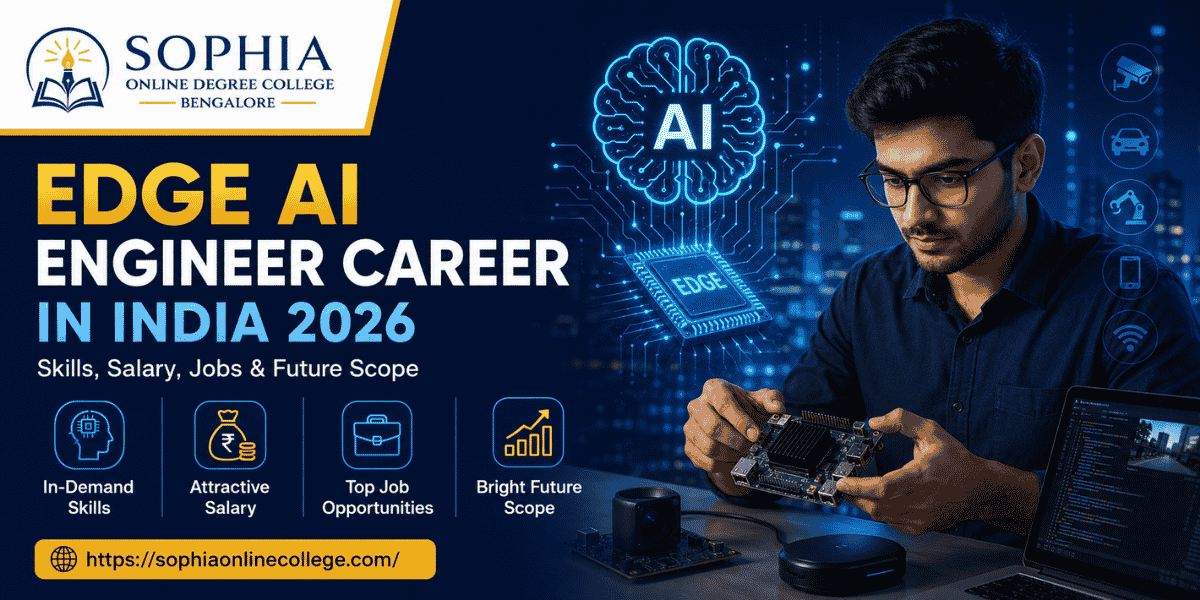
Artificial Intelligence is no longer limited to cloud computing or large data centers. Today, smart devices like surveillance cameras, wearable fitness trackers, autonomous vehicles, and industrial robots are capable of making intelligent decisions instantly using Edge AI technology. This rapid transformation has created exciting opportunities for professionals interested in building AI-powered solutions closer to where data is generated. As a result, the Edge AI Engineer Career in India has become one of the fastest-growing career paths for aspiring AI professionals in 2026.
Whether you are a student, a software developer, or someone exploring new-age technology careers, the Edge AI Engineer Career in India offers excellent growth potential, competitive salaries, and opportunities across multiple industries. With organizations investing in smart manufacturing, healthcare devices, robotics, and IoT solutions, professionals skilled in Edge AI are increasingly in demand.
If you’re wondering what the Edge AI Engineer Career in India involves, the skills you need, the best learning path, and the future opportunities available, this guide covers everything in a simple and practical way. By understanding the Edge AI Engineer Career in India, you can make informed decisions about your education, certifications, and long-term professional goals in one of the most innovative fields of Artificial Intelligence.
Edge AI Meaning
Before exploring the Edge AI Engineer Career in India, it’s important to understand what Edge AI actually means.
Edge AI refers to the deployment of Artificial Intelligence models directly on devices located at the “edge” of a network instead of relying on cloud servers. These edge devices process data locally, enabling faster decision-making, lower latency, improved privacy, and reduced internet dependency.
For example:
- Smart security cameras detecting suspicious activities
- Autonomous vehicles identifying road signs in real time
- Smartwatches monitoring heart rate instantly
- Factory robots detecting production defects
- Drones navigating without cloud connectivity
Unlike traditional AI systems that send data to remote servers for processing, Edge AI performs computations directly on the device. This makes applications more efficient, secure, and responsive.
Why Edge AI is Becoming Popular?
Several factors have contributed to the growing adoption of Edge AI across industries:
- Real-time data processing
- Improved privacy and security
- Reduced cloud infrastructure costs
- Faster AI predictions
- Better offline functionality
- Lower network bandwidth usage
- Support for smart IoT ecosystems
These advantages are encouraging organizations to invest heavily in Edge AI technologies, making the Edge AI Engineer Career in India increasingly attractive for technology professionals.
Why is the Edge AI Engineer Career in India Growing Rapidly?
India has emerged as one of the world’s fastest-growing technology markets. Digital transformation, Industry 4.0 initiatives, smart city projects, and AI-driven automation have significantly increased the demand for professionals who can develop and deploy intelligent edge solutions.
Some of the major reasons behind this growth include:
Growth of IoT Devices
Millions of IoT devices are being connected every year. These devices require intelligent processing capabilities without depending entirely on cloud infrastructure.
Smart Manufacturing
Factories are adopting AI-powered quality inspection systems, predictive maintenance, and robotics to improve productivity.
Healthcare Innovation
Medical equipment now uses Edge AI for instant diagnostics, patient monitoring, and remote healthcare applications.
Automotive Industry
Advanced Driver Assistance Systems (ADAS) and autonomous driving technologies rely heavily on Edge AI.
Retail Automation
Retail stores are implementing AI-powered surveillance, customer analytics, and inventory management systems.
As these sectors continue to expand, the Edge AI Engineer Career in India is expected to remain one of the most promising AI career options for the coming years.
What Does an Edge AI Engineer Do?
An Edge AI Engineer is responsible for designing, developing, optimizing, and deploying AI models on edge devices.
Their daily responsibilities typically include:
- Developing machine learning models
- Optimizing deep learning models for edge deployment
- Integrating AI with embedded hardware
- Testing AI applications on devices
- Improving model performance
- Monitoring deployed AI systems
- Collaborating with software and hardware teams
Unlike traditional AI engineers who primarily work with cloud-based systems, Edge AI Engineers combine Artificial Intelligence with embedded systems, making the Edge AI Engineer Career in India both challenging and rewarding.
Essential Skills for Becoming an Edge AI Engineer
Building a successful Edge AI Engineer Career in India requires expertise across multiple technical domains. Employers look for professionals who can bridge the gap between Artificial Intelligence and embedded hardware.
Essential Skills for Edge AI Engineers
| Skill | Why It Is Important |
| Python | AI model development and automation |
| C/C++ | Embedded programming and performance optimization |
| Machine Learning | Building predictive models |
| Deep Learning | Developing intelligent AI applications |
| TensorFlow Lite | Deploying lightweight AI models |
| ONNX | Cross-platform AI model optimization |
| Computer Vision | Image recognition and object detection |
| Embedded Systems | Running AI on edge devices |
| Linux | Managing embedded operating systems |
| IoT Fundamentals | Connecting smart devices and sensors |
Programming Languages
Python remains the most preferred programming language for AI development. However, C and C++ are equally important for optimizing AI models on embedded hardware.
Machine Learning
A strong understanding of supervised learning, unsupervised learning, and reinforcement learning helps engineers create efficient AI solutions.
Deep Learning
Knowledge of neural networks, CNNs, RNNs, and transformer architectures enables professionals to build advanced AI models.
Embedded Systems
Since Edge AI operates on hardware devices, engineers should understand microcontrollers, embedded processors, and hardware interfaces.
Computer Vision
Image classification, object detection, facial recognition, and video analytics are among the most common applications of Edge AI.
Model Optimization
Engineers must reduce model size while maintaining accuracy through techniques like quantization and pruning.
Mastering these skills can significantly improve your chances of building a successful Edge AI Engineer Career in India.
Edge AI Course
One of the most common questions students ask is:
Which course should I choose to become an Edge AI Engineer?
There isn’t a single degree dedicated exclusively to Edge AI. Instead, students usually combine education in Artificial Intelligence, Machine Learning, Embedded Systems, and IoT.
Popular educational pathways include:
Bachelor’s Degree
Students often pursue:
- Computer Science Engineering
- Electronics and Communication Engineering
- Artificial Intelligence & Machine Learning
- Information Technology
Some learners also explore Engineering distance education programs to strengthen their technical foundation while balancing work or other commitments. Although practical exposure is essential for Edge AI, distance learning can be useful for theoretical concepts.
Students searching for flexible higher education options often look for a B.Tech correspondence college in India or a Correspondence college in India that offers recognized engineering-related programs. It’s important to verify accreditation and understand that many AI-focused practical skills will still need hands-on project experience.
Master’s Degree
Professionals looking to specialize further may consider postgraduate studies in:
- Artificial Intelligence
- Robotics
- Embedded Systems
- Data Science
- Machine Learning
Some working professionals search for an M.Tech correspondence college in Karnataka to continue their education while remaining employed. Choosing an approved institution with a relevant curriculum can help strengthen advanced technical knowledge.
Similarly, learners interested in flexible technology programs sometimes explore IT distance education to build software development, networking, and computing fundamentals that support future AI careers.
For learners based in Karnataka, distance education in Bangalore has become an attractive option because many institutions offer flexible learning support alongside access to technology communities, workshops, and industry events.
Professional Certifications
Apart from academic degrees, employers highly value certifications in:
- Machine Learning
- Deep Learning
- TensorFlow
- Computer Vision
- Embedded Linux
- IoT Development
- NVIDIA Jetson Development
- Edge AI Deployment
Practical certifications combined with portfolio projects often have a greater impact than certifications alone.
Learning Roadmap for Beginners
If you’re starting from scratch, follow this progression:
- Learn Python programming.
- Understand Data Structures and Algorithms.
- Study Machine Learning fundamentals.
- Learn Deep Learning frameworks.
- Explore Computer Vision.
- Understand Embedded Systems.
- Work with Raspberry Pi and NVIDIA Jetson.
- Learn TensorFlow Lite and ONNX.
- Build real-world Edge AI projects.
- Apply for internships and entry-level roles.
This structured approach helps you gradually develop the skills needed for the Edge AI Engineer Career in India without feeling overwhelmed.
Can Freshers Build a Career in Edge AI?
Absolutely. While many employers prefer candidates with project experience, freshers can stand out by showcasing practical skills instead of relying only on academic qualifications.
Some portfolio ideas include:
- Smart attendance system using facial recognition
- AI-powered plant disease detection
- Object detection for traffic monitoring
- Real-time mask detection
- Smart parking management system
- Industrial defect detection using computer vision
Building such projects demonstrates your ability to apply concepts in real-world scenarios and strengthens your profile for internships and entry-level opportunities.
Why Choose the Right Learning Partner?
Choosing the right training institute can make a significant difference in your learning journey. Along with academic knowledge, learners should look for industry-oriented programs that include practical projects, mentorship, and career guidance. Sophia Online College supports aspiring technology professionals by focusing on hands-on learning and helping students build job-ready skills aligned with evolving industry requirements.
Edge AI Engineer Salary
One of the biggest reasons students and working professionals are exploring the Edge AI Engineer Career in India is the excellent earning potential. As industries adopt Edge AI for automation, robotics, healthcare, and smart devices, companies are willing to pay competitive salaries to professionals with the right technical expertise.
Salary packages vary based on factors such as:
- Educational qualification
- Technical skills
- Project experience
- Company size
- Location
- Certifications
- Expertise in AI frameworks and embedded systems
Freshers with strong portfolios and hands-on experience in deploying AI models on edge devices often receive better opportunities than candidates with only theoretical knowledge.
Average Edge AI Engineer Salary in India (2026)
| Experience Level | Average Annual Salary |
| Fresher (0–1 Year) | ₹5 – ₹8 LPA |
| 1–3 Years | ₹8 – ₹14 LPA |
| 3–5 Years | ₹14 – ₹22 LPA |
| 5–8 Years | ₹22 – ₹35 LPA |
| Senior Edge AI Engineer | ₹35 – ₹50+ LPA |
Salaries are approximate and may vary depending on the organization, city, technical expertise, and industry demand.
Factors That Influence Salary
Several factors can help professionals earn higher packages:
- Expertise in Machine Learning and Deep Learning
- Experience with TensorFlow Lite and ONNX
- Embedded systems programming
- Computer Vision projects
- Robotics and IoT knowledge
- Real-world deployment experience
- Cloud integration skills
As organizations continue investing in AI-powered products, the Edge AI Engineer Career in India is expected to offer even stronger salary growth in the coming years.
Edge AI Engineer Jobs
The demand for Edge AI professionals is increasing across both startups and multinational companies. Since Edge AI combines Artificial Intelligence with embedded computing, engineers have opportunities in diverse industries.
Popular Job Roles
After gaining the required skills, you can apply for roles such as:
- Edge AI Engineer
- Machine Learning Engineer
- AI Engineer
- Computer Vision Engineer
- Embedded AI Engineer
- AI Software Engineer
- Robotics Engineer
- IoT AI Developer
- Embedded Systems Engineer
- AI Research Engineer
Each of these roles contributes to designing intelligent systems capable of processing data locally on devices.
Industries Hiring Edge AI Engineers
The Edge AI Engineer Career in India extends far beyond the IT industry. Today, almost every technology-driven sector is adopting intelligent edge computing solutions.
Automotive
Modern vehicles use Edge AI for:
- Driver assistance systems
- Lane detection
- Obstacle recognition
- Autonomous driving features
Healthcare
Hospitals and healthcare companies use Edge AI for:
- Medical imaging
- Patient monitoring
- Wearable health devices
- Early disease detection
Manufacturing
Factories deploy Edge AI to improve:
- Quality inspection
- Predictive maintenance
- Production automation
- Industrial robotics
Retail
Retail businesses benefit from:
- Smart surveillance
- Customer analytics
- Automated billing
- Inventory management
Agriculture
Farmers increasingly use AI-powered drones and sensors for:
- Crop monitoring
- Soil analysis
- Irrigation management
- Pest detection
Smart Cities
Governments are implementing Edge AI in:
- Traffic monitoring
- Public safety
- Waste management
- Smart energy systems
Future Scope of Edge AI in India
Edge AI is expected to become one of the most transformative technologies of this decade. With the rapid growth of AI-powered devices, demand for skilled professionals is projected to rise steadily.
Trends Driving Future Growth
Smart Manufacturing
Industry 4.0 is encouraging factories to automate production using AI-enabled devices.
AI-Powered Healthcare
Portable diagnostic equipment and wearable devices are becoming increasingly intelligent.
Autonomous Transportation
Self-driving technology and intelligent transportation systems rely heavily on Edge AI.
Robotics
Industrial robots are becoming more autonomous using real-time AI processing.
Smart Homes
Voice assistants, smart appliances, and security systems continue to expand globally.
5G Networks
The rollout of 5G enables faster communication between edge devices, improving AI performance.
These developments indicate that the Edge AI Engineer Career in India will remain highly relevant as businesses continue adopting intelligent automation.
Challenges in an Edge AI Career
While Edge AI offers excellent opportunities, professionals should also be prepared for certain challenges.
Some common challenges include:
- Limited hardware resources
- Model optimization
- Power consumption
- Device compatibility
- Security concerns
- Continuous learning
- Rapid technology changes
The good news is that these challenges also make Edge AI professionals highly valuable, as specialized skills are difficult to replace.
How to Get Your First Edge AI Job?
Breaking into Edge AI doesn’t necessarily require years of experience. A well-planned learning strategy and practical portfolio can significantly improve your chances.
Here are a few tips:
- Learn Python thoroughly.
- Build a strong understanding of Machine Learning.
- Practice Deep Learning models.
- Explore TensorFlow Lite and ONNX.
- Work with Raspberry Pi or NVIDIA Jetson.
- Create real-world projects.
- Contribute to open-source repositories.
- Participate in AI hackathons.
- Earn industry-recognized certifications.
- Keep your GitHub portfolio updated.
Employers value candidates who can demonstrate practical implementation rather than just theoretical knowledge.
Is Edge AI Engineering the Right Career for You?
The Edge AI Engineer Career in India can be an excellent choice if you enjoy:
- Solving real-world problems
- Artificial Intelligence
- Robotics
- Embedded systems
- Computer Vision
- Building smart devices
- Continuous learning
If you are passionate about creating intelligent applications that work efficiently on devices, this career offers long-term stability, innovation, and growth.
Why Learn Edge AI with Sophia Online College?
Choosing the right learning platform can accelerate your career journey. Sophia Online College offers industry-focused training designed to help learners develop practical skills through hands-on projects, expert mentorship, and career-oriented guidance. By combining theoretical knowledge with real-world applications, students can build a strong foundation for emerging AI roles.
Whether you’re a beginner or a working professional looking to upskill, Sophia Online College provides learning support that aligns with current industry expectations and helps prepare you for opportunities in the rapidly evolving Edge AI ecosystem.
Conclusion
The Edge AI Engineer Career in India is rapidly emerging as one of the most exciting technology careers in 2026. As industries continue adopting AI-powered devices, professionals who can develop and deploy intelligent solutions at the edge are becoming increasingly valuable.
From healthcare and manufacturing to robotics, automotive, retail, and smart cities, Edge AI is transforming the way businesses operate. By learning the right programming languages, mastering Machine Learning and Embedded Systems, and building practical projects, aspiring professionals can establish a successful Edge AI Engineer Career in India with excellent salary prospects and long-term growth.
If you’re ready to build future-ready AI skills, now is the perfect time to start your journey. With expert-led training, practical projects, and career-focused learning, Sophia Online College can help you take the next step toward becoming a skilled Edge AI professional.
Ready to Build Your Career in Edge AI?
The demand for skilled Edge AI professionals is growing rapidly across industries, making now the perfect time to start learning future-ready technologies. If you’re looking to build practical skills in Artificial Intelligence, Machine Learning, Embedded Systems, and Edge AI, Sophia Online College offers industry-oriented training, hands-on projects, expert mentorship, and career support to help you stay ahead in the competitive job market. Take the first step toward a successful Edge AI career today!
Contact Sophia Online College to explore our AI and emerging technology courses and start building the skills employers are looking for in 2026 and beyond.
FAQs
1. What is an Edge AI Engineer?
An Edge AI Engineer is a technology professional who designs, develops, optimizes, and deploys Artificial Intelligence (AI) models on edge devices rather than relying entirely on cloud computing. These devices include IoT sensors, smart cameras, drones, wearable devices, robots, autonomous vehicles, and embedded systems that process data locally for faster and more secure decision-making. Edge AI Engineers work with Machine Learning, Deep Learning, Computer Vision, and embedded hardware to build intelligent applications that operate efficiently with low latency. As businesses adopt smarter technologies, the Edge AI Engineer Career in India is becoming one of the most sought-after career options in the AI industry.
2. What skills are required to become an Edge AI Engineer?
To build a successful Edge AI Engineer Career in India, you need a combination of programming, AI, and hardware-related skills. Strong knowledge of Python and C/C++ is essential for developing and optimizing AI applications. You should also understand Machine Learning, Deep Learning, TensorFlow Lite, ONNX, OpenCV, Embedded Systems, Linux, and IoT fundamentals. Additionally, learning model optimization techniques such as quantization and pruning helps improve AI performance on resource-constrained devices. Practical experience through real-world projects, internships, and certifications can significantly improve your job prospects and prepare you for industry challenges.
3. What is the average Edge AI Engineer salary in India?
The salary for professionals pursuing an Edge AI Engineer Career in India depends on experience, technical expertise, industry, and employer. Fresh graduates can expect annual salaries ranging from ₹5–8 LPA, while professionals with one to three years of experience often earn between ₹8–14 LPA. Mid-level engineers may receive ₹14–22 LPA, whereas senior professionals with specialized expertise in AI deployment, embedded systems, and computer vision can earn ₹35 LPA or more. Certifications, practical project experience, and proficiency in modern Edge AI frameworks can further enhance salary prospects and career growth.
4. Is Edge AI a good career in India?
Yes, the Edge AI Engineer Career in India is an excellent choice for students and professionals interested in Artificial Intelligence, IoT, and embedded technologies. As industries such as healthcare, manufacturing, automotive, agriculture, and retail increasingly adopt Edge AI solutions, the demand for skilled professionals continues to grow. This career offers competitive salaries, exciting projects, and opportunities to work with cutting-edge technologies like robotics, autonomous systems, and smart devices. Since Edge AI combines software and hardware expertise, professionals in this field enjoy strong job security and long-term career growth in India’s rapidly evolving technology landscape.
5. Which degree is best for an Edge AI career?
If you’re planning to build an Edge AI Engineer Career in India, pursuing a bachelor’s degree in Computer Science Engineering, Artificial Intelligence, Electronics and Communication Engineering, Information Technology, or Embedded Systems is a great starting point. These programs provide the technical foundation needed for AI and hardware development. A master’s degree in Artificial Intelligence, Robotics, Machine Learning, or Embedded Systems can further improve career opportunities. Along with formal education, employers highly value certifications, practical projects, hackathon participation, and hands-on experience with platforms like Raspberry Pi and NVIDIA Jetson for Edge AI deployment.
6. Can freshers get Edge AI jobs?
Yes, freshers can successfully start an Edge AI Engineer Career in India by demonstrating practical skills and project experience. While some companies prefer experienced professionals, many organizations hire entry-level candidates who have built strong portfolios showcasing Machine Learning, Computer Vision, Embedded Systems, and IoT applications. Creating projects such as smart surveillance systems, object detection models, or AI-powered automation solutions can significantly strengthen your resume. Participating in internships, coding competitions, open-source contributions, and earning relevant certifications also helps freshers stand out during recruitment and increases their chances of securing their first Edge AI job.
7. What are the best tools for learning Edge AI?
Developing the right technical toolkit is essential for a successful Edge AI Engineer Career in India. Beginners should start with Python, TensorFlow Lite, PyTorch, ONNX, and OpenCV to build and optimize AI models. Hardware platforms such as Raspberry Pi, NVIDIA Jetson, Arduino, and ESP32 provide practical experience in deploying AI applications on edge devices. Familiarity with Linux, Docker, Git, and embedded programming further enhances your skills. Working on real-world projects using these tools not only improves technical expertise but also helps create a strong portfolio that attracts recruiters in the AI industry.
8. What is the future scope of Edge AI in India?
The future of the Edge AI Engineer Career in India is highly promising as businesses continue investing in intelligent devices and real-time AI applications. Technologies such as 5G, Industry 4.0, autonomous vehicles, robotics, smart healthcare, and Industrial IoT are accelerating the adoption of Edge AI across multiple sectors. As organizations seek faster, more secure, and energy-efficient AI solutions, the need for skilled Edge AI Engineers is expected to grow significantly. Professionals who continuously upgrade their knowledge and gain practical deployment experience will enjoy excellent career opportunities, attractive salaries, and long-term job stability in this rapidly expanding field.