
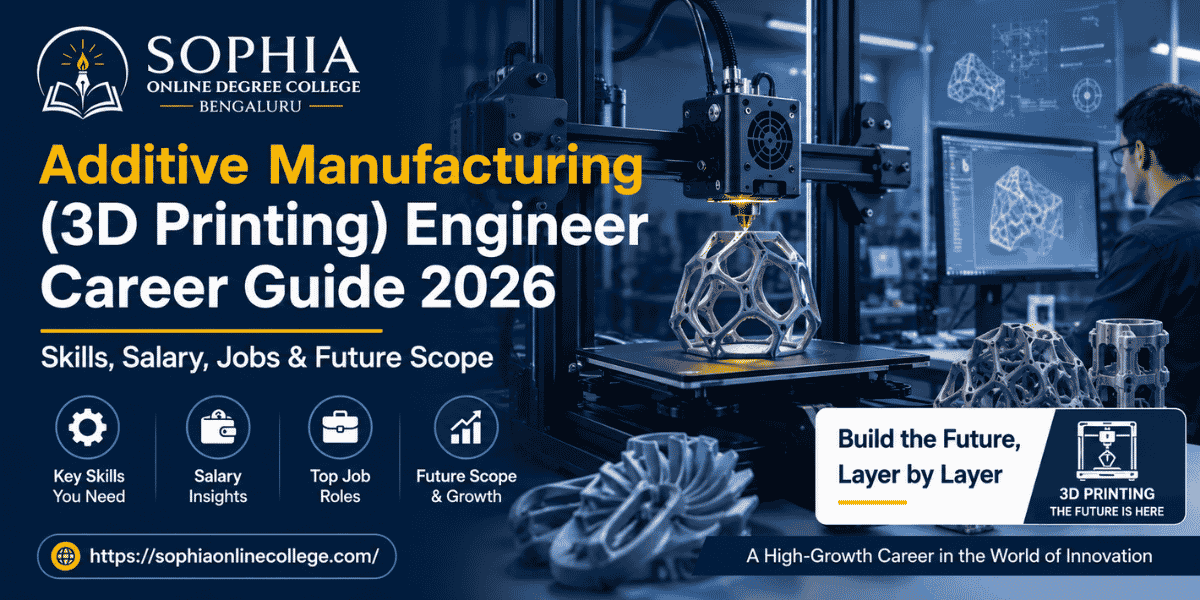
Additive Manufacturing (3D Printing) is transforming the future of engineering by changing how products are designed, developed, and manufactured. From aerospace components to customized medical implants, Additive Manufacturing (3D Printing) enables industries to create complex, lightweight, and cost-effective products with greater precision than traditional manufacturing methods. As industries continue embracing digital manufacturing and Industry 4.0, the demand for skilled Additive Manufacturing Engineers is rising rapidly. This guide explores everything you need to know about building a successful Additive Manufacturing (3D Printing) career, including essential skills, job roles, salary expectations, educational pathways, and future opportunities available in India and across the globe in 2026.
Why Additive Manufacturing is Changing Modern Engineering?
Manufacturing has evolved significantly over the past decade. Earlier, engineers relied on subtractive manufacturing methods where material was cut, drilled, or machined to create products. Today, Additive Manufacturing (3D Printing) builds products layer by layer directly from digital designs, minimizing waste and improving production efficiency.
The technology is helping organizations produce lighter, stronger, and more complex components that were previously difficult or impossible to manufacture.
Some major advantages include:
- Faster product development
- Reduced production costs
- Minimal material wastage
- Greater design flexibility
- Easy customization
- Rapid prototyping
- Sustainable manufacturing
- Shorter product development cycles
Industries across automotive, aerospace, healthcare, robotics, construction, and defense are increasingly investing in Additive Manufacturing (3D Printing) because it supports innovation while reducing manufacturing time.
Traditional Manufacturing vs Additive Manufacturing
| Feature | Traditional Manufacturing | Additive Manufacturing |
| Production Method | Material Removal | Layer-by-layer Printing |
| Material Waste | High | Very Low |
| Prototype Development | Slow | Fast |
| Design Complexity | Limited | Highly Flexible |
| Product Customization | Difficult | Easy |
| Manufacturing Cost (Small Batch) | High | Cost-effective |
What Does an Additive Manufacturing Engineer Do?
An Additive Manufacturing Engineer is responsible for designing, developing, testing, and improving products created using industrial 3D printing technologies. Their work combines mechanical engineering principles with advanced digital manufacturing tools.
Daily responsibilities include:
- Designing 3D CAD models
- Preparing printable files
- Selecting suitable materials
- Operating industrial 3D printers
- Monitoring print quality
- Optimizing manufacturing processes
- Conducting product testing
- Troubleshooting production issues
- Collaborating with design and R&D teams
Unlike conventional manufacturing engineers, these professionals focus on creating innovative designs that maximize the capabilities of Additive Manufacturing (3D Printing) technology.
Many students pursuing Engineering distance education are now learning CAD software and digital manufacturing concepts to prepare for careers in this rapidly growing field.
Additive Manufacturing Process
The Additive Manufacturing Process involves building physical objects layer by layer from a digital 3D model instead of removing material from a solid block. This process offers greater precision, lower waste, and faster production compared to conventional manufacturing techniques.
The complete workflow generally includes the following stages:
Step 1: Product Design
Engineers first create a digital 3D model using software such as:
- SolidWorks
- CATIA
- Fusion 360
- Siemens NX
- AutoCAD
The design determines the final shape, dimensions, and functionality of the product.
Step 2: CAD File Conversion
The completed design is converted into STL or OBJ format, making it compatible with slicing software.
Step 3: Slicing
Slicing software divides the model into thousands of thin horizontal layers.
Popular slicers include:
- Cura
- Simplify3D
- PrusaSlicer
These tools also generate machine instructions for the printer.
Step 4: Material Selection
Different industries require different materials depending on product requirements.
Common materials include:
- Plastics
- Metals
- Ceramics
- Carbon Fiber Composites
- Resins
- Nylon
- Titanium
Selecting the correct material directly impacts strength, durability, and production cost.
Step 5: Printing
Industrial 3D printers manufacture the product layer by layer using technologies such as:
- FDM
- SLA
- SLS
- DMLS
- Binder Jetting
Step 6: Post Processing
After printing, engineers perform:
- Surface finishing
- Heat treatment
- Sanding
- Painting
- Polishing
- Quality inspection
This ensures the final product meets engineering standards.
Students enrolled in a B.Tech correspondence college in India often study manufacturing technologies that provide a strong theoretical foundation for understanding modern production methods like additive manufacturing.
Additive Manufacturing Metal
One of the fastest-growing applications of Additive Manufacturing (3D Printing) is metal printing. Instead of using plastic filaments, engineers use specialized metal powders to manufacture highly durable industrial components.
Popular metals used include:
- Titanium
- Stainless Steel
- Aluminum
- Nickel Alloys
- Inconel
- Copper
- Cobalt Chrome
Metal additive manufacturing is widely used in industries where precision, lightweight structures, and high mechanical strength are essential.
Major applications include:
Aerospace
Aircraft manufacturers use lightweight metal components that improve fuel efficiency while maintaining structural integrity.
Healthcare
Medical companies manufacture customized implants, surgical instruments, dental prosthetics, and orthopedic devices.
Automotive
Automobile companies produce engine parts, brackets, prototypes, and lightweight structural components using metal additive manufacturing.
Defense
Defense organizations use advanced 3D printing for rapid production of specialized equipment and replacement parts.
Energy
Power generation companies manufacture heat-resistant turbine components and complex industrial equipment.
Metal printing significantly reduces production time while improving product quality, making it one of the most valuable technologies in modern engineering.
Students graduating from a Diploma in Engr correspondence college in India can strengthen their careers by learning industrial CAD software, materials science, and additive manufacturing technologies alongside their diploma education.
Why Companies are Investing in Additive Manufacturing?
Organizations worldwide are rapidly adopting Additive Manufacturing (3D Printing) because it improves innovation while reducing operational costs.
Some key business benefits include:
- Faster prototyping
- Lower inventory costs
- Reduced production waste
- Improved product quality
- Better customization
- Shorter supply chains
- Faster product launches
- Sustainable manufacturing practices
Companies are increasingly looking for engineers who understand both traditional manufacturing and digital production technologies.
Students pursuing distance education in bangalore can complement their academic learning by mastering CAD tools, 3D modeling software, and additive manufacturing concepts to stay competitive in this evolving engineering landscape.
Industries Hiring Additive Manufacturing Engineers
The adoption of Additive Manufacturing (3D Printing) has expanded far beyond prototype development. Today, organizations across multiple sectors rely on 3D printing engineers to develop innovative products, reduce manufacturing costs, and improve production efficiency.
Some of the top industries hiring Additive Manufacturing Engineers include:
Aerospace
Aircraft manufacturers use 3D printing to create lightweight components that improve fuel efficiency while maintaining structural strength. Companies require engineers who understand advanced manufacturing techniques and precision engineering.
Automotive
Automobile manufacturers use additive manufacturing for rapid prototyping, customized vehicle components, tooling, and lightweight structural parts.
Popular recruiters include:
- Tata Motors
- Mahindra
- BMW
- Mercedes-Benz
- Tesla
Healthcare & Medical Devices
Medical companies manufacture:
- Customized implants
- Prosthetic limbs
- Dental devices
- Surgical tools
- Orthopedic components
using industrial 3D printing technologies.
Defense
Defense organizations increasingly use additive manufacturing for rapid production of specialized equipment, replacement parts, and advanced weapon system components.
Consumer Electronics
Electronics companies utilize Additive Manufacturing (3D Printing) for designing compact device components, testing product prototypes, and reducing manufacturing cycles.
Construction
The construction industry has begun using large-scale 3D printers to manufacture walls, concrete structures, bridges, and modular housing systems.
Robotics
Robotics companies require engineers to manufacture lightweight robotic arms, customized mechanical parts, and complex assemblies.
Research & Development
Government organizations, universities, and private laboratories continue investing heavily in additive manufacturing research for developing next-generation industrial solutions.
Students pursuing Correspondence college in india programs can prepare for these industries by combining engineering fundamentals with software expertise and practical project experience.
Skills Every Additive Manufacturing Engineer Must Learn
Success in this field requires both technical expertise and strong analytical abilities.
Technical Skills
Every aspiring engineer should master:
- CAD Design
- SolidWorks
- CATIA
- Autodesk Fusion 360
- AutoCAD
- Siemens NX
- Material Science
- Reverse Engineering
- CNC Fundamentals
- GD&T
- Product Design
- Industrial Drawing
- Quality Control
- Rapid Prototyping
Knowledge of industrial standards further improves employability.
Soft Skills
Besides technical expertise, employers also value:
- Problem Solving
- Communication
- Teamwork
- Creativity
- Project Management
- Critical Thinking
- Attention to Detail
- Time Management
These skills help engineers collaborate effectively with design teams, production departments, and research professionals.
Best Software Every Additive Manufacturing Engineer Should Learn
Modern manufacturing depends heavily on advanced engineering software. Learning these applications significantly improves job opportunities.
SolidWorks
One of the most widely used CAD software applications for creating industrial product designs.
CATIA
Popular in aerospace and automotive industries for advanced mechanical design.
Autodesk Fusion 360
Excellent software for beginners learning CAD, CAM, and product development.
Siemens NX
Used extensively for industrial product engineering and advanced manufacturing.
Materialise Magics
Helps prepare CAD files specifically for industrial 3D printing.
Cura
An essential slicing software that converts CAD models into printable machine instructions.
ANSYS
Used for simulation, structural analysis, thermal analysis, and product validation.
Engineers who master these software tools become highly valuable across manufacturing industries.
Popular Additive Manufacturing Software
| Software | Primary Purpose | Skill Level |
| SolidWorks | Product Design | Beginner |
| CATIA | Industrial CAD | Intermediate |
| Fusion 360 | CAD + CAM | Beginner |
| Cura | Print Slicing | Beginner |
| Materialise Magics | File Preparation | Advanced |
| Siemens NX | Engineering Design | Advanced |
| ANSYS | Simulation & Analysis | Advanced |
Additive Manufacturing 3D Printing
Additive Manufacturing 3D Printing is no longer limited to laboratories or prototype development. It has become one of the fastest-growing manufacturing technologies worldwide, enabling companies to design complex products with greater speed and precision.
Unlike traditional manufacturing methods that remove material, additive manufacturing builds products layer by layer using digital models. This approach offers several advantages, including reduced material waste, shorter production cycles, and the ability to manufacture customized products efficiently.
Some of the most common Additive Manufacturing 3D Printing technologies include:
- Fused Deposition Modeling (FDM)
- Selective Laser Sintering (SLS)
- Stereolithography (SLA)
- Direct Metal Laser Sintering (DMLS)
- Binder Jetting
- Electron Beam Melting (EBM)
Each technology is selected based on factors such as material type, application, production volume, and required precision.
Students pursuing Engineering distance education can significantly enhance their employability by learning these technologies alongside CAD software, industrial design principles, and manufacturing processes. As industries continue embracing digital transformation, professionals skilled in Additive Manufacturing (3D Printing) will remain in high demand.
Additive Manufacturing Engineer Salary in India
The salary of an Additive Manufacturing Engineer depends on technical expertise, software proficiency, certifications, industry, and years of experience.
Freshers (0–2 Years)
Average Salary:
₹4–6 LPA
Fresh graduates with CAD and 3D printing skills often secure higher entry-level packages.
Mid-Level Engineers (3–6 Years)
Average Salary:
₹7–14 LPA
Professionals managing industrial projects, product design, and manufacturing optimization earn competitive salaries.
Senior Engineers (7–12 Years)
Average Salary:
₹15–28 LPA
Senior professionals working in aerospace, defense, or multinational manufacturing companies often receive attractive compensation packages.
International Opportunities
Countries such as:
- Germany
- United States
- Canada
- United Kingdom
- Japan
- Singapore
offer significantly higher salaries for experienced Additive Manufacturing Engineers.
Students completing a B.Tech correspondence college in India program and gaining expertise in CAD software, industrial automation, and additive manufacturing technologies can improve their chances of securing these global opportunities.
Career Growth Roadmap
A typical career progression looks like this:
Engineering Student
↓
CAD Designer
↓
Junior Additive Manufacturing Engineer
↓
Manufacturing Engineer
↓
Senior Design Engineer
↓
Research & Development Engineer
↓
Production Manager
↓
Engineering Consultant
↓
Director of Manufacturing
Professionals who continuously update their technical skills, earn certifications, and work on innovative manufacturing projects often experience faster career advancement.
Future Scope of Additive Manufacturing (3D Printing)
The future of Additive Manufacturing (3D Printing) is brighter than ever. As industries move toward smart manufacturing and Industry 4.0, companies are investing heavily in digital production technologies that improve efficiency, reduce costs, and support sustainable manufacturing practices. The global 3D printing market is expected to grow rapidly over the coming years, creating thousands of new engineering opportunities.
Emerging technologies are further expanding the role of additive manufacturing, including:
- Artificial Intelligence (AI)
- Machine Learning
- Industrial Automation
- Smart Factories
- Digital Twins
- Robotics
- Internet of Things (IoT)
- Sustainable Manufacturing
These innovations enable engineers to design smarter products, optimize production, and manufacture highly customized components with minimal waste.
The future applications of Additive Manufacturing (3D Printing) include:
- Space exploration
- Electric vehicles
- Biomedical engineering
- Construction technology
- Aerospace innovation
- Renewable energy
- Defense equipment
- Consumer product customization
Engineers who continuously learn new software, materials, and manufacturing technologies will enjoy excellent career growth and international job opportunities.
Why Students Should Learn Additive Manufacturing?
Learning Additive Manufacturing (3D Printing) gives engineering students a significant advantage in today’s competitive job market. Unlike traditional manufacturing roles, additive manufacturing combines engineering knowledge with modern digital technologies, making professionals more versatile and industry-ready.
Key benefits include:
- High-demand technical skills
- Better placement opportunities
- Higher starting salaries
- Global career prospects
- Exposure to Industry 4.0
- Opportunities in research and development
- Entrepreneurial opportunities in product design
- Freelancing and consulting possibilities
Students pursuing distance education in bangalore can complement their academic learning with CAD software training, industrial certifications, and practical projects to build a strong profile for future employers.
Similarly, those studying through a Correspondence college in india can remain competitive by developing practical expertise in product design, rapid prototyping, and advanced manufacturing technologies.
Common Mistakes Beginners Should Avoid
Many aspiring engineers delay their career growth by overlooking essential technical and practical skills. Avoiding these common mistakes can help you build a stronger foundation in Additive Manufacturing (3D Printing).
Ignoring CAD Fundamentals
Strong CAD skills are the backbone of additive manufacturing. Mastering software like SolidWorks, CATIA, and Fusion 360 is essential.
Depending Only on Theory
Practical projects, internships, and prototype development are equally important. Employers prefer candidates with hands-on experience.
Not Learning Material Properties
Understanding plastics, metals, composites, and resins helps engineers select the right material for each application.
Skipping Slicing Software
Many beginners focus only on CAD while ignoring slicing software such as Cura or Simplify3D, which is critical for successful printing.
No Engineering Portfolio
Maintain a digital portfolio showcasing CAD designs, prototypes, certifications, and completed projects to impress recruiters.
Ignoring Industry Certifications
Professional certifications in CAD, additive manufacturing, or product design significantly improve employability and career growth.
Conclusion
Additive Manufacturing (3D Printing) is reshaping the future of engineering by enabling faster innovation, sustainable production, and advanced product development. As industries increasingly adopt digital manufacturing technologies, skilled Additive Manufacturing Engineers will continue to enjoy excellent career opportunities across aerospace, automotive, healthcare, robotics, defense, and research sectors.
Whether you’re beginning your engineering journey or planning to upgrade your qualifications, developing expertise in CAD software, materials science, industrial design, and additive manufacturing technologies can open doors to rewarding careers in India and abroad. Continuous learning, certifications, and hands-on projects will help you stay ahead in this rapidly evolving field.
Build Your Engineering Career with Sophia Online College
The future belongs to engineers who combine academic qualifications with practical industry skills. Sophia Online College offers flexible learning opportunities that help students pursue higher education while preparing for modern engineering careers.
Whether you are looking for Engineering distance education, a B.Tech correspondence college in India, a Diploma in Engr correspondence college in India, or planning to pursue an M.Tech correspondence college in Karnataka, Sophia Online College provides quality education designed to support your career goals.
With Sophia Online College, students can build strong technical foundations, develop industry-relevant skills, and prepare for emerging careers such as Additive Manufacturing (3D Printing), automation, robotics, and advanced manufacturing technologies. Take the next step toward a successful engineering career with Sophia Online College today!
FAQs
1. What is Additive Manufacturing (3D Printing)?
Additive Manufacturing (3D Printing) is an advanced manufacturing technology that creates three-dimensional objects by adding material layer by layer based on a digital design. Unlike traditional manufacturing methods that remove material through cutting or machining, additive manufacturing minimizes waste while producing complex and highly customized components with exceptional precision. This technology is widely used in industries such as aerospace, healthcare, automotive, and construction for rapid prototyping and production. Students pursuing Engineering distance education can prepare for careers in this field by learning CAD software, material science, and industrial manufacturing processes alongside practical engineering projects.
2. What does an Additive Manufacturing Engineer do?
An Additive Manufacturing Engineer designs, develops, and optimizes products using industrial 3D printing technologies. Their responsibilities include creating CAD models, selecting suitable materials, operating advanced 3D printers, performing quality inspections, and improving manufacturing efficiency. They also collaborate with design teams, production engineers, and researchers to develop innovative products for various industries. These professionals play a vital role in reducing production costs and improving product performance. Students studying at a B.Tech correspondence college in India can strengthen their career prospects by learning engineering design software, manufacturing principles, and additive manufacturing technologies through academic programs and practical training.
3. Is Additive Manufacturing a good career in 2026?
Yes. Additive Manufacturing is expected to be one of the fastest-growing engineering careers in 2026 due to increasing investments in Industry 4.0, aerospace, healthcare, automotive, and smart manufacturing technologies. Organizations worldwide are adopting 3D printing to improve efficiency, reduce production costs, and accelerate product development. As a result, skilled engineers are in high demand across multiple sectors. Professionals with expertise in CAD software, industrial materials, and manufacturing processes can expect excellent career growth and attractive salaries. Students pursuing M.Tech correspondence college in Karnataka programs can further enhance their expertise and qualify for advanced technical and research positions.
4. What skills are required for Additive Manufacturing Engineers?
To become a successful Additive Manufacturing Engineer, professionals need expertise in CAD design, SolidWorks, CATIA, Fusion 360, material science, reverse engineering, rapid prototyping, quality control, and industrial manufacturing processes. Knowledge of slicing software, product testing, and design optimization is also highly valuable. In addition to technical abilities, employers seek communication, analytical thinking, teamwork, creativity, and project management skills. Students pursuing Engineering distance education can strengthen these competencies by earning industry certifications, participating in internships, and completing live engineering projects. Continuous learning ensures engineers remain competitive as additive manufacturing technologies continue evolving across industries.
5. Which software should an Additive Manufacturing Engineer learn?
Additive Manufacturing Engineers should master industry-standard software used for product design, simulation, and 3D printing preparation. Popular tools include SolidWorks, CATIA, Autodesk Fusion 360, Siemens NX, Materialise Magics, Ultimaker Cura, Simplify3D, Autodesk Netfabb, and ANSYS. These applications help engineers design components, prepare printable models, perform structural analysis, and optimize manufacturing processes. Learning multiple software platforms increases career opportunities across industries such as aerospace, healthcare, and automotive manufacturing. Students enrolled in a Diploma in Engr correspondence college in India can significantly improve their employability by combining academic studies with practical software training and certification programs.
6. Can diploma students become Additive Manufacturing Engineers?
Yes. Diploma holders can build successful careers in Additive Manufacturing by developing strong technical knowledge and practical experience. Students graduating from a Diploma in Engr correspondence college in India or regular diploma programs can learn CAD software, product design, industrial drawing, 3D printing technologies, and manufacturing processes through specialized training. Employers increasingly value practical skills, software proficiency, internships, and project experience alongside formal qualifications. By earning industry certifications and continuously upgrading their technical knowledge, diploma graduates can secure positions as CAD Designers, Junior Additive Manufacturing Engineers, Product Design Engineers, and Manufacturing Technicians across various engineering industries.
7. What is the average salary of an Additive Manufacturing Engineer in India?
The salary of an Additive Manufacturing Engineer depends on technical expertise, experience, industry, and location. Entry-level professionals generally earn between ₹4–6 LPA, while engineers with three to five years of experience typically receive ₹7–15 LPA. Senior engineers working in aerospace, healthcare, research, or multinational manufacturing companies often earn ₹18–30 LPA or more. Professionals who continuously improve their software skills, certifications, and project experience enjoy faster salary growth and leadership opportunities. Students pursuing distance education in bangalore can enhance their earning potential by combining flexible education with practical training in CAD software, industrial design, and additive manufacturing technologies.
8. Which industries hire Additive Manufacturing Engineers?
Additive Manufacturing Engineers are employed across industries that require precision manufacturing, product innovation, and rapid prototyping. Major employers include aerospace companies, automotive manufacturers, healthcare organizations, medical device companies, defense establishments, robotics firms, consumer electronics manufacturers, construction companies, research laboratories, and industrial automation organizations. As global industries increasingly adopt digital manufacturing, demand for skilled engineers continues to grow. Students studying through a Correspondence college in india can improve their career opportunities by learning advanced manufacturing software, completing engineering certifications, and gaining practical experience through internships and live industrial projects.
9. What is the future scope of Additive Manufacturing (3D Printing)?
The future of Additive Manufacturing (3D Printing) is extremely promising as industries continue investing in smart manufacturing, automation, Artificial Intelligence, robotics, and sustainable production technologies. Engineers in this field will play a crucial role in developing lightweight aerospace components, customized medical implants, electric vehicle parts, construction materials, and advanced industrial equipment. Emerging trends such as Industry 4.0, digital twins, and mass customization will further increase global demand for skilled professionals. Students pursuing B.Tech correspondence college in India can prepare for these opportunities by learning advanced manufacturing software, earning certifications, and gaining practical experience through engineering projects and internships.