
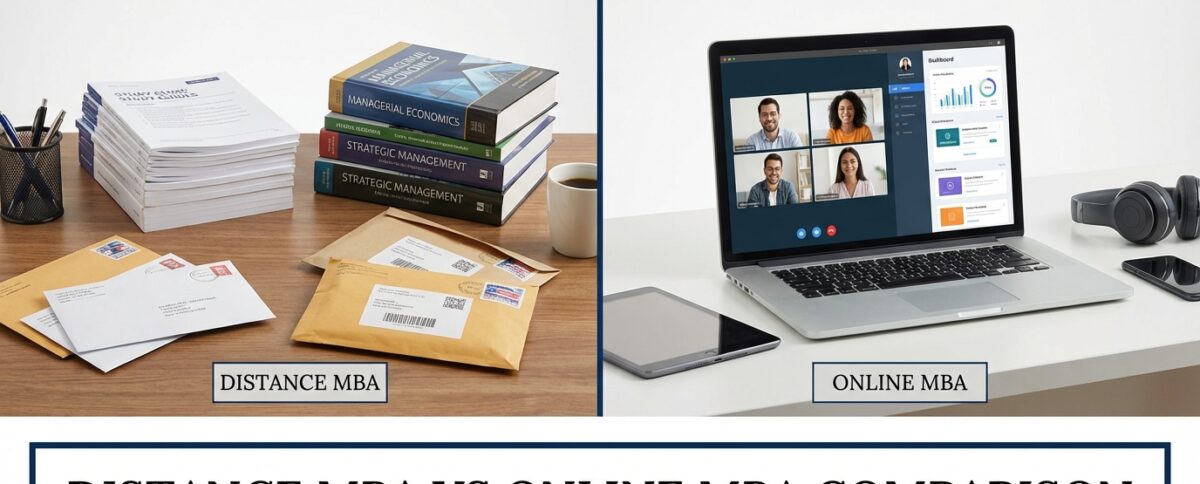
Choosing the right management degree is a crucial decision for working professionals, entrepreneurs, and fresh graduates aiming to enhance their career opportunities. With flexible learning becoming the new norm, thousands of learners today compare Distance MBA vs Online MBA to understand which format suits their professional goals, lifestyle, and learning style. Both programs are recognized across industries and supported by regulatory bodies when pursued from UGC-approved universities. However, each mode offers a unique structure, delivery format, and learning outcome.
Understanding the Difference Between Distance MBA and Online MBA
What Is a Distance MBA?
A Distance MBA is a structured management degree where the study materials are provided through printed books, recorded sessions, or postal delivery. Students primarily learn at their own pace with scheduled exams and limited real-time interaction. This mode is ideal for candidates who prefer self-study with periodic academic support.
What Is an Online MBA?
An Online MBA is a fully digital learning program conducted through virtual platforms, live classes, digital libraries, online exams, and interactive discussion boards. Learners receive real-time support from professors, access to webinars, industry workshops, and continuous engagement tools, making it highly suitable for working professionals who need flexible yet immersive learning.
Course Delivery & Learning Experience
Online MBA Learning Model
The Online MBA format offers a highly interactive MBA online education experience. Students benefit from live sessions, case studies, digital assignments, placement training modules, and direct faculty interaction. The ability to learn from anywhere without scheduling conflicts makes it one of the most sought-after MBA online courses in India and abroad.
Distance MBA Learning Model
In a Distance MBA, students receive pre-designed learning content which they can study independently. While this preserves flexibility, it involves fewer live interactions and limited academic networking. Those who prefer structured self-study, minimal screen time, and long-term flexibility often choose this model.
Flexibility and Time Management
Both formats are designed to support students who cannot commit to a traditional on-campus schedule. However, their delivery differs:
- Online MBA: Real-time classes with recordings available for later access, ideal for professionals managing deadlines and family commitments.
- Distance MBA: Study anytime without class schedules, best for learners who prefer studying at their own pace without live attendance requirements.
University Accreditation & Certification
Whether you choose Online MBA or Distance MBA, ensure the program is a UGC approved MBA. Accreditation directly impacts degree validity, international recognition, and employment eligibility in corporate and government sectors. Top universities offer placement support, LMS access, and capstone projects across both formats.
Career Outcomes & Industry Recognition
Online MBA Career Benefits
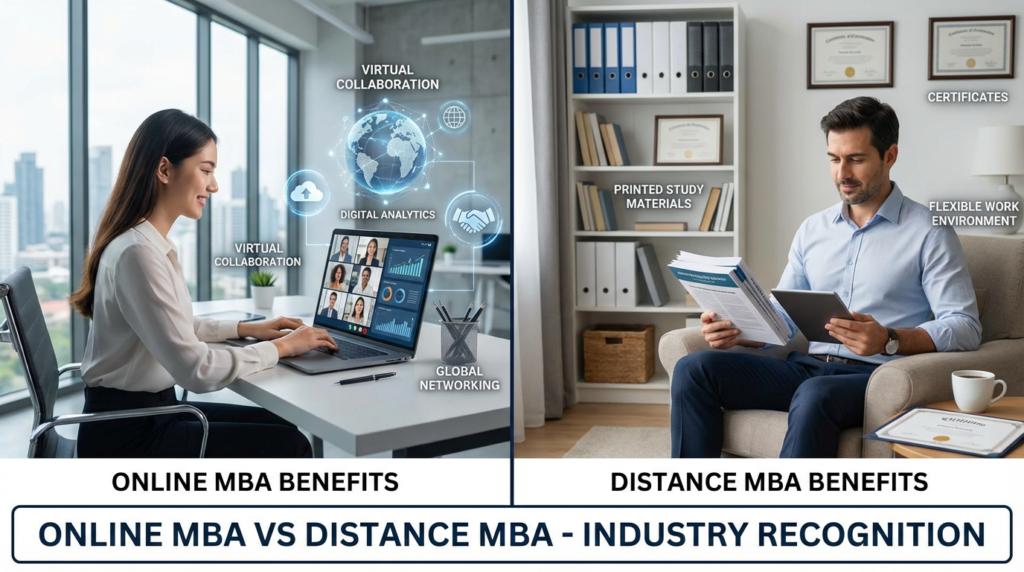
An Online MBA aligns with current industry requirements such as digital transformation, global business markets, analytics-driven decisions, and leadership learning. Companies today value graduates who are familiar with virtual business tools, online collaboration, and real-time communication platforms.
Distance MBA Career Benefits
Distance MBA graduates gain recognized management credentials without the requirement of daily academic participation. It is a preferred option for government employees, entrepreneurs, and professionals with travel commitments.
Important Note:
Both degrees carry similar career value when obtained from accredited institutions. The delivery mode alone (Distance or Online) does not affect recognition.
Technology, Support & Learning Tools
- Online MBA: Virtual classrooms, discussion portals, AI-powered learning dashboards, digital case studies, and global networking.
- Distance MBA: Printed modules, offline study, and minimal digital dependency.
Candidates who appreciate tech-enabled learning prefer Online MBA, whereas those who wish to minimize screen time prefer Distance MBA.
Who Should Choose What?
Choose Online MBA If You:
- Want live faculty interactions and business simulations
- Prefer global networking opportunities
- Need placement assistance, webinars, and industry mentorship
- Are comfortable with technology-enabled learning
Choose Distance MBA If You:
- Prefer pure self-study with fewer academic touchpoints
- Have low internet access or frequent travel requirements
- Need flexible learning without scheduled attendance
- Prefer traditional study formats
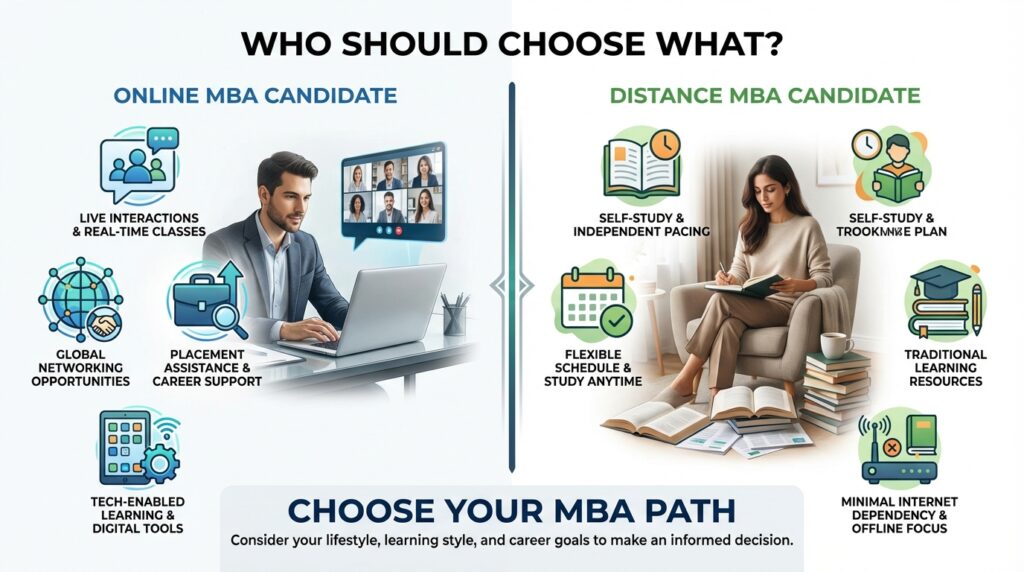
Comparing Online MBA vs Distance MBA clearly shows that the right choice depends on individual learning styles rather than program quality.
Which Is Better Overall?
Both Online MBA and Distance MBA serve professional upskilling needs, but Online MBA offers stronger engagement, corporate alignment, and real-time learning, making it the preferred choice for modern professionals.
Distance MBA remains a strong option for individuals who value independence, printed learning materials, and non-digital study methods.
Online MBA vs MCA
If you are comparing online MBA vs MCA, remember both programs lead to different outcomes. MCA is IT and programming-focused, ideal for technical roles, while Online MBA is business and management-oriented, ideal for leadership, finance, marketing, analytics, and operations careers.
When comparing Distance MBA vs Online MBA, the decision is not about superiority, but personal fit. If live classes, corporate exposure, and interactive learning matter, an Online MBA is the ideal choice. If independent study and minimal screen time suit your routine, a Distance MBA is the better option.

At Sophia Online College, students can also explore related flexible programs such as Online & Distance BBA, B.Com, M.Com, BCA, MCA, along with Executive MBA, all designed to support career growth with UGC-approved recognition, recorded lectures, flexible exams, and guided academic support.
Whether you choose a management or technology pathway, Sophia Online College ensures accessible learning, professional development, and globally accepted qualifications tailored to your career goals.
FAQ
1. Which is better – Distance MBA vs Online MBA?
Both formats are valid and industry-recognized. An Online MBA offers interactive learning with live classes, while a Distance MBA provides flexible self-study without regular attendance.
2. Are Online MBA and Distance MBA approved by UGC?
Yes, when pursued from a UGC-approved MBA university, both degrees hold national and international recognition.
3. Do employers value Online MBA and Distance MBA equally?
Yes. Recruiters value the degree based on accreditation, university ranking, and specialization—not the delivery method.
4. What is the main difference between Online MBA and Distance MBA?
An Online MBA includes live lectures, digital assessments, and real-time faculty interaction, while a Distance MBA relies on independent learning through study materials and limited live engagement.
5. Who should choose an Online MBA program?
Professionals who prefer live classes, interactive case studies, digital tools, and global networking should choose MBA online education through an Online MBA.
6. Who should choose a Distance MBA program?
A Distance MBA suits learners who prefer reading-based self-study, minimal screen time, and complete schedule flexibility.
7. Can I pursue an Online MBA while working full-time?
Yes. MBA online courses are specifically designed for professionals, with recorded sessions and weekend live lectures.
8. Do Online MBA programs offer placement support?
Most Online MBA programs offer placement assistance, career counselling, resume preparation, and virtual recruitment support.
9. Is Online MBA better than MCA?
Online MBA vs MCA depends on career goals. MBA is business-oriented (management, finance, marketing), whereas MCA is technical (software, systems, development).
10. Are Online MBA exams conducted digitally?
Yes. Online MBA exams, quizzes, and internal assessments are conducted through secure digital platforms, often with remote proctoring.